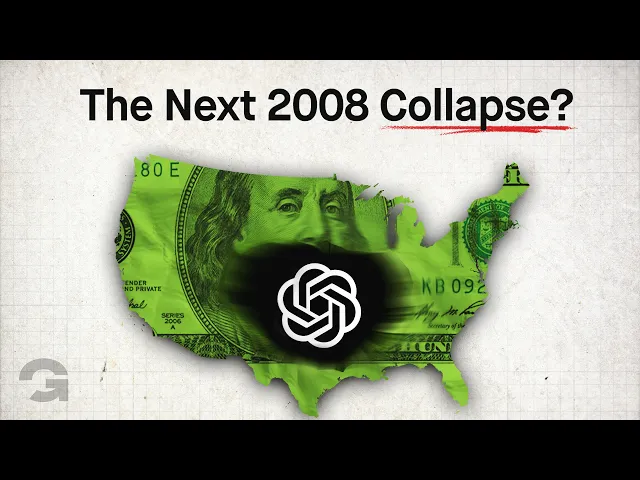
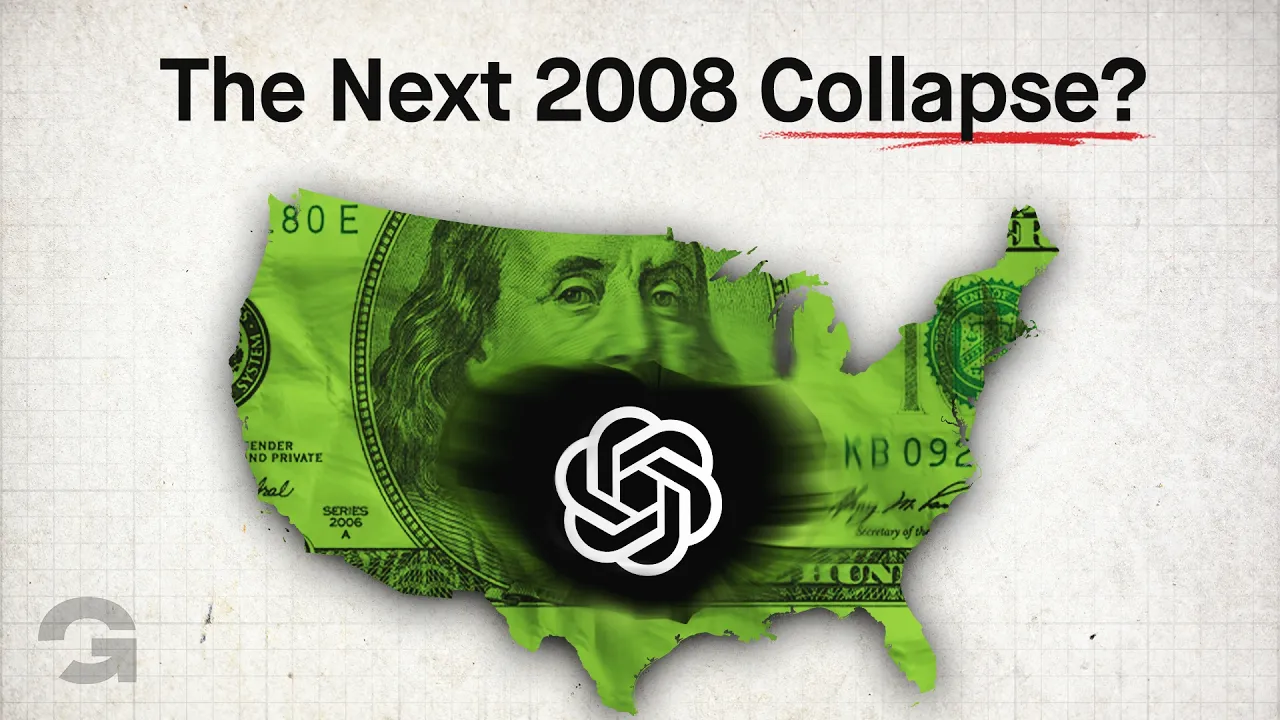
2008, Wall Street made risky bets on mortgages, called them safe, and crashed the economy. And today, they're back at it again, but with AI. This time, the bet is even bigger.
And I mean that literally. More than two giant AI data centers, each the size of Walmart, are being built every week across America. And these data centers power all the AI you use.
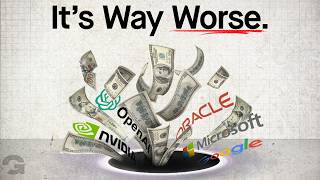
But I mean, that's all good if they make more money than they borrow, but no, they're not. We have no idea how we may one day generate revenue. These buildings are buried in billions of debt before they make a single dollar.
And just like 2008, Wall Street is taking that debt, slicing into layers, and selling the top as safe investments. But here's where it gets a little weird. Even the safe parts of these deals are paying junk level interest.
So, if it's really safe, why are they pricing it like it's risky? Because lenders know what's really hiding underneath the surface. And as long as you believe the hype, they can bet your money on AI growing forever.
But what happens if it doesn't? What happens with you and everyone else when the biggest bet in human history goes wrong? >> 80% of US [music] stock gains this year came from AI companies.
>> Trillions being spent. >> Money going into somewhat unproven technology. [music] >> Investors will pull back.
>> It's now inevitable. >> Sell it all. >> And the bubble will pop.
So to understand whether this is the next 2008, the best way is just showing you. So I'll be a private equity firm in this demonstration buying an AI data center, but these big ass warehouses are expensive, so I'm going to have to raise some money, which shouldn't be a problem with all the hype around AI, right? But once you see this, you'll understand why a safe sure bet may not always be what it seems.
Anyways, let's say after months of negotiating tax breaks and promising job creation, we cut a deal to build an AI data center in Virginia's data center alley. And the project is going to cost $100 million. But obviously, I don't want to risk much of my own money.
I'll just put in 10 millions of my own cash. I'm going to borrow the other 90 million, some from banks, but mostly from private lenders this time and even from the very tech companies that will eventually rent out this building. So remember that matters later.
So now I know who I should borrow money from. But now you might be thinking, why would anyone lend me $90 million for a building that doesn't exist yet? I mean, when private equity buys an existing company, that makes sense.
The company's already making money, but an empty data center isn't making anything but dust. Well, it's because investors are making one big bet. The AI demand will explode, and tech companies like Microsoft, Google, and Amazon will be fighting to pay rent for years.
And it's not going to just be any rent, right? It's going to be long-term locked in leases where tens of millions of dollars. But there's a problem.
Since these tech companies are just renting the space like a tenant in an apartment building, if the hype slows down and they don't need the capacity anymore, they can walk. So, if that happens, this $90 million in debt that I have isn't going anywhere. So even before a single server is plugged in, I have all this debt.
But why all the negativity? Because the thing is, not only was my data center built, so are hundreds of others. In just the third quarter of 2025, hyperscalers like Microsoft, Google, and Amazon leased more data center capacity than the entire year of 2024 combined.
And Microsoft alone is spending $219 million every single day on these data centers. So as of now, there's nothing to worry about. These data centers are making real money.
and everyone's happy, right? Well, that's if we ignore the fact that I just borrowed a bunch of money, the fact that the Wall Street lenders now hold a giant risky loan on its books. And if it turns out that I can't afford to pay the loan back eventually, then Wall Street who lend me that money is going to lose a lot of money.
But not to worry, because Wall Street figured out a way to do what they always do best, which is to pass the risk to someone else. because now they can take those risky loans from the multiple data center projects that's out there, bundle them together into one big package to sell to others. But you might be thinking, why the hell would anyone buy these?
Well, simply because when data centers collect rent and pay back these loans that they're under, they also pay interest in that interest becomes profit for someone who holds these bonds. But remember, since we're bundling different loans from different data center projects, there's going to be different risk associated with each one. So to mitigate that, what they do is split that bundle into layers rated by how safe each one is or how likely that loan is to get paid by whoever it's under, right?
It all sounds familiar. In 2008, they took a bunch of these risky home loans or mortgages, mixed them with a few safe ones, and the whole thing was sold as a safe investment. And in 2008, that top layer was stamped AAA, which is the safest possible rating.
So these are things that like pension funds and insurance companies and your grandma's retirement fund would buy. But by the end of 2008, 80% of those were downgraded to junk. So, similar things happening here with the data centers, but with a slight little twist.
This time, 34 billion of these data center bonds were sold, but 84% of them were rated A, not AAA. So, it's still safe enough for your grandma's pension or retirement funds to buy. But if we look even closer, these A-rated bonds that usually pay around 5% interest are paying 8, 9, sometimes 12% interest.
Those are literally junk level rates. So what's happening here is that even when it's rated as safe, it's being priced like a bigger bet because your pension fund that is buying them. No, there's risk because again, if a Microsoft and Google walk away from a data center because of slowing AI demand, the rent stops and if the rent stops, the bonds default.
And if the bonds default, your retirement account takes the hit. So of course, none of this has happened yet, but now you understand the stakes. But for any bubble to burst, you always need a trigger.
And on this topic of AI, one thing that keeps getting overlooked is what these tools are even built on, which is data. And your data from emails, documents, and personal conversations are increasingly treated as training material or ad inventory. And that's exactly where today's sponsor, Proton Mail, fits in.
Proton Mail is a free-touse email service built around privacy. And unlike traditional email platforms, it does not scan your messages, show ads, [music] or track your behavior. Your emails are encrypted, meaning only you and the person you're emailing can read them.
And what I like about it is that it feels familiar and usable without trading any sort of convenience for security. And switching it over was straightforward for me. You can import all your old emails with you if you want.
And in a world rushing to automate everything, it's worth having one place that isn't watching you. So, if you want a safer alternative to regular email, scan this QR code or go to the proton. me/gen to try Proton Mail for free.
And now, back to topic. Because when all this money is going to data centers, not to mention that the stock market is continuing to go up, what would even be a trigger when it seems like everyone is all in on the biggest bet in human history? I look closer and I found some signs.
Because when you're this deep in debt, even small crash can turn into big problems fast. But when all this money is going into data centers and the stock market is continuing to go up, what would even be a trigger look like when everyone seems to be all in on this big bet? So, I looked closer and I found some [music] signs.
What I found is that when you're this deep in debt, even small cracks can turn into pretty big problems. And the first place these warning signs are starting to show up is in the credit market. Remember how I said earlier that tech companies are also building these data centers?
That's exactly what Oracle is doing by borrowing billions to build AI data centers for Open AI or TAGBT. But what we're seeing recently is the cost to ensure Oracle's debt [snorts] spike to levels never before seen since 2009. Okay, but what the hell does that mean?
When Oracle issues bonds to raise money, investors who buy those bonds are taking a risk that Open AI will actually pay the rent. But I think everyone knows this. Open AAI is burning billions with like zero profit.
So that's a risk in and of itself. But if there's a problem, there's going to be a market. To alleviate those sorts of fears, other investors sell insurance on that risk called credit default swaps or CDS.
And when that insurance cost triples like it just did for Oracle, it means that the market is literally screaming that Oracle might not get paid back. So, when the credit market is showing these sorts of signs, it's no wonder why Oracle stock has now fell 42% from its all-time highs. And remember those A-rated bonds with the junk interest rates that are labeled safe right now?
Well, they're only going to be considered safe if an open AI can keep paying rent. But right now, that credit market is betting that it won't. And if history shows that's usually stage one of how things start breaking because let's say Open AI has to cut back and rent payments drop by, let's say, 30% or the cost of water and electricity that is required for all this keeps rising.
And with the circular nature of the AI black hole that I talked about in my first video starts triggering problems in this loan means problems in this loan start triggering problems in other loans. And now more and more companies are struggling to make interest payments start actually missing them. And investors start panicking and rating agencies have to step in and now those safe A-rated bonds get downgraded to true junk junk status.
Now, companies like Oracle or private equity building data centers can't borrow more to finish constructions and projects [music] get cut. And unlike 2008 when foreclosed homes were later resold, in this case, you can't just repurpose a data center into apartments or office buildings. And just like that, this domino effect can lead to this sort of collapse.
And it's really like we didn't learn anything from 2008 that no amount of financial engineering can ever eliminate real risk. But it also makes sense that when the people who built these house of cards continually get bailed out while everyone else suffers a consequence, history seems to keep repeating. But there is one big difference in this case with AI.
That difference determines whether this is just going to be another financial up or something worse because this whole video I've been showing you how this looks like 2008. But what I haven't answered yet is whether this will actually cause the next 2008. And to answer that, that comes down to two things.
Whether the AI hype is real and where the risk actually lives. So, let's start with hype because when we talk about this AI bubble, everyone always points to what happened with the dot boom. In the 1990s, telecom companies started laying massive amounts of fiber octave cable.
And when the bubble burst, 85 to 95% of that fiber just sat there unused. So people like to use this as the same thing with data centers. But what nobody talks about is that fast forward to today.
Those cables are exactly what we use every day. In fact, that's the only reason you can watch this YouTube video as background audio while you scroll through Tik Tok and also simultaneously watch Netflix with your ADHD ass. So even if AI hype is way ahead of reality right now, that doesn't mean that it can't catch up.
Because if the ultimate goal especially is to replace human labor altogether, we very might see a case where AI demand actually does go up forever. So the real question here isn't whether AI hype is real compared to the other bubbles. What matters most is where the risk lives and how that compares to 2008.
So stop getting distracted and bring it back on the full screen because this next point is like the most important part of the video because in 2008 the mortgage risk was everywhere. Big banks especially held the loans. They packaged them.
They traded them and the whole system was interconnected. It's exactly why we saw what we saw when one bank went down. So did almost every other bank.
But when we look at it in this banks are making loans in some instances, but not as much. They're passing it off to private credit funds and other private investors chasing higher returns and who are willing to take on more of that risk. To put simply, the good news is that if this does blow up, it's not going to take down the entire financial system.
But a bad news is your grandma's pension fund may take a hit. Norway's $2 trillion sovereign wealth fund, who invests in everything from stocks to even real estate, and who are one of the most conservative investors on the planet, is actively avoiding AI data centers. The big reason why is because it's still very unclear on whether these things will actually [music] make money.
So again, no, this probably won't blow up like 2008, but if it does break, it's going to be a lot quieter collapse where the hype dies down slowly and people won't notice until it's already happened. But that's also exactly why you need to pay attention. In 2008, a few guys made millions betting against the collapse.
And just like you and I, they couldn't change the system, but they chose to understand it while everyone else chose blind ignorance. And look, I'm saying this from a standpoint because what is happening with AI right now does make me really nervous. Jobs are going to be lost.
A lot of industries are going to be disrupted. But the thing is, it's always been that way since the world started. Since day one, you can't stop innovation no matter how hard you try it.
So, it remains to be seen whether AI replaces us all. But you do have two choices. One is you can try to stop it and say it's bad for humanity, but chances are you're going to lose.
or you can embrace it and use it in a way that improves your life and allows you to stay ahead. Because whether you hate or love AI, in a world of money and power, those who accept reality will always win. So, I'll be curious to see what you say in the comments, but just whatever you decide, don't wait until it's too late.
And one way you can stay ahead to get smarter about money and power every week in 5 minutes, you can sign up for my free weekly newsletter in the video description. But if you missed the first video that I made on the AI bubble and why it's more of a black hole, you can watch that here.