Biodiversity is not three types of minced meat in the supermarket, but what keeps us alive. You could even say that the biodiversity crisis is the big sister of the climate crisis. More species have gone extinct in the last hundred years than in *thousands* of years.
And it's not just fewer insects on the windscreen. Everything from the air we breathe to healthy digestion and chocolate eating: our wealth and health are completely dependent on functioning ecosystems. And bad news: there is a tipping point at which everything will collapse.
The question today is when we will reach it. We humans like to see ourselves as independent of nature. But we, as well as every other living thing, are dependent on the vital services that ecosystems provide for us.
The reason for this dependence is that all life has co-evolved and relies on the presence of other species. Humans are actually an ecosystem *themselves*. Countless microorganisms live on, in and from us.
For example, skin mites, which we fortunately don't usually notice. Or intestinal bacteria. One study even found that each of us emits our own individual cloud of microbes.
huh Well. In an ecosystem, for example in the jungle or in a savannah, the species rely on each other. The gut bacteria are given a protected environment with plenty of food.
And we rely on them, among other things, to help digest our food. And we also rely on a whole lot of other "services" provided by nature. For example, on the supply of vitamins that our body does not produce itself.
Instead, it relies on the fact that they are in the creatures we eat. And the creatures we eat are also dependent on yet other species. For example, more than three quarters of the world's cultivated plant species are partially or even entirely dependent on pollination by animals.
Without these pollinators, harvests worth around 280 to 690 billion euros would be threatened. Take cocoa, as an example. *audible gasp* There are many such ecosystem services and only a few of them can be valued in monetary terms.
But they affect all areas of our lives: they provide raw materials and means of production, regulate temperatures, clean the atmosphere, water and soil, and give us food. And, of course, we simply enjoy being in nature. Last year, the world's population exceeded 8 billion.
The UN expects it to peak at 10. 4 billion. And here comes the big problem: all these 10.
4 billion people *need* a functioning ecosystem. But our Ecosystems are extremely endangered. Even if they sometimes don't seem to be.
First we have to understand that ecosystems are networks. Ecosystems are "complex systems". And this is not just an eloquent description, but a technical term from systems theory.
The weather system and the brain are also complex systems. For us, this means that they are difficult to describe, analyse and predict - in other words, they are complex. Just finding, identifying and counting the individual parts of an ecosystem - i.
e. the individual species - is a *huge* amount of work. To date, 2.
1 million species are already known. But nobody really seems to know whether that is 25% or even 2. 5% of all existing species.
In order to describe an ecosystem, researchers have to use cameras, microphones, traps, landing nets, binoculars, magnifying glasses, microscopes and genetic analyses to follow up every clue and examine every square metre. This means that an ecosystem alone often contains thousands of species. And that was the easy part.
Now you still need to know what characteristics each species has and what interactions it has with other species. And there are practically an infinite number of possibilities. Sometimes the interrelationship is mutually beneficial.
For example, when ants care for and protect aphids in order to snack on their sweet secretions. Sometimes one side benefits while the other is harmed. For example, when fungi turns ants into mindless zombies and eventually kills them.
And sometimes the two sides are in competition. For example, when different ant species and colonies fight over territories. We learn from these examples: Firstly, ants are super interesting.
And secondly, an ecosystem like this quickly becomes very confusing. No human can memorise it all. That's why we rely on computer models.
But even supercomputers can't model the entire complexity of reality. Okay, good, so ecosystems are totally complex and difficult to understand. Got it.
But the dangerous thing about complex networks is not only that it takes us a very long time to even halfway understand them. Their complexity also gives them a very deceptive quality: you can't necessarily tell when they are on the verge of catastrophic collapse. You can visualise it like this: You have an ecosystem in which many species are dependent on each other.
Now you are losing one species after another and not much happens at first. This is because the more species there are in the system, the easier it is to mitigate the extinction of individual species. Let's say now: The number of species decreases continuously, then at some point we reach a point where the loss of one species can no longer be absorbed by another species.
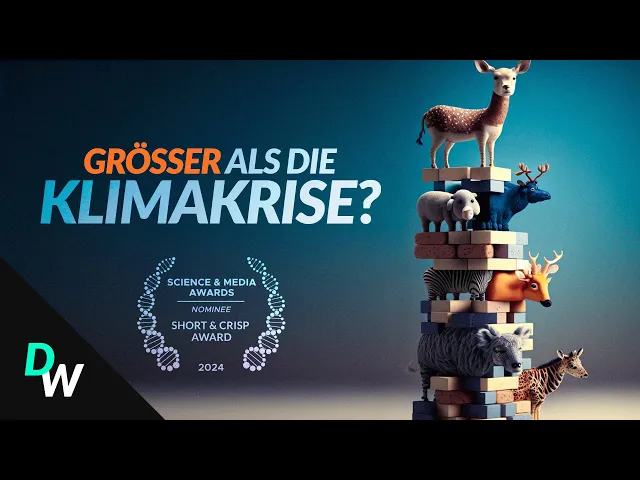
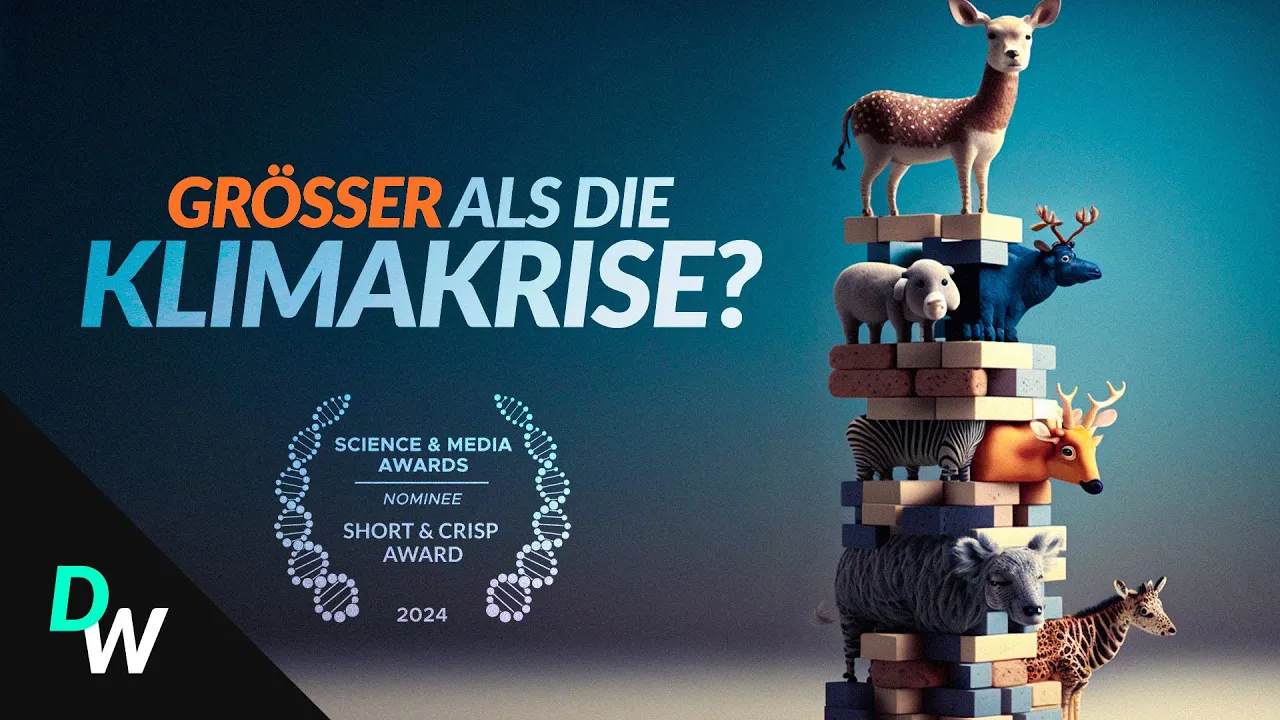
Like a Jenga tower, everything collapses and suddenly many species become extinct at once. This is the tipping point at which there is no turning back. The entire ecosystem is irretrievably lost and with it the services on which we depend.
The resilience of ecosystems therefore arises from the diversity of ecosystems, the diversity of species and genetic diversity combined - all of this is biodiversity. And it is precisely this biodiversity that is rapidly going down the drain. Humans have been hunting animals to extinction since prehistoric times.
As food, medicine, hunting trophies or pets: large, healthy specimens of exotic and rare animals are highly prized. The oceans are not safe from us either: most fish stocks are heavily fished and often already *over*fished. By travelling around the world, we are - usually unintentionally - transporting species from their native habitats to new ones.
If they find optimal conditions and no predators there, they become invasive species that wipe out the native species. Then there is the environmental impact of modern industry. We produce around 400 million tonnes of plastic every year.
Then there are exhaust fumes, industrial waste and pesticides that end up in the environment. We have already made a video about acid rain in Germany, for example. Even worse than that is the ever-increasing land use.
We use more than a third of the land mass and 75% of freshwater resources for agriculture alone. Added to this are our settlements, industrial plants and transport routes. Forests are being cleared, moors drained and rivers straightened.
Native plants and animals are losing their habitat. And then there is man-made climate change. Animals and plants occupy an individual "climate niche".
This means that they have comfort zones for temperature, humidity, rainfall and light intensity. If the climate zones change faster than animals and plants can follow or adapt, they will die out. People themselves are also affected.
The vast majority of people live in a very clearly defined climate niche. And that too is changing. Densely populated areas in India and South-East Asia, for example, are becoming less favourable to humans.
Unlike most wild animals and plants, humans can of course move away. And they will have to if their health is threatened and agriculture in the region can no longer feed them. The problem is that other people already live where they are moving to.
And that naturally creates conflicts. All these factors are contributing to an unprecedented extinction of species. 42,000 are threatened with extinction - and only just over 7% of all known species have even been assessed.
Several studies indicate that the extinction rate is extremely high. Namely 100 to 1,000 times as high as the average for the last 10 million years. Among mammals, wild animals only make up 4% of the biomass.
96% is accounted for by humans and their pets. Since 1995, there has even been talk of a great mass extinction. This means that more than 70% of species are expected to become extinct in a relatively short period of time.
Such events have only occurred 5 times before. The impact of humans on nature is therefore in the same category as the meteorite that wiped out all dinosaurs and many other species 66 million years ago. It took around 11 to 12 million years for the extinction and re-emergence rates to normalise again.
And one thing is clear: we don't have that time. So what can we do? Returning to the computer models that researchers use to better understand ecosystems.
Of course, researchers are now trying to find out how far we have already pushed the planets system to its limits. However, we have already mentioned that this is almost impossible with such complex systems. But perhaps there is a good way to make an estimate if you model only some of its parts rather than the whole system.
You probably know this from the climate debate: the local weather forecast is only valid a few days into the future and you need exact data for modelling. But you don't have to measure every detail for climate modelling. Measurements of relatively few factors averaged over 30 years and over the entire world are sufficient.
This makes the trends predictable on a large scale and in the long term. You want to see the forest. Not just trees.
In a recently published study, for example, researchers argue that we know enough about terrestrial vertebrates to make realistic predictions about their biodiversity. Instead of modelling real animal species, they recreated an earth in the computer, which they then populated with artificial land vertebrates. Each animal species has a defined body size, climate niche and nutritional requirements.
The model then combined many tens of thousands of these animal species into ecosystems and compared them with real data. They then applied the usual climate models along with data on expected land use to this artificial world in order to simulate the period from 2020 to 2100. They redid all of this a 100 times for each of the 3 climate scenarios.
The result was that terrestrial vertebrates will probably lose 17% of their biodiversity by 2100. That's already bad. But even worse is that the individual ecosystems will probably lose up to 50% of their ecological interactions.
This is exactly what makes an ecosystem stable. In other words, a small loss of biodiversity results in a major loss of stability. So is the catastrophic collapse of the system approaching faster than we realise?
It is certain that we are currently putting extreme pressure on the ecosystems and it is clear that there will come a point at which they tip over. It is difficult to say how close the individual systems are to their tipping point. However, using models and knowledge about the climate niches of the ecosystems, attempts are being made to estimate this as accurately as possible.
The most endangered ecosystems are the tropical coral reefs. According to the IPCC report, they could be destroyed by long heatwaves in just a few decades. And with them will disappear the basis of life for many fish that people in the nearby coastal regions live on - but which we also find in our freezers.
That's the bad news. Optimistically, however, combating climate change also helps to protect biodiversity and vice versa. This is because dying ecosystems release CO2, while recovering ecosystems store CO2.
The conversion of agriculture will be particularly difficult. On one hand, intensive agriculture is part of the problem because it depletes the soil. On the other hand, it has continuously reduced per capita land use.
In December, at the UN Biodiversity Conference in Montreal, measures were agreed to end the man-made extinction of species by 2050. The specific resolutions include placing 30% of the earth under protection and restoring 30% of damaged ecosystems. If we can manage *that*, then perhaps we can finally take a sigh of relief.
But this must also happen. For example, by actively bringing back endangered species, by cleaning the oceans of plastic and rewilding forest areas. This and much more is what a new initiative called "Planet Wild!
" is doing, which will be launched in spring and in which I am personally involved. Planet Wild is a community of people who want to give something back to nature. With contributions from members, crucial nature conservation missions are implemented worldwide that effectively stabilise ecosystems and protect animals.
The whole thing is documented transparently in exciting videos. If you want to find out more, you can take a first look at the initiative and join the waiting list via the link in the description. I have already seen the pictures of the first mission and can only say: it's worth it!
As always, thanks for watching and stay curious. Your Cedric.