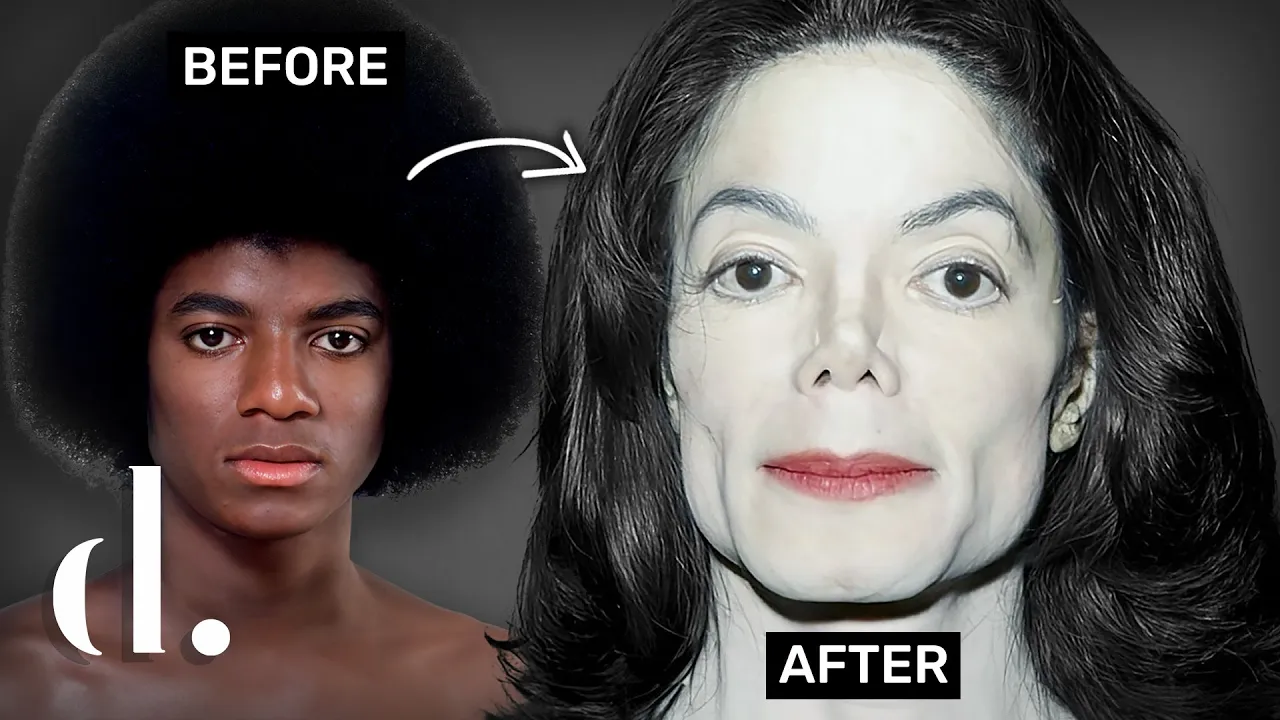
Michael Jackson and plastic surgery. The two are synonymous with each other as a result of countless column inches dedicated to the artist's changing appearance over the decades. From lip reductions and cheek implants to eye reshaping and botch nose jobs, there isn't much that Michael Jackson's face hasn't allegedly undergone.
As stated in the tabloids, overtly sensationalized by media outlets or downplayed by the artist himself. What is the truth behind the years of speculation and what plastic surgery did Michael Jackson actually have? Here's the detail.
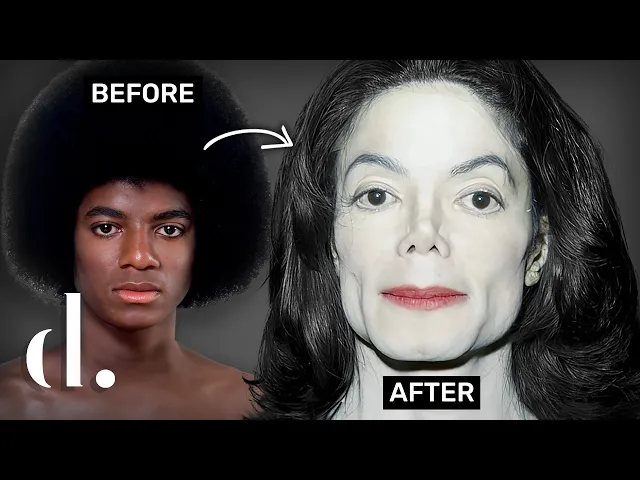
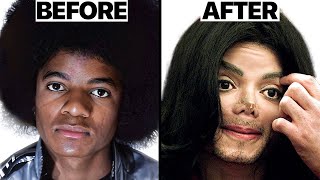
If this video title sounds familiar, it's because it is. As the first ever video on this channel was also on this subject, and because that video was somewhat popular, we thought it deserved a 2021 update. So, with the help of upscaled video footage and after two years studying Michael Jackson's evolving appearance, we are going to chronicle the plastic surgery procedures Michael Jackson has known to have undergone alongside images of before and after in order to make an accurate assessment of the work he had done during his lifetime.
Michael Jackson's first foray into plastic surgery came in 1979 when at the age of 21, Jackson reportedly broke his nose while in dance rehearsal. Needing surgery for the break and with the release of his first solo record as an adult off the wall coming up, Michael decided to at the same time undergo his first rhinoplasty. Michael Jackson entrusted Beverly Hills plastic surgeon Steven Hofflin, who would work on the likes of Elizabeth Taylor, Joan Rivers, Ivana Trump, and was Jackson's preferred choice for many years to come.
Before, Michael Jackson's nose was characterized by its broad bridge and widened nostrils, as well as its lack of definition and projection at the tip. After surgery, Hofflin gave Michael a slimmer and more defined result while still maintaining the integrity of his original nose. However, according to Jackson, the surgery was not a complete success as he wasn't satisfied with its overall appearance and complained of breathing difficulties that would affect his singing.
Therefore, in 1981, during the hiatus between Offthe-Wall and his mega hit Thriller, Michael decided to go back to Steven Hofflin to perform a second rhinoplasty. Hofflin later explained, quote, "Nosses sometimes can't be reduced all at once, and it can take a two-stage procedure. Not just reshaped, Michael's nostrils were surgically reduced by cutting and removing skin, creating a scar around his nostril crease, resulting in the dramatically reduced size of his nostrils.
And as a result of the second procedure, Jackson's nose was made even narrower and the tip less bulbous. Still unsatisfied and with thriller skyrocketing up the charts, Michael Jackson decided to undergo a third rhinoplasty during the summer of 1983, revealing the result in his say music video with Paul McCartney. This time, Michael's nostrils and nose tip were further reduced.
His tip was now as narrow as the bridge, and his profile was given a slight upturned appearance. Unfortunately, not all Michael Jackson surgeries would be voluntary. As on January 27th, 1984, while Michael and the other members of the Jacksons were filming a Pepsi commercial in Los Angeles's Shrine Auditorium, pyrochnics set Jackson's hair on fire, causing secondderee burns to his scalp and extensive hair loss to his head.
In the run-up to 1984's Victory Tour, Michael Jackson endured a series of painful surgeries, whereby they cut away scarred areas and stitched his unaffected scalp together in hopes of disguising Jackson's injury and covering the now palmsized bald spot on top of his head. As indicated in this rare home footage, presumably taken while Michael Jackson was recovering from surgery as well as practicing his dance moves for his upcoming tour, Michael can also be seen wearing a surgical splint on his nose as well as dressings on his scalp. This would suggest that during his scalp procedures, Jackson decided to have his nose revised for the fourth time.
[Music] This theory is further substantiated when Michael appeared at his mother's birthday celebrations with his nose looking different as though still slightly swollen a month after surgery. During the victory tour, it was clear from Michael Jackson's side profile that his nose tip was further refined and its upturned position had become unnaturally whimsical in its appearance. However, by 1986, it became apparent that Michael Jackson was visibly having issues with his recently surgically altered nose.
As on May 6th, 1986, Jackson appeared at a Pepsi press conference with sunglasses on, disguising a nose that appeared asymmetric and had a stage of collapse. With filming for commercials and new music videos coming up, the next month, Michael was photographed wearing a surgical mask for the first time. In that July, while attending the funeral of Vincent Minnelli, photographers noticed his nose altered as well as the addition of a Kirk Douglas style dimple to his chin.
His jawline's new look was achieved by the use of an implant. As his autopsy report noted that he had two incision marks at the bottom of his chin. After the release of his bad album in 1987, Michael Jackson's new look made him a relentless media target.
With bombastic stories of him and his bouts with plastic surgery becoming regular tabloid fodder in the newspapers. After years of touring and promoting, Jackson had little time to pursue additional image makeovers. On September 14th, 1990, Michael Jackson received the first ever quote Michael Jackson Good Scout Humanitarian Award at the Sentry Plaza Towers in Los Angeles.
With sunglasses firmly on, it is clear that Jackson was again suffering from ongoing complications with his nose as it appeared uncharacteristically pinched and in a state of collapse. Presumably, Michael had several surgeries to help rectify these issues, but for reasons that were medically needed and not necessarily cosmetic. Another ongoing grievance that Michael Jackson continued to seek treatment for well into the 1990s was for his scalp.
With little success from his 1984 surgeries, Michael decided to undergo a radical treatment that would finally relinquish his need for hair pieces to disguise the bald spot caused by scar tissue left after the Pepsi accident. The tissue expander treatment consisted of implanting balloons into areas surrounding the scarred tissue that over time are blown up to expand the skin on the scalp. This is in the hope of then in surgery they can stretch the skin over the affected areas, cut the scar tissue out and sew the healthy areas together.
Because the whole process is so visible, hats have to be worn during this period. And for a two-month stretch in the spring of 1993, Jackson was only ever seen in public with his signature fedora on. As part of Jordan Chandler's testimonial against Jackson, he noted that the artist would wear his fedora at all times and how odd he felt it was when he would even sleep with it on when they shared a bed together.
Unfortunately, this surgery was ultimately unsuccessful and Michael Jackson would continue to rely on hair pieces and semi-permanent tattoos to disguise his hairline. By 2001, and at the release of his album, Invincible, Michael Jackson was again having significant issues with his nose. Presumably untrusting of doctors, the artist had effectively given up trying to rectify its problematic issues.
Described by doctors as having a quote nasal Jackson could no longer breathe through his nose. From images, it is clear from his side profile that Michael Jackson's nose lacked any projection, as though it had collapsed onto itself. and also he didn't have enough nasal passage for his nose to function for breathing.
Behind the scenes, Karen Fay, Jackson's longtime makeup artist, has revealed that it was suggested to him that he should darken his skin and wear a prosthetic nose during the filming of his You Rock My World music video. However, once this request got to Michael, the artist was reportedly so distraught he lashed out and trashed his dressing room, breaking down into a puddle of tears and crying over his years of intense insecurities concerning his appearance. However, it appears that Michael Jackson did eventually seek treatment to rectify his nasal issues as indicated on November the 13th, 2002 during an appearance in the Santa Maria Superior Court.
During his questioning, Jackson was asked by the judge to remove his surgical mask. And when he did, Jackson revealed his nose was covered in tape used to limit swelling after surgery. After his appearance, images taken were splashed across newspapers with headlines suggesting the tape held Jackson's nose together and that without it, his nose would fall apart.
Of course, all untrue. Michael Jackson had actually undergone a successful reconstruction that bought a lot of the structural integrity of his nose back. With an intense fear of growing old and of the aging process, Michael Jackson became a regular client of Arnold Klene, a dermatologist that specialized in dermal filler injections.
to initially treat Jackson for acne and scarring that had occurred as a result of cosmetic surgery, but then to combat the signs of aging with regular filler and Botox injections starting from the early 2000s. As indicated by scars noted in his autopsy report, in 2003, Michael Jackson sought a more invasive solution and decided to undergo a full facelift procedure. Jackson revealed his new, more youthful look by making several public appearances like that at the BET and Radio Music Awards that year.
The latter being when this image was taken of Jackson, causing a media sensation and again splashed across tabloid front pages under numerous plastic surgery disaster headlines. A photograph Michael Jackson grew to detest. [Music] During the last years of his life, Michael Jackson's dermatologist said that his aim was to rebuild Jackson's face in an attempt to make him look more normal, including a reconstruction of his nose using fillers.
He said that his nose was small, but was beginning to look a lot more natural again. Wtoane, a temporary tissue filler, was also injected to build up areas of the face and even out others that had been visibly impacted by infection, scarring, and the effects of his long-term illnesses. But what do you think?
Did Michael Jackson have more or less surgery than you had expected? And do you think there's anything here we may have missed out?