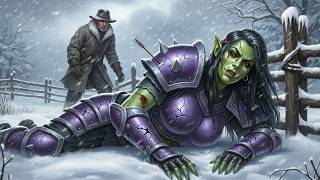
Winter had teeth that year. It bit through leather, through wool, through skin, and into bone, as if the world itself had decided that warmth was a privilege few deserved. Snow fell not in gentle flakes, but in sharp, slanting sheets, driven sideways by a wind that howled like something wounded and furious. The road into the human village had long since disappeared beneath white drifts, and the wooden fences that Marked property lines stood like broken ribs against the storm. No sane traveler walked in weather like this. No one desperate enough to survive would choose this path unless
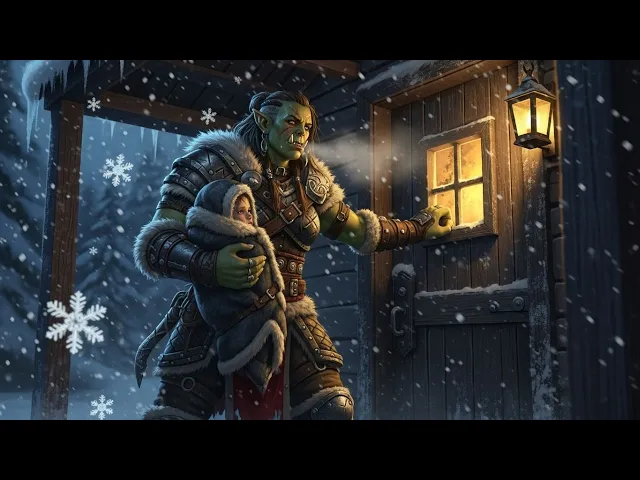
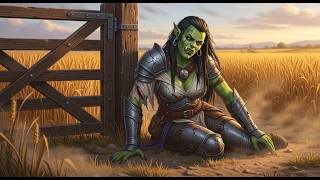
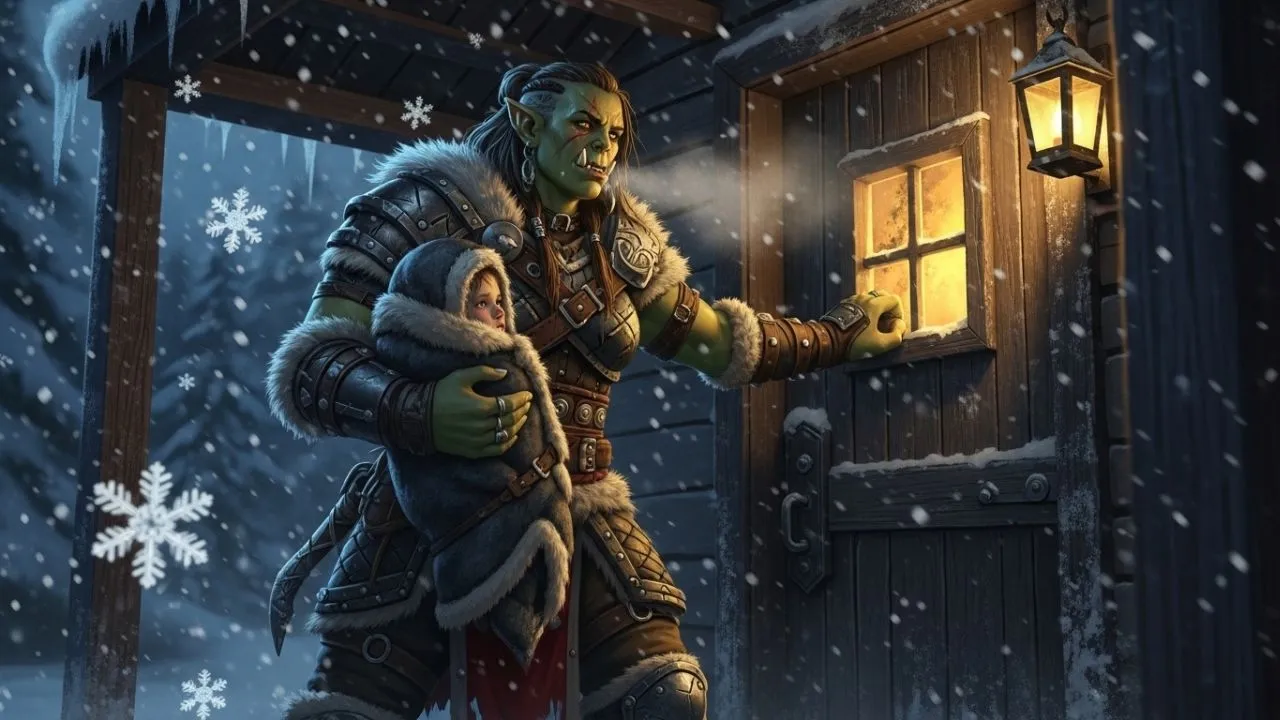
every other path had already led to death. But she walked anyway. The orc woman moved slowly. Each step a negotiation between strength and collapse. Her cloak, once thick enough to deflect mountain rain, had been worn thin by months of travel and hunger. It snapped violently in the wind behind Her, revealing glimpses of green skin gone pale from cold. In her arms, she carried a small bundle wrapped in patched fabric. The bundle trembled once, then went still. That stillness frightened her more than the storm. "Stay awake," she whispered into the cloth, her breath fogging between them.
"Yenna, stay with me." The child did not answer. 6 years old and already quieter than any 6-year-old should ever be. 2 days ago, she had cried about the cold. Yesterday, she had complained of hunger. Tonight, she simply breathed in shallow poles that rattled faintly in her chest. That was worse. Silence meant surrender, and surrender in winter meant burial. The war had ended 8 months ago, or so the humans claimed. The banners had been lowered. The drums had stopped, but no one had told the land. The northern territories, where orcs once farmed and built and raised
their children, were nothing but ash choked fields and frozen Mud. The humans had retreated south to their walled towns, and between them lay emptiness, abandoned villages, hollow homes, memories that would never be reclaimed. Peace had not rebuilt anything. It had only paused the killing. She had avoided human settlements for as long as she could. Pride was an old companion. Pride told her she was clanborn, warrior wed, not some beggar scratching at foreign doors. Pride reminded her that humans had Driven blades into orc chests and called it justice. Pride told her she would rather freeze standing
than kneel breathing. But pride did not warm a child. Pride did not fill a stomach. Pride did not bring back the dead. The village emerged through the snow like an accusation. Wooden houses crouched behind low stone walls. Smoke curled from chimneys, lazy and golden against the gray sky. The scent of baking bread drifted faintly on the wind. so warm and Human it almost made her dizzy. Light glowed behind shuttered windows. Life existed here. Life that had survived the same war that had shattered hers. She stopped at the edge of the first house. Lifted her hand,
hesitated. The skin across her knuckles was cracked and bleeding from cold. If she knocked, the door might open. If it opened, she might see fear or worse, hatred. She might hear the word monster spoken softly but firmly before the door slammed shut Again. She might see someone reach for a weapon. Behind her, the wind shrieked. In her arms, the small bundle shifted faintly. She knocked. The sound felt impossibly small against [music] the storm. She knocked again harder. Footsteps approached inside. The latch lifted. The door opened a fraction, just enough for a human face to peer
out. Eyes wide at the sight of green skin beneath snow. The door closed immediately. She stood there for a Moment, staring at the wood. The snow gathered on her shoulders. Ya did not move. For houses later, she no longer expected doors to remain open. Each knock brought the same pattern. The cautious creek, the startled breath, the swift refusal. No words, no curses, just fear moving faster than compassion. The fifth house sat at the far edge of the village, slightly removed from the others. Larger, older, a farmhouse perhaps, once surrounded by fields that Now lay buried
in white. The shutters were worn. The roof sagged slightly under the weight of snow. Smoke still rose from the chimney. She walked toward it because there was nowhere else left to walk. Her legs trembled as she climbed the three wooden steps. She did not knock immediately. Instead, she leaned her forehead against the door and closed her eyes. "Please," she whispered. Not to any god she believed in, but to whatever force governed mercy In this world. Then she knocked. Silence stretched long enough that she wondered if the house was empty. Then footsteps, heavy, deliberate. The latch
turned slowly, as if the person behind it was deciding whether this moment would matter. The door opened fully. A human man stood in the threshold. late 30s perhaps, broad- shouldered, but lean in the way of someone who worked alone. A scar cut from his left eyebrow down to his jaw, pale against weathered skin. His eyes were gray, not cold exactly, but emptied of illusions. He looked first at her face, then at the bundle in her arms, then at the blood on her knuckles staining his door. For a long moment, neither spoke. "We're freezing," she managed,
her voice raw from wind and swallowed pride. and hungry. The child stirred faintly. A whisper barely stronger than breath escaped the fabric. Please, the man's jaw tightened. Something passed across his face. Recognition perhaps, not of her specifically, but of loss. Of something once held and now gone. The wind gusted, pushing snow past his boots into the entryway. He could close the door. He should close the door. Every sensible lesson this land had taught him said to close it. Instead, he stepped aside. "Come in," he said quietly. And with those two words, simple, almost careless, the
world shifted in a way neither of them yet understood. The Warmth inside the house did not feel gentle. It struck like pain. After days of wind and numbness, heat stabbed into frozen skin with cruel insistence, and the orc woman nearly staggered under it. The fire in the hearth crackled steadily, throwing amber light across rough wooden floors and barestone walls. The house was not rich, not decorated, not filled with laughter or signs of a bustling family. It was a house built for work and survival, a house that had Forgotten what comfort meant. She stepped inside slowly,
careful not to drip melting snow onto the floorboards, though the gesture felt foolish after the blood she had already left on his door. The human shut the door behind them, sealing out the storm with [music] a solid finality that made something inside her chest loosened just slightly. Outside, Winter still howled. Inside, there was air that did not cut the lungs when breathed. "Sit," he said, gesturing Toward the hearth. His voice was low, controlled, not warm, not hostile, measured. She lowered herself carefully near the fire, easing her daughter from her arms and wrapping what remained of
her cloak around the child's small frame. Ya's lips were pale blue against green skin. Her breathing came in short, fragile poles. The woman rubbed her daughter's hands between her own, trying to coax life back into stiff fingers. The human disappeared into the adjoining Room without another word. She tensed instantly. Her eyes flicked toward the doorway, calculating distance. wait the nearest object that could become a weapon if necessary. Trust was not something she had the luxury of offering blindly. He returned with blankets, thick wool, worn but clean. He knelt without hesitation and wrapped them around the
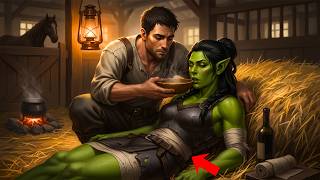
child first, then the mother. His movements were efficient, almost clinical, like a man accustomed to Tending wounds. He did not avoid touching her skin, though she noticed his hands lingered a fraction of a second before withdrawing. Not from disgust, but from awareness. There's soup, he said after a moment. Feed her slowly. If she eats too fast after starving, she'll get sick. The fact that he knew that unsettled her. He spoke from experience. L sat in the room between them like a third presence. He handed her a wooden bowl. Steam rose From it, carrying the scent
of root vegetables and salted meat. The smell alone made her stomach twist painfully. She held the spoon to Yenna's lips first. "Slow," he reminded quietly. The first sip barely made it down before Yenna's eyes widened. "It's warm," the child whispered horarssely, tears springing to her eyes. "Mama, it's warm." Something inside the orc woman cracked then. Not pride that had been broken days ago, but the tight knot of Control she had forced around her fear. She bowed her head and let silent tears fall onto her daughter's hair. Across the room, the human turned away, staring into
the fire as though giving her privacy was the only kindness he could manage. After several slow spoonfuls, Yenna's breathing steadied. Color began to creep faintly back into her cheeks. The human poured more soup and set the bowl within the mother's reach. You can eat, he said. There's enough. She Hesitated only a second before taking the second bowl. The warmth spread through her chest painfully, like thawing earth cracking under spring sunlight. Silence settled, but it was no longer sharp. It was heavy, measured, waiting. Why? She asked at last, her voice still rough. He did not pretend
to misunderstand. Because closing the door would have been easier, he said. And I'm tired of easy. That's not an answer. It's the only one I've got. He finally Looked at her fully. Then your orc? Yes. My son died fighting orcs. Her hands tightened around the bowl. My husband died fighting humans. They held each other's gaze for several seconds. No shouting, no accusations, just truth laid bare and unadorned. "The war's over," she said quietly. "The fighting stopped," he corrected. "That's not the same thing." The fire shifted, logs cracking softly. Outside, snow continued its relentless fall. He
stood slowly, Moving toward the door. For a heartbeat, fear returned. Had his mercy reached its limit? But instead, he leaned against the wooden frame and crossed his arms. "I'll give you shelter," he said carefully. "Food, a bed upstairs for the night." Relief flickered across her face, but he raised a hand slightly before it could settle. I didn't say it was free. Of course not. Nothing in this world was free. I have no coin, she said. No clan, no weapons left to trade. I don't want coin. He gestured vaguely toward the dark fields beyond the frost
streaked window. The war took most of the hands that worked this land. I've got 40 acres I can't manage alone. Fences rotting, roof caving in, animals half-fed. He looked back at her, not at her face, but at her arms, at the muscles still visible beneath hunger. You work, he said. You stay, you eat. Your daughter eats. You both stay warm. It was not charity. It was not mercy. It Was a contract carved from necessity. She understood immediately what he was offering and what it would cost. Orcs did not work human land. Not after the blood
spilled between their kingdoms. To accept meant swallowing pride deeper than she had ever imagined. It meant choosing survival over honor. In her arms, Yenna shifted weakly, small fingers clutching the blanket. Pride did not keep children alive. "Will work," she said. He nodded once, as though this Was the only answer he had expected. "Good," he replied. "Work starts at dawn. It should have felt humiliating. It should have felt like defeat. Instead, as the fire warmed her bones and her daughter slept without shivering for the first time in days, it felt like something far more dangerous. It
felt like the beginning. Dawn came without mercy. The storm had quieted, but the cold remained, clinging to the earth like a final warning. Pale light seeped Through frostlaced windows, turning the farmhouse into a muted landscape of gray and gold. The orc woman woke before the sun fully rose. Instinct dragging her from sleep the moment silence replaced the storm's howl. For a heartbeat, she didn't know where she was. Then she felt warmth beneath her cheek and the steady breath of her daughter beside her. The memory of the door opening returned like something fragile she was afraid
might vanish if she moved too quickly. Yenna Was still sleeping, curled into the wool blankets with color returning slowly to her skin. Not healthy yet, not strong, but alive. That was enough for now. Downstairs, she could hear movement, wood being stacked, metal clinking softly, the scrape of boots against the floor. He was awake, working already. She dressed quietly and descended the stairs. The farmhouse looked different in daylight. It was not just sparse, it was stripped. Hooks on the walls where Tools once hung in greater numbers. Faint squares where paintings might have been before being sold.
A table meant for more than one person now set for only two bowls of porridge. He stood by the hearth, stirring oats in a small pot. He didn't turn immediately when she entered. "You're up," he said after a moment. "Yes, good. There's food. No welcome, no softness, just function. She sat at the table. The wooden chair creaked under her weight. He placed a Bowl before her, then one at the third seat, the small one clearly meant for a child. He had thought ahead. You don't have to start work today, he said, still not looking directly
at her. She's not ready to be alone long. I can work, she replied. That wasn't a question about you. She fell silent. He finally turned then, leaning back against the counter. In daylight, she could see him more clearly. The scar along his jaw was old, but the grief in his eyes was not. It Lived close to the surface. "What's your name?" he asked. "Tuzza," he nodded slightly. "Egar." Names carried weight. They made things real, harder to dismiss. Yenna shuffled down the stairs a few minutes later, clutching the blanket around her shoulders. Her small feet hesitated
at the sight of Edgar, but hunger pulled her forward. "Morning," Edgar said. Ya blinked at him. You didn't disappear. No. She seemed to accept that as a good sign and Climbed into her seat. She ate slowly, just as instructed, though her eyes never left him for long. Children measured safety differently than adults. They watched tone, posture, breath. Tuza watched both of them. After breakfast, Edgar handed her a pair of worn leather gloves and gestured toward the back door. Barn roofs half gone. Snull finished the rest if we don't patch it. She followed him outside. The
farm stretched wide behind the house. Fields Swallowed by winter, but clearly vast. Fences sagged like tired soldiers. The barn leaned slightly to one side. Roof caved in near the center. You managed this alone? She asked. Since the war and before, my son helped. The word son hung in the air like frost. Tuza said nothing. Silence sometimes respected grief better than sympathy. They worked without ceremony. Edgar showed her where timber had been stacked, how the support beams needed bracing before anything Else. He spoke in short instructions, practical and precise. She followed without hesitation. Their rhythm came
faster than either expected. She was strong despite hunger, lifted beams alone that would have required two human men, balanced herself along icy edges with the sure-footed instinct of someone raised in mountain terrain. Edgar noticed, adjusted his movements accordingly. They did not talk about the war. They did not talk about loss. They Did not talk about the fact that 8 months ago they might have tried to kill each other without hesitation. Instead, they hammered nails into wood. By midday, sweat mixed with the cold air. Tuz's muscles trembled from both exertion and weeks of malnutrition. Edgar noticed
her slight stumble before she could hide it. Break, he said. I can keep going. That wasn't a request. They stepped down from the barn roof and stood in the snow, breathing hard. The Silence between them no longer felt like hostility. It felt like something cautious. Measured. "You don't look like a warrior," Edgar said after a moment. "I wasn't," she replied. "But you lost one." "Yes." He nodded once. "So did I." "That was all." Back inside, Yenna had dragged one of Edgar's old books from a shelf and sat cross-legged near the fire. When they entered, she
looked up quickly. Look, she said, holding up a page filled with drawings. Dragons. Edgar paused. Something softened in his expression. That was my son's favorite book, he said quietly. Yenna tilted her head. Where is he? Tusa stiffened at the bluntness. But Edgar did not snap. He died, he said. In the war. Oh, children absorbed truth differently. Ya looked back at the page thoughtful. That's sad, she said simply. Yes, Edgar agreed. The rest of the afternoon passed in quieter labor. Tusa chopped wood. Eda repaired fence posts. Their movements grew less Guarded with each passing hour. Not
friendly, not trusting, but no longer enemies in the immediate sense. As the sun dipped low and painted the fields in pale gold, Tuza stood at the edge of the land and looked back at the farmhouse. Smoke rose from the chimney. Inside, her daughter laughed at something Edgar said. A short, startled laugh that seemed to surprise even him. Tusa felt something she hadn't allowed herself in months. Not safety, not yet, but Possibility. Two enemies under one roof. And for the first time since the war ended, neither of them was reaching for a weapon. The village noticed
before the week was over. It always did. Small places survived on routine. And routine was a delicate thing. When smoke rose from Edgar's chimney twice a day instead of once. When footprints in the snow showed larger unfamiliar patterns crossing his land. When a small green child was seen peering through his front Window at passing wagons, routine shifted. And when routine shifted, suspicion followed. Tusa felt it the first time she walked into the village alone. Edgar had handed her a small pouch of coins that morning. Flour, salt, nails, he said. Ignore anyone who tries to start
something. That happens often, she asked. depends whose board. She had walked the frozen road with her shoulders straight, head high, or pride might have bent, but it had not broken Completely. The market square was alive with the dull hum of winter trade, bundled figures bartering, carts creaking over packed snow, breath clouding in short bursts. Conversation dipped when she entered. Not dramatically, not loudly, just enough. Eyes tracked her as she moved. Some curious, some fearful, some openly resentful. She stopped at the baker's stall first. The woman behind the counter, Ma, had flour dusted in her Hair
and eyes like chipped stone. She recognized Tusa instantly. "We don't serve orcs," Ma said before Tusa could speak. "I have coin. Still don't serve orcs." A few nearby customers turned slightly, pretending not to listen while listening very carefully. I'm not here for trouble, Tusa said evenly. Just flower, Ma's jaw tightened. My husband died in an orc prison camp. The words struck like a physical blow. Tuza absorbed them without flinching. My Husband died on a human blade, she replied quietly. That doesn't make you even. No, Tuser agreed. It makes us the same. Ma's hands trembled slightly
around the sack she was holding. For a moment, it seemed she might throw Tuzu out. Sell her the flower. The voice came from behind the stall. Father Godwin stepped forward, white hair brushing the collar of his worn priest robes. His face carried the exhaustion of a man who had buried too many sons. "She's an Orc," Ma insisted. "She's a customer," Godwin replied. "With coin," Ma hesitated, not because she had changed her mind, but because refusing the priest publicly would cost her more than sing the flower. With a sharp motion, she slammed a sack onto the
counter. Five silver. Tuza paid without argument. She did not thank her. Outside, Godwin fell into step beside her. You're staying with Edgar, he said. Yes. That will cause trouble. It already has. Godwin studied her profile as they walked. Edgar's a good man, so I'm told. He lost his son, 16 years old. The boy wanted to study books. Instead, he learned how to die. Tuza swallowed. Grief makes people cruel, Godwin continued. But it can also make them brave. Depends what they choose. Which is he? Godwin gave a tired smile. That's what the village is waiting to
see. By the time Tusa returned to the farm, the weight of the whispers had settled into Her bones. Edgar was in the barn repairing a broken latch. They refused you? He asked without looking up. The baker did. Ma. Yes. She lost someone. So did I? He nodded once. They'll talk. They already are. He set the hammer down and faced her fully. Are you afraid? Tuza considered the question honestly. Not of them. Good. She lifted her chin slightly. But I will not have Yenna grow up where she is hunted with eyes. She won't. He said flatly.
It was not loud. Not dramatic, but something in his tone carried weight. A boundary drawn quietly but firmly. That night the whispers turned sharper. Three men gathered near the edge of Edgar's field after dusk. torches glowing faintly against the snow. Tusa saw them from the window first. They won't cross the fence, Edgar said calmly, stepping to stand beside her. They like shouting, not acting. The men did shout words about betrayal, about harboring enemies, about blood That hadn't dried properly before being forgiven. Edgar stepped outside alone. Tus's heart pounded, but she did not follow. The wind
carried his voice clearly across the yard. She works my land, he called evenly. She earns her keep. If you've got a problem with that, bring coin and help fix the barn yourselves. One of the men spat in the snow. You think this is over? You think letting them in changes what they did? No, Edgar replied. But slamming doors Won't bring back what we lost either. Silence followed. Long tense. Then slowly the torches retreated. Edgar came back inside without triumph, without relief. This won't be the last of it, Tusa said. No, he agreed. Upstairs, Yenna shifted
in her sleep. Tuza looked toward the ceiling, then back at Edgar. Why? She asked again. He met her gaze. Because I'm tired of burying people. Outside, the village whispered. Inside, two former enemies stood in shared Silence. Not as friends. Not yet, but as something more dangerous. Allies. And the village was beginning to notice. Winter loosened its grip slowly, as if reluctant to surrender what it had nearly claimed. The snow began to thin along the fence lines first, revealing dark soil beneath like bruised skin healing under sunlight. Icicles shrank day by day, dripping steadily into puddles
that reflected a sky no longer entirely gray. Spring did not arrive Boldly. It crept in carefully, testing whether the world would allow it to stay. Tusa felt the shift in the air before she saw it. The cold no longer sliced as sharply. The wind carried hints of damp earth instead of only frost. Change was coming. Change was always dangerous. She had been working beside Edgar for nearly a month now. The barn roof was reinforced. The wellroppe replaced. Fence lines tightened. The rhythm of labor had settled between them Like a language neither had meant to learn,
but now spoke fluently. They did not waste words. They did not revisit old wounds. They worked. Yenna had begun to laugh again. That was the most terrifying change of all. The child followed Edgar through the field some afternoons, asking questions about crops and tools, and why humans planted in rows instead of scattered patterns like orcs did in the north. Edgar answered each question without impatience, Sometimes blunt, sometimes dry, never cruel. Tuzo watched from a distance, uncertain whether gratitude or fear sat heavier in her chest. One evening, as they stacked chopped wood near the side of
the house, Yenna tugged at Tusa's sleeve. "Mama," she said quietly. "Can we plant them now?" Tuza stilled. The small leather pouch still hung around Yenna's neck, the last thing she had refused to sell, even when hunger had carved into her pride. Inside were three Black ironwood seeds, smooth and hard as polished stone. Her husband had pressed them into her hand the night before he left for war. We'll plant them when I get back, he had said. Ironwood takes a hundred years to grow tall, but it lives for a thousand. Our grandchildren will sit in its
shade. He had never come back. The seeds had remained seeds. Plant what? Edgar asked, noticing the shift in Tusa's expression. Yenna held up the pouch eagerly. Pop his trees. Silence fell between the adults. Edgar wiped his hands on his trousers. Ironwood. Tusa nodded once. They don't grow easily. I know. They take decades before they even show above ground. I know. Why carry them this far? T's fingers tightened around the pouch. Because they were meant to be planted. Edgar studied her for a long moment. Then he looked out over his land, the wide stretch of fields
slowly emerging from frost. "Then plant them," he said Simply. Tusa blinked. "Here." "Yes, this is human land. It'ss land," he corrected. The statement was quiet but firm. Yin's face lit up. Really? Edgar nodded. Well need to pick the right spot. Ironwood roots run deep. Can't interfere with the crop lines. Tuza stared at him as if he had spoken madness. You would allow that? She asked carefully. You're working the fields, he replied. Seems fair you plant something that's yours. Fair. The word unsettled Her more than kindness had. They walked together to the far edge of the
property where the land sloped gently upward. The snow had melted enough there to expose damp soil. Edgar knelt first, pressing his palm against the earth as if measuring it. "This spot," he said after a moment, "won't block harvest. Gets enough light." Tuza hesitated only a second before kneeling beside him. Yenna watched with wide, solemn eyes. Tuza opened the pouch and removed the first Seed. It felt heavier than it should have, heavy with memory, heavy with grief. She pressed it into the ground. Edgar covered it with soil. The second seed followed. Then the third. They stood
in silence afterward, looking at three small mounds of turned earth. "Will they grow?" Ya asked. "Yes," Tuza said softly. "Ironwood always grows." "Just slowly," Edgar added. Yenna smiled satisfied. "But not everyone would be." The next day, word spread. A farmer from The adjacent property had seen them digging near the field line, seen green hands and human soil. By afternoon, murmurss move through the market again. Not just about sheltering an orc, but about allowing her to plant roots. Roots? Ma had muttered darkly. First they work the land, then they claim it. Father Godwin heard the rumors
before Edgar did. He came walking up the road near sunset, boots splashing through early thaw. "You planted something," he Said without greeting. "Yes," Edgar replied. "Was that wise?" "Probably not." Godwin sighed. You know what it looks like? It looks like a tree. It looks like permanence. Edgar glanced toward the hill where the seeds now rested beneath soil. Maybe permanence is what we need, he said quietly. Godwin studied him carefully. You're pushing the village. They've been pushing for years. Be careful. Edgar nodded. When Godwin left, Tuza stood beside Edgar at The edge of the field. They
won't like this, she said. No, you could still dig them up. He looked at her then, something steady behind his eyes. "Will you?" She shook her head. "Then neither will I." The wind moved gently across the thawing land. The three seeds rested unseen beneath the soil, too small to threaten anyone, too silent to matter. But seeds were dangerous things. They grew, and so did the idea that perhaps this farm was becoming something neither Kingdom had intended. Not human, not orc, but shared. And that was far more unsettling than war. Spring arrived not with fanfare, but
with insistence. The mud replaced snow. Green shoots pushed through soil that had once seemed permanently frozen. And the village prepared for its annual spring festival, a tradition older than the war, older than most grudges, older even than memory. It was meant to celebrate survival, a reminder that winter could Be endured, that life returned. For Edgar, the festival had been something he avoided since his son's death. Crowds meant laughter. Laughter meant reminders of what he no longer had. But this year was different. Ya had heard about it from Owen, a freckled 14-year-old who occasionally helped Edgar
with fence repairs and had taken an unexpected liking to the green-skinned child who asked more questions than he could answer. "There'll be music," Yenna had Said breathlessly over dinner and dancing and honeycakes. Tusa had hesitated immediately. It is not wise. But Edgar surprised them both. Well go, he said. Tusa looked at him sharply. You know what that means? Yes, it will not be quiet. I know. Ya's eyes shone brighter than the spring sun. The village square was already alive when they arrived. Tables lined the cobblestone center covered in bread, cured meats, and early greens. Musicians
Tuned worn instruments near the fountain. Children darted between adults like restless birds. The moment Tuses stepped into the square, something shifted. Not dramatically, not violently, but conversation thinned. Laughter faltered. Heads turned. Green skin was difficult to ignore against festival colors. Edgar walked beside her without hesitation. Yenna held Tusa's hand tightly at first, then loosened her grip as curiosity overcame caution. "Stay close," Tusa murmured. They found space near the edge of the square. Edgar left briefly to gather food. Tuza felt the weight of eyes pressing against her like invisible hands. Mama, Yenna whispered. They're staring. I
know. Why? Because we are different. Ya considered this. Different isn't bad. No. Tuser agreed quietly. But some people think it is. A small group of children edged closer. One boy about Yin's age pointed openly. She's green. he announced. Yes. Ya replied calmly. Works are bad. Yenna frowned slightly. I'm not bad. My father says they are. Your father is wrong. Gasps rippled lightly through nearby adults. The boy's mother rushed forward, pulling him back sharply as though proximity alone were dangerous. Don't speak to her. The woman hissed. Edgar returned just in time to see the exchange. He
handed Yenna a honey cake without comment. Then the music started. At first, it was tentative, fiddles and Drums warming into rhythm. A few brave villagers stepped into the center of the square, dancing awkwardly, but with enthusiasm. Allan spotted them and hurried over. "You came?" he grinned at Yenna. "Do you want to dance?" Ya glanced at Tusa. Tuza hesitated, then nodded once. Yenna stepped into the square. For a moment, nothing happened. Then Owen grabbed her hand and began demonstrating exaggerated dance steps. Clearly more confident than skilled. Yenna stumbled, laughed, tried again. Her laughter rang clear and
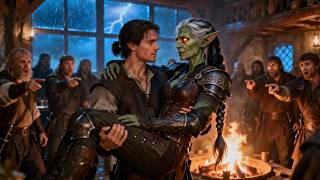
bright across the square. The sound carried. It cut through tension like a blade. Some villagers looked uncomfortable. Others looked uncertain. A few even smiled. Then a voice broke the fragile balance. Get that thing away from my son. The shout cracked through the music like a snapped bowring. The musicians faltered midnote. A woman stood near the center of the square, face flushed with anger. Martha, widow of a soldier who had died in the third year of the war. Her finger pointed directly at Yenna. She doesn't belong here. The square went silent. Alwin stepped instinctively in front
of Yenna. She's just dancing. She's an orc. She's a child. Father Godwin's voice cut in firmly as he stepped forward. She's what killed my husband. Martha's voice trembled. My brother, you expect me to watch them laugh in our square? Murmurss rose around them, agreement from some, Discomfort from others. Tuza felt her body tense, instincts screaming to move toward her daughter. Edgar's hand caught her wrist gently. "Wait," he murmured. Then he stepped forward himself. The crowd parted instinctively, "Not because of authority, because of something steadier resolve." "Martha," Edgar said calmly. "You lost your son, too," she
snapped. How can you stand there? And yes, he interrupted softly. I did. His voice was not loud, but it carried. I Buried him. 16 years old, bled out in mud because someone told him war was necessary. Martha's anger faltered for a heartbeat. I have every reason to hate, Edgar continued. Every reason to look at that child and see enemy. He turned slowly toward Yenna, who stood frozen behind, tears pooling in her wide eyes. But I'm tired, he said. Tired of burying sons. Tired of choosing hate because it feels easier. He faced the crowd. She didn't
kill your husband, he said Evenly. She didn't kill my son. She wants to dance. Silence. Heavy. Uncertain. Martha's face crumpled, anger dissolving into grief. I just miss him, she whispered. I know, Edgar replied. A long moment stretched across the square. Then Edgar turned back to Yenna and held out his hand. Do you still want to dance? he asked gently. Yenna nodded, wiping tears with the back of her hand. Then let's dance. He stepped into the square with her. It was awkward, uneven. Edgar clearly out of practice. Yenna stumbling but laughing through tears. Owen joined again.
After a moment, a long, fragile moment. One of the musicians resumed playing. Then another villager stepped forward. Not many, but enough. Tuza watched as the circle slowly widened again. Martha remained at the edge of the square, crying quietly, not in rage, in grief. The festival did not return to what it had been. It became something else. Not healed, not United, but changed. And sometimes change began not with treaties or battles, but with a child refusing to stop dancing. Peace never lasted long enough for comfort. It only lasted long enough for hope to become visible. And
visible hope had a way of attracting attention. The riders came at dawn. Tusa heard them before she saw them. The steady thunder of hoves across thawing earth. Not frantic, not chaotic, disciplined, purposeful. She was already Awake, splitting kindling beside the barn while Edgar checked the early sprouting rose near the fence line. Yenna was still asleep upstairs. Six horses crested the rise beyond the planted ironwood seeds. Six human soldiers and polished male bearing the crest of the northern crown. Edgar straightened slowly. He did not reach for a weapon. There was none to reach for. They're early,
he muttered. Tus's jaw tightened. They're not here for Harvest. The riders slowed at the edge of the property, but did not dismount immediately. Their captain, identifiable by the insignia stitched across his chest, surveyed the land with sharp, assessing eyes. His gaze lingered briefly on the hill where three small mounds of soil marked the ironwood seeds. Then he rode forward. Edgar Thorne, the captain called. Edgar stepped toward the fence. That depends who's asking. Captain Davick, Northern Guard. The man's voice carried authority without shouting. We've received reports that you're harboring orc refugees. Reports: The village had been
whispering. Someone had decided whispers were not enough. She's not harboring, Edgar replied evenly. She works here. The captain's eyes shifted to Tuza. She stood straight, did not lower her gaze, did not step back. "Works are expected to return to designated territories under treaty terms," the captain said. "The treaty says they may return," Edgar corrected. "Not that they must." The captain's mouth tightened slightly. The spirit of the treaty doesn't override the written law. Edgar interrupted calmly. "I've read it." There was a pause. The soldiers behind Daverick shifted in their saddles. Hands rested near sword hilts but
did not draw. "You're aware," Daverick continued carefully. "That your decision creates unrest within the village." "Unrested Long before she arrived," Edgar replied. Daverick dismounted at last. "The crunch of his boots against gravel sounded louder than it should have." "Let's speak plainly," the captain said. "There are concerns this farm is becoming symbolic." Tuza understood immediately. roots, seeds, shared labor. Symbols frighten people more than swords. She earns her place, Edgar said. Does she pay tax? Yes. Does she swear loyalty to the crown? Tusa stepped forward before Edgar could answer. I swear loyalty to no crown, she said
steadily. But I have broken no law. Daverick's gaze sharpened. You fought in the war? He asked. My husband did. And you? I survived. A flicker of something, perhaps reluctant respect, crossed his expression. Behind them, the farmhouse door creaked open. Yenna stood in the doorway, blanket wrapped around her shoulders. "Mama," she called softly. Every soldier turned. Tus's heart Lurched. Daverick's eyes lingered on the child for a long moment. "She was small, thin still, though healthier than weeks ago. Her expression was not defiant. It was confused. "She's not a threat," Edgar said quietly. Dick exhaled slowly. No,
he agreed. She's not. Silence settled between them. Heavy but uncertain. We don't want conflict. Dick said finally. But if this spreads, if what spreads? Edgar asked. Work planting trees, mixed settlements, cross Allegiance. People forget why lines were drawn. Lines were drawn in blood. Edgar replied. Maybe it's time they were drawn in something else. Da studied him carefully. You're not a politician, Thorne. No, I'm a farmer, and farmers rarely challenge crowns. I'm not challenging anything. I'm feeding my land. The captain turned slowly, scanning the farm once more. The barn freshly repaired, the fence is strengthened, the
hill where the seeds Rested. You understand, Dick said at last, that if violence erupts because of this, the crown will not ignore it. I understand, Edgar said. Daverick mounted his horse. Well be watching, he said. Keep it quiet. The riders turned as one and began the slow ride back toward the village road. Tuza stood rigid until the sound of hooves faded completely. Only then did she exhale. They'll return, she said. Probably, Edgar replied. You could still send us Away. He looked at her sharply. Do you want to leave? She glanced toward Yenna, who had stepped
cautiously into the yard now, staring at the receding riders. No, Tusa said. Then neither do I. They stood together in the thinning chill of early morning. The threat had not been loud. It had not been violent. It had been something worse. A warning. This farm was no longer just a place of survival. It was becoming a statement. And statements in a world barely healed from War had consequences. The soldiers visit changed something in the air. Not visibly, not dramatically, but like a crack in ice that spread silently beneath the surface. Tension deepened. The village no
longer whispered. It watched. For 3 days, nothing happened. On the fourth, it did. Tusa sensed it before sunset. A shift in wind, a weight pressing against instinct. She was repairing a split fence rail when she noticed birds lifting suddenly from the Treean, not in scattered flight, but an alarm. Edgar stepped out of the barn at the same moment. You hear that? He asked quietly. She did. Not host this time. Boots. Many of them. They crested the rise in a loose line, not soldiers, not uniformed. Villagers, a dozen men and women, faces tight with a mixture
of anger and righteousness. Some carried torches, others held farm tools gripped a little too firmly. At their front walked, Tuza's stomach tightened. Yao Was inside. "Stay here," Edgar said. "I won't hide," Tusa replied. "I didn't ask you to." He stepped forward until he stood just inside the fence line. Tusa moved to stand beside him. The villagers stopped several yards away. The torches hissed faintly in the cooling air. You should have listened. One of the men called out. We warned you. About what? Edgar asked evenly. About letting them take root. Tusa understood. Then this was not
about food or shelter. It was About permanence. Drock stepped forward. This farm used to be simple, he said, his voice lower than the others. It used to be just land and work. Now it's a symbol and that frightens you. Edgar asked. It confuses people. D replied sharply. Confusion leads to conflict. Conflicts already here. Tuza said quietly. You brought it. Murmurss rippled. One of the younger men lifted his torch higher. You think planting trees means this becomes shared land. Their trees, Edgar said. They're orc trees. The accusation hung heavy. Tusa felt the old instinct stir. The
urge to bear teeth, to show strength, to remind them that fear ran both ways. But she did not move. Drock's eyes shifted briefly toward her. Something conflicted lived there. He was not here out of blind hatred. He was here because the world, he understood, was shifting. "You have a daughter," Tuza said softly. The statement cut through the noise. Drock Stiffened. "She's eight." Tuza continued. "Mine is six. Do you think either of them care whose blood fell first? That's not how the world works, someone muttered. It could be, Edgar replied. The young man with the torch
stepped closer to the fence. We're not here to argue philosophy, he snapped. We're here to draw a line. Edgar looked down at the snow damp ground. There's your line, he said calmly. The fence hasn't moved. The man hesitated. Because That was the truth. No land had been taken. No law broken. Only an idea had crossed a boundary. We won't allow this to spread, the man pressed. You don't have to allow anything. Edgar said, "You just have to decide what kind of world you're building. Don't preach to us. I'm not preaching. I'm working. She's working. If
that threatens you, ask yourself why." Silence stretched. A baby cried faintly from somewhere within the gathered crowd. One of the villagers had Brought their child along. The sound was small but piercing. Tuza's eyes flicked instinctively toward it. Mother recognized mother. Drock noticed. He looked at the small hill beyond the farm where three subtle mounds marked the ironwood seeds. "You really think they'll grow?" he asked quietly. "Yes," Tuza answered. "And what then?" "Then there will be shade." The simplicity of the response unsettled more than any defiance would have. D stepped forward Until he stood only a
few feet from the fence. The torch light reflected in his eyes. For a heartbeat, Tuza thought he might cross it. Instead, he planted the butt of his ax into the snow. Not as a threat, but as a marker. You stay on your side, he said. We already are. Edgar replied. Drock exhaled. Then he turned. Slowly, one by one, the villagers lowered their torches. They did not apologize. They did not smile, but they left. The field grew quiet Again. Tusa remained standing long after the last shadow disappeared. They'll test it again, she said. Probably. Edgar agreed.
You stood for us. You stood with me. Inside the farmhouse, Yenna watched from the window wideeyed. Tusa knelt beside her when she entered. Were they going to hurt us? Yo whispered. Not tonight, Tusa said. Edgar closed the door behind them. Outside, the snow continued melting, exposing dark earth beneath. Lines had been drawn, but no Blood had been spilled. and that in a world not long removed from war was its own kind of victory. Spring did not ask permission before deepening. The snow vanished entirely within days of the confrontation, retreating into the mountains where it belonged.
The earth softened, dark and rich, breathing out the scent of renewal. And on the hill at the edge of Edgar's land, three small shoots broke through the soil. Tusa saw them first. She had risen before Sunrise, as she often did, to walk the fields alone before the day demanded labor. It was a habit born from war. Check the horizon, read the wind, measure threat before it arrived. But that morning, what she found was not threat. It was green. Three slender stems pushing stubbornly upward from the earth, each barely taller than her finger, leaves tight and
dark as polished stone. Ironwood alive. For a long moment, she did not move. She knelt Slowly, careful not to disturb the fragile growth and pressed her hand into the soil beside them. "You grew," she whispered. "Behind her, footsteps approached." Edgar stopped beside her, following her gaze. "Well," he murmured. "Would you look at that? They weren't supposed to surface this quickly," Tuza said softly. "Maybe they were tired of waiting." She almost smiled. Yenna came running moments later, breathless and brighteyed. Did they? Did they? Tusa Lifted her gently and pointed. Yana gasped. They're tiny. They won't stay
that way, Edgar said. How big will they get? Bigger than this house, he answered. Bigger than me. Bigger than Mama. Much bigger than Mama. Ya beamed at that. Word spread faster this time. By midday, Owen had seen them. By afternoon, Father Godwin had climbed the hill to inspect them himself. He stood with hands clasped behind his back, staring down at the delicate shoots as Though trying to understand what kind of power could exist in something so small. They're just trees, he said eventually. Yes, Edgar replied. Godwin glanced sideways at him. You know they'll talk again.
They always do. Some will see this as invasion. Some might see it as investment. Godwin chuckled quietly at that. They're stubborn, he admitted. They're iron wood. Tusa said they don't bend easily. A few villagers lingered at the edge of the property That evening. Not with torches this time. Not with anger, with curiosity. Martha was among them. She stood silent for a long time before finally stepping closer. Not crossing the fence, but not turning away either. They're small, she said quietly. "Yes," Tusa replied. "They don't look dangerous." "They aren't," Martha swallowed. My husband planted an apple
tree the year before the war. She said it never bore fruit. Tusa didn't know what to say to that, so she said Nothing. After a moment, Martha nodded once, almost to herself, and walked away. The shift was subtle, not acceptance, not forgiveness, but something softer than fury. That night, as Twilight painted the fields in gold and violet, Edgar and Tusa stood on the hill together. You realize? Edgar said we may never see them fully grown. I know they'll outlive us. Yes. Then why plant them? Tuza looked at the horizon, at the village, at the fields,
at the Farmhouse that had once been only his and was now something shared. Because Warplants graves, she said quietly. Someone has to plant something else. Edgar was silent for a long moment. You ever think about leaving? He asked. Before she answered, yes. And now she looked down at the three fragile chutes standing defiantly against the open sky. No, she said below them. Ya chased fireflies near the fence line while Alwin showed her how to cup light gently Without crushing it. The village was still divided, still cautious, still healing, but no one came with torches. No
soldiers rode at dawn. And on the edge of land once defined by borders and blood, three ironwood trees stretched toward a future neither kingdom had planned. Sometimes peace did not arrive in treaties or declarations. Sometimes it arrived quietly as roots digging deeper than hatred ever could. Years did not pass gently. They moved the way Seasons always did steadily without asking permission. The farm changed first, then the village, then slowly the space between two kingdoms. The ironwood trees did not grow quickly, but they grew without apology. By the third year, they stood taller than Yenna. By
the seventh, their trunks were thick enough that two children could not wrap their arms fully around them. By the 10th, their branches cast wide, cooling shadows over the hill, where once there Had only been suspicion. Yenna was 16 when the first formal delegation arrived. Not soldiers this time. Officials or can human both. The war had faded into history, though not into forgetfulness. Trade routes had reopened cautiously in scattered regions. Small mixed settlements had begun appearing along border territories. Experiments more than promises. But none had drawn as much attention as Edgar's farm. Because Edgar's farm had
never declared Itself anything. It had simply endured. Tuza stood at the crest of the hill as riders approached from both directions. Human banners from the south, work crests from the north. Edgar stood beside her, older now, hair stre with silver. The lines in his face had deepened, but the emptiness that once lived in his eyes had softened into something steadier. "You expected this?" Tuza asked quietly. Eventually, he replied. The riders dismounted at the Base of the hill. Ya, no longer a child, no longer fragile, walked forward before either of them could stop her. She wore
no armor, no insignia, just simple work clothes stained with soil. "What brings you?" she asked plainly. The human envoy stepped forward first. "We've heard this land functions differently." The orc representative nodded once. "No violence reported, no forced allegiance, shared harvests." Yenna glanced back toward the farmhouse where Alwin, now Broad-shouldered and steady, directed workers unloading grain sacks from a cart driven by both human and orc hands. It functions, she said. Under whose authority? The human envoy pressed. She tilted her head slightly. Under work. The orc envoys lips twitched faintly. You understand, the human said carefully. That
neutrality is complicated. It doesn't feel complicated, Yenna replied. You plant, you build, you trade, you don't kill. The envoys exchanged a look. Edgar stepped forward then, resting a weathered hand against one of the ironwood trunks. When she knocked on my door, he said calmly. I didn't open it to change kingdoms. Tusa glanced at him. I opened it because closing it would have killed a child. Silence followed. The wind moved gently through ironwood leaves. A sound deeper than ordinary trees, almost like a low. The village resisted at first, Edgar continued. Then They watched, then they worked.
Turns out most people are too tired to keep fighting if someone shows them another option. The orc envoy looked up at the towering trees. "These will stand centuries," he murmured. "That's the idea," Tuza replied. The human envoy folded his hands behind his back. And if conflict rises again, he asked. Yenna answered before her parents could. Then well stand here, she said. And refuse it. It was not naive. It was not Foolish. It was simply firm. Below the hill, the village moved as it always did now. Market stalls where both languages were spoken. Shared tools, children
with mixed features chasing one another between carts. Martha sat near the well with her grandson, a boy who did not remember the war at all. He pointed at the ironwood trees and asked what they were called. Shade, she answered softly. The envoy stayed until dusk. They asked questions, took notes, measured yields, And counted livestock. They found no hidden militia, no secret agenda, only land worked by hands of different colors. When they finally departed, they did not leave with threats. They left with something more dangerous. Possibility. That night, Edgar and Tuza stood once more beneath the
ironwoods. The trees were tall enough now that their branches intertwined overhead. Do you regret it? Edgar asked quietly. She looked at him. Regret what? Opening the Door, Tusa stepped closer to the trunk and pressed her palm against the rough bark. My husband wanted these planted, she said softly. He thought they would mark the beginning of our family's future. She looked toward Yenna, laughing below with Owen under lantern light. He was right, she continued. Just not in the way he expected. Edgar exhaled slowly. "That night," he said. "When you knocked, I almost didn't answer." "I know.
I heard the wind First, then your voice. What made you open it?" He looked up at the ironwood branches swaying overhead. "I was tired of losing," he said. Tusa nodded. The trees rustled softly, leaves catching moonlight. Two kingdoms had not signed a grand piece because of one farm, but they had begun visiting it, learning from it, copying it. And sometimes history did not shift because of kings or crowns. Sometimes it shifted because a door opened during a storm and someone Chose not to close it.