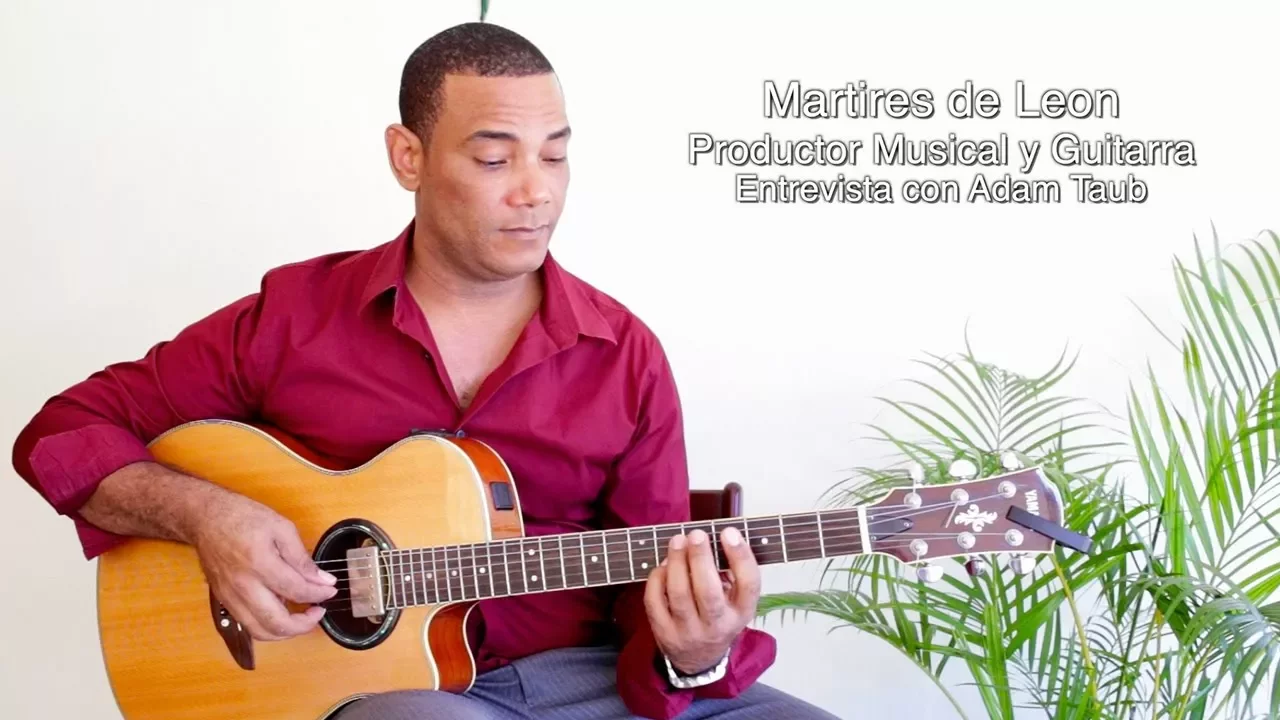
My name is Martires de Leon, I'm from La Romana, city in the East of the country. My first encounter with music was when I was very young. I would make everything I saw into a guitar.
The guitar has always been my passion. When I'm doing an arrangement, such as a songs intro, there arrives a moment when I put my back to the speaker in the studio, And I visualize myself as the public. Like I'm in a bar and the song plays.
I analyze it and it should give me something. . .
I should feel like, if I was the public, I would get up and dance, or have a drink. If it doesn't give me this feeling I change the arrangement and the intro. Martires de Leon is one of the most important lead guitars and producers in Bachata.
The songs in this video are a small example of his large body of work as a guitarist and producer. I call it an "Intro that turns over tables. " A "Turning tables over Bachata" means that when the song comes on people stand up immediately.
It doesn't have to be fast or slow but rather have a danceable rhythm. It has to be contagious. When it begins it has to call you to dance or to fiesta.
I would say Bachata is a melancholy, a sadness, a lament expressed musically. You feel it in the melody, in the way the guitar is played, In the way the singer expresses themselves. For me, this melancholy expressed musically is Bachata.
. . With guitar, bongo, bass, güira, and a singer, this is Bachata.
Ramon Torres, a famous singer in the genre, gave me the huge oppurtunity to belong to his group. He said to me, "Martires, we have to practice to record. " I thought, 'what do you mean record?
' I was surprised because in this era there were the masters Edilio, Agusto Santos, Jaime But I put my. . .
I'm not going to say I put in my knowledge, because I didn't have any, but I put my heart in it. It was by Ramon Torres. .
. You are born a Bachatero. You feel Bachata, And everything you express is a feeling related to Bachata, but like I told you I worked in Trio music also, where there is another structure, form, idea, and phrasing.
So, I started playing Bachata with Ramon Torres and after that I went and played in a Trio, and after playing in the Trio I started in music production and recording. I brought a lot of ideas. .
. such as harmonic changes like this and I would put certain chords that I learned in the Trio. .
. Then I would continue like normal and then suddenly I would change. .
. I went to Santiago and did a lot of work with Rafael Montilla. In the beginning I did a group called Junior y Jorge.
They had a popular song called "Piensa en Mi. " "Piensa en Mi" was well known internationally. Modern Bachata, the structure.
. . has a lot to do with what came before in Bachata.
Like I told you, before they used this type of combination a lot in Bachata, and from these same combinations you can do this. . .
Its kind of the same, but with a different way of playing. Its not marked as strongly. So the sounds you capture in the recording studio.
. . now technology allows you to do a lot, distort the guitar sound and put effects.
. . these things make it modern.
Monchy was like my son, from La Romana, he sang etc. So when we did "Hoja en Blanco" I did the guide. Because there was not a singer yet.
I sang it the best I could. Then Monchy came and put his voice on the track. We didn't have the female singer yet.
I listened to various singers from Santiago and Santo Domingo. . .
until a musician, El Mello. . .
said, "Listen, I have the singer for this. " It was a Sunday I remember. I went and it was Alexandra.
She began to sing and I said to myself 'She the one! ' She stayed, and her and Monchy did not even know each other. Monchy was in La Romana and she was here.
Thank God this song had an international impact that was something on a different level. Why? Because it was a man and woman singing Bachata together.
The sound we achieved in this song was very smooth and soft. It was a sound that was in agreement with the lyrics and a man and woman singing Bachata. I was born, and have lived, and grown in the Bachata.
This has been my musical genre and I think I will die in this. I'm a natural Bachatero, and proud to be one. Thank God this has brought the bread to my home to my beautiful family.
I'm so thankful.