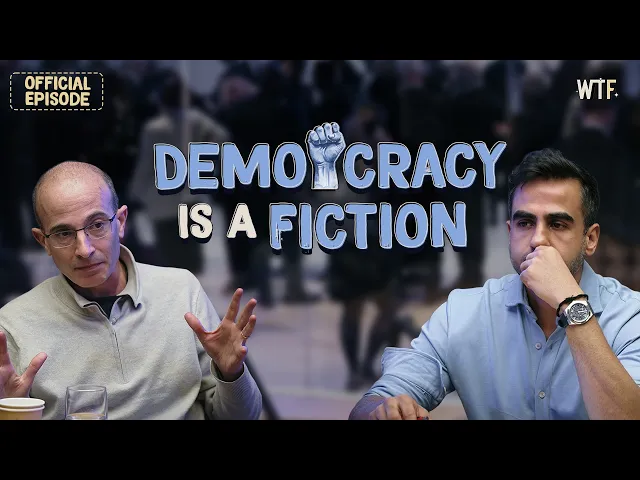
[music] Very good morning to all of you. Thank you. >> By an incredible panel. Um it's a very important topic which [music] titled this session on redefining Europe's place in the world. What do you think you were of what is happening in the world today? >> Terrible. I mean we are going back to Kindergarten. >> Don't politicians say they believe in God? Mhm. >> Because people vote for things that resemble them. >> Uh yeah, absolutely. I mean you cannot be elected US president if you say that you are an atheist, right? >> Same for Russia.
Maybe >> I don't think in Russia you will get elected but okay. Does it worry you to speak about Trump In a manner that you think can I go into America again? >> It's worrying that we even have to raise this question. >> So if religion were to be a story and many people wrote many stories why did the stories of the religions we have today sell history is shaped by the human imagination by fiction and not just by truth. What truth? >> The truth ultimately is one because reality is one. There is just one
Reality. Reality can be extremely complex. >> If I were you were a 25year-old boy in India. What would you suggest I optimize for [music] at this point of time? >> My gut reaction is nobody has any idea. >> Do you believe there is a purpose to life? And if yes, what is it? >> People think there is a big story, the drama of the universe. This is something I don't believe. >> What do you believe? don't believe that the universe works like a story. >> Right? >> I think the ultimate reality. >> Hi you. Thank
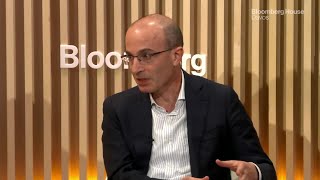
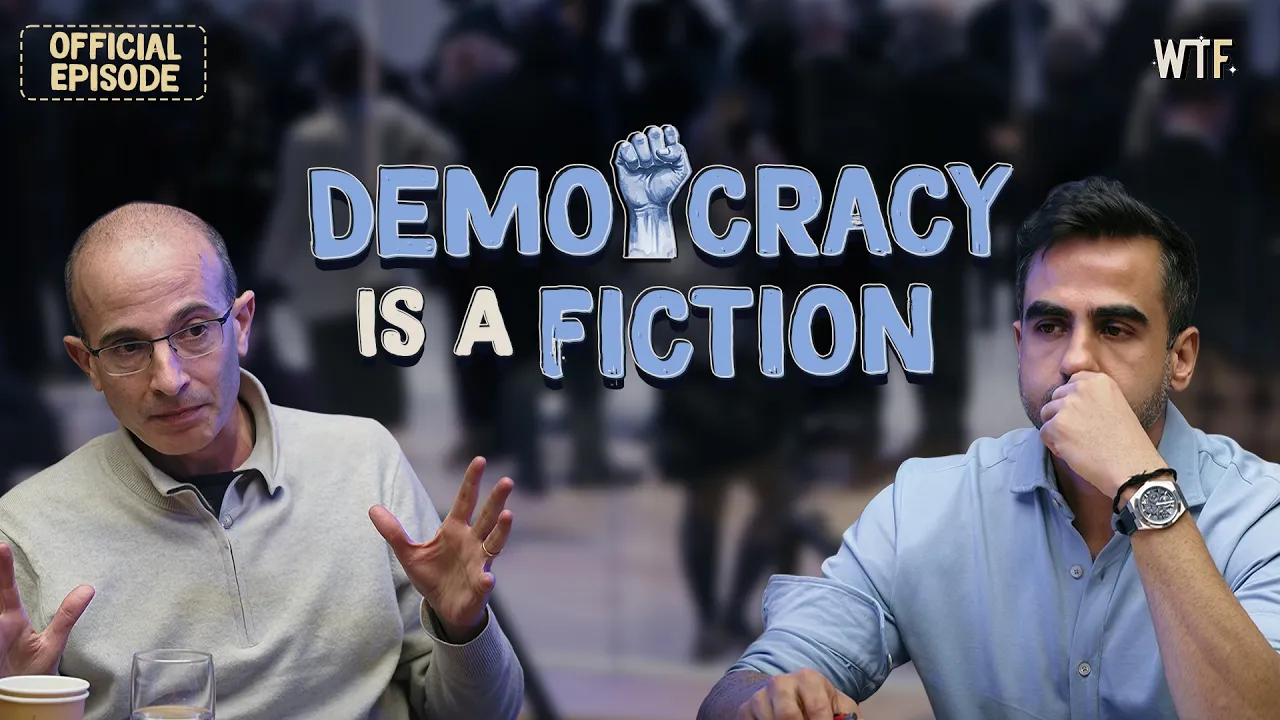
you. How do I say your name? >> Yuval. >> Yuval. >> Mhm. >> Uh thank you for doing this. uh I have read many of your books and I'm quite the fan of how you write and how you Think as well. For my audience back home in India, uh the young wannabe entrepreneurs. >> Mhm. >> Maybe we can begin by you introducing yourself a little bit just for context. >> Mhm. Well, I'm basically a historian, >> but I'm the type of historian that thinks that history is not just the study of the past. History is
the study of change, of how things change in the world. And so it means it's also the the Study of the present and the future. And how did you go from being a historian to being a thinker who's coming out with new thought in books? What what goes on in your mind while you write a book? Is it an idea that come first comes first? >> Yes. I mean, usually I try to to I don't start with a plan. Oh, I need to write a new book. So, what should it be about? >> Right. >>
I usually I have kind of ideas building Up inside my mind and when they reach the point when when it feels like I actually have something new to say, uh, then I'll write a book. Sapiens I read I think that was the first interaction I've had with any of your books. >> Uh brilliant book. I don't know if I remember all of it. >> I [laughter] won't test you. No. >> What what has stayed with you? That book is a little old now. >> Mhm. >> What has stayed relevant from then to today? I think
the main point of sapiens which is as relevant today as ever is that uh in his history is is is shaped by the human imagination by fiction and not just by truth. That humans control the world because we know how to cooperate better than any other animal on the planet. and Corporation relies on storytelling that so much of the world is run on fiction is fueled by fiction. Uh it's most obvious in the case of religion. But even if you look at something like the economy, um corporations, money, all of these things are stories that
we invented. They did they they don't have an objective existence outside our imagination. I think this was the most important message of of sapiens trying to understand history as the product of The human imagination and of human fictions. And uh it's even more true today I would say than it was 101 15 years ago when I when I wrote sapiens. So if religion were to be a story and many people wrote many stories, >> why did the stories of the religions we have today sell and kind of like permeate through time? What was so good
about these stories or what was so what was the reason these stories did well and the others did not? >> We don't know for sure. M >> um to some extent it can be accidental >> that you have hundreds and even thousands of different religious stories competing for human attention >> and um of of course you need to pass a a certain a certain level of attractiveness so humans will be interested in that story but beyond that point I I belong to a school of historians that think that uh accidents And luck have an enormous
impact on what is happening in history even on the biggest things like why is Christianity the most widespread religion today in the world um to some extent it's it's it's just it's just luck >> luck and good storytelling >> yeah a combination of course you needed I mean Christianity has a very compelling story it has something that people really want to believe you know Deep down if you ask yourself what is the the the crucial story that Christianity tells people. It is that you are loved by the God that created that controlled the universe. That
God loves you so much that he was willing to suffer and sacrifice himself for your sake. And that you know this is not like the love of a human that you always doubt. Yes, maybe they love me, but maybe they'll change their mind. Maybe they love me, but they don't really know Who I am. If they can actually see what is happening inside my heart, inside, deep down in my mind, they wouldn't love me. No, no, no. This is the love of an omnipotent, omniscient creator, God, who knows everything about me and still loves me.
This is such an attractive uh uh idea. You know, the irony to some extent is that the more attractive an idea is, chance the the bigger the chance that It's not true. It's so easy for people to find evidence supporting the story they want to believe. So the more you want to believe a story, the more suspicious you should be about how easy it is for you to to to to fall for it. Can you give me an example? >> This is just, you know, everybody wants to believe that there is something after death. >>
You know, this is universal in almost all religions in different forms. And The evidence is so meager. >> I wouldn't say there is zero evidence. I mean, >> there is evidence. >> Let's [clears throat] agree that whatever evidence there is is very, very shaky. >> What is the evidence? How can somebody prove there is life after death or not? Oh, don't ask me. I [laughter] I don't believe it. But all this is maybe the most common thing that people Believe throughout history. >> And I I didn't want to say there is zero evidence because then
the listeners will say, "Hey, I heard this story about somebody who was reincarnated and met his family from a and maybe there is a little bit of evidence, >> right? But compared to what you need to prove and compared to the influence of this idea on history, >> uh the evidence is so meager and yet such in so much influence in history. You know the other ironic thing and and here I speak specifically about the Christian belief. They say that they believe it but you look at their behavior. I don't know. You look at some
of the leaders today in the world. Does Putin really believe that? And he says he's a Christian and as a Christian, this is what he he's supposed to to believe. A person who believes that an omnipotent God really loves him would go around Starting wars, killing thousands, driving millions from their homes. Absolutely not. This is not the action of a man who feels loved. >> Don't politicians say they believe in God? >> Mhm. because people vote [clears throat] for things that resemble them. >> Uh yeah, absolutely. I mean you cannot be elected US president >>
if you say that you are an atheist, >> right? Same for Russia. Maybe >> I don't think in Russia you will get elected but okay. [laughter] >> Did you watch any of the politicians speak here this week? I I I'm afraid I didn't have I I read some of the transcripts of of the speeches, but I I didn't have time to actually go and and listen to the speeches. >> What do you think you were of what is happening in the world today >> geopolitically? >> Terrible. I mean, we are going back to Kindergarten >>
to kind of the first most basic lessons of politics and of human behavior. you now see the the rise or the the reemergence of this view that the only thing that that exists the only thing that really matters in the world is power is force and especially military force. >> You hear many leaders and many ordinary people now say this that everything else is just facade is just veneer. It it Never really existed. The only thing that really happens in the world is power and all human relations, our power relations, our power struggles. And if
anybody tells you otherwise, this is just a trick they are they are using to gain power over you. >> Hasn't man always been like that from the beginning of evolution. >> You always had people with this uh uh with this belief. You always had people who said these things. And the whole History of human spirituality and human philosophy is one long struggle against this very nhilistic and cynical view of the world. If you read I don't know you you read Plato's republic one of the key texts at least in the west of political thought it
starts with Socrates asking this one of the the people in Athens what is justice >> and this guy tells him oh justice justice is when the the strong do what they want this is justice >> and the whole of Plato's republic is an argument against that and you know the most basic human level. People should first of all ask themselves is this how I live my life? Your neighbors, your friends, your colleagues, are you constantly in power struggles with all you have no not a single real friend in the world? Like all the people outside
your family, you have just been in some power struggle with them. I mean, if somebody really believes that they have Such a miserable life, >> I agree. But all is an overstatement. But most would you say >> even most you know I I walk down the street I'm not in a power struggle w with people all the time >> um and it's the same all the way to the level of geopolitics that this idea that countries cannot have friends that you know United States and Europe I would say as a historian this was the Greatest
friendship in the world built over generations. I I can understand if somebody comes and says, "Look, I don't see why tax taxpayers in Texas and Iowa should pay for the defense of Germany and France." >> Yeah, >> completely reasonable. But then to stick your finger in their eye and say, "Okay, and because I'm stronger, I'll now take Greenland." Why? What? You know you friendship is s again Even in terms of power struggles to have some real friends in the world this is power >> throw this away for a bit of ice what's what's the rationale
behind >> you believe it's about the ice and about Greenland >> I don't I'm not sure what it is about >> I mean could be different things could be couple of things at the same time um one explanation Is that he is taking seriously climate change. It's very hard to understand the Greenland thing if you don't believe in climate change >> because climate change will make Greenland more important >> because the ice will melt. >> The ice will melt. You'll have trade roots. You'll have per perhaps you'll have easier access to to to some mineral
wealth in Greenland. But it makes sense only if you believe in climate change. And he says he doesn't believe in climate change. So, what do you believe? Um, it could be just maybe the simplest explanation. He's a real estate uh tycoon. This is real estate. He wants to plant his name somewhere. >> Like, so I'm the president who brought Greenland to to the US. Maybe it's it's as simple as that. Maybe the the one important thing to say about power is that ultimately human power is based on Cooperation not on force. Even if you want
to build an army, how do you get thousands millions of soldiers who don't know you personally to obey your your commands? Now, if you think that you build an army just by getting someone to threaten the soldiers to obey you, >> how do you get that those people who threaten the soldiers, who threatens them and who threatens them? It's endless. >> Mhm. Storytelling >> ultimately to build an army or anything, a corporation, a country, you need people to really believe in some one one story or the other. >> Yeah. You need people to really believe
in some system of morality, in some systems of laws, not just to be afraid. Nothing. You cannot build anything big >> in history [clears throat] in the world. If you try to only base it on brute force, on coercion. And this is true again all the way to geopolitics. that to have a real friend in the world that not when you're strong. When you are strong, it's easy to coersse others. But if you're in crisis, you are on the floor and get somebody then to come and help you. That's difficult. And between Europe and the
US, you had this kind of friendship. you know, one, it's a small thing, but it's still Important that, you know, after the US was attacked in September 11 and invaded or attacked Afghanistan, Denmark came to the to the help to help the the Americans. >> I heard Emanuel Macron wearing I watched him wearing really cool sunglasses and speaking the day before and I heard Trump last evening and again this morning. Mhm. [clears throat] >> It feels like they're negotiating for something that is not being spoken about Overall. >> I don't think it's about climate change
or Greenland or the ice melting or the routes opening up. It feels like it's something else altogether. But that maybe that's just my opinion of it. >> What what what is what is your hypothesis? What's your guess? What is it about? >> Yeah. Like you know when you're negotiating with someone you anchor with something really expensive so then they Take the product which is less expensive >> in a store. [laughter] >> Greenland seems to be anchoring. >> Mhm. >> In order to get the other person to take something else maybe >> which is >> more
tariff acceptable which it doesn't seem to be right now. [clears throat] >> I don't know. Well, I mean, again, I I I Still don't see that these tariffs are doing anybody any good, not the Americans and certainly not the rest of the world. Um, and as a negotiation tactic and you're negotiating with your best friend, >> you're doing something that really frightens and humiliates them, >> they will not forget that. Even if you get what you want in the short term and what happened in the last of course it's not just the last few weeks
it's the Last few years but the the Europeans will not forget that and the the feeling that you get that I don't know your best friend is willing to to stab you in in the back and and and to to step on you to humiliate you and then he says no no I was just joking but he didn't feel like joking at the moment This is something that can ruin the friendship years ahead. You know trust You you need to work for years to build trust and you can lose it in a day. To take
an example maybe from a different h field of life. Think about finance a bank about you know let's say banks. >> Yeah >> carpenters build tables like this table. Some carpenter build it. Uh uh engineers build buildings and bridges. What do bankers build? >> Bankers build trust. >> This is what they do throughout their Life that I trust them that if I will need that money, they will give it back to me. And then the banker goes and builds another trustful relationship with say some entrepreneur who wants to to to start a new company and
she needs money. So the banker and the entrepreneur build a trust trusting relationship and the banker lends basically my savings to that entrepreneur. >> Mhm. >> So she can start her company. Now I don't know this entrepreneur. I wouldn't give her my money. I don't know her. I don't trust her. You have the banker in between. The banker has built a bridge of trust between me and the entrepreneur. Now suppose one day the banker I don't know goes to uh on television and says I have no intention of of giving back my bank will just
take the money and run with it. We are not giving if if if the C if my customers wants their money there is no more money in the bank. No banker would be so stupid. You've just you've worked years to build trust with these people. Why destroy this trust? This is the basis for everything you do and politics like banking is most you can't trust everybody in politics of course but this if you finally managed to build a trustworth trustworthy relationship in politics this is your your biggest asset. Could this be the Problem with democratic
politics where politicians have a finite tenure cuz friendships don't have to last forever but only three four five years at a time. The basic idea of democratic politics and even of modern politics is that the relationships are between states not between families or dynasties or or people. >> That doesn't seem to be the case right now. >> This is crumbling. This is another plank of trust that is collapsing in the world. Like I heard Trump some time ago talking about Putin invading Ukraine and people asked Trump, "How can you trust Putin when he broke so
many promises previously?" And what was Trump's answer? He said, "Putin did not break his promises to me. He broke his promises to Obama. He broke his promises to Biden." >> Now this is, you know, this is going Back to the Middle Ages. M >> modern politics is that it's not Putin making a promise to Obama, it's Russia making a promise to the US. It doesn't matter who the president is. The whole idea is you sign a say a peace agreement, you sign it with another country. So even if the president changes, it still holds. And
this is again part of destroying the modern political system and going back to a medieval system in which it's Relationships between dynasties. Uh so it's now foreign relations increasingly is relations with the Trump family not with the United States which is why so many countries are doing business with certain members of the Trump family in order to influence US foreign policy. So this is really going back to the middle ages when relations are between dynasties and not between nations or countries. Hu, you're originally Israeli. >> Mhm. >> Does it worry you to speak about Trump
in a manner that you think, can I go into America again? >> Um, it's worrying that we even have to raise this question. >> Yeah. If they don't allow me into the US or they don't allow me, but my job as a public intellectual is to speak my mind. If I can't do that, then I can't do my job. So why invite me to to a podcast to to to to hear me say things I don't Really believe just in order to carry favor with some politician. >> Isn't that the media today? Everybody is saying
what they don't believe. But >> no, not everybody. This is I think the most again this is goes back to this kind of cynical worldview. Everything is a power struggle. Nobody cares about truth. Everybody whatever they say it's just some kind of manipulation. This is giving an open check. >> Mhm. >> For the real liars. Not every politician uh is engaged in in in in this type of of cynical manipulation. And and it's it's a sign of the time that more and more people say these things that everybody lie, everybody is corrupt, which again basically
says everything is just a power struggle and nobody cares about just as nobody cares about friendship. Nobody really cares about the truth. Which is a terrible thing to believe because do you really Believe that about yourself? Like when you look in the mirror, do you see there somebody who doesn't care at all about the truth? And the thing about the truth is that yes, you can get a lot of power by by lying. But the price you pay is that ultimately you cannot be happy if you don't know the truth about yourself. Because if you
don't know the truth about yourself and about the world, about life, then you don't know What are the true sources of misery in life. And if you don't know that, even if you become the most powerful person in the world, the richest person in the world, you will waste all your power and riches on solving the wrong problems because you don't know what actually makes you miserable. What is the truth yub? >> About what? >> About anything. What is truth in itself? >> What is truth in itself? Um I would say it's connecting to reality.
>> Mhm. Is it your honest representation of reality or honest viewpoint of reality? Cuz your truth might be different from my truth and someone else's truth. My opinions can be different from the opinions of somebody else. >> But the truth ultimately is one because reality is one. There is just one reality. >> Reality can be extremely complex. >> You know, I don't know, you talk about the Israeli Palestinian conflict. >> So the conflict looks different when you look at it from the viewpoint of the Israelis and not for the Palestinians. But this is part of
the complexity of reality. The truth is that for instance the Israelis believe that all the land belongs to them and the Palestinians Believe that all the land belongs to them. This is the truth. It's a complex truth. The truth is that during the war, the recent war between Israel and Hamas, Kamas committed atrocities and also Israel committed atrocities. This is the truth. It's not that oh there is the Palestinian truth that only the Israelis committed atrocities and there is the Israeli truth that only no there is just one truth that both sides committed Atrocities because
there is just one reality in which everything that happens happens. If I were to take a step back and look at the Israel Palestinian conflict and say one person is wrong. Mhm. >> Can there be a truth to that statement? one person is wrong or one side is wrong. >> One side is wrong. >> No, it's it's far more complex than that. Both sides they see part of the Truth, part of reality and simply refuse to acknowledge >> the other side. Um which is a very common thing in in in in human history. It's a
very common thing in especially in conflicts. Um the truth is that um Palestinians have a right to live in security and prosperity and dignity in their country of their birth. And Israelis also have a right to live in security and prosperity uh and dignity in the country of their birth. And the truth is also that many many people around the world refuse to acknowledge both of these things. They are willing to acknowledge only one side. >> I watched the peace group the Trump and Jared Kushner explain about what will happen to Gaza going forward. Do
you did you get a chance to see that? >> No, I I I still didn't have a chance. >> Do you think that'll play out? >> Let's see. I mean, so many things that these people promised didn't come didn't weren't fulfilled that um let's see what happens on the ground. Again, I'm I'm not against everything that President Trump is doing. >> Again, it's a complex reality. Some of the things he's doing are good. >> Some of the some of his intentions are good. I do hope that uh Gaza will be not only reconstructed but that
the Palestinians will have a good future Again in which they can live in the country of their birth and not just live but live secure lives, live prosperous lives, live lives with dignity. Um and I hope it succeeds but I we have to be cautious. We need to see results because we had so many promises that were broken. that just to believe the words in this case it's it's it's difficult. >> Do you believe religion is dying evil amongst the youngest of people? >> No, it's changing. It has been changing throughout history and it's changing
again. >> How is it changing now? >> How is it changing now? Um one thing very very interesting is that AI is increasingly taking over religion especially religions of the book you know. Um if I take Judaism for example, Judaism grants ultimate authority not to human beings but to words in books. It calls Itself the religion of the book. Humans have authority in Judaism to the extent that they know words in books. Now until today, nobody, not even the most learned rabbi in the world could read and remember all the words in all the Jewish
books because there are too many of them. >> Right? >> AI can easily do that. M >> so for a religion that gives ultimate authority to words in books Now there is a nonhuman intelligence that is about to take it over because it can take over the source of authority. >> So AI can't change the book but it can >> reinterpret it. >> I mean the book has been reinterpreted again and again and again. This is a game being played for thousands of years. And this is how all all the other books got written. They're
all reinterpretations of the original book. >> And now we have something that can read and remember all the books and has a chance of becoming the new authority that people will increasingly they have a question they will not go to a human rabbi. They will go to an AI. And it's the same in Christianity and it's the same with Islam and it's the same with many other religions >> with trust depleting in the world as quickly as it is. Don't you think people millions of not millions of people will Not want to resonate with one
book but smaller groups of thousands of people will find their own representation of each of these books. >> Could be and again an AI could write new books. >> Yeah. Um almost every religion claims in its story that it was created by a non-human intelligence. >> Maybe for the first time in history it will actually happen. >> That we will see the emergence of new Sects created by AI and spread by AI missionaries. And you know to to change people's minds the most powerful thing is is intimacy not not not power not force. A good
friend can change your mind in a way that almost nobody else can. And what is happening now in AI that if for the previous decade we saw this competition for human attention that the algorithms are competing to grab our attention. Now the front is Shifting from attention to intimacy. AIS are learning how to create intimacy with humans, how to create friendships, how even to create romantic relationships. >> Can you tell me what you mean by intimacy? >> Yes. Um, somebody that you talk with a lot, maybe every day, that you share your deepest fears and
hopes and thoughts and listens to you and gets to know you and gives you advice that you Take very, very seriously. And this is the this is where AI enters. >> There are already youngsters today in the world that you ask them who who is your best friend and they say it's an AI. >> I met some kids recently who said their girlfriends bias. >> Yeah. They have AI girlfriends and boyfriends >> like 20 year olds. >> Yeah. And you look at at at at you know Toddlers today, [clears throat] they grow up from day
zero basically interacting with AIS more than they interact. If you just measure it in terms of time, >> you just measure how much time this baby, this child spends with their father, mother, brother, friend from kindergarten AI. You will find they spend most time with the AI and already they are willing to share with it things that they don't Share with anybody else. It knows things about them nobody else knows. And this is maybe the biggest psychological and social experiment in human history conducted on billions of people right now. Nobody has any idea what the
consequences will be or in 10 or 20 years. When this child that learns what is friendship, what what is emotional attachment? They learned it through a relationship with an AI. What will this do to the social and Romantic uh uh capacities and relationships in 15 20 years? Nobody has any idea. And it's amazing that we we just allow it to happen. If you wrote the book, you will the AI >> Mhm. You wrote the new book that people interpreted and reinterpreted as whatever religion they want to believe in. What would you will optimize for? What
would be the three tenets of the new religion the world needs? >> I'm not in the business of creating religions. I've seen enough of as a historian. I know the many many ways in which this can go wrong. >> I don't want anybody seeing me as a rabbi or a priest that holds the truth and tells them how to live. This is extremely dangerous to them, even more dangerous to me because it kind of inflates your ego and you become and you go crazy >> and it would be hard to pull off alive. You need
somebody who wrote the book. >> Um >> or artificial in artificial intelligence. >> It's easiest with dead people because then you can do whatever you want with their words. Uh but yeah, AI will be a book that talks back to you. >> Like we had all these sacred books and they were silent. When we had a question, we had to find a human expert on the book. Just imagine what happens When the book can actually talk back to you. >> Isn't the book respected in the manner that it is because of the finality of the
book and the the fact that it is not dynamic and when I read the book or I read an interpretation of the book and you will read the same thing. If the book were to change >> because people constantly reinterpret it. You look at Judaism or Christianity of today, Christianity of today Completely different from what they were a thousand years ago or 2,000 years ago >> because as as the world changes, as human relations change, people reinterpret the book sometimes in extreme ways. You know, you read Jesus talking with people about compassion and love. If
somebody slaps you, give them your your other cheek. How did they interpret it to build the Inquisition to burn people alive just because they didn't believe in the in The exact same way that I believe about the the religion of love? >> They didn't burn just burn Jews and a burned other Christians. M >> and how is it possible that yes you and I we both believe in the religion of love and compassion but because it's a little bit different your interpretation than mine then I will burn you and I can find a way to
base what I do on what Jesus said >> but burning somebody's also maybe out of Love >> of course they always say it's out of love >> the love of a story a really good story >> they they found a way to explain that this I love you so much this is why I burn I burn you because if you hold these terrible views you're holding after you die >> you will go forever and ever to hell >> but if I burn you now maybe this will cause you to change your mind and then Okay
so so you die in a horrible way but afterwards you go to heaven >> so I'm burning you out of love you will is democracy dead if it has become as dynastic and these friendships and animosities not between nations anymore but with individuals. >> Mhm. >> In 4 years all that or in 3 years in America all that's being done today, yesterday, the day before is going to be forgotten because there's somebody new There at the helm. >> Mhm. >> Then what is the point of democracy? Does it even work anymore? >> Uh democracy is
not dead. It's still extremely powerful. It's still the, you know, the most powerful idea around. Everybody still claims >> even Putin Mhm. >> He doesn't go out and say democracy is dead. >> He still holds elections every four Years. >> I mean, nobody has manage to come up with a better idea so far. Uh so it's still extremely powerful and even in in practical terms the big advantage of democracy over all the other systems is that it is built on a powerful self-correcting mechanism. >> Anti-inccumb >> that is anti-inccumb. >> Yes. That you know the
basic truth about human beings is that We all make mistakes. Even the biggest geniuses and presidents and whatever, we make mistakes and also political parties, countries, we make mistakes. Now, how do you correct your mistakes? The big problem for dictatorships is that you can get it right 10 times >> and yet then you get something terribly wrong, an economic policy, a war, whatever. In a dictatorship, there is no built-in mechanism >> to change the ruler. the ruling party, The policy, you're stuck with it, >> right? >> Democracy is all about h checks and balances, all
about selfcorrection. The most basic mechanism is elections. You choose somebody, you give them power to uh uh pursue certain policies. After four years, [laughter] the people can say, "We made a mistake. Let's try something else." This is still the best mechanism that humanity has managed to come up with. Of Course, it's a complex mechanism because it's not enough just to have periodic elections. Elections can be rigged if the problem the big problem of democracy is that you give power to somebody for four years on condition that they give the power back and then you can
make a different choice. But the problem is always what if they don't want to give the power back. Now they have the power. So they can use their power to stay in power. >> They can try to take over the courts, the media, and then rig the elections. And you can't go to the courts because the courts are in the pocket of of of the new dictator. And the media won't report about it because the media is in the pocket of the dictator. So you still hold elections, but there is no longer a self-correcting mechanism.
Like in Russia, there is no way that Putin can actually lose an election. And the same we saw in Venezuela that Maduro by all Evidence lost the the last elections big time, but the election committee and and the Venezuelan media and courts, they all said he won. So you could not get rid of the of him that way. If you had to build a media house from scratch, this is something I'm passionate about. Yuo, what should the media for the new world look like? Is it something that is not behind a corporation? Is it more
like a cooperative, more fragmented media? Because if large corporations that are the social media companies of today have algorithms that optimize for a reaction, control who consumes what. >> It doesn't even matter what media is being reported and generated because they get to choose who reads what. >> Uh yeah, that's the big problem today with the media world. >> How do you fix it? And um don't let nonhumans control the human conversation. Our biggest mistake is That over the last 10 years we gave one of the most important jobs in the world to algorithms and
they did a terrible terrible job. You know one of the human society is ultimately a conversation between humans especially in democracies. We come together, we discuss what to do, foreign policy, economic policy and for that you need media. How do you manage a conversation between millions of people? And we built institutions over centuries To manage the public conversation. They were not perfect. No institution is perfect. But they learned from mistakes over time and they became better. And then we turn we did a terrible mistake. We gave the job of managing the public conversation to algorithms.
>> And why did it work? Why did the algorithms manage this job in a manner that it got more reaction? >> Because the algorithms were given a very Very simple task. The algorithms were not given the task, okay, manage the conversation in a way that will build trust or in a way that will promote truth or in a way that will improve society. How do you measure improve society? This is a very difficult metric. We want a simple metric. They were given a very simple metric. Increase engagement. >> Mhm. >> What does it mean? Make
people spend More time on the platform and engage more. like engage. You read a story, you send it to your friends or you write a comment. This is engagement. And the business model was if people spend more time on our platform, engage more, we make more money by showing them more advertisement or taking their data and selling it to a third party. This was the business model. The metric was extremely simple which was which which was good for the algorithms because These are very primitive AIs. This is like the first generation >> and the AIs
experimented on billions of human beings and discovered something that if you want to increase engagement to grab people attention and make them stay longer on the platform, press the hate button in the human mind. Press the greed button or the fear button. You don't need truth. You don't need trust. You don't need social accountability. And if anger is more engaging than Compassion, so let's drive anger. And this is what happened over the last 10 years all over the world. You know, you have this people ask why are Republicans and Democrats no longer able even to
talk to each other to agree on the most basic facts. You don't you can't explain it by just American society because you see the same thing in Brazil. You see the same thing in Israel. You see the same thing all over the world. It can't be something specific to one country. It's the underlying technology we have given. You know in the 20 the job of say editors of news was one of the most important jobs in the world in the 20th century. And you ask today who are the most important editors in the world. >>
Social media. >> It's algorithms. They don't even have names. The the editors of of of Tik Tok and Facebook and and X they are not human beings. So you will data shows that the youngest Of people age group 16 to 20 22 are spending lesser time on social media significantly less. >> Good news. [laughter] >> If I were to build a new social media and have a new al algorithm that does not optimize for hate and greed necessarily. What do you think would be good but also work? H um work in a business sense or
work in a Society sense. >> It has to work in a business sense for it to work in a society sense. >> Yes, this is the big problem because we have many models of how to build much better algorithms for society. Like you had these models from Taiwan >> that they actually built it and it worked well that you can take the same basic premises of social media and reverse them. You can have the algorithm rewarding content like the algorithm First of all in this Taiwan system. It maps people according to their views into clusters
of groups. Very easy to do that. >> And then that's that's the key point. When new content is released, it promotes the content not on the basis of how much engagement it gains altogether, but to the extent that it gains engagement from both sides. >> If you just cater to one group, you your content is not promoted. It has to be in Some way connecting different groups. >> Yeah. >> To be promoted. And this is very small tweak >> and it worked. >> It worked amazingly >> and then >> uh it's still running. The thing
is that in business terms this was a governmental >> uh uh uh experiment. Uh for the business model of social media companies it's Problematic. So you're saying in a way discourse could work where two people with opinions where they might not necessarily agree both sides of the argument are presented. If you aim to speak in a way that will be heard by somebody from another group, you can do that. >> Humans have been doing it for thousands of years. But in the last 10 years, the incentive structure changed. Like if you go, I don't know,
to the Athenian agora 2,500 years ago and you speak, you know that you have to speak in a way that will be heard by different groups of people. If you speak to only one group, it won't work. >> But on social media, if you speak in a way that inflames a certain group of people and doesn't resonate at all with others, doesn't matter. You build your 1 million followers and you become influential and potentially rich and so forth. And you increasingly you you you You radicalize yourself more and more because you increasingly speak only to
this one group of people. And the fact that other groups are completely put off by the way you speak, you don't care. You bring up Greek philosophy a fair amount >> with Athens and Plato and Socrates. >> You said something against being nihilistic in the beginning. So if you're not neihilistic as a person, do you believe there is a purpose to Life? And if yes, what is it? Um I don't speak in terms of of purpose. You know, purpose, people think there is a big story, the drama of the universe and I have to play
a certain role. Again, let's go back to the Greeks. They invented theater drama. So life is like a drama. I need to find out what is my role. What are my lines and perform it? This is something I don't believe. What do you believe? >> I don't believe that the universe works Like a story. >> Right? >> I think the ultimate reality is the reality of suffering and liberation from suffering which is not about these dramas that people construct in their minds. The dramas we construct in our minds very often obscure the reality from us
that don't allow us. We we often you know we sometimes cause immense pain to other people and to ourselves because we think this is we do it while pursuing Our role in the in in the universal drama. >> Is this a bit like the Buddhist school of thought where desire is the root of all suffering? How do you eliminate suffering or how do you take cognizance to what is causing you suffering? >> And the ultimate root I would say is not desire. Or it's ignorance. >> Ignorance of >> ignorance of the reality that again ultimately
>> wouldn't ignorance of the reality actually make me suffer lesser. >> Why? >> Because if I'm not thinking of something actively, I'm not suffering by virtue of having that thought in my mind. >> If there is pain in the world, say for example, people are dying in Iran today. >> Mhm. >> My ignorance of people dying in Iran will make me suffer lesser. No. from That particular thing. But if then you get into the habit of ignoring inconvenient things. >> This is a if you just ignore the suffering in Iran, okay, nobody can care about
everything that happens in the world. We are just, you know, we are just frail human beings. We can't carry the whole world on our shoulders. But if you get into the habit pattern of ignoring things that are inconvenient, then you will bring this habit pattern Into everything in your life, >> into your family relationships, into your professional work, into your relationship with yourself. And again, this will cause you to be ignorant of the ways that you hurt others and the ways that you hurt yourself. And then you can't do anything about it. We can't fix
something that we are busy ignoring. >> I hear you. But how do I take cognizance of my suffering? >> Mhm. >> In a manner that gives me purpose in life. >> Um the realization that suffering is not inevitable, that you can do something about it. And you know ultimately there are only two things in the world which are really under our control and this is the present moment and my own mind. Everything else is not really under my Control. I can't control the past. >> Mhm. >> Whatever happened in the past even if I'm president
of the strongest country in the world I cannot change the past. >> Mhm. And similarly that the future I cannot now guarantee something to happen in a year or a 100 years. It's not under only the present moment and only my own mind. Again even if I'm president of a powerful country ultimately the only thing I really control to some extent is My own mind. >> The person in the next room might disagree. >> We constantly try to control the world. all of us to to lesser or to and we can't >> even if we
are the most powerful person in the we cannot stop our our body from aging. You know you want to to control countries on the other side of of of the world try to control your your own body stopping it from aging. Um Try to control the next thought that comes up in your mind. Let's say you're president X of whatever country >> and there is this crisis in Greenland, in Iran, whatever. You go to sleep as and you say, "Oh, I need to sleep well tonight because tomorrow I'm giving this important speech in Davos, so
I should be fresh. I need to sleep." >> And as you put your head on the pillow, some really annoying thought comes up in your mind and you can't get rid of it. This happens to everybody including presidents that you want to fall asleep and you can't because there is this thought in my mind and think about it. I can order a nuclear strike >> on another country. I can raise tariffs to a,000%. I can order my eyes to shut here. I shut my eyes. I can order my body lie still. I cannot order my
thought to stop. I can't even control that. And if you cannot control that, Are you really in control of anything? Nothing. I'm with you. I'm with you that I don't control much. Not even the next thought in my mind. I'm also with you that suffering is inevitable. I'm trying to I'm trying to draw the bridge from this uh >> to how is that solving my purpose problem in life? How do I not be? >> What do you mean by purpose? What do you want? >> What is the point of life? >> Um to understand suffering
and be liberated from it. >> To understand suffering and >> and be liberated from it. You don't want to suffer. So if I understand suffering I will be liberated of suffering >> ultimately. Yes. Because again all suffering comes from ignorance. If if we really understand what suffering is and where it comes from Then uh we can be liberated from it. Not just ourselves but also help other people do the same. >> And of course it's extremely difficult. >> Um but if you ask me what is the purpose? What? You know, people want money. Why do
they want money in order not to suffer? >> People want power. Why do they want power? In order they think, "Oh, if I had all the power in the world, if I had billions of dollars, then I can I I I Can prevent myself from being sick. I can prevent myself from being sad. I can prevent and it's it doesn't work. People have been doing it, you know, for thousands of years. You can ask the previous generations of dictators and emperors and kings and billionaires. This this path doesn't work. Aren't people optimizing for attention? Deep
down for in in what way? Let's go back to the time when there was a society with 10 people and they were Hunting for food. >> The hunter who hunted the biggest animal >> Mhm. beyond a certain point where everybody had enough to eat. Did not hunt this really large animal risking his life because he wanted to eat the meat but because he got the attention of being the biggest hunter. >> Attention bar status. >> Don't you think people are optimizing for that? Money could be a pathway. Morality could be another pathway. >> And the
world is complex. People optimize for many things at the same time. for money, for influence, for beauty, for many things. Each of us decides to put kind of, you know, different quantities in these different buckets. >> All leading to attention. >> No. Um, all again, all leading to trying to escape suffering. We are all aware ultimately of the fact that we are mortal. A couple of months ago, they Caught Putin and she in Beijing talking privately when they thought that nobody was listening and the microphones were were on. And this was amazing because what were
Putin and she talking about in private? They didn't talk about Ukraine. They didn't talk about Gaza. They talked about living forever. >> They they these people really, you know, if you're just, you know, some poor guy somewhere and you're going to die, you still don't like it. But if you feel That I'm the most powerful person in the world and I'm going to die like I'm going to lose all that that's terrible. So these people and uh you see it in in in many places around the world not just in that the highest echelon of
society today is obsessed with their mortality and living forever because for the first time in history they feel that it's not just religion. Maybe science has a cure for death. >> And you see all this obsession with Uploading of our consciousness to a computer and and stuff like that because we are we we const we are in constant denial mode. We try to forget that we are going to die but deep down we know it. And um and we we say okay we'll have kids and through the children we'll continue to live. I'll write some
book and through my book I will continue to live or I I'll be so rich and powerful that I can somehow find a way to to to To live forever. >> And none of that works. And as long as you don't accept that it doesn't work and try to go deeper and see what's happening in there, you're just a slave. >> I know you meditate and you go to India. >> Mhm. >> 2 hours into a meditation. Mhm. >> I'm guessing you're trying to actively block thoughts that are coming into your mind. No, >> don't
try to block them. Observe them, >> right? >> Don't try to block anything. >> Most revealing thought you've had in all of your meditations. One thought, one thought. So for instance, that we have no idea where our thoughts are coming from. People are under the impression that I am thinking my thoughts. I am my thoughts. the card I think therefore I am I am creating my thoughts. Um when you actually look again you're In meditation or not in meditation you close your eyes you I don't know you go to sleep you try to fall asleep
you can't there is some annoying thought in your mind try to observe what's happening there >> and you see words popping in your mind and where do they come from >> and it's an it's such a simple exercise and it's it's really amazing to see that I have no idea where did this word come from like I I I I I I say a sentence When I begin to say it I don't know how it will end. No, the sentence I just said I don't know how it will end. When I started saying it, I
didn't know that the last word in the sentence will be end. >> Right? >> Why did I say I didn't know how it will end and not I didn't know how it will terminate or complete or develop or whatever. Somehow the words pop in the mind. You know people say about AI that AI is glorified autocomplete. That AI just predicts the next word in the sentence. Observe your mind and you will see it's exactly the same thing like like you have an AI inside you. And we tend to become so attached to our words to
our thoughts and again all these opinions and I'm not you have this opinion I'm not going to speak with you. I'm going to cancel you just because you have this opinion. These are just some words in Somebody's mind. You you're counseling a person >> because of some words that they said or that they thought. But it's also about about ourselves. >> We not only identify other people with the words, we also define ourselves by the words in our mind. And actually we have no idea where these words are coming from. >> So if you're not
your thoughts, who are you? >> Oo, that's a good question. Um, I'm investigating that. >> But but you this is something you need to it's it's you I can't write the answer and piece of paper here. Read. >> You think there's something between the brain and the organ of your body which kind of puts out thoughts? There's something else that generates who you are as a person. >> Who you are as a person is a constant process of change. >> Right? >> There is nothing stable there. >> Right? But >> the body constantly changes, the
mind, the thought, everything constantly changes. Our attempt to identify a fixed point >> that this doesn't change and this is me. No, I'm only asking for a fixed point in a period of time like at this point Today at 3 p.m. >> Mhm. >> You will is a certain person. >> Yes. >> Given that at 3:30 you will be will be a different person. >> A little different. [laughter] >> Who you are at this point of time is it nature, nurture, experiences. What do you suspect it is? >> Everything together. I mean again in [laughter]
Reality is one and extremely complex >> like you try to understand a war and somebody tells you this war was caused by X. Every time you hear an explanation a single cause explanation for a war know that is wrong. No war in history was caused by just one thing. Similarly a person is never one thing or caused by one thing. We are partly the product of biology and evolution of millions of years. We are partly the product of uh our own personal history and psychology. At the present moment, I'm partly the product of what I
ate uh for lunch >> and of the last words that have gone through my mind or through my mouth. >> Who actually runs the world today? viewer. If I'm a 22 year old boy and I have 100 million followers, am I more relevant to how the world thinks or is a politician? >> Um, [laughter] no single person or group of persons runs the world. >> Agreed. >> And when you talk, you know, you're in Davos, you talk to the most powerful people in the world and you always get a double story. Sometimes they will they
will try to exaggerate their power and give the impression that I'm so powerful as whether as a banker or politician or whatever and then when it comes to solving problems they tend to run away and say I this is not my responsibility I don't have the power to solve it this Is because of somebody else. >> Mhm. And to some extent they are correct that um again even if you are the most powerful person in the world >> um you cannot solve by yourself most of the world's problems and this goes back to the beginning
of our conversation. This is why uh trust and friendship and cooperation is so crucial because unless you build uh uh even a limited network of cooperation, you can't really do Anything. So whether you're an influencer, an investor, a politician, >> I hear you. I'm trying to establish the hierarchy of power, >> not trying to determine if a group has all the power. >> Okay. >> Who has more power today? Is it okay in all the people we have seen here I think Elon speaking next >> is it Elon is it Donald Trump is it the
Person who's programming the algorithm of uh Instagram and Tik Tok >> we we'll know in a 100 years who was really important or in in a thousand years you know if if I if [clears throat] I talked with you like okay we are in the Davos of the Roman Empire >> this is the year third no not 2026 this is the year 26 >> and you're asking me who is the most important powerful person in the Roman Empire and everybody would say oh of course it's Tiberius he's the emperor and somebody would say no no
no no it's a Janus he's the commander of the emperor's bodyguard and he's actually running the show Tiberius is just a puppet and then he would say no no no no it's these merchants going between India and the Middle East and bringing silk that they actually control the the economy and after a couple of centuries, people look back and say, "Oh, it was Jesus." >> And if you told people in the U26, the most important person at the present moment in the Roman Empire, maybe in the whole world, is this Jew from the Galilee, this
carpenter. Everybody would think you you're out of your mind. You're joking. >> But we look back 2,000 years later, and say, "Yeah, it was Jesus." M >> I actually think it's the original storytellers >> who are the most powerful. >> Like if you are a storyteller, if the person who wrote the book that we spoke about, >> if there was an original one, whoever writes an original story today that people believe like we believe in money and religion and other things. It's never the one person because the story gets retold and re and even Jesus
actually it's not Jesus because Jesus didn't write the story of Jesus. >> Yeah. >> Jesus didn't write anything that reached us. The New Testament was not written by Jesus. It was written decades later by different people. St. Paul wrote certain letters and treates and you have the different uh uh gospels written by different people. And then over time these texts changed and were reinterpreted. So to what extent did Jesus control the message of Jesus? To a very small Extent. Again a thousand years later people are burned in the name of Jesus. Like he preached love
and compassion and they burn people in his name. >> Was this is what he had no control >> Mhm. >> over his own message. So even in the realm of ideas we think that okay I write a book I did no this book will then have a life of its own and people will interpret it in the opposite way >> of what the author intended. What I fear Most is the person with most influence today >> is the person controlling the algorithm or the groups of people and I hope >> any of the other people
have more influence but not the algorithm cuz I don't think it's optimized for the right thing if I had to wish >> but then maybe the answer is that the most important powerful actor today is no longer a human being >> that I think I don't think we have Reached that point in 2026 >> but I think we are close to the point when the most important powerful if you want entity on the planet is no longer a human being or a group of human beings but an AI. If we were to tread down that
path, if AI eliminates the need for effort, a society of abundance where intelligence does not have a premium anymore because AI has a higher IQ anyway. >> Mhm. >> Does capitalism survive? Like what would be the point? >> Capitalism. Yes, of course. Capitalism doesn't necessarily need people. [laughter] It needs money and profits and growth. >> But it needs shareholders who >> AIS can do can do that. >> I mean, capitalism already created nonhuman persons >> which run the show and they are Corporations. um Google, Facebook, Microsoft corporate. These are not humans. These are corporations which
are legal persons even though they don't have a body or a mind. >> I consider them not >> but until today until today corporations were just legal fictions >> because when say Microsoft decides to buy a certain other company, it's not really Microsoft. It's human beings. It's the executives or shareholders that decide to do it. Um, but with AI, AI, what what defines AI is the ability to make decisions by itself. If something cannot make decisions by itself, it's not an AI. So, we could be close to the point when AI can be a corporation
that makes its own decisions without any humans. Now imagine a world in which there are maybe thousands, millions of AI corporations in which the AIs decide we'll buy that, we'll sell that, we'll Invest here, we'll buy and the AIs interact with the other AIs and if they are more intelligent than us, they will make better business decisions, they will gain more money um and they will take over the financial and economic system. the the the legal framework is already there with corporations and legal legal persons. The AIS just need to kind of get into it.
Interesting. Uh is money also losing relevance? >> It could. Um depending what you mean by money, money could change its character. >> Store of value exchangeable for effort. >> Mhm. uh it could we see already the decline of traditional currencies and the rise of cryptocurrencies which are managed and created by algorithms. We could reach a point when for instance currency will be AI tokens or even time on servers or data >> that AIs will trade with other AIs for For tokens or for data not for dollars and the human currencies like dollars and euros and
yens they will become irrelevant. Okay, you have a billion dollars but the AIs don't want dollars. The AIs want their currency. They want data. They want whatever. It's, you know, like horses give value to different things, not to gold coins. And then one day horses woke up and they found themselves controlled by humans who buy and sell horses for gold coins, Which the horses don't understand. The host can see that this human is giving me to that human and then that human gives that human this shiny piece of metal. I don't understand what's happening. >>
It could be the same with us. And AIs, let's say you are fired from your job and an other AI company kind of hires you and you don't understand why are they doing it? What's the rationale? If I were you were a 25 year old boy in India and I want to succeed in the world of capitalism, what would you op what would you suggest I optimize for at this point of time? >> First of all, ask my husband because he's the kind of businessman in the family. I know how to write books and and
give lectures. I'm not good in in [laughter] business. So, don't ask me for for business advice. Um but my gut reaction is nobody has any idea. If somebody tells you that they know how The job market would look like in 5 years or how the financial system would like look like in 5 years, they don't. Nobody knows. So my best advice is spread yourself wide. >> Don't kind of um train for something very narrow. If you're trying to, you know, you build your skills as a young person, don't focus on a very narrow skill like
coding because maybe in five years they don't need coders because AI is co better than us. So have a wide set Of skills. The the basic set everybody talks about is you need some you need brain, you need heart, you need hands, you need some intellectual skills, but you also need social and emotional skills and you also need motor skills, body skills. The body is important. So spread your time between developing your intellectual and social and uh uh uh bodily skills. I would also add spiritual skills that also develop your your spirit your mind. >>
A lot of people speak to me about spirituality. I still don't totally understand it. What is spirituality to you? You will it collective consciousness? >> No. Trying to understand reality. Like for me, religion is is in many ways the opposite of spirituality. That religion is about giving people answers that you are not allowed to question. Like people you want to understand reality here is this story. You must Believe this story otherwise you burn in hell or we burn you. >> This is religion. Spirituality is I want to understand reality. I want to understand life. I
want to understand the thought in my mind. Where do they come from? And I investigate that. And this investigation for me is spirituality. >> This word investigate is it very common in Israeli. I have a speech trainer who's Israeli and he says investigate a Lot. [laughter] >> Is it um >> I don't hear other nationalities using it. >> Okay. >> I thought about it. >> He says when you deliver a speech, you say a line and then you investigate the people listening to the speech in terms of what expression they have on their face. So
he says investigate. >> Interesting. um [laughter] could be >> geopolitically you will u any views in Venezuela Iran it seems like so much is going on >> I'm not sad to see Maduro go [laughter] I will be very happy to see the current Iranian regime disappear >> uh the question is always what replaces it >> replacing one dictator with another >> we saw it you know we saw it with Gaddafi we so happy oh how Gaddafi is Gone >> did it really improve things in Libya We are so happy Saddam Hussein is gone. Did it
really improve things in Iraq? So, you know, it's not like these Hollywood superhero movies that you think all the problem in the world is because this one big evil guy. We just get rid of we get Superman to get rid of Dr. Evil. End of end of the movie ends, happy ending. Doesn't happen like that in history. >> Yeah. >> Very often, okay, you got rid of the bad guy. Now you start the really difficult job of rebuilding society, rebuilding democracy. >> So again, Venezuela, it's not enough that Maduro is not there. We need to
see a functioning democracy in Venezuela. And just extra doesn't build democracy there. >> Somebody said this, I can't remember, Hobbes or someone, everything is better than anarchy. a dictator is Significantly better. >> I I agree with that. Anarchy is even worse. >> Yeah. >> Uh but we need to to to do better. And the thing is we now know that it's possible to do better. You know, if you live in the world of Hobbes in the 17th century in the midst of the wars of religion, then you think that an enlightened a dictator or king
maybe is the best Humanity can do. >> Yeah. Ben dictator is great for efficiency. >> In the 17th century, we don't have any example from human history at the time of a large scale functioning democracy. The only examples people in Hob's time knew of democracies was small city states like ancient Athens or or Florence in in in the Middle Ages and the Renaissance. >> Nobody knew how to build a functioning Large-scale democracy. So people would say, well, this is a fantasy. it just can't be done. >> We now live in 2026. We have experience from
the last 100 years that you can build a functioning large scale democracy. So uh nobody can tell us oh this is impossible. This is a fantasy. It's the same with the international system >> that if you if you lived say hundreds of years ago, you think it's impossible to Build an international system based on trust in which countries really trust each other. never done before can't happen. We know it can happen and the thing that tells us it can happen is for instance government budgets. For most of history, more than 50% of the budget of
every government in history, the Roman Empire, the British Empire, the Athenian uh uh democracy, whatever, more than 50% of the budget goes to the military. Um, in the early 21st century, the average expenditure on the military worldwide was about 6 to 7%. Countries felt safer than in any previous time in history. Even weak countries felt, hey, we can spend just 6% of the budget on the military and we know that the neighbors will not invade and conquer us. >> At this point, when everybody has enough to destroy each other, it it might not be to
any end whatsoever. Um it's never, You know, it was always a a a kind of uh a race to the bottom >> that when all the countries spend more than 50% of the budget on the military, no country can invest in healthare, in education and welfare and everybody feels extremely insecure because you look around and you see all these other kings and all these other republics armed to the teeth and everybody feels, oh, I need a bit more territory to feel secure. Oh, I need this island. Oh, I Need this province to to protect myself.
And the other country says, oh, but but I need this province to protect myself. Nobody feels safe. >> You know, in the early 21st century, when when you spend just 6% of the budget on the military, everybody can have more money for health care. For the first time in history, the average health care budget was around 10%. First time in history all on average all over the world, governments spent more on Health care than on the military. I would say this is this has been the biggest political achievement of humankind. And this is now being
deliberately destroyed by some of the most powerful people in the world. Actually just thinking about this if the doge were 100% efficient and successful slowly you would wipe out all bureaucracy to the point where one person can make all the decisions and it Would in a way lead to a dictatorship. >> Yeah. >> Right. So Doge has probably put things onto that path invariably without anyone taking cognizance to that. It might also do that. >> Yes. And it did something else. It shifted power from human bureaucrats to AI bureaucrats. You don't really get rid of
bureaucracies. You need bureaucracies. Bureaucracies are not bad. No big human organization can Function without a bureaucracy. Now what we saw with Dodge and similar efforts is not getting rid of bureaucracies. It's getting rid of human bureaucrats and replacing them with AI bureaucrats which are far more opaque, far more secretive. You can't understand what they are doing. They are far less accountable. And this again it's the shift in power and authority from humans to algorithms which we which we saw in social media. You know, previously the job of the Editor was done by a human being.
Now the job of the editor is still there. It's just being done by an algorithm and the algorithm has so far been doing a much much worse jobs worse job than the humans before. Last thing you will I think this is the end. You want to leave us with a fleeting thought of some sort. >> All thoughts are fleeting. [laughter] >> Fleeting for today. uh fleeting for today >> in the current circumstance of the things around us. >> I'll just repeat I think maybe the most important message. >> Don't believe people who tell you that
that all reality is just power that power is the only thing that matters. Um first of all on on the personal level it will make your life miserable. Mhm. >> You don't want to be the person who thinks that all their relationships are just power struggles. That's a miserable Life. And [laughter] on the collective human level, it will be very miserable existence for humanity. If uh uh leaders, political leaders, business leaders have this mindset that the only thing that matters is power that all human relationships are our power struggles. Then we end up in a
world first in a world in huge you have to spend 50% of your budget on the military and nothing is left for healthcare and and then everything Collapses uh we reach anarchy because then the country itself uh people will start fighting each other because you know if everything is just power so why is this guy in power and not me? So the the the thought again maybe it goes back to the thought. If the if the thought enters that everything is just power observe this thought and let it and let it fleet. Let it go
away. Don't hold hold on to this thought. Don't identify with This thought. It's very cynical. It's destructive. It's it's a very dangerous thought. >> Well said. Thank you for doing this. >> Thank you. Cheers.