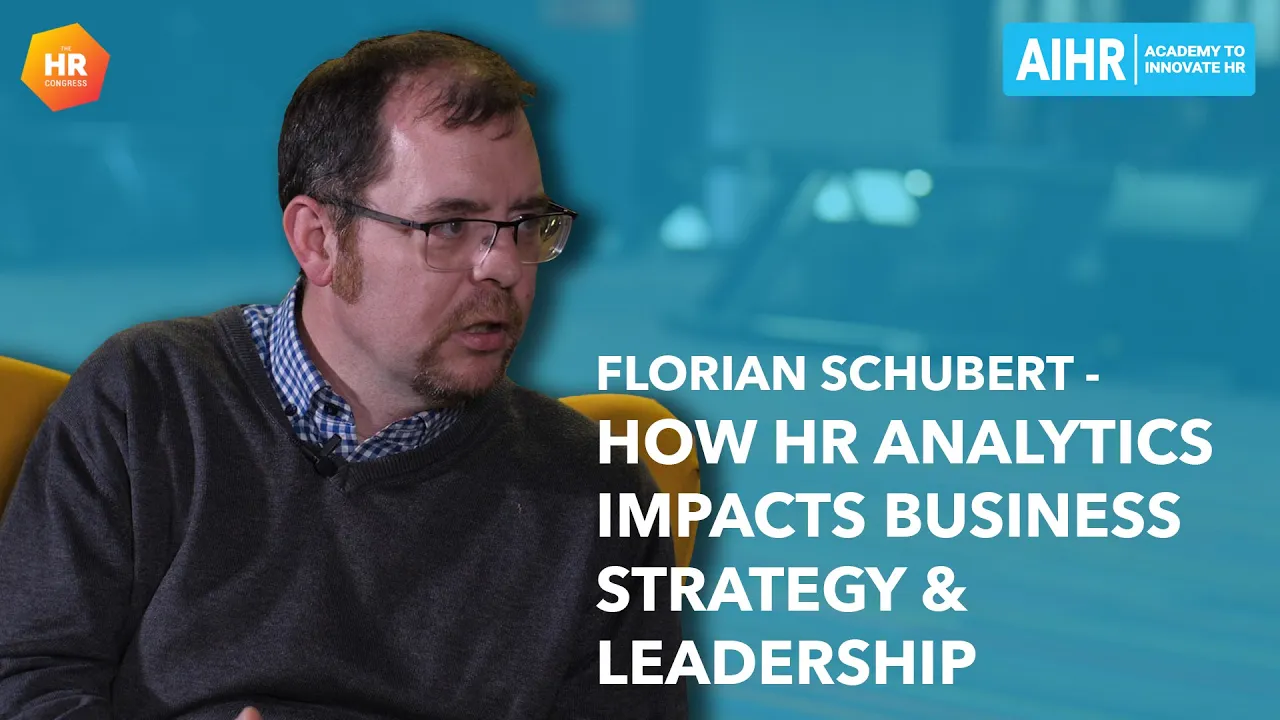
What could be the question on, with people analytics? People analytics still struggles in convincingthe business that they really deliver,that we're really delivering value adding answers to business questions. Which means expanding generalstrategic questions on CXO expanding by theHR dimension.
So if we are able todeliver examples where we answer today with the imperfect data we have, then we're also able to collect the data for them. Thanks so much for being here. What is your vision on the HR-ITinfrastructure and the analytics?
Do you see an alignment? When I started my career infinance and controlling, we developed the job profile for controller. Controllers would be perfectly able to calculate plus, minus, dividing.
. . do some quantitative descriptive analytics,not close to what the data flow in IT systemwas reflecting.
So, about 20 yearslater, we made a step. And now if you hire a junior controller,he's really able, end-to-end, to controldata flows in IT systems. So when we talk about synchronization between HR-IT strategy andpeople analytics, we mainly talk about skill sets ofunderstanding, influencing data flowswithin the IT system.
And in the job profile of the people thatuse this data, this is currently not reflected. When I think about what thejourneys should focus on is exactly bringingHR IT teams together, not only the functional requirementsside, but also the IT execution side,in addition to the people analytics leaders to really bringtogether the requirement andoutput that is needed. And I think that's very interesting, because it wouldn't be the first company where I talk to someone and they say:"Yeah, we're building a dashboard.
So should I build the dashboard of the available data? Or should I finda way to collect that data that'sactually business-relevant, and then collect it? " And then in asking the questions, they answered them themselves in a way.
And I think that'sexactly the problem that you're describing People analytics data is always,in a way, imperfect. So you will never reach the statusthat you have a complete dataset My advice to peers who are asking"so, how do you start your journey? "is: always take what you have.
From the people analytics perspective,even if I just describe 1% correctly,it's better than describing nothing. And in that context,we're in a much better positionto work with imperfect data and combine it with external datasetsand get an answer that is close tothe business question. But it must not be perfect.
Because on the other side, my view on people analytics data is that it supports the 40% that should be data driven decision-making. But still, I have a clear view that 60% of the decisionsthat we take every day, is maintainedby experience, by empathy, by external factors that were out of control. And my job as a people analytics leaderis just to secure the 40%.
So, how do we make sure that today, we're already capturingthe data that we will need in two or three years? What could be the questionanswered with people analytics? People analytics still struggles in convincing the business that we're really delivering value adding answersto business questions; which meansexpanding general strategic questions on CXO level,expanding by the HR dimension.
So if we are able to deliver examples where we answer today with imperfectdata we have, then we're also ableto collect the data for that. If I have these both on board, because I cantell them, we secure this future strategy, then they're allowing us to collect the data. One final questionto challenge you a bit on this.
I think one of the top priorities for anyCEO lately has been leadership,When I talk to an HR person, I say, "Okay, how are yougonna support leadership with your data? "And then we all know there's not much data on leadership. Shouldn't that be something thatwe look at from a system perspective and say: "Hey, maybe that'swhere we need to start capturingdata because leadership is important, leadership will remain important.
" What I'm really convinced aboutis that behavior and leadership output is mainly reflectedin feedback. Feedback from customers,feedback from employees, feedback from peers, feedback from the market. So if you're able to collect relevant feedback data,you're able to measure leadershipeffectiveness.
However it works in detail for the one organization you were in. But what I see is: Yes, we ask our employees or customers or whomever. .
. But first, we don't bring it together. It's not connected to the strategy.
And it's normally ad hoc driven. So we ask, and we throw it away. So it's not so much that we could not collect the data,or that we don't have an ideaas people analytics people what data we need to give exact answersto the business questions they have.
But sometimes we're missing the tools and the allowanceto do what needs to be done to realizethe answers to this question.
![5 HR Analytics Case Studies | AIHR [WEBINAR]](https://img.youtube.com/vi/VBJ6WDVr4Q8/maxresdefault.jpg)
![Power BI for HR | How to Build an Interactive Dashboard & HR Data Analytics [2024]](https://img.youtube.com/vi/kqmqO_OPEbE/maxresdefault.jpg)