in the last video we looked at how Airlines construct their Fair structures and why there are so many fairs from the same airline in a given market and we ended up with something that looks like this a demand curve with one more than one uh price point so let's just take a quick review we started out by saying well what if the airline only had one price P1 well the demand curve tells us that at Price P1 1 the airline would sell q1 q1 um seats and let me trying to choose my pen here q1
seats and at that price and quantity the airline would obtain would uh be able to capture this amount of Revenue remember the revenue is equal to price times quantity and price times quantity is represented by this rectangular uh this re rectangle under the curve and then we said well that's uh that's how we would maximize Revenue if we had only one price in the market we would find the price that maximized the size of this rectangle but we could capture even more Revenue if we added prices so the airline would add a lower price P2
and capture this additional Revenue here from customers who were only willing to pay P2 and they would capture this additional quantity and then they would also add a higher fair so for those customers who are willing to pay more than P1 they'd be willing to pay Q3 the airline would capture this additional rectangle of Revenue here so the total revenue that the airline would be able to capture with this Fair structure with three fairs in the market would be the sum of the areas of all these rectangles and that would be that would be easy
to add up now they are uh still leaving some money on the table so there's still some consumer surplus here so customers along the demand curve above this point here would be willing to pay more than P3 but they would get the seats for P3 similarly customers who would be willing to pay more than P1 would get the seats for P1 and same thing for uh customers who are willing to pay P1 but bought the seats for P2 and then down here there is some some demand that won't be satisfied because there's no fair in
the market that these customers would be willing to pay and they wouldn't travel at all so this Theory works pretty well uh we can see that adding prices to the market will capture a greater portion of the revenue opportunity but there's a fairly obvious problem here too right while we uh we called these customers in the last video I think we called this customer uh X and maybe these customer Y and these customer Z in reality you know there are customers who are willing to pay P3 for the C they would prefer to pay a
lower fair and while we have these ex customers who are willing to pay P1 they would rather pay P2 so these customers are really really have different willingness to pay but they're not so independent that these customers wouldn't buy the other product that the X customers wouldn't buy the the Y product they prefer to pay a lower fair so in order to capture all of this Revenue opportunity the airline needs some way of segmenting the market segmenting the market so um if they just put these three prices out there well as soon as the lower
price hit the market the all of the seats would be sold at that at that fair so the airline needs some way to prevent customers who are willing to pay a higher price from buying lower price seats so they need to find a way to get the Z customers to only pay P3 and not to purchase the same product at a lower fair and the way they do this this is something that I'm sure you'll be familiar with is they add uh pricing restrictions okay pricing restrictions uh they also call these fences so they put
fences around the lower fairs so that higher Fair customers won't be able to buy them and these restrictions are uh the things that you see in the airlines markets all the time there are Advanced purchase Advanced purchase um so you might have a let's say a uh let's change colors here 21 day 21 day AP Advanced purchase requirement or you might have the minimum stay minimum stay so maybe your most restrictive Fair has a Saturday stay requirement so to qualify that for this fair you have to purchase it 21 days in advance of departure stay
over Saturday night and this would be a round trip fair so that's one way they could put and let's say that's on the let's say that's the restrictions on this lower fair so to to qualify for the lowest Fair on the market the P2 Fair the customers would have to meet the mo the highest restrictions so they'd have to purchase their ticket 21 days in advance they'd have to stay over Saturday Saturday night and then uh purchase a round trip and in this way the airline is attempting to capture the the segment of the mark
that's very price sensitive and keep those customers who are less price sensitive on this portion of the demand curve from from purchasing those tickets and these you know these lowf Fair customers tend to be more the e your customers who make their uh plans in advance they stay at the their destination uh over the weekend because that's how they they man they they plan their vacations and of course you know they they generally go and come back to the same place that they originated their travel on the other end of the spectrum the uh the
highest Fair customers tend to be the least flexible they tend to be business customers their their their meeting schedule and their their business business plans don't uh firm up so far out that they can make their purchases 21 days in advance they generally don't like to stay over a weekend they like to get to their destination and come back before the weekend and um that will prevent them from purchasing or qualifying for the lowest fair and then in the middle here there's there's some combination of the two so maybe this is a maybe this is
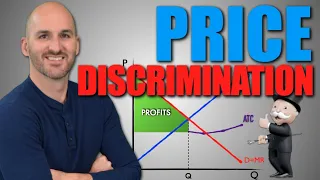
a 7-Day AP and a 3-day a 3-day minimum stay so in the middle here you have customers who are not quite as flexible as these real price sensitive vacationers uh but also have some more flexibility than the than the business customers so by putting these fences around these different fairs the airline is able to in in to some extent segment the market into different types of customers and in economics we would call this price discrimination price discrimination so let me me choose a different color down here pink I think and price discrimination and price discrimination
is uh what happens when you can segment the market and and charge different prices so price discrimination is basically when a firm in nation write that is when a firm charges different prices to different customers for the same product so different different prices in the market different customers are paying those different prices but they're getting the same product now the airlines will will construct these products in a way or these fairs in a way that they really they can be seen as different products right because the P3 fair is much more flexible than the P2
fair so the the product that the airline is selling is the flexibility to manage your travel from point A to point B from a consumer perspective they generally see generally see the product is as the seat uh the seat or the or the ability to get from from a to be uh in that seat so they see that there's different customers on the plane paying different prices but all ACH all getting the same product either way it's price discrimination which is a way that a legitimate way that firms will uh try to maximize revenue and
maximize profit and actually it it it there is a portion of the market that really benefits from price discrimination right because when we only had remember when we only had P1 and we said that was the optimal price for a market that only had one fair so if the airline was only able to charge one price and there was no segmentation no price discrimination there would only be one price well these customers would actually benefit the P3 the Z customers who are willing to pay P3 would actually benefit because they'd be paying a lower price
than they would be willing to pay but the Y customers in this structure wouldn't be able to travel at all because they're not willing to pay P1 so anyone along this part portion of the demand curve down here would not be able to travel at all in this market because there's no price that they'd be willing to pay so price discrimination is good for the airline it benefits some portion of the market uh by providing lower fairs that otherwise wouldn't be available