So, everyone's talking about starting an AI automation agency, but the truth is there are actually lots of downsides to this business model that people are not talking about. I've been running an AI automation agency for over one and a half years right now and worked with more than 70 businesses. And although I'm very happy I run one and we've grown a lot, there are quite some challenges to scaling this business model.
So, in this video, I want to give you an alternative AI business model that I've ran for the last eight months that can be much more scalable and headache-free, which is selling AI productized systems. So, in this video, I'm going to give you my honest experience running both these business models, show you what AI systems are and how they're different from AI automations, hopefully help you decide what would be best for you, and I also show you how to build and sell these AI systems to potentially grow a more scalable and profitable AI business. So, as I said, I've run my AI automation agency for around 17 months by now.
And uh I'm selling these productized AI systems for around eight months and I've separated these two businesses entirely. So, I have one team running the AI automation agency and one team uh selling these productized AI systems, selling and building these productized AI systems. Uh now, I put the business metrics here because I think the metrics speak for itself when comparing these two business models.
As you can see uh for the AI automation agency our margins currently are around 40% and that's because we work with uh 16 employees or uh contractors and the net revenue we've made over these 17 months is around the mid6 figure uh number and for the productized AI systems our margins as you can see are significantly higher at 85% and that's because we only work with four employees or contractors and the net revenue now almost is surpassing the net revenue from the AI automation agency in just 8 months compared to 17 months. And maybe even more interesting is most of the revenue has actually come from the last 3 4 months. So the growth curve for this business model has been lot much more exponential and this for the AI automation agency much more linear.
Now what I do want to add here is of course when I started this and I was still working by myself or with a smaller team the margins were of course a lot higher but as you want to grow an AI automation agency you will have to hire more people and this will slim down your margins. So how do I define these business models of what we actually sell? So in the AI automation agency, we sell uh custom workflow automations for the customer's existing processes, right?
So we make the customers existing processes and workflows more efficient by automating or enhancing uh these processes with AI automations. While with productized AI systems, we sell a pre-built AI system that we have designed that delivers a specific business outcome. Now you might be wondering why I called it a productized AI system.
I think it's a good uh name or description for this kind of system. Some people might give it another name. Uh you might be wondering why I not call it an AI SAS because AIASS is actually just one way you can sell a productized AI system which I'll get to later in this video and also uh clarify a bit more what I mean with a productized AI system.
So what are the upsides of these two business models? Of course with the AI automation agency, the big upside is you can start this today, right? You don't even need that much technical expertise to start this business today.
You can basically get a client today, help them optimize and automate and enhance their existing processes with AI automation and you can make money uh right away, right? So the time to revenue with this models very fast. If you find a client today, you can get paid today and you can also learn very fast because you can directly work with these customers from day one.
Of course, you need some technical expertise, but you can learn a lot while doing this for clients. While the upsides of course for the productized AI systems is it can be a much more scalable model uh because you can build this system once and sell it multiple times to different businesses and therefore you can have way higher margins. Now of course in reality this is a bit more tricky than it sounds right because actually building a product that works across different companies takes time and a lot of iterations but once you have it of course it's much more scalable.
Now some of the challenges we faced uh while uh doing both of these businesses first of all for the AI automation agency which these challenges might sounds familiar to you if you're running one yourself is that first of all of course every build's going to be custom you are uh automating and enhancing their existing processes in their business. So therefore every business has unique processes and therefore almost always your builds are going to be custom and built from scratch for each client. Even if you work for a specific niche or industry, you might be a able to reuse some automations you built before, but you will always have to customize the build for the specific business.
The second big downside or challenge of this model is that scoping and pricing can be really difficult. In order to understand uh a project and the scope of a project, you really have to understand how this business work and you really have to understand how the process works. And if it's a larger project, it can really take quite a while before you really understand the scope of a specific project and therefore it can be really difficult to price these kinds of projects too.
Right? The second thing in general, this is just a very hightouch sort of service you're providing to businesses. Right?
You're very much working inside of the business of a client and therefore there's generally a lot of heavy client back and forth involved and a lot of time is spent actually communicating with clients in this business model. Another challenge I faced a lot is uh businesses are are messy and many businesses don't have very wellestablished processes in place. So a lot of times before actually automating a process or workflow, we have to actually establish the workflow in the first place or improve it because many business processes are frankly just bad in the first place.
So a lot of times you actually first have to define a better process or establish a process before automating it. Then there's can be quite heavy maintenance. why these systems break sometimes they don't always work perfect especially over the longer term so there is quite some maintenance involved and all of this together just means as you're running sort of an hightouch uh service provider type business model the way you're going to scale this if you want to scale this type of model you're going to have to scale it through mostly hiring right and managing people right and you just have to be aware that if you want to scale it that's what you have to be really good at and what you have to sort of find fun to although of course for the metrics it sounds like way better business model and it it potentially is.
It still comes with a lot of challenges to build these productized AI systems too because of course building a really valuable productized AI systems that delivers consistent outcomes across different businesses just takes time and a lot of iteration uh to actually build a valuable product, right? It does require domain expertise uh also in a specific niche to actually design a proper process and and because it takes time generally the time to revenue is a lot slower. Now, just to be clear, I'm not bashing the AI automation agency model at all.
I think it's a really interesting business model. I think the demand for it will grow exponentially over the upcoming months and and years. And second of all, I also think the AI automation model can be a great introduction to actually find opportunities for potential productized AI systems, right?
So, it can be a great transition into a more scalable model too, which I'll get to later in this video. Now, that's why I also put here the key skills to building both of these businesses because if you really decide to to go for a scaling AI automation agency, what you just want to be aware of is that most of your work is actually going to be revolved around hiring, managing, and client relationships, right? Those are the three key skills you have to be really good at and probably enjoy doing in order to scale an AI automation agency to to higher numbers.
Or you can also decide to keep your AI automation agency lean and small and maybe even work by yourself and then of course this is different but then of course there's a ceiling to uh how much you can scale towards and for the key skills to build an AI productized systems business uh you will have to get you have to be really good and enjoy product development because you're building products you have to be good at distribution and go to market right marketing has to be on point and you do have to have some domain expertise probably in a specific industry uh to be able to build a valuable product. Now, lastly, what kind of automations can you sell in both of these models? Now, for an AI automation agency, of course, you can sell any type of of process automation, including internal operations, sales marketing, HR, anything you can think of really.
And for AI productized systems, you're probably limited to more sales marketing and HR recruiting because internal operations usually are so unique to each business and so heavily integrated into their own uh softwares, etc. that it will probably be hard to build a pre-built system that works for uh different companies in a niche uh if you're working specifically on operations, right? So, usually they're more focused on sales, marketing and HR.
So, how do I define this difference between AI automations and AI systems? Now, as I said before, most AI automations we build uh have to be customized for each uh business unique processes. And at least according to my definition, an AI system is a pre-built system that works for different companies uh with the same system with the same setup.
Right? Now there's a second big uh difference again according to my definition and this is not a hard line. This is more like a spectrum but in general AI automations uh you can see more like tasks and AI systems more like jobs.
Now what do I mean with that? Basically in general uh most AI automations we build they automate a component of a larger workflow right while an AI system can automate an endto-end workflow. So you can see an AI automation more like a task inside of a larger job while an AI system can automate more like a job function, right?
And therefore an AI automation generally uh tends to deliver more of an efficiency win, right? It uh makes existing process inside of a larger job uh more efficient by automating or enhancing it. While an AI system can directly deliver a business outcome or goal or directly contribute to an important business KPI like uh meetings booked, traffic, conversion rates, etc.
Uh therefore, generally AI automations have a medium business impact because they deliver more of an efficiency win while an AI system can have a very high business impact because it delivers or contributes directly to a business KPI. And again, the important distinction here too of course is that an AI system is based on your process. you've pre-established a process that delivers a business outcome and therefore of course this domain expertise is important and an AI automation is based on the existing customer process or workflow right and lastly at least this is what we've seen is because you're trying to automate an end-to-end workflow or a larger workflow let's say an SEO AI system or AI content system you generally need human in the loop because you can't automate that entire workflow uh end to end you need to have a human in the loop decision maker to take decisions in between, right?
Well, an AI automation generally, not always, can run autonom autonomously, right? Because it's just one task inside of a larger job. So, I put a few examples here, but I'm just going to show you an example here.
So, one example of an AI automation could be a keyword research automation, which can definitely make the process of keyword research a lot more efficient inside of a business by automating or even enhancing the workflow. But keyword research of course is still one task or component of the larger workflow or job which is SEO. All right.
So if we look at an SEO ecom AI system which is of course the system we build and sell to clients at the moment. We are de developing some other systems at the moment but this has been our core product. Um of course SEO consists of a lot more than keyword uh research right you have research and strategy involved in SEO.
We have content generation. We have publishing. We have analytics.
Uh and each of these consists of multiple tasks, right? Strategy, competitor research, keyword research, metatitle generation, content generation, internal linking. Uh in publishing, we have multiple.
In analytics, we do we we have tech audits, site audits, performance analytics. And usually most work or jobs or larger workflows also work in a loop, right? That's why we call it a system because you put in the work uh you analyze the results, you optimize the strategy, and you do the work again.
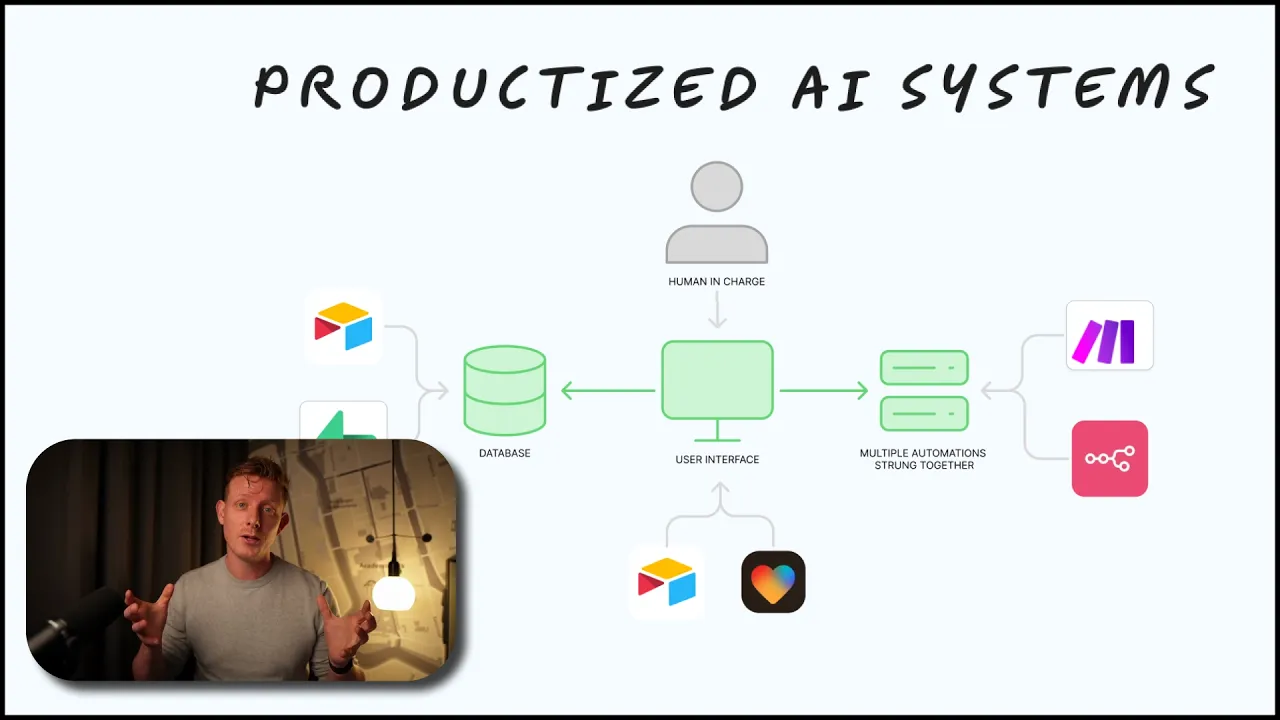
And that goes into a loop, an infinite loop basically to actually achieve a goal more efficiently. Right? So the way we build this these systems is by basically stringing together all of these smaller automations inside of this larger AI system.
Right? And as you can see here, this part for example is keyword research, but it's just one part of the larger AI system. Again, there's much more tasks or automations involved in the larger workflow.
Now, as you can see here, we've all stringed them together with a web hook. Instead of basically making one huge automations that autonomously automates this entire process because as soon as you're going to try and automate these large end to-end workflows, you try to make it completely autonomous, it's going to run into errors, right? Because you can imagine if we run this uh entire automation and we string it together and something slightly goes wrong in the beginning, you can imagine it will have really bad consequences at the end.
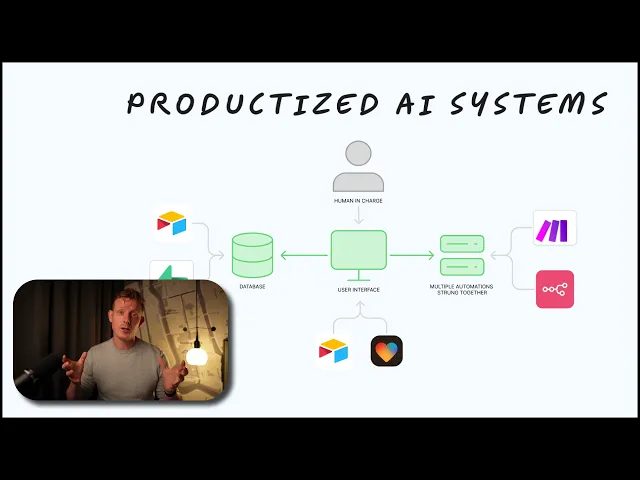
And second of all, what we've noticed is it's just far more efficient having actually a human in charge. So the way we do this is by building these systems through air table interfaces where a human is in charge of the process where a human decides to execute on these different tasks or automations through the interface on air table. It can iterate on the outputs.
It can change things still if you if the user wants to and is still in charge of running this entire process. Right now, it doesn't always have to be this gigantic large workflow. Of course, this if I look at this graph, of course, a a pre-built AI system doesn't always have to go and automate an end-to-end workflow.
This can also be a lot more on this side, for example, uh more on the task side, but still a pre-built system. Uh let's say, for example, a LinkedIn content system. You can still have a pre-built AI system that uh can generate LinkedIn posts for people.
uh but the more it's on the job side of course the more it will deliver a business outcome and the more value your system will have so the more you can have it on this job site the more value the system will have and this of course you can iterate and build upon over time too right our SEO system started out a lot simpler we've built and improved the system uh by working with more clients so it was probably also more on the task side first and eventually more and more towards the job side delivering a higher business impact Now, I'll give you a very quick walkthrough of the AI SEO system in a second. Uh, but if you want the full step-by-step breakdown of that system, I uh did do a full video on that system on my channel before. So, if you're interested, make sure to check that one out.
I'll make sure to link it up here, too. Uh, now before doing that, very quickly, what are the main components of AI systems? Now, because generally we tend to try to automate large workflows, we need this human in charge, human decision maker, human in the loop.
And therefore, we need a user interface. Now we generally use air table as our user interface but of course you can use other tools like lovable uh bolt or even build it with custom code if you know how to code. Then the second component is of course we need a database to store all of the data from the executions of these smaller automations or or workflows uh to use in the subsequent automation steps basically and that's why we also use air table again because we can basically combine the interfaces with uh the database but of course you can also use other tools like superbase or there are many other uh databases out there and then of course we have these multiple automations strung together inside of an AI system.
Now uh this can you can see basically as the back end and now we run this on nad but of course you can also run this on make. com. I actually know some people have built AI systems or even AI SAS on make.
com. Now what are the ingredients for AI systems? Now generally to be able to build an AI system generally you do need some experience uh and some data uh from this specific industry or system you're building because of course uh you have to design a pre-established uh process that delivers a business outcome and that that will require some domain expertise right now of course the system has to be pre-built now sometimes some customizations might be involved like let's say for example in this system they have a completely they have a different CR CMS for example for publishing uh outside of the common ones, then we might make an exception and customize it a bit to be able to publish it on their specific CMS.
But in general, you can see this is a pre-built solution. Now, this doesn't mean it's a one-sizefits-all solution. It just means that the customization or the tailoring for a specific uh business is done by the system itself or by done by the user.
And I'll show you this in example of the SEO system. So here we have the main dashboard and you can see all the different tasks that are involved in SEO generally and uh they can execute on all of these. So for example here in the SEO campaigns here you can start a campaign for a specific business and you can see it's almost like a little bit of a SAS right but the great thing is we can build these systems with no code tools and therefore we can build MVPs quite quick but make it look like a SAS to clients etc which helps a lot.
So, as you can see here, we can uh add a new company. We can do SEO for here, right? We can just add in the company and the URL.
And of course, SEO does need some tailoring and strategy for specific company. So, again, this is not a one-sizefitsall solution. It does have to be customized to each specific business.
But the difference is this is built into the system. So in this first section, the SEO campaigns, if a user fills out a new URL in a company, the system will automatically, you know, do research on these on this specific company and come up with a business overview of this company, as you can see here, our company offering, in this case, my company, uh the ICP, ideal ICP, and it will generate a strategy. And here of course again we have the human in the loop to always be able to iterate and adjust anything before actually starting these campaigns.
All right. And you can see here we have multiple tabs with all the different things we we can do in this system which is URL inspections. This is the tech audit on page report technical issues on page speeds snippet analysis.
We have URL classification. And here we can generate the pages or optimize pages, right? Product or pillar pages, category pages, uh mofu content which is middle of the funnel content, right?
And from here we can also take actions right here. We can generate the content, we can generate ideas that link back to this content, uh etc. If you again want to have the full walk through, uh make sure to check out my other video.
But this system generates the content. It does keyword research, content description, uh it does internal linking. Uh but you can see the power of this.
It looks like a little SAS product. Uh but it's entirely built with no code. So this brings me to the last part which is uh how do you actually sell these kinds of AI system?
There are really three main business models uh to sell these AI systems and I think they're all interesting and can depend also a little bit on the stage where you're at. Now, a very interesting one to start with when you're just building out an AI system is to actually go the traditional agency route. Now, in this case, you're basically just presenting yourself to clients as more of a traditional agency.
So, especially if you, for example, are building maybe an AI BDR system in the sales space or in the marketing space, let's say an AI content system or an AI SEO system like we have, you don't even have to show the system to the client. you can just present your offer more like a traditional agency where you deliver a business outcome like lead generation uh marketing uh services etc. And then you use the system in the back end um to deliver the business outcome.
And because of course you've productized and automated your uh service delivery, you can of course scale this to really interesting numbers and uh you can scale the business model much more than traditional marketing agencies or lead generation agencies could ever do. And lots of marketing agencies and lead generations agencies who are getting into AI do this automatically. Of course, they're trying to automate their back-end service delivery because they get a huge edge over the competition because they can enhance their offering and they can automate their service delivery.
But this could be definitely an interesting way to get started, especially if your system might not be well enough uh developed to sell it just like that to a client. You still need to develop it a bit, develop it a bit. you can use the system on a daily basis uh to improve it etc and to deliver the business outcome to the client.
While you're doing that you're making it better and the advantage of this first business model of course you can price this much more like a traditional agency which is usually a pretty high retainer and usually you can also charge commission or ref share on uh leads uh booked in the calendar etc. Now the scalability of course because there's still more of a hightouch service uh is a little bit less than these other models but can definitely be an interesting one to get started with. Now the advantage of this is it's sustainable with few leads and you can use it on the databases yourself to improve the solution.
Now a second model which is the model we use is what we call the out of the box model and this is quite an interesting model and it sort of comes back to the old software days uh where we basically sell the AI system template to the client right so it comes back to the old software days because in the old software days companies basically bought the actual software on their computer instead of uh the new age SAS where you're just basically using the software in the cloud right so you're actually getting the software now we've we've been using this system is like we sell this AI agency in a box, AI SEO agency in a box and it's actually really interesting because many companies are kind of sort of sick of these subscriptionbased services and it feels like they're getting a lot more when they actually get the system themselves right so a lot of companies might willing to pay a lot more for getting the actual solutions onto their computer uh than for SAS of course and in this case of course the customer uses the system to get the outcome And in this case we charge for example a high implementation fee and sometimes with a low recurring right that will be the business model and therefore it's a bit more scalable because of course there's lower touch uh with the client especially in the long run most of the customization and implementation is done initially when we deliver the project but after that is very little and therefore it is more scalable. Um but of course the downside of this is you still do need to do that setup and sometimes a little bit of training on your system and second of all you are giving away the template right you are giving away your secret sauce in a sense uh so uh you might be creating a few more competitors in the marketplace now we believe there's enough room first of all and if you have enough distribution you'll probably create enough demand anyway but of course that is a downside and then the third one which I'd recommend only if you've really tested this and this model and you know that your system is really good and really solving a painoint for a large audience then you could also transition it into a complete AI SAS right and in AIS you basically sell access to the system right that's the difference right in this one you sell a business outcome here you sell the template and here you sell access to the to the system now in this case of course the customer again is in charge of the system uh and in general with AI SAS you can only do this with low recurring and therefore it also makes sense to not jump into SAS right away especially if you don't have a lot of market traction yet because for a SAS to become profitable you generally just need quite a few customers uh quite a lot of customers to make it profitable so you can always start with these two business models before uh jumping into a SAS when you know you have distribution and growth and you know your solution really solves a pain point and this I think is uh the the mistake many people make that come from a non-technical background and learn how to build AI systems or AI automations is the first intuition is to jump into an AI SAS to make it as scalable as possible. But it's very difficult to build a valuable AI SAS uh out of nowhere without having worked with lots of customers, without customer feedback, without iterations etc.
So if you've used these before, you already have had a lot of iteration and feedback from customers. So you know that when you jump into a SAS, it's a lot less of a risk because you know your product delivers value, right? And of course, it's important when you're jumping into an AI SAS is that you have distribution, right?
An AI SAS only going to work when you can actually reach enough customers to make it profitable. And this is usually the bottleneck for many AI SAS and will only become more of a bottleneck in the future with tech being democratized. More and more people will be able to build these systems and AI SAS.
So distribution will become more and more important. So if you're jumping into AAS, make sure you have a really good go-to market strategy. Right?
So that's the the downside here. So the upside of course is no ongoing work and it's the most scatable model. Uh but it is riskier might require capital and require strong go-to market experience.
So that's why I put this arrow here change the business models maybe when distribution grows. We are still deciding if we eventually go AI SAS we might do this but for now we're pretty happy here. Now lastly to finish it off and in my next video I'm going to show you step by step how to build an AI system the way we built these systems with air table.
So if you're interested, make sure to check out my next video. But how do you approach building an AI system? I just put a little road map here uh that I think might help.
So first of all, you always want to make these systems as much niche as possible, especially in the beginning, right? Your only way you're going to be consistently delivering a business outcome uh through one AI system is by really niching down and knowing one industry, right? So you want to pick an industry niche.
And the way I always uh uh look at it is play to your strength, right? Pick an industry that you've already worked in or are you are passionate about, right? Because that's going to make it your life a lot easier.
You already know the pain points. You know how this industry works, right? So you have an edge there.
So pick your industry. That's the first step. Then you pick a business outcome, which is really important for these systems, right?
They have to deliver. The more of an outcome they can deliver, the stronger they they are and the more you can sell them for, right? And in general the biggest pain points for businesses and the biggest business outcomes you can give businesses is lead generation and recruiting.
Now why is that? Because growing companies can only are only limited by two things which is more leads or more people to handle the new leads. Right?
So that's why lead genen and recruiting are the most high value business outcomes especially for growing businesses. Right? Now around lead legen of course you can think of many different AI systems right we can have SEO systems we can have uh BDR systems we can have uh paid ad systems we can have Google uh Google Google ads PPC systems uh voice systems there are many many options here same in recruiting and of course if you have a lot of experience with maybe a business outcome that is not rec recruiting or lead genen you could still think about an AI system around that uh outcome let's say customer service system for businesses that don't really have a customer service system yet.
Uh things like that, right? So pick a business outcome and again play to your strengths, right? Then there are basically three main paths I think best paths to building an AI system, right?
Because building it from scratch is a little bit the trap that I mentioned before that many many people fall into is like from day one I know now how to build a product. I'm going to build an AI SAS and sell it to thousands of people. If you don't have a lot of experience in SAS building or go to market, this is going to be a very challenging route.
So that's why I put a few different routes that I think might be better. Uh now the first one again is the traditional agency approach which I mentioned before and the advantage of that is really you can start building the system for yourself, iterate on the system while you're still making money when building the system, right? And this can be a really good route for existing agency owners and consultants of course because they're already doing this on a consistent basis.
All they have to do is automate their own service delivery and their their own tasks and they also automatically sort of build an AI system because they're already solving business outcomes, delivering business outcomes to clients, right? So the way you do that of course is by systemizing and automating your own service delivery. You still sell the outcome and then you improve and standardize the system more and more across multiple clients, right?
Where you eventually can maybe build an AI system and of course change your business model to make it more scalable, right? Then uh the second approach which is the one we actually followed which I think is a really good approach and that also speaks again for the AI automation agency especially when you're get getting started is start with an AI automation agency first right which can be really good for starting professionals technical profiles but really anyone uh because you start building custom solutions for your specific niche you can then identify high ROI and repeatable automations that might work also for other companies in your niche and you can even go as far as this which we are doing now is we only take on custom projects that we know can can potentially become an AI system that we can rebuild to sort of have uh a pre-built system that can work for different companies in that niche. So you can even go that far.
You only take custom projects that you can eventually maybe transform into an AI system. But in the beginning I just recommend build some custom solutions. You come up with ideas.
You understand the niche better. you'll understand the pain points of companies better and then it'll be a lot easier for you to identify a potential AI system. Then again you have the same thing right you identify if you've identified one you can standardize that system and try to resell it to your current clients in that niche for example or of course promoted as a separate product right you try to resell it and then of course across multiple clients you improve and standardize the system more and more uh while maintaining high value right until you eventually get to an AI system then of course the last option is the product first approach where you go straight to building a system now again for most people I wouldn't recommend this necessarily because you do need some experience in building products.
You need to have some kind of distribution uh in general or go to market experience. Uh but it's not easy to build a valuable product from scratch without actually working with clients, right? So unless you really know a big pain point for a company and you have a very strong idea on what to build, uh then this might not be the best path for you, right?
And the second downside of this model is of course with these we are making money while building systems while eventually building a more scalable business. But with this one we are taking the risk because of course we're investing our time into building the product while not making money or cash in in in the short term. So we build an MVP straight away.
Now highlight MVP very important with all of these AI systems. You want to start with an MVP. So again you might not have to automate this entire endto-end workflow.
Start with a small part. Make sure that's valuable. iterate on it, test it with a few clients, then add some features on top until eventually you can have a more valuable and and and bigger uh workflow automation or system.
Uh again, same path. Then once you have an AI system, you pick your business model, right? You can sell the outcome or you can sell the system, right?
You can approach it like that. You first sell the outcome with a traditional agency. Then you transition to out of the box.
And once you've tested it with out of the box with multiple clients, they're happy. you know your product is optimized then you can transform it into a SAS right and again I put the arrow there with scalability now that's it for this video sorry for the long rambling uh I I seem to have problems keeping it concise but I hope you got some value out of it if you're still here if you did then I highly appreciate a like and a subscribe uh in my next video I'll show you uh step by step how to set up one of these AI systems from scratch so we're going to build it one from scratch patch. Uh, so if you're interested in that, uh, stay tuned for that.
Thank you so much for watching and, uh, I hope to see you in the next one.