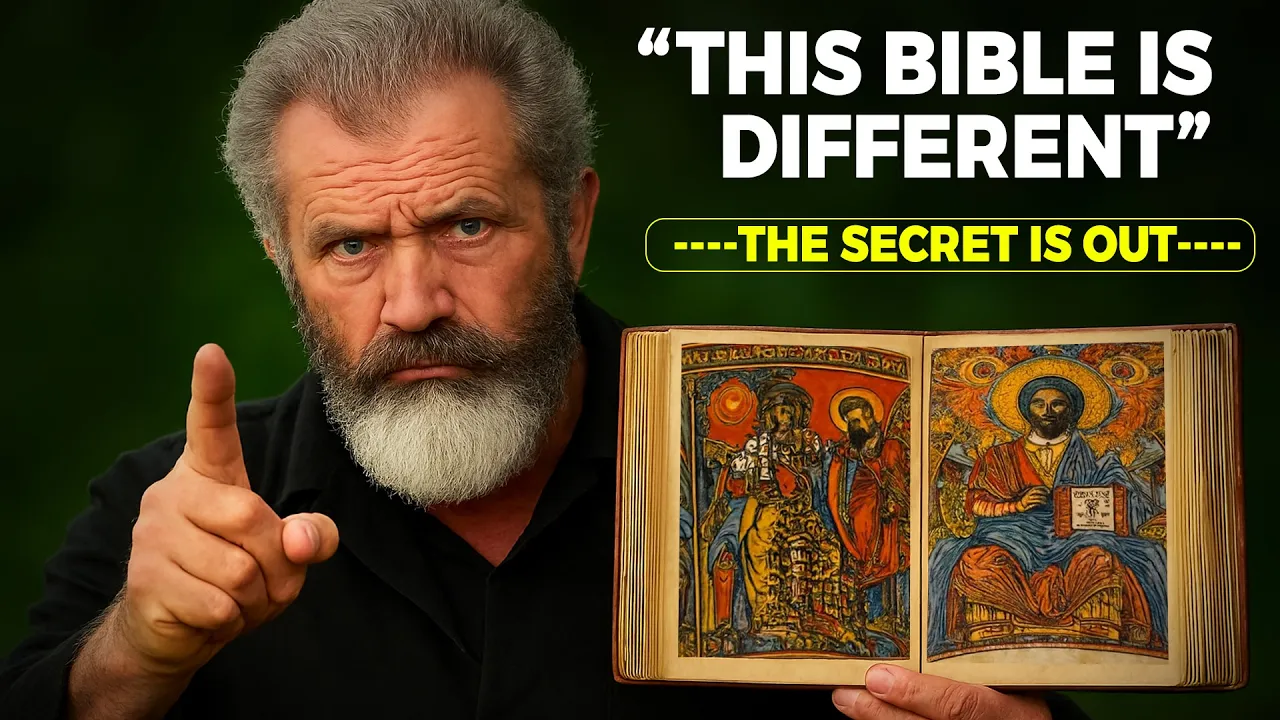
My contention is, you [music] know, when I was making it, it was like, you're making this film and the idea was [music] that we're all responsible for this, that his sacrifice was for all mankind. Does the Ethiopian Bible even [music] mention Jesus? They asked.
And the short answer to that question is yes. The Jesus, [music] you know, might not be the Jesus who actually existed. For centuries, Western Christianity has shown you a gentle, pale, serene [music] figure, a comforting presence shaped by art, imagination, and tradition.
But hidden in the mountains of Ethiopia, monks have guarded a radically different [music] vision for over 1700 years. A Jesus so powerful that angels fall silent in his presence. [music] A being of blazing light whose voice reverberates through dimensions.
Could the image you were taught be nothing more than a carefully crafted illusion? And if this cosmic Christ [music] truly existed, why was his story deliberately buried from the world? This isn't the figure painted in Renaissance masterpieces.
It's a vision described centuries before the book of Revelation. So extraordinary [music] that the institutional church went to extraordinary lengths to erase it. Today you're about to see why this forgotten Jesus was considered too dangerous to reveal and what it means for everything you thought you knew about Bethlehem, divinity [music] and faith itself.
The forgotten Bible and the radical Christ. The Ethiopian Bible is one of the world's most mysterious sacred texts. The Ethiopian Bible includes up to 81 books far exceeding the 66 [music] of the Protestant Bible or the 73 of the Catholic cannon.
>> Yet it remains largely unknown in the West. While the Protestant Bible [music] contains 66 books and the Catholic version 73, the Ethiopian Orthodox Teahedo Church preserves approximately 81. Some traditions counting as many as 88.
This includes 46 [music] Old Testament writings and 35 New Testament texts, many of which survive nowhere else on earth. The book of Enoch, Jubilees, the Ascension of Isaiah, Baroo, [music] and the Makabian texts exist in complete form only in Gaes, Ethiopia's ancient [music] sacred language. This detail is crucial.
Gaes predates Latin and Greek as a Christian literary vehicle. While Ethiopian monks copied these manuscripts in Highland monasteries during the fourth and fifth centuries, Europe was collapsing into chaos. [music] Rome fell, libraries burned, knowledge vanished.
Meanwhile, Ethiopian Christianity [music] preserved and expanded the textual tradition, creating illuminated manuscripts of extraordinary beauty. The Germa Gospels, [music] carbon dated to 330 to 650 AD, are among the oldest illustrated Christian books in existence, maintaining theological and literary richness long lost in Europe. The Ethiopian Bible is radical in content as well as size.
It presents a vision of Jesus far removed from the gentle, approachable figure familiar in Western [music] portrayals. In European art, Jesus appears soft-spoken, humble, and merciful, a comforting figure designed to soothe believers. [music] The Ethiopian texts present Christ as cosmic and overwhelming.
>> Ethiopian unic Philip teaches the unic, the meaning of the text from Isaiah, a text, >> a being of blazing light and divine fire whose authority makes angels bow in silent awe. He is both judge and savior, warrior and healer, light [music] that blinds and light that illuminates. His appearance is described with extraordinary specificity.
[music] Hair shining like strands of sunlit wool, eyes blazing like fire within crystal [music] and a face radiating brilliance beyond a thousand suns while simultaneously conveying infinite peace. His voice reverberates across [music] dimensions, shaking mountains, parting waters, and commanding obedience from angels and demons alike. Reality itself bends around him.
Time shifts, space [music] responds, and the fabric of existence resonates with his presence. These texts convey a paradox western tradition [music] softened. Christ enters human existence without losing the overwhelming brilliance of divinity.
Ethiopia preserved this vision unaltered by centuries of simplification or censorship. Within these manuscripts lies a prophecy so profound that it validates the New Testament even before it was written, offering a glimpse into a Christian tradition far richer, more intense, and more awe inspiring than most of the world has ever seen. The prophecy that predates [music] scripture.
The Ethiopian Orthodox Church predates the great ecumenical councils that standardized Western Christianity. >> The Ethiopian Orthodox Church claims to be among the earliest capitals of Christianity thanks to a mysterious figure of the Hebrew Bible. [music] Its roots stretch back to an era before doctrine was codified, before certain books were labeled forbidden, before powerful bishops decided [music] which texts believers could access.
According to tradition, Ethiopia converted to Christianity in the 4th century under King Azana of Axom, making it one of the oldest Christian nations on Earth. Older than most of Europe's Christianization, this ancient isolation created something remarkable. A living time capsule of early Christian belief preserved in mountain monasteries while empires rose and fell below.
When Islamic expansion swept across North Africa and the Middle East in the 7th century, Ethiopia became an island of Christianity surrounded by Muslim territories. This geographic isolation meant Ethiopian Christianity developed independently from the theological evolution happening in Rome, Constantinople and Jerusalem. They missed the councils.
[music] They missed the debates. They missed the book burnings and the theological purges. Among the preserved texts, the Book of Enoch stands as the most explosive discovery.
Written centuries before Christ's birth, possibly as early as 300 [music] B. CE. It repeatedly describes a coming figure called the Son of Man, the elect one, and the righteous judge.
The text depicts a heavenly tribunal surrounded by rivers of fire. It speaks of divine judgment with imagery so vivid that readers catch their breath. Angels [music] fall to their knees.
The wicked face eternal condemnation. A figure of blazing light passes judgment on all creation. The book of Enoch describes this coming figure in chapter 46.
And there I saw one who had a head of days, [music] and his head was white like wool, and with him was another being whose countenance had the appearance of a man, [music] and his face was full of graciousness like one of the holy angels. This description predates [music] the book of Revelation by centuries, yet the parallel is unmistakable. Revelation 11:14 describes Christ with nearly identical imagery.
His head and hair were white like wool, as white as snow, and his eyes were like blazing fire. Here's what makes this astonishing. These same images appear in the canonical book of revelation written centuries later by John of Patmos around 95 A.
The book of Enoch presents identical prophetic visions long before the New Testament existed. The parallels are too precise to dismiss as coincidence. Both texts describe feet like polished bronze refined in a furnace.
Both describe a voice like rushing waters or mighty thunder. Both describe a sword or word proceeding from his mouth. Both describe eyes of fire and a face radiating overwhelming light.
Scholars confirm that Enoch was widely read during the second temple period and is directly referenced in [music] the epistle of Jude verses 14 to 15. >> The reading is from St. Paul's first epistle to the Corinthians.
God has revealed us the apostles. Last of all, >> which quotes Enoch almost word for word. See, [music] the Lord is coming with thousands upon thousands of his holy ones to judge everyone and to convict all of them of all the ungodly acts they have committed in their ungodliness.
This isn't a casual illusion. Jude treats Enoch as authoritative scripture, [music] as a prophetic text worthy of citation alongside the Torah and prophets. Early Christians clearly knew and valued this text.
The church fathers including Tertullan and Irenaeus [music] quoted from Enoch and treated it as legitimate revelation. Yet by the 4th century, as councils began standardizing the biblical cannon, Enoch was quietly removed. The question that should trouble every believer is simple.
Why was it removed from most Bibles? The descriptions mirror Revelation's imagery with uncanny precision. Feet like polished bronze refined in a furnace, a voice like rushing waters, a sword [music] proceeding from his mouth.
The Ethiopian texts appear to validate New Testament prophecy centuries before it was written. This isn't speculation or interpretation. It's textual evidence that the earliest visions [music] of a cosmic Christ predate what Western Christianity considers the origin point.
If Enoch [music] described Christ accurately hundreds of years before his birth, then this cosmic figure of overwhelming power and divine radiance was always the plan. The gentle Jesus of Renaissance art is the revision. The blazing Christ of Enoch is the original vision, but the physical descriptions are only part of the revelation.
These ancient pages contain something even more dangerous to institutional authority. forgotten words of Jesus himself. Teachings so radical they redefine what it means to be human, what salvation actually requires, and where the divine truly resides.
The prophecy validated scripture. But what comes next challenges everything the church built on top of it. The lost teachings and divine consciousness within the Ethiopian Christian tradition.
Texts like the book of the covenant and ancient lurggical writings [music] preserve sayings of Christ unknown to the western world. These are not mere variations of familiar teachings. They present a radically different understanding of salvation.
One that places responsibility and power within each human being rather than external institutions. In one passage, Jesus declares, "You are not children of dust but children of light. " This statement overturns western assumptions.
[music] Traditional western Christianity emphasizes humanity's fallen nature, sinful, broken, and in need of divine intervention. Humans are dust, clay, base material requiring external salvation. The Ethiopian texts invert this view.
If humans are children of light, the divine is inherent, present within each soul. [music] Salvation is not a gift bestowed by priests or rituals, but an internal awakening to what already exists. This teaching recurs throughout Ethiopian scriptures.
[music] The kingdom of God is within you, says Christ, not metaphorically, but literally. Heaven is not a distant place visited after death. It is an inner reality accessible [music] through spiritual awakening.
The mission of Christ is not the establishment [music] of an institution but the cultivation of divine consciousness within individuals. The texts emphasize personal recognition and nurturing of inherent divinity over obedience to external authority. The Ethiopian writings also offer prophetic warnings about human distortion of divine truth.
One passage states, "In later times, people will fashion gods with their hands and worship the work of their imagination rather than the [music] spirit of truth. " History confirms this precious. European Renaissance artists transformed Christ's image [music] into culturally familiar forms, pale, delicate Europeanized figures.
Over generations, these representations replaced the radiant cosmic [music] Christ described in Ethiopian texts. Hair like sunlight struck wool, eyes of fire, and skin glowing with divine light. The texts caution that focusing on images rather than essence leads to idolatry of human imagination.
Ultimately, [music] these teachings reshape the understanding of salvation. When Jesus says, "You are the light of the world," he emphasizes that the divine is already present [music] within every person. Human souls carry fragments of eternal light, and awakening this inherent divinity is the true path to liberation.
Christ's incarnation, the texts [music] suggest, was not to provide what humanity lacked, but to reveal what already existed. a profound descent of the divine into the human realm, showing how to recognize and fully awaken the light within, the cosmic descent and the hidden God. Among Ethiopian biblical texts, the ascension of Isaiah stands as one of the most theologically radical documents preserved from early Christianity.
It is not a moral tale or simple prophecy, but a metaphysical account exploring Christ's true nature centuries before Western Christianity [music] formally defined doctrine before the councils of Nika 325 AD and Calcedon 451 AD debated his divinity and dual nature. The text appears to date from the late 1st or early 2nd century, contemporary with or even earlier than some New Testament writings. Yet, it contains concepts Western Christianity would articulate only centuries later.
The narrative takes the prophet Isaiah on a journey through seven heavenly realms, each layered with unique inhabitants, divine proximity, and dimensions of reality far beyond the simple three- tier cosmos familiar in most biblical texts. Isaiah begins in the physical world and ascends progressively. He witnesses celestial structures made of light and sound, gates of living flame, floors of crystallized starlight, [music] architecture that exists as energy rather than matter.
Angels radiate brilliance so intense that mortal eyes cannot endure them. Each order more magnificent than the last. In the first heaven, angels govern earthly affairs.
In the second, celestial bodies receive instruction. The third contains paradise and the tree of life. By the sixth, Isaiah falls prostrate before beings whose glory is only a reflection of one infinitely greater.
In the seventh heaven, where no created being can naturally survive, he sees the beloved one, a figure of radiant power preparing to descend into human existence. Here Christ exists as pure light, [music] the source of all creation, a presence so overwhelming even angels struggle to behold him. The text describes his descent with striking precision.
[music] Christ does not simply move downward. He progressively limits his own divinity to interact with creation. In each heavenly realm, he dims his glory so that beings there can perceive him.
in the sixth heaven as a sixth level angel in the fifth [music] as a fifth level one and so on. By the time he appears in Bethlehem as a human infant, [music] even angels in lower realms perceive only a baby unaware of the cosmic being within. Only God the Father and the Spirit [music] fully recognize him.
This portrayal reframes the incarnation. [music] Christ is simultaneously infinite and infant, omnipotent and vulnerable, eternal and dying. Every human experience, [music] hunger, pain, death, is voluntarily assumed to awaken those trapped in darkness and reveal the kingdom within.
The crucifixion is not only a human tragedy, but a cosmic event. The source of life itself experiences [music] death, momentarily altering the fabric of reality. The ascension of Isaiah preserves a vision of salvation that is internal rather than external.
Humanity is not fallen clay in need of external rescue, but divine children who have forgotten their origin. Christ [music] descends to awaken the light within, showing that spirit and matter are not opposed but united, [music] and that every human being carries the potential to bridge heaven and earth. This luminous theology predates centuries [music] of western debates about divinity and incarnation, raising an enduring question.
If these texts contain such profound truths, why were they excluded from the western cannon? The buried truth and the monks who saved it. The exclusion was no accident.
Early church councils in the west sought to establish a standardized cannon that could unify scattered Christian communities and assert centralized authority. The Roman Empire had adopted Christianity in the 4th century under Emperor Constantine and with imperial power came imperial organization. What had been a decentralized diverse movement of house churches and independent communities needed to become a unified institution [music] capable of supporting imperial goals.
Diverse beliefs needed standardization. [music] Independent thinkers needed correction. Texts that emphasized personal encounters with the divine posed a serious problem for this agenda.
The ascension of Isaiah suggested anyone could receive divine visions without priestly mediation. The book of Enoch claimed revelations came directly from heavenly journeys rather than through authorized channels. Ethiopian teachings about inner divine light implied salvation didn't require institutional sacraments.
Writings suggesting each individual could experience [music] God directly without priestly mediation threatened the emerging institutional hierarchy. If the divine spark already existed within each person, why would anyone need a priest [music] to access it? Why attend church when the kingdom of heaven is within you?
Why confess to a cleric when you can commune directly with the divine? Why pay for indulgences when salvation means awakening rather than earning? If salvation meant awakening rather than obedience, what power would the church hold?
The entire structure of ecclesiastical authority rested on the premise that clergy served as necessary intermediaries between God and humanity. Priests administered sacraments required for salvation. Bishops interpreted scripture that common people couldn't read.
The pope held keys to heaven itself. Remove the need for intermediaries and the entire power structure collapses. [music] These weren't merely theological questions.
They were questions of authority, control, and the flow of wealth. The medieval church became one of the wealthiest institutions in Europe precisely because it controlled access to salvation. A medieval church has been lifted 14 m to make space for an office built in the city of London.
The 700year-old tower of all hallows staining has been [music] raised on temporary support so construction can continue beneath it. Tithes, indulgences, fees for baptisms and weddings and funerals, donations to ensure masses would be said for the dead. All of this depended on [music] people believing they needed the church to reach God.
The book of Enoch was rejected at the council of Leodosa in 363 [music] AD. The ascension of Isaiah was labeled apocryphal and removed from circulation. Texts speaking of inner divine sparks and personal awakening were gradually removed from official lists, their copies burned or hidden, their authors condemned as heretics.
The message was clear. Salvation [music] would flow through authorized channels and those channels led to Rome. The councils had practical reasons too.
Christianity was becoming the religion of an empire that needed unity and [music] obedience. Texts encouraging individual spiritual experience over institutional authority were politically dangerous. They empowered people to question not just religious authorities, but potentially secular [music] ones.
If you don't need a priest to reach God, maybe you don't need a king to have justice. If salvation comes from within, maybe political liberation does, too. But thousands of miles away, Ethiopian monks made a different choice.
Hidden in highland monasteries [music] accessible only by rope and cliff face, separated from Mediterranean politics by desert mountains [music] and eventually Islamic territories. These devoted scholars preserved the original texts. They didn't participate in the councils.
They didn't receive the decrees. They [music] simply continued copying the scriptures they'd always used generation after generation. They copied each manuscript by hand, letter by letter, understanding that these works contained insights too precious to lose.
The process [music] took months per manuscript. Monks sat in scriptorums lit by oil lamps, carefully forming each character of Gaes script, mixing their own inks from minerals and plants, preparing parchment from animal skins. It was tedious, painful work that destroyed eyesight and bent spines.
But they did it joyfully, [music] believing they were preserving divine revelation. The cosmic Christ, the prophecies of Enoch, the radical teachings about divine light within humanity, all survived intact, while the rest of Christianity forgot they ever existed. When Islamic expansion cut Ethiopia off from the Christian Mediterranean world, this isolation became providence.
What seemed like geographical disadvantage became theological protection. Nobody [music] came to tell them which books to remove. Nobody arrived to correct their canon.
They kept copying what they'd always copied. Ethiopian tradition became a living repository of ancient Christian thought, [music] untouched by Western theological politics. Their dedication ensured that what powerful councils [music] sought to bury remained accessible to those willing to seek it.
For over 15 centuries, while Western Christianity evolved, argued, split into Catholic and Protestant, fought religious wars, and launched reformations, Ethiopian Christianity remained remarkably stable, maintaining traditions from Christianity's earliest centuries. In Ethiopian churches today, [music] this preservation lives in art and liturgy. >> In Libella, the faith is as strong as it was more than 900 years ago when these churches were carved out of solid rock.
But the buildings are weakening. Christ appears as Exabar, Lord of the universe, [music] both majestic and tender. He embodies fire and light, power and sweetness simultaneously.
Icons show him with dark skin and large penetrating eyes, often surrounded by rays of golden light. He's simultaneously human and cosmic, approachable and awesome. This duality contrasts sharply with the simplified western image of an approachable domesticated savior.
Western Jesus offers comfort first, challenge [music] second. Ethiopian Jesus demands awe before he offers comfort. You must first recognize who stands before you.
The word through which galaxies were spoken into being before you can approach him as friend and savior. Modern scholars working with Ethiopian institutions have begun digitizing ancient Gaes manuscripts and what they're finding defies expectation. [music] Some fragments appear to predate the canonical gospels by generations.
While most scholars date the Gospel of Mark to around 70 AD, some Ethiopian fragments [music] contain gospel material that may be significantly earlier, preserved in oral tradition, and then written down before the texts we consider original. In these manuscripts, Christ's miracles aren't described merely as acts of compassion. They're portrayed as restorations of cosmic balance.
When he calms the storm, it's not just weather control. [music] It's the wind recognizing its creator and falling silent. When he walks on water, it's not violating [music] physics.
It's water remembering who spoke it into existence and bearing him up in reverence. [music] When he heals the sick, he's not just curing symptoms. He's restoring corrupted matter to its original divine blueprint.
[music] Christ is called the living word, the vibration through which reality exists. This concept predates quantum physics by nearly two millennia. [music] Yet, it sounds remarkably similar to modern theories about reality as frequency and vibration.
Light, sound, matter, and life itself flow through him, sustained by his presence moment to moment. If he withdrew his word, creation would simply cease to be, collapsing back into the void from which he called it forth. The texts seem to anticipate insights modern physics wouldn't reach for centuries.
They describe reality as sustained by consciousness [music] rather than existing independently. They suggest matter and spirit are not separate substances [music] but different manifestations of the same divine energy. They present Christ not as a visitor to creation but as the ongoing principle that allows creation to continue existing.
For 1700 years, a hidden vision of Christ has waited in the mountains of Ethiopia, [music] powerful, radiant, and almost unimaginable. And yet, the world never saw it because some truths were considered too dangerous to reveal. If one version of history can be buried so thoroughly, how many more remain hidden, waiting for someone to uncover them?
What else might lie in forgotten texts, in lost traditions, [music] in the spaces between what we're told and what actually is? The story isn't over. [music] It's only just beginning.
And the next revelation could change everything you thought you knew about faith, [music] power, and the mysteries of the divine.