In the last part of this hijacker series, part four, we dealt with the beginning of how the Protestant Reformation began. We have been going through this history because it is important to understand how the faith that so many hold in Christianity today came to be. You see, there are many who claim Christianity today; there are many who go to Protestant churches and believe they are following the faith that will lead them to our Father and redemption.
But sadly, what many do not know, or are unaware of, is that there has been an infiltration, a hijacking. The faith that many uphold and follow today are just revisions of the foundation that Rome laid more than 1,500 years ago when they adopted Christianity as their religion. There have been many adaptations to the faith that have come about because of the changes that happened during the Renaissance and the Protestant Reformation.
Today, there are many different Christian denominations, and all of them claim to be in the truth. But the problem that people have is knowing which one is actually in the truth. Which church should they be a part of?
Which one do they follow? The direct answer to that question is none of them; none of these denominations. And while I've been alluding to this for many years, I have not gone through enough of the history that could really break it down and prove it.
If you are preparing for our Father's Kingdom, it is important that you follow a truly biblical faith, one that understands Yah and the covenant that He has made with Israel, one that understands the gift of grace that He provided the world through Yahusha, and one that is all about His truths and living in repentance for our rebellion and the rebellion of the generations past. Too many people are following religion, believing in the God that they would like to know, rather than the one that they truly have. In the times that we're in, as we are truly preparing for our Father's Kingdom and waiting for Him to fulfill the promises He has made us, it is important that we live in the truth.
The Protestant Reformation is a major topic that we have all been influenced by, but most of us are truly unaware of how. We just know that we are Protestants because of Martin Luther. So now that we are going over the history of this movement, understanding from part three that the foundation Martin Luther came from was the foundation that Rome established and laid, we can see how far the Roman Church went with the creation of this Christian faith—right up to selling people indulgences that they could purchase and redeem themselves.
In part four, we discussed how and why the Protestant Reformation began, which was not just because of a complete break from this false Roman system, but because of the disagreement with Rome in regards to indulgences. Martin Luther was seeking debate; he was not fully breaking away from Rome in the beginning; he was just stating his objections. From this series, you should be able to see that the foundation that Martin Luther came from is a false foundation from Rome, and instead of removing all influence and mindsets that came from this false foundation, he chose particular ones and debated them.
Because he got attention, it started a movement. The movement was not about putting the Most High Yahweh as our priority; the movement was that people could now disagree with the Church of Rome. This is the main change that the Protestant Reformation brought forward, and so this is what we have seen as we've gone through this history.
But we still have not gotten to the main events that brought the most attention to this Reformation period. I recognize it's easy for someone to have their basis of disagreement because while they see about Luther and his foundation and they see how the Reformation started, it still does not mean in the end that Martin Luther came to a full understanding based in truth, which is how we all got to where we are today. I do understand that because this has not been fully dealt with yet, there is still room for skepticism and doubt.
So what needs to be done is a clear breakdown of the major moments of the Protestant Reformation. We need to discuss the main history of the Protestant Reformation that changed the world. This video will deal with the most important part of the history of the Protestant Reformation and how the Reformation truly changed the world.
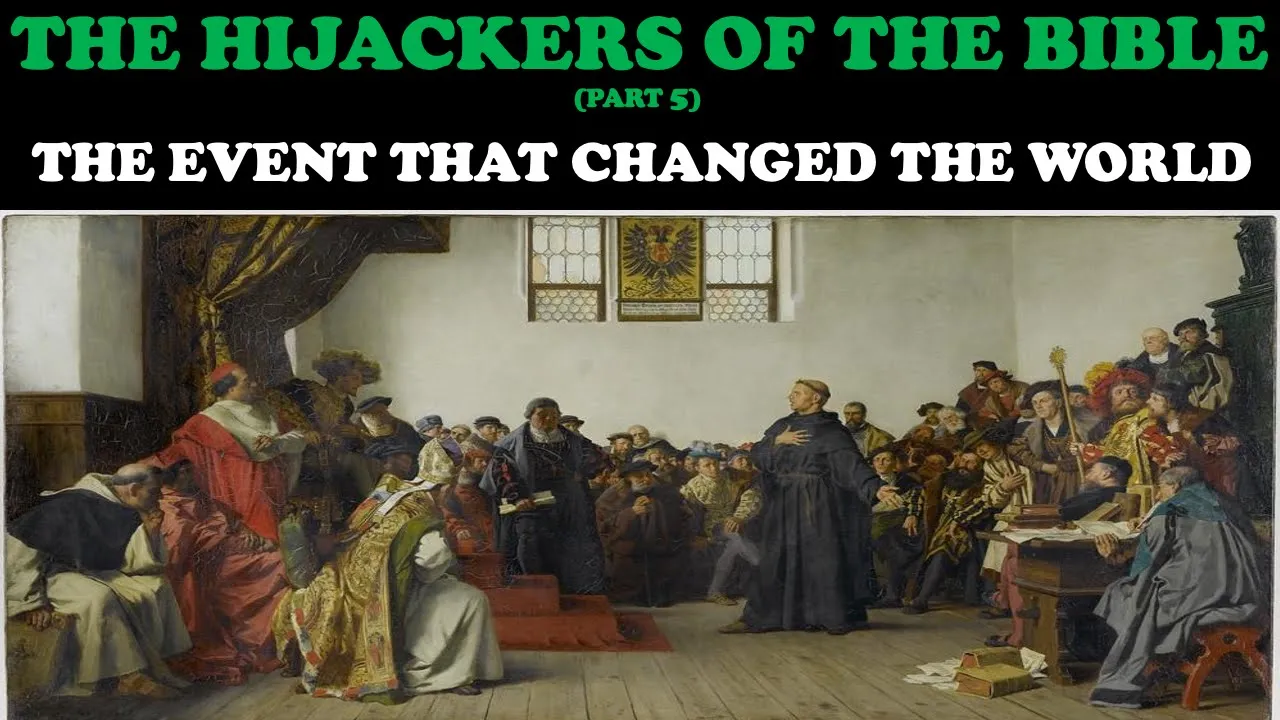
So in this part of the series, we will now discuss when Luther was put in front of the emperor of the Holy Roman Empire, as well as a representative of the Pope, where he made the most famous line of the Protestant Reformation. As we go over this information, by the end of this video, it should be made much more clear that this movement was another agenda where we saw Satan hiding, hijacking the authority of our faith, and planting more tears. This history is the reason why there is so much division and confusion within the body of Messiah today, but once this knowledge and understanding take hold, we can now be set free, and we will no longer be led by lies and falsehoods any longer.
So in this part, we will now discuss the most important moment of the Protestant Reformation that truly changed the world. Let's begin. Okay, so we ended part four with the backlash that Luther received after he posted his 95 theses on October 31, 1517.
He posted his theses in regard to the indulgences being sold by the church, and his disagreement made it all the way to Rome, where Sylvester Masolini, also known as Prius, concluded that whoever says that. . .
The Church of Rome may not do what it is actually doing in the matter of indulgences; a heretic, and so Luther would now have to travel to Rome and face the Inquisition. After this, for the next three or four years, we will see that Luther never actually made it to Rome, and there were formal meetings and debates in regard to Luther. For time's sake, I will not go into all the details because the information is inconsequential.
What should be noted is that Luther was getting attention, and he was debating the matter while also petitioning Rome to have his case dealt with in Germany instead of him having to go to Rome. Over the years, he wrote many different pieces and had many different debates. This is why I said he’s one of the most documented people in history.
One of his most important debates happened in Leipzig, Germany, in 1519. The purpose of this debate was to discuss Martin Luther's teachings and was initiated and conducted in the presence of Duke George of Saxony, who was an opponent of Luther. This debate was significant because, in this debate, Luther took a new and shocking theological position that would be the main basis for the Protestant movement going forward.
It seems to be a given today, but that's only because of the Protestant information. Luther came out decisively for the idea that the Bible must supersede the Church. This doctrine came to be known as Sola Scriptura.
Sola Scriptura simply means that all truth necessary for our salvation and spiritual life is taught either explicitly or implicitly in Scripture. He also challenged and contested the doctrine of purgatory, asking where in the Bible it could be found. He challenged the idea that the Pope could put himself in the place of Christ.
Luther saw that no one could stand as the true head of the Church but Christ, and this is what caused Luther to begin calling the Pope Antichrist, because to stand where only Christ could stand was to be Antichrist. He accustomed himself to seeing the papacy in this way and became less and less shy about saying so. You see, at this time, these were dangerous and provocative stances that no one had any idea he would take, but he was taking them.
These major ideas were the major breaking points in how the Protestant Church began. It started from indulgences, yes, but as Luther continued to speak and debate, his argument began to grow, and new revelations began to come to light. I don't doubt these kinds of revelations because I have experienced them as well.
The more you speak on a subject, trying to prove a point while there are lies mixed in, the other points lead you to new revelations, and you start growing in more convictions. So I can understand how this idea began to grow. Like I said in part four, these revelations you are hearing about should not be a surprise to you, nor should you agree with them.
These are the reasons why you are Protestant and not Roman Catholic. I mean, I do not disagree with any of these revelations, but I must be clear that just because I agree with these points does not validate the whole movement. While Luther was calling out falsehoods, he never actually got to the point of understanding that his whole foundation was off because of the replacement theology that started from Rome.
Please understand that as you hear about his challenges to Rome, he never got to the heart of the matter and understood who Yahweh is in covenant with and how we must come back to Him. While he declared Sola Scriptura, he never applied it enough in full to make the movement be based in truth. For many of you, this should be understood because you are not Lutheran; if he were in full truth, you would be a Lutheran and not a Baptist or a Seventh-Day Adventist.
We will deal with all of these differences later, but it's clear that most of you watching are not Lutherans. There is a reason why that is so. Anyways, Luther began to grow his arguments against Roman Catholic Church doctrines in 1519.
He advocated that the Church should allow the ordinary people—not just the clergy of the Church, but ordinary people too—to take both the bread and the wine at Communion. Luther was establishing the idea that everyone who has faith in Christ is equal and that the Church's position, that priests are somehow different from the people in the pews, is wrong. Because of this, he was known to the ordinary people in the pews—these people, also known as laymen or laypeople.
Through Luther, they believed that they now had a voice, and this was one of the main ways the Reformation spread from parish to parish, as more and more believers demanded that they too receive the wine along with the host. Luther was really beginning to feel that somehow he had been liberated to say whatever he must. He found himself rapidly and dramatically rethinking everything and saying so in his writings.
Before Leipzig, he was a little tame and timid, but after Leipzig, he became more wild and aggressive, attacking everything that he felt needed to be attacked while seeming to have no patience or care for considering how it might actually come across. In one of his writings, he wrote, “The time for silence is over; the time to speak has come. ” There were reasons for his newfound aggression.
One of the reasons was, in 1520, when he found out that the famous Donation of Constantine was a forgery. You see, the Donation of Constantine was a document purported. .
. To have been written by Emperor Constantine early in the 4th century, this is when Constantine established Christianity as the religion of Rome. This document gave all authority over Western Europe to the pope, and the Roman Church used it for centuries to underscore the inviolability, meaning the fact of being safe or protected from attack or interference.
They used this document to underscore the fact that you cannot attack the Pope's authority. When Luther saw that it was now proven to be a forgery, he became emboldened because he realized that the Church had used a lie to silence his critics for centuries. He felt betrayed, and it made him wonder what else was a lie.
Shortly after this, Pope Pius published a new document proclaiming the same argument for the unquestioned authority of the Pope. In the document, Pius did not use any Scripture or reasoning; the Pope's authority trumped everything and went so far as to say that the Pope could not err, which meant to be a mistake. The Pope could not be a mistake, even if he were to cause so much offense as to lead multitudes to hell.
Basically, he said that the Pope could never be questioned. Luther now felt that he was dealing directly with the powers of Hell, which he obviously was. He now believed what he had ultimately feared: that the Church had, in his own generation, been overtaken by the forces of the Antichrist.
To this day, there are people who claim that the papacy is the Antichrist, the Beast of Revelation, and it should be understood that this is not original thought; it is rooted in Martin Luther and has over time grown because of more examples of hypocrisy. Of course, the Roman papal system and the Church are false, but if you believe that the Pope is the Antichrist, it's because in some way you have been influenced by Martin Luther. Just know that most of you focus on Rome while you're under the authority of England; it makes no sense.
However, I don't want to lose my point here. Luther began writing more and more and was openly declaring that the Roman Church's monopoly on the spiritual must come to an end. He argued that God had never separated priests from laymen, which again shows his lack of care and understanding of how Israel and the Levitical priesthood were put in place.
Anyway, the whole idea of Jesus coming to Earth was to forever smash these distinctions, to open the gates of Heaven to all who had faith, and to call everyone to be a royal priesthood. He began to appeal to the various rulers throughout Germany, telling them that they could and should throw off their shackles from Rome and be free. In 1520, Luther wrote a letter to Pope Leo X, the Medici Pope: "The Church of Rome, formerly the most holy of all churches, has become the most lawless den of thieves, the most shameless of brothels, the very kingdom of sin, death, and hell, so that not even the Antichrist, if he were to come, could devise any addition to its wickedness.
Let not those men deceive you, as they pretend that you are lord of the world who will not allow anyone to be a Christian without your authority, who babble of your having power over Heaven, hell, and purgatory. They that call thee blessed are themselves deceiving thee; they cause thee to err and destroy the way of thy path. I have truly despised your sea; the Roman Curia, neither you nor anyone else can deny that it is more corrupt than any Babylon or Sodom ever was.
As far as I can see, it is marked by a completely depraved, hopeless, and notorious godlessness. " He wrote that to the Pope. He also wrote his second treatise called "The Babylonian Captivity of the Church" and in it put forth two propositions of Christian liberty: the first, a Christian is perfectly free, lord of all, subject to none; the second, a Christian is a perfectly dutiful servant of all, subject to all.
In this work, he spelled out his doctrine of sola fide, faith alone, which boldly declared that it is faith in Jesus that brings us salvation and not our own moral efforts. Jesus did all that was necessary to bring us to Heaven by his death on the cross, and we need only to trust in him. To try to add to what Jesus did with any works of our own is absurd, offensive to God, and heretical.
Now, let me stop here and make this clear, because it should be noted that this argument was really in reference to the practices that Rome put forth through the selling of indulgences. Understand this: there was no point at this time where people were advocating keeping the commandments. This was not a discussion at that period in time.
But this doctrine of Luther is one of the main premises and foundations of the lawless Protestant Christian Church that advocates not keeping our Father's commandments that he etched in stone when taking Israel in covenant with him. The premises Luther put forth in sola fide is the basis of Christian doctrine within the Protestant Christian Church, and it is important that if you know this doctrine, you should understand how it actually came to be and what he was actually referencing. Today, it's used against keeping the commandments, but when it was created, it was based on a mindset that was against the Church selling people tickets to Heaven.
You need to understand where these things come from, but the point should be clearly seen: Luther was clapping back, and he was digging into the Church. Done. Before now, it just so happens that this happens under the first Medici pope.
But okay, I don't have enough evidence to show my conspiracy theory, so I don't use it. I'm just giving you the facts. In 1520, Rome decided to respond to Luther, and on June 15th, 1520, Pope Leo issued a papal bull against Luther.
A papal bull is a type of public decree or charter issued by the pope. This bull condemned Luther; it was published on June 24th and was posted at St. Peter's in Rome.
Wherever the bull was posted, the works of Luther were to be burned. On December 10th, Luther held an event in which he sent invitations to several hundred fellow professors and students who had assembled. It was at this time that Luther cast the papal bull into the flames.
One after the other, papal decrees were now defiantly hurled into the fire. The Protestants were beginning to rebel. So, on January 3rd of 1521, Pope Leo issued a new papal bull, which carried out the threat of the previous bull and excommunicated Martin Luther.
But it also went far beyond just condemning Luther; it was a legal notice to all in the Empire that whoever, in any way, aided or abetted this outlaw would also be excommunicated. It also declared that all territories or cities that supported Luther were officially under interdict, meaning that they were also excommunicated from the church. They were forbidden to offer any of the seven sacraments of the church.
This was the ultimate weapon of Rome; by denying the sacraments of the church, it was literally saying that they were denying salvation itself. Pope Leo was coming back hard, but this did not have the effect Rome expected. Once the bull was published, many Germans took it as an invitation to follow Luther's example.
From a month earlier, they staged book burnings of their own, boisterously casting their copies of the bull and many other hated writings right into the flames. They rebelled even more, and then Luther wrote a response: "Farewell, thou unhappy lost blaspheming Rome! The wrath of God has come upon thee as thou hast deserved.
We have cared for Babylon, but she is not healed. Let us then leave her, that she may be the habitation of dragons, specters, and witches, and true to her name of Babel, in everlasting confusion—a new pantheon of wickedness. " So, the pope knew that his power was on the decline, and he needed to show up support with the emperor.
Because if Emperor Charles I of the Holy Roman Empire did not enforce the bull on Luther, it would mean little. Now, because of Luther's popularity in Germany, the emperor responded to the pope. Yes, but he knew that he had to walk a political tightrope.
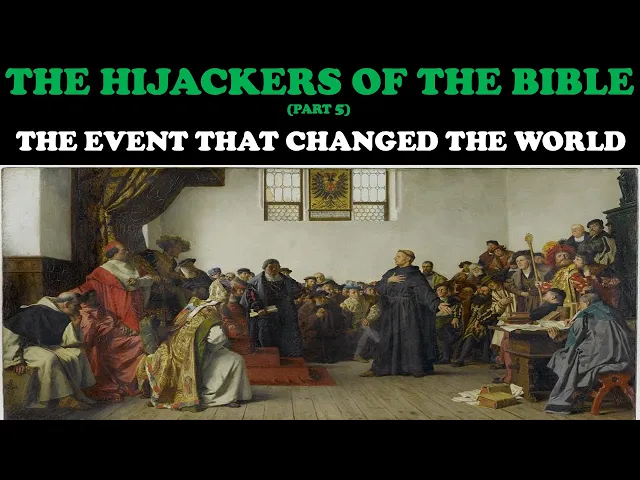
His solution was not to have Luther come to Rome, but to invite Luther to appear before the next Imperial Diet, which would take place in the central city of Worms, and Luther gladly accepted the invitation. To be clear, an Imperial Diet has nothing to do with food; a diet refers to the council or assembly of nobles gathered at the behest of the emperor. So, in April, Luther made his way to Worms.
Along the way, he was greeted by masses of admirers. His writings and teachings had spread; as I said before, it was due to the power of the printing press. Luther was now a celebrity, and people wanted to see the man who was defying the pope in Rome and would now stand before the emperor.
He had been looked at as a champion of the people, someone who seemed to speak for them against oppressive power. Many were sure that he was going to his death, and they told him when he arrived in Worms. He received a tremendous reception.
He was now going to stand before the emperor of the Holy Roman Empire, Charles I, grandson of Ferdinand and Isabella of Spain—the same ones who, only a few decades before, brought forth the Spanish Inquisition and harshly persecuted the true Yahudim in Spain, which forced them out. Luther came to stand before Emperor Charles, and in front of him was a table piled high with Luther's own books—about 40 in all. They were especially bound for the occasion.
The emperor had summoned Luther there to answer two questions. The first question was whether all these books bearing his name had indeed been written by him. The second was whether he wished to recant anything from them.
That was all. Johannes von der Ecken was the emperor's spokesman who asked these questions, and he made it clear that they wanted only simple yes or no answers. They would not be drawn into a debate.
So, Luther said, "This touches God and His word; this affects the salvation of souls. Of this, Christ said, 'He who denies me before men, him I will deny before my Father. ' To say too little or too much would be dangerous.
I beg you, give me time to think it over. " He said that he wanted to answer satisfactorily and in a way that did no violence to the Divine word and endangered his own soul. This was not the answer anyone expected.
Vonder Ecken conferred with the Diet and the emperor. He responded, "You do not deserve to be granted a longer time for consideration; yet, out of innate clemency, His Imperial Majesty grants one day for your deliberation, so that you may furnish an answer openly tomorrow at this hour, on this condition that you do not present your opinion in writing, but declare it by word of mouth. " So, they sent Luther from the chamber back to his quarters.
Many nobles visited Luther to encourage him, not to fear for his life, that all would be well. Luther declared that he would not recant anything of which he stood accused. He wrote the next day, Luther stood before them.
Vander Ekin asked the previous day's second question a second time: did Luther stand by all these many books, or was there something in them he wished to retract? Luther was now prepared. He began by saying that to answer the question of whether he would retract anything from these books, he must first point out that the books themselves fell into three categories.
First, there were those works in which he dealt with the Christian faith in a very straightforward manner and which even his critics acknowledged were good and useful in instructing the faithful. He said even the papal bull itself, which had so roundly and harshly condemned him, had admitted this. He very cleverly began by establishing that he was not merely some troublemaker, but that everyone had agreed he had written many approved instructions on important matters.
Then he said the second category of books invected against the desolation of the Christian world by the evil lives and the teaching of the Papists. Who could deny this? When the universal complaints testify that by the laws of the popes, the consciences of men are wrecked.
You see, what he was doing here was playing to the audience of the German nobles who were in attendance, most of whom passionately agreed that Rome had abused them in all manner of ways. You see, Luther said, property and possessions, especially in this illustrious nation of Germany, have been devoured by an unbelievable tyranny. Even my enemy, Duke George, would have agreed on this score.
He went on to say that should he recant at this point, he would open the door to more tyranny and impiety, and it would be all the worse. Would it appear that he had done so at the insistence of the Holy Roman Empire? Then he said there was a third category of books.
This third class, he said, contains attacks on private individuals. "I confess I have been more caustic than comport with my profession, but I am being judged not on my life, but for the teaching of Christ, and I cannot renounce these works either without increasing tyranny and impiety. " He said a lot more; he compared himself to Christ appearing before the Sanhedrin.
Vander Ekin was not impressed by what Luther had said and replied sternly, "You do nothing but renew the errors of Wycliffe and Hus. How will the Jews, how will the Turks exalt to hear Christians discussing whether they have been wrong all these years? You have no right to call into question the most holy Orthodox faith instituted by Christ, the perfect lawgiver, proclaimed throughout the world by the apostles, sealed by the red blood of the martyrs, confirmed by the sacred councils, defined by the Church, in which all our fathers believed until death and gave to us an inheritance, and which now we are bidden by the pope and the emperor to discuss, lest there be no end of debate.
I ask you, Martin, answer candidly and without horns: do you or do you not repudiate your books and the errors which they contain? " And from this, Martin Luther spoke the words for which he had become famous since then. "Your serene majesties and your lordship seek a simple answer.
I will give it in this manner: plain and unvarnished. Unless I am convinced by the testimony of the Scriptures or clear reason, for I do not trust in the pope or in the councils alone, since it is well known that they often err and contradict themselves. I am bound to the Scriptures I have quoted, and my conscience is captive to the word of God.
I cannot and I will not retract anything, since it is neither safe nor right to go against conscience. " And these are the famous words: "I cannot do otherwise. Here I stand.
God help me. Amen. " It's often quoted: "Here I stand, I can do no other.
" And this is how historians like to document the end of this scene, but in fact, Vander Ekin told Luther that his remarks had not answered the question sufficiently, and Luther was then escorted out of the chamber. This was the most famous moment of the Protestant Reformation. It was at this point that historians declared it one of the most significant moments in history.
This point right here ranks with the 1215 signing of the Magna Carta and the 1492 landing of Columbus in the New World. It is said that the modern world was born because of this moment. There could be no question that what happened that day unequivocally led to all manner of things in the future, among them, 254 years later, the American Revolution.
It is said that this moment right here was said to have changed history. So, what exactly changed? You see, once the interpretation of the Scriptures and the concept of truth was taken away from the church itself, it was given to each individual, and real and objective truth itself was effectively abolished.
There was no more truth. Once the authority of the church was broken up, there was now the opportunity to disagree with the church; anyone might disagree with any authority. From this, a thousand churches might spring up, each with its own version of the truth.
And guess what? This is precisely what happened. You see, before the Reformation, the Catholic Church reserved the right to say that it and it alone spoke for God.
Whereas after this event, because of Luther pointing out that the pope had been mistaken and that the church councils had also made mistakes, he was saying that the church could not reserve the right to only speak for God. Therefore, if the church, via the pope and councils, were able to make mistakes and sometimes not speak. .
. For God and God's truth, Luther asserted the idea that only the scriptures could be that inherent standard to which everyone, including The Church, must adhere. So, if the scriptures plainly said something different from what the councils and the pope said, it must be the councils and the popes who were in error and were obliged to change their views.
There was no other way around this. Luther appealed to the idea that anyone could understand what the scripture said if one only dared to look at it. He knew that if he could force them to merely look at it to try to show him his error, they would see that, in fact, it was them who had been in error.
This is what the Protestant Reformation was all about. The change was about showing that the pope and his councils of leadership could be in error and, therefore, they did not always speak for God. This idea changed the world.
Now, we'll stop here at this moment, and in the next part, we will conclude with what happened after this Diet and what happened with Luther in the end. I do not want to lose you, and I do not want this important understanding that I'm about to explain to get past any of you. It is crucial that you understand what changed from this point on.
Let's put it this way: I have long established in this Hijacker series that the Roman Catholic Church is the tares that were planted by Satan; they are weeds that were growing along with the wheat. Because of the Protestant Reformation, some of the tares left the field Rome was planting, and they spread out in their own field, spreading more of this tainted tare seed. The Protestant Reformation now made the Christian Church like the Wild West.
Based on Luther, anyone could read the Bible and disagree with the doctrine or point, and now, because of this difference, they could start their own church. I illustrated this in part four, and I will illustrate it again. The Protestant Reformation didn't just end with Luther's view being the standard.
Once someone disagreed with some of Luther's theology, this person would then form a new denomination. If another didn't agree with another part, they formed another denomination. You will see that this is how the world of Christianity we are in today was formed.
Luther was just the spark of it. The Protestant Reformation was just the next evolution of the Christian world where people debated more about scripture than actually following our Father and making His kingdom the priority. We have all these denominations in the world today and all these Christian groups, and it just seems that this has been the way things have been forever.
We have rarely been told the story of why and how Christianity is so divided. The Protestant Reformation was not just a split from Rome; it was a split from all authority. Anyone who had a voice and a compelling argument was now able to make their own Christian group, their own Christian church.
You will see that this is exactly what happened, and what came from this was just confusion. Later on, you will see that as we get to England and their Reformation, this Empire that was so steeped in Freemasonry began creating their own church doctrines and their own church denominations that most of us in this Western world are influenced by. After the Protestant Reformation, Freemasonry later sprang up about two centuries after, and by this time, we have many different branches of Christianity, some of which were actually started by Masons.
Martin Luther was just the beginning of it all. The whole thing to understand is that the foundation of all this was always off. Luther argued that the scriptures should be the final say, and it’s of course not that I disagree with this point because I do believe that this is true.
The scriptures are how we know what it is our Father has declared and what He desires and has promised. However, depending on how you were taught to read the scriptures, it can lead you to a new faith than what the scriptures actually present. If we are told to read primarily the New Testament first, and then we build our faith from that, your foundation is off.
If we are taught to reject and ignore the Tanakh, your foundation is off. If we are taught that the church replaced Israel, your foundation is off. And what's worse is that because of this humanist movement and people now basing their life off of what makes them more happy and fulfilled, all these false foundations become the standard of the Protestant Christian church.
Here’s the scariest point: let’s say that you are now actually in the truth, and you have decided to go back to Yah's authority. Because of this movement, you are just classified as another denomination. The truth now became subjective to how one feels and what one has read.
The attitude should actually be that we all go back to the beginning of the Bible and read it straight through, letting Yah's word form our theology. But because of the Protestant movement, many different doctrines and theologies sprouted up due to the compelling arguments of other individuals. What you are understanding now is that the Protestant Reformation was not about putting the Most High as our priority.
The Protestant Reformation movement was actually about the fact that people could now disagree with the Church of Rome, and now regular men could be in charge of establishing the truth. The truth became subjective; it was what you wanted to believe in, and therefore there was no more absolute truth because the truth was now able to be debated. Now have millions of people around the world declaring the truth of the Bible, creating more division and confusion surrounding our Father's Kingdom, all while ignoring the fact that they are not even in covenant with Yah.
Those who come to Yahweh through Yahusha are actually grafted into Israel and are heirs to the promise through Abraham. However, they cannot just make up their own faith and decide how they want to apply it from this point on. In the Protestant Reformation, Christianity became more lawless and more defensive about being lawless.
Everyone was able to make their own doctrines and uphold their own traditions, which is why we can even debate today about pagan holidays and whether we can celebrate them or not. It's because the truth became subjective and dependent on one's own denomination. Basically, the main feeling is that if you choose not to do it, then that's fine, but your Christian doctrine doesn't have the right to judge mine.
It's about arguments and debates, and not at all about our Father's will. So just because someone loves Christmas at this time of year, and enjoys the gifts and the atmosphere, they feel justified in placing that above our Father's command to not worship Him as the pagans worship their gods. They feel justified because the Protestant movement created subjective truth about how we can worship our Father.
The saddest part of it all is that everyone who follows this kind of doctrine is being led straight to hell. It is prophesied that in the last days perilous times will come; for men will be lovers of themselves, lovers of money, boasters, proud, blasphemers, disobedient to parents, unthankful, unholy, unloving, unforgiving, slanderers, without self-control, brutal, despisers of good, traitors, headstrong, haughty, lovers of pleasure rather than lovers of God, having a form of godliness but denying its power. From such people, turn away.
For of this sort are those who creep into households and make captives of gullible women, loaded down with sins, led away by various lusts, always learning and never able to come to the knowledge of the truth. (That's 2 Timothy 3:1-7. ) This is exactly what we see today: people always learning but never able to come to the knowledge of the truth.
You will see that the Protestant Reformation was the beginning of the fulfillment of this prophecy that we are seeing take place today. I hope that after you understand this history, you can gain more understanding of how we got to this point in history, and you can grasp what needs to change within us individually as we come back to our Father and worship Him in spirit and in truth. Most Christians claim to be Protestant because this is what we are told we are.
We are Protestant because we protest the Church of Rome. But just because you do this does not mean that you are in the truth. Just because you are an enemy of my enemy does not mean that you are valid—at least not when it comes to serving our Father in the truth and the way that He desires and deserves.
Listen, it's time to wake up and walk in truth. Truly, these times of ignorance Elohim overlooked, but now commands all men everywhere to repent. (That's Acts 17:30.
) Yes, we were all in times of ignorance, but because the Kingdom is approaching, it is time that we wake up and repent. You must understand that you will have no recourse with Him because while you were given falsehoods and lies, you also had the word in your hands. You will find that it was your choice to follow man rather than seek out our Father on your own through His Word.
Everyone says that they believe in Scripture alone (Sola Scriptura), but hypocritically, no one is reading Scripture alone. Please, please make sure you do not make this mistake. I am not telling you to follow me in my doctrine; I'm telling you to pick up your Bible and read it without influence and understand what Yahweh has been saying and pleading with His children for millennia.
It's time to repent and come to our Father in truth. It's the only way you're going to make it out of what's coming to this world. So please make sure you make the right decision today and come to our Father in truth.
And please turn away from the false doctrines and the false traditions of men. Be blessed. Hallelujah!
Praise Yah! Okay, thanks again for watching. If this has blessed you, please make sure to like it and share this video with others.
If you haven't done so already, please make sure to subscribe to this channel. Y'all willing, I upload every Friday. Also, please don't forget to subscribe to this channel on Facebook and Instagram, as well as on my website, truthunedited.
com. As always, I'd like to thank all who donate and contribute to this ministry. Your donations are truly a blessing to this ministry, and they help very much.
I thank you for your love and your support, and for letting our Father use you. You're truly a blessing, and I really, truly appreciate your support. Be blessed.
Okay, thanks again, everyone, for watching. I love you all!