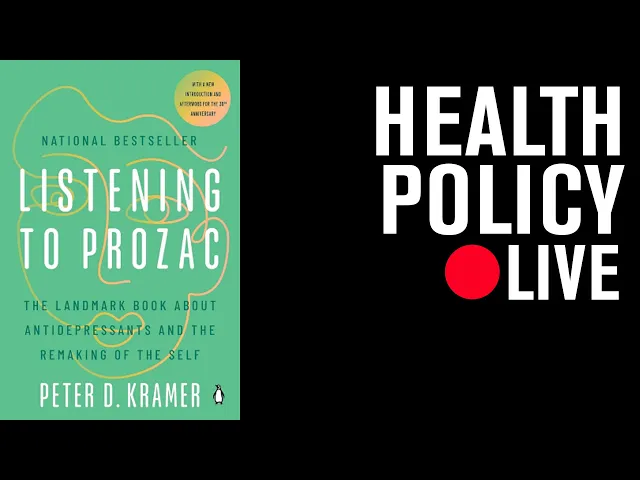
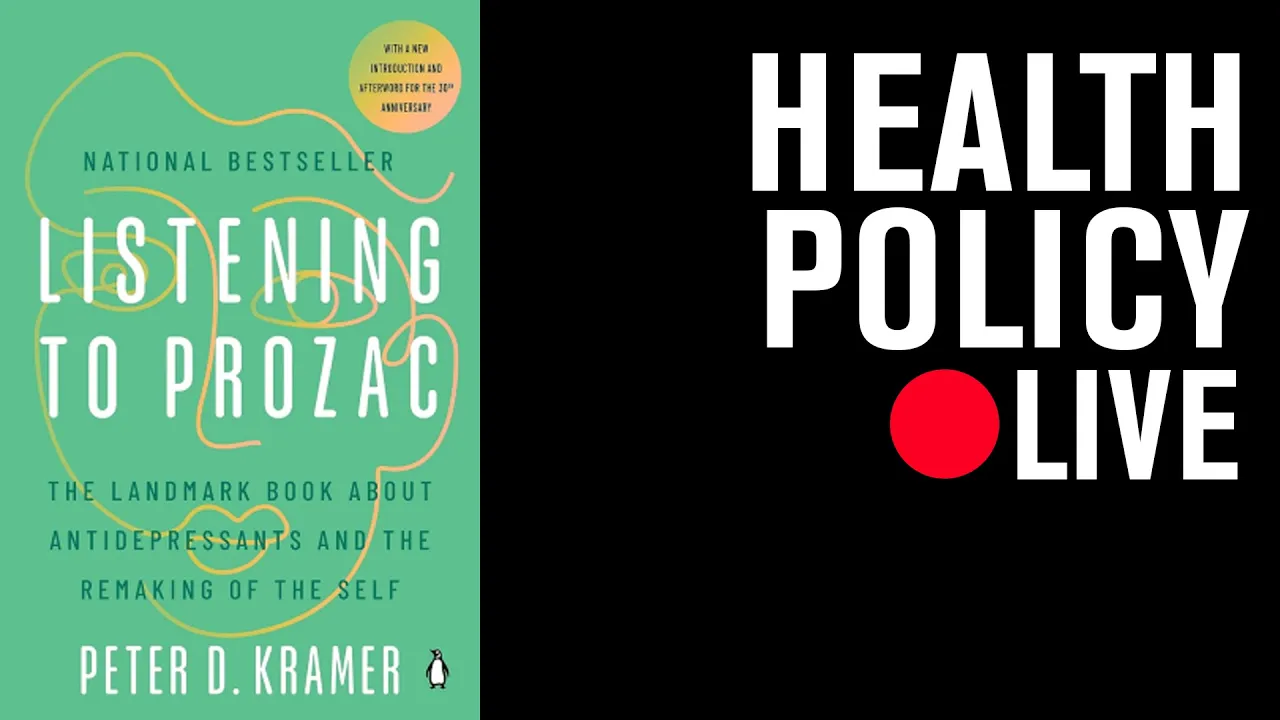
Well thank you so much for coming I'm Sally satell I'm a residence scholar here and I'm also a former mentee of Dr Peter Kramer I met him in 1982 at the Brown University School of Medicine and I was assigned to him for supervision and he hasn't stopped supervising so and I'm very grateful for it so I'm going to give a slightly longer introduction than usual Um before I introduce the participants today I want to take a moment to bring two things into perspective for folks Prozac itself and then the book listening to Prozac today Prozac
is kind of prosaic with an S not a z and but it was a huge big deal 35 years ago uh it was approved by the FDA in December of 1986 and it was almost immediately attractive to psychiatrists because the side effect profile was Significantly less than than two other classes of medications which were developed in the 50s and used with some frequency but um but not nearly as much as Prozac came to be used and those were called tricyclic antidepressants Elavil that's the one most people have heard of and then these drugs called monoamine
oxidase Inhibitors which were tricky because you couldn't eat certain things with them and they both worked but as I say they did have side effects so Um so Prozac was just so appreciated for the fact that it had a fairly low side effect profile and um and it just took off within within a few months there were 650 000 prescriptions per month written and by 1992 8 million people were on SSRI excuse me at SSRI which means selective serotonin reuptake inhibitor that was a class of medication that Prozac belonged to I mean it was truly
a pro a Blockbuster drug for Eli Lilly by 1990 it was on the cover of Newsweek you may recall Tony Soprano um was the at first reluctant recipient of Prozac so at that time though Psychiatry was in a kind of a transition period this was the 19 well uh the 1970s Prozac was as I said approved in 1987 but um Peter was trained in in the 70s in medical school and that was the beginning really of the era of what we call biological Psychiatry and it was displacing the Freudian world view which saw psychiatric symptoms
not so much as attached to specific mental diseases but rather as arising from unconscious conflicts and for which Insight through psychoanalysis or psychodynamic Psychotherapy was considered the Cure um the latter was you know but that was falling away and in the 70s medication for depression so I said uh which was Considered mainly a neuroses actually um we're in use I mentioned those two medications before but they came with unpleasant side effects so this is this is one change that's happening or moving more from an analytic um uh Enterprise to to more of a biological one
of course they can coexist and now they do to a large extent but in terms of Paradigm shifts that's What was going on around the time and another Dynamic that was happening um was that Memoirs of depression were kind of being written most notably the one by William styron called Darkness visible and and this was eroding the taboo about talking about one's own mental health and these these were big deals so when Prozac was its fancy name being a fluoxetine hydrochloride came along you know in this era when medications were Having a more role to
play and when people were talking more about depression I mean it really was your timing was brilliant so when Peter started prescribing Prozac and soon 1988 because it was approved in December of 1987. he started to see a transformation in many and not all of them maybe 20 percent but it was really an incredible transformation it wasn't just a reduction in the Symptoms of depression the low energy and the sorrowful mood and the self-recriminations and the suppressed appetite and all that but also changes changes in temperament some people went from being indecisive to assertive from
self-effacing to confident from obsessional to more contemplative um people who ruminated over their flaws or over the state of the world became so more complacent This really changed people's lives they took challenges that they would never have taken before they changed their circumstances and most importantly they listened excuse me they thought differently about themselves and that's really what inspired the word and the title listening to Prozac that's what really inspired it that they were listening they were thinking differently about themselves they were almost listening to the changes that this drug Inspired in them and then
Peter was listening to them listening to themselves but it also raised a fascinating uh question profound questions about identity and the extent to which our characters our characteristics and our characters have biological underpinnings and then it raised the question of well what if people who were otherwise healthy who weren't depressed were given these medications and it changed their Personalities people are not unrecognizable but you know in significant ways changed aspects of their temperament you know what about that so as Peter writes in his new introduction and it is a very if even if you have
the book definitely take this because this is a 50 page um introduction that his uh book at the time was quote built on worries over the Challenges that ssris posed for medical ethics and our understanding of personhood so it's a little hard to get more profound than that the book was greeted with rapturous reviews but my favorite one was from the American Journal of Psychiatry I forgot who wrote it but it said Kramer Kramer presents Elusive and convincing case that American Psychiatry is not brain dead It's a became a national seller bestseller and international bestseller
that sparked all kinds of listening memes listening to listening to Oprah Prozac excuse me Oprah Nightline The Today Show was assigned in courses on medical ethics and psychopharmacology and Psychiatry was the biggest seller um since uh Freud and the first Psychiatry book that engaged an entire public conversation but even bigger the ultimate indicator Of its reach its crowning mark on the public imagination where the cartoons so I just want to show you a few of them if I somehow I think I'm going to not get this right I should have rehearsed this hello can you
get me the first slide thank you okay great um I'm sure you can see it um so that's a happy child I'll just read It of course your Daddy loves you but he's on Prozac so he loves everyone the next one there are four um this is taking Prozac I only Chase parked cars I love that that was you know again the aspect of the of the transformation where people are just just just calmer maybe a little less aggressive um although on the other hand some people became more assertive another one um since I've started
taking my Viagra With my Prozac I've been having great sex but I don't care and finally this one could we up the dosage I'm still having feelings okay so that's where we were in 1993 and we are all assembled here to discuss where we are now in terms of depression treatment the field of Psychiatry and and culture so now for the formal part of your introduction um Peter Kramer and these are truncated Um I could talk for the whole time about these folks um Peter's practice Psychiatry and taught Psychotherapy in Providence Rhode Island for almost
40 years and he now works full-time excuse me Wright's full time which is harder than work and it is an Emeritus professor of Psychiatry and human behavior at Brown University he's written eight books his most frequent is a not most recent one is a novel and I Think that's what you're going to continue to write it sounds like from what you told me Peter novels from here on um and that's a fascinating novel called the Great the death of the great man and which a psychiatrist treats a trump-like patient he's also written an intellectual biography
of Freud in 2016 he wrote ordinarily well the case for antidepressants um which is a name implies uh is it's Really a tour de force of the scientific literature but very readable on antidepressants and makes the case for their importance even though as you know they've been there's been skepticism public skepticism for quite a while as Scott Stossel Who's down there wrote in his New York time review a New York Times review of Peter's book ordinarily well quote he presents a case for the superiority of clinical wisdom over Statistical analysis Kramer events is such humility
that no one could accuse him of being a pro-medication ideologue and in fact humility and compassion are the two words that are come up in all the commentary about it about his work so I invited Daphne Merkin and Scott Stossel to comment on Peter's book 30 years later because they are both brilliant writers and they are brilliant sufferers Daphne of depression and Scott on Anxiety and and through those prisms I know they would have enormously insightful things to say Daphne Merkin is a literary critic essay is the novel he's a former staff writer for the
New Yorker her recent stunning Memoir on depression excuse me it's called this close to happy she's written so many moving essays on the con condition she's written two novels and her collection of essays are wide-ranging meditations on topics from Family to religion to the psychological impact of money and of course sex um and a quest to make her therapist laugh one of the con one of your um admirers said you are comfortable mixing Wittgenstein and Groucho Marx and that is so true she's profiled Taylor Smith Madonna and Kim Kardashian and her work really runs from
the profound to the profoundly entertaining she's taught at the 92nd Street Y and other uh writing Programs Scott Stossel is the national editor of the Atlantic magazine he's written uh two books the first is Sarge The Life and Times of Sergeant Shriver which was award-winning biography and his second book uh which I reviewed in in love was called at a New York Times bestseller My Age of Anxiety fear hope dread and the search for peace of mind it was shortlisted for the 215 welcome book prize and was awarded the Eric Harrison Institute prize for excellence
in mental health media his book is just outstanding I just can't say enough wonderful things about it it's it's a gripping Memoir it's kind of three things at once it's it's a and very funny in Parts it's uh meticulously researched uh clinical and psychopharmalogical history of anxiety and a very astute cultural analysis and one of the I'll close by saying Peter one of the comments you made in Listening to Prozac can't remember now if it's a new introduction or the original but that anxiety is the anxiety is the heart of the psychological understanding of man
it's the route to self-discovery so that may come up anyway so what's going to happen here is now I'm going to now that I've introduced you Peter you can come up here or sit where you are and give a few words on the on the book The 30-year anniversary and um and then you will sit down or continue to stay there and I will ask you an incisive question and uh I'll start you off with with a penetrating question and then um and then it's I will have a light touch from here on when and
Daphne and Scott will take it away after that thank you all I I think I will stand up on the okay Uh grounds of maybe thinking better um foreign I'm not being heard or clear I think as I get older they I start thinking a lot on on microphone and mumbling you know as I do uh I I want to start by expressing gratitude of of different sorts uh some of the Gratitude and I'll leave this topic immediately has to do with the current novel uh death of the great Man uh when I circulated the
typescript people were a little afraid of it it begins has a murder mystery form slightly and begins with a foolish autocrat dead on a psychiatrist couch and people were afraid to blurb it they were afraid to endorse it because we're in times where people are afraid what from followers will do and Daphne Merkin stood up right away and offered a very generous endorsement and I don't know Daphne that we've been on stages like this before other than that acquaintance and Sally did as well and then when the book sort of languished I think for similar
reasons it was sort of kryptonite Scott stood up and did a feature piece part interview in the New Yorker that's just very thoughtful and generous and I'm grateful for that uh sort of attention and courage and I'm grateful also to Sally for uh bringing Me here to DC to look back on listening to Prozac someone who was going to be here today unfortunately couldn't make it is Walter Reich who uh was a practicing is still practicing psychiatrists but was in the Carter Administration later became head of the U.S Holocaust Museum and um I want to
tell a little about how I came through Walter to come to Washington because it gives a sense of what Listening to Prozac was to me in its formation uh and I I say this also to sort of locate the book locate the perspective of the book and I'll say a little about how people take the book as opposed to how I I took the book in its day so I was in the uh 1970s late 1970s towards the end of my psychiatric residency at Yale and I fell in love with uh Rachel who uh whom
I later married and we've been married uh for over 40 years uh my Supervisors were a little worried uh because I said to them that I was going to leave The Residency and come to Washington where Rachel was working and finish out my residency at George Washington or Georgetown and the person immediately ahead of me my immediate boss said that if I would do extra work for him for six months and you have to imagine what that is like in a Psychiatry residency that just sort of time and a half in a Psychiatry Residency for
six months I could come to Washington and be supervised by Walter who was on the Yale faculty and finished out my concentration Community psychiatry in Washington Walter was head of a program that disseminated Cutting Edge ideas about Community Psychiatry to community Psychiatry settings to Community Mental Health Centers uh so I did the uh extra work and um came down to Washington and by the time I arrived that program had ended so My interest in Psychiatry were very largely Psychotherapy and Community Psychiatry uh Public Health Psychiatry basically bringing services to the underserved and I was shunted
in the government immediately to work under Jerry clairman in what was called the division of Science of the uh of Adam have the alcohol or drug abuse and Mental Health Association which oversaw and I imagine the other Institutes And uh my job there was actually only one other professional there who was Charlie Krauthammer and I'm sure the American Enterprise Institute remembers Charles Krauthammer but he um had been a Psychiatry resident under Jerry and he left to become a speechwriter from Walter Mondale he later became one of our Premier conservative commentators but he uh left that
job so I was left alone in the division of Science and my job was to master the federal portfolio In scientific research so I knew all the studies from the nrmates and the drug and alcohol institutes and the veterans association and I had to translate the science for legislators and trans translate Jimmy Carter's policy for research administrators so I was sort of an inadvertent scholar of cutting a scientific research and I knew the researchers because we had the money and the researchers came to us so I got to know the biological the brain Researchers in
Psychiatry that was among other things Jerry's Jerry clairman's main interest so skip forward as Sally has already done for us and I should say what a terrific uh framing introduction really give us a sense of what these uh where these medications came from what they meant and I kept careful notes on my patients I kept Psychotherapy notes I did mostly Psychotherapy and I had separate notes for medication as doctors do and I started noticing that my Medication notes were looking a lot like my Psychotherapy notes that patients were attributing change to these medications that was
like the kind of change that we aspire to is psychotherapy and so I wrote a couple of articles for doctors I was by then a regular columnist in a trade paper about this phenomenon and that led to a book contract for listening to project so this you know I I felt in a way uniquely maybe not uniquely but particularly Able to write this particular book this was a book by someone who is very interested in Psychotherapy whose main focus was Psychotherapy who happened to know you know sort of the entire scope of federally funded research
and who also knew the scientists and could draw on them and I started writing people and saying I wanted to write this book and this was pre-google pre-alta Vista people would send you boxes of their off print so I Get these big cardboard boxes with 60 papers by a given researcher and worked my way through them and I had a sense you know I thought I had a sense of um what I could say so the articles that I've written for um colleagues were sort of the essence of listening your Prozac they would say you're
seeing what I'm seeing that these medicines are having personality effects temperament effects that go beyond uh Just restoring a person to where he or she was before the episode of depression or the officers in obsessionality whatever the medicine was given for and in addition the patients are attributing change to these medications in the way that they normally attribute it to psychotherapy and believing that the medicines tell them something about themselves that they perform a sort of dissection and tell them what about themselves is carefully develop uh Personhood and what is biological happenstance that what the
medication changes presumably is biological Latin stands and as I said some background in animal ethology cell biology all sorts of areas and listening to Prozac is an attempt to make lots of different scientific disciplines shed light on this phenomenon that I observed parenthetically this is why I went into Psychiatry I don't think I've pulled this off ever again but I was a great Admirer of Freud the late freudography that I did recently is a little more skeptical but I was a fairly unquestioning admirer of Freud and I wanted to do what he did which was
to sit with patients and discover things about the mind you know without all the apparatus of uh modern scientific research and of course I drew on the apparatus of my modern scientific research indirectly but you know this sort of was my dream to have a clinical Observation that would um lead to people think differently about how we're constituted it so I think that's sort of the the introduction I I will say one other thing which is uh you know Sally mentioned this foreign new interest in order pathography that William styron had written an op-ed for
the New York Times related to Primo Levy suicide and it was so controversial so Aroused so much interest that he turned into this short book uh Darkness visible which actually is largely skeptical about Psychiatry but increased reader's interest in Psychiatry and made depression sort of known as an ailment and discussable and when listening to Prozac came out although it was about this very narrow issue which is whether these medications had personality effects and why that's plausible it was taken to be a book about Depression so that the book wasn't normally popular popular I went from
bookstore to bookstore people would come up and online and say they're very grateful for the book it was so helpful to visit one or another relative of theirs and the first time this happened I said well I I was confused I said I didn't mean for it to be helpful which I I understood immediately was rude and a mistake and cruel um but because you had to kind of Explain what depression is and how we think about it psychologically and biologically the book was taken to be in that tradition of expanding the discussion of depression
and you know I think a lot of the interest in it some of it I hope was due to this um New Perspective I was introducing but a lot of it just had to do with people wanting to read about depression altogether and uh you know it's an extremely common ailment and I think People saw themselves and of course people would call me up and say they saw themselves in this event vignette and could they see me or did I know someone in their City who it is kind of work so um I think it
is a book that really has those two personalities one sort of uh in the mainstream and in the cultural mainstream thinking about depression and how we're going to talk and think about depression and then this other one uh having to do with really taking a Psychotherapist view of these new medications in regards to effects that they had and we're not fully expected to have before they entered clinical practice so why don't we stop there and you know I kept referring to listening to Prozac but the subtitle is is very um informative as well it's called
antidepressants and the remaking of the self so so my question is Um you even asked this question in the introduction do you think you could write this book today how would be different why why or why not yeah so you know in the I wrote this new introduction and I had fun working I was very glad to be asked to do this to look back over 30 years 35 years of Prozac 30 Years of his book and um the um uh Jorge Luis borgas has a short story uh Pierre Menard author of The cohote and
it is a fake review by a fake reviewer of a non-existent book and the non-existent book is by Pierre Menard and what Pierre Menard has done is he has written two chapters in 1918 two Chapters of uh Vicky hot day and Menard says how much more brilliant uh Borge says borgas's narrator says how much more brilliant Menards Quixote is than Cervantes because it was easier for estevantes the one particular chapters about military Glory easy uh you know to write about military Glory when everybody believed in military Glory but in 1918 you know after the horrors
of World War One how much you know how ironic uh how how ambiguous and you know Full of contradictory meaning it is to write these very same words and uh I use that as a framework for this introduction because I think we have gotten in Europe to antidepressants and so many people are on them uh so many people stay on them a long time in particular people who don't respond to them get exposed to them a great deal I I think our drug trials this is an ordinary well I write about this because we have
you know 10 Cent appeal antidepressants that work well the only person who people who enter drug trials now are people who don't respond to antidepressants so we're testing a group that is uh very hard to treat uh it makes the medicines look bad statistically uh there also is something called an anti-psychiatry movement which is just an interesting phenomenon if there's no you know anti-nephrology or anti-optimology uh movement and uh this Begins with psychoanalysis with uh people saying the psychoanalysis values Conformity too much that it categorizes people too strongly and so on but rapidly moves into
opposition to medication and uh psychiatric diagnosis and uh so that there are all these articles that are debunked but are kind of zombie science that stay in the public eye saying that antidepressants are just glorified placebos placebos of side effects there's a lot written about The difficulties of these medicines and there are more difficulties when people stay on them for 20 years so I think if you wrote this book today you would really be swimming Upstream uh and as I say the streams uh which are now polluted with Prozac you know you'd be swimming up
Upstream in a stream you you don't want to be in um that said uh so and I sort of play a little with what what's someone who Wrote this book today would be doing it you know it would it would be insisting uh on the values of these medicines despite this uh lack of popularity 30 years ago these medicines were sort of titillating they were on the cover of Newsweek they sort of had the fate of celebrities sometimes being celebrated and sometimes being criticized but there was a general sense of wonder about them I think
we've lost our sense of wonder And if you take the long perspective that since Hippocrates humans have wanted to have specific medications for melancholy you know the fact that we found some in the 1950s and found better tolerated ones uh you know 20 years later I think remains very remarkable but let me stop there just because I think there are other people out here who have very interesting things to say but I think we we could say more on those lines as well Go uh there should be an antique Nephrology um uh I'm I'm in
favor of authentic kidneys no no um you know adulterated kidneys with treatment no I mean I'll I'll I'll just say that like in some way I mean I still remember I was showing um before we came out here I was showing Peter my original marked up um you know Galley copy of listening to Prozac from 1993 and I'm in some ways Was an ideal reader because um you know an intellectual level I was I've always been interested in Psychology and Freud and the nature of the self and different modalities of of treatment more personally and
emotionally I had at that point I was in my early 20s you know been through years of psychotherapy and suffered um depression anxiety you name it and Had been through a whole panoply of um sort of the drugs of the era you know starting in the early 80s from Thorazine and a member mean um and Valium you know two uh and at the time I read this I was actually unmedicated I think maybe I was on the zipper mean which would be my second um sort of a Time on on a tricyclic um and and
I was sort of fascinated and terrified by what um you know Peter had To say about these um patients of his who had these transformative experiences where they felt like Not only was there depression you know cured or went into remission but also that he would sort of observe these Transformations and personality and on the one hand I recoiled because it was like well wait a minute um What is it you know who am I what is the nature of the self um you know this is the other reason that I was so fascinated by
this and remain fascinated by these questions today um you know if if these drugs a lot of what Prozac and the and the generation of SSRI medications sort of brought to the fore were these questions about what is the essence of the self what is the essence of Psychopathology and the relationship between Um you know is my to the extent if I am suffering from pathological anxiety or depression is that is there a a neuro you know a a neural correlate of that a biological substrate that is equivalent to like you know what a diabetic
has in terms of malfunctioning of the pancreas or something like that or you know and and I think the short answer is yes but at the same time this is me and who I am and I like to think that there is something individual and Um within my you know it gets in a matter of a Free Will and so on in that and at that level I sort of recalled I was like that that sounds terrifying I don't want to give up myself and this you know Peter talks in the book um I don't
think this was your coinage um Peter coined um uh pharmac or cosmetic psychopharmacology but there was a longer one going back um pharmacological Calvinism which I think I Naturally gravitated to which is like no no you know suffering is good you grow through suffering you need to be your authentic self on the other hand I was drawn to this powerfully because the case studies which he wrote so very well were people who in some of them sounded very much like me and they would start taking the drug and they would just get better and happier
and um better than well as Um you know he talks about uh and so I you know I I had this complex reaction to it and it was not long after that I think in some part in some way influenced by having read it having read Peter's book that I that I sort of um succumbed to the ongoing um encourage and treaties of my than psychiatrists to to go on to an SSRI it was not as it happened um Prozac but it was a a comparable drug And um you know it it worked and so
you know I I think that the questions that that uh Peter posed in 1993 even though there has been you know the growth of the anti-sychiatry movement which has gotten um energy from you know what happened with Purdue and and you know opioid addiction and all that um the the these questions about um you know How can we use psychopharmacology to Aid Psychotherapy in uh ways that uh get people who are stuck in depression or anxiety to a better place and there's all kinds of questions which he talks about both in in in the original
book and in the new introduction in the new appendix to the to the revised Edition about you know how has our scientific understanding about how these drugs work and what the costs and benefits may may Or may not be but but I feel like there is something to me that was appealing on a personal level uh in thinking about how can I make myself feel better and also at an intellectual level of how do I think about this and what is the nature of the self interacting with these um in this case kind of chemical
interventions but you know as Peter talks about in in um the the the new addition you know same thing could be saying about how we Interact with technology today this also affects the self so anyway I don't know if that was entirely coherent but um the book had had a profound impact on me and I and I um you know to this day remember elements of it and I guess the last thing I'll say is you know he quoted you know Walker Percy was always a a a novelist um who I read and admired and
he um cited the Thanatos syndrome which at that time was a fairly recent novel Which um is a book that talks about it gets to the heart of some of these questions and in the Thanatos syndrome um you know these sort of well-meaning um but possibly Sinister well definitely Sinister you know sort of uh Town Elders uh introduce this drug called heavy sodium into the water supply to make people better and women more sexually compliant and people happier and in some ways it's a Utopia and in some ways it's a dystopia and this is something
that Sort of um echoing around the uh margins of of the questions that we had about Prozac and it's ilk when they were in introduced in the in the 80s and 90s so please just well I've been moving all over the place in my brain um since Peter started talking and I had a few thoughts one of them is I actually in my own Memoir use Bill Stein's memoir as an example of what is not a reflective book about depression I called it the male narrative depression in which depression comes out of nowhere like Chicken
Little falling from the sky and I don't think I know Rose styron well I just reviewed her book about her life and she said to me Once when we were talking on Martha's Vineyard but how did you think of going into therapy and I thought to myself how did he think you think of not putting him into therapy in some ways to me siren is the very intelligent apotheosis if that's the right word um in the ever going nature nurture debate That's behind some of these questions about medication and Psychotherapy to me he stands for
an inability to deal with the environmental aspect of his depression and by the way after he was depressed and got better he had many many more depressions that got ever worse um and I don't I don't think Rose Diamond describes very funnily whitally but dismissively the therapist He goes to um so I think in some ways his Memoir while it's always taken a sort of breakthrough stuck to the side of um cleaved to the notion of depression is biochemical and I think that's a dangerous notion actually um the times asked me some years ago Sarah
Silverman the comedian apparently Said on one of the morning talk shows which I myself never watch that she didn't want to get have a child because she didn't want to pass on depression so I wrote a piece called as depression inheritable and I still think and I said you know it's about 50 percent I think schizophrenia is a little more but you don't suddenly get depression It's environment I once said to I was put on um every medication very early but I was put on Prozac before it was FDA approved should have invested in the
stock um and I said to my then therapist but how can you medicate a bad childhood and he said something some good answer but you can't talk to an Ulcer you need first to have the ulcer cured and then you can talk about it but I had a terrible um experience with Prozac I think I was put on much too much and then I couldn't sleep and I was put on a sleeping pill called deserol and the combination I ended up with urinary retention that went on for three months but I think that's a So
I'll never know if Prozac would have made me would have changed my character I did just speak to a psychopharmacologist actually my own who said he didn't think this character change happened with people with deep depression that it more happened with low grade depression but I'm but I think there is a big distinction between clinical Uh depression and for lack of a better word you're more walk a day depression um that all said I also read Peter's book when it came out and I found my Edition filled with I was thinking utterly unreverential a bit
of books much as I love them so it's full of Turn Down pages and check marks And I do think it was a very um revelatory book for many many people about the whole issue the Cosmetic psychopharmacology part of it I don't know I mean I I wrote a piece about depression which I said has anyone ever seen change what does change look like but I was speaking more of Of I think again profound depression in which I think the medication can bring you out of the depression Peter may have different experience but doesn't bring
you to at least it hasn't for me to suddenly being a better version of yourself or more outgoing version of yourself I don't know if that has to do with a Hierarchy of depression I don't know what Peter thinks about that um but coming back to the book I think it made people think I still think depression is a fairly although Prozac made it more fashionable I still think depression is stigmatized as recently as this morning I have a very bad shoulder which is About to be replaced and I took a driver from New York
to DC who a friend recommended and I said to my friend about the driver I didn't know he suffered from depression and was in fact in a hospital and she said to me he told you that right away and I thought basically this is my impression and you can both Have different Impressions obviously the culture remains unsophisticated about depression I still think there's a lot of because depression is on a continuum many people think oh I don't feel good but I pull my boot straps up every morning I think there's still a lot of that
in the culture I think there's still a lot I mean I worked at the New Yorker and the times Supposedly sophisticated places by the time maybe I know the New Yorker was once more welcoming to what should we call it mental illness or disturbed writers but by the time I was there they were not um they famously had an insurance I think it was Chubb that covered frequent therapy sessions but I remember being very self-conscious About experiencing depression and I wrote a piece of New Yorker called wasn't called crazy must have been called something about
being in a psychiatric hospital and that to me still felt more taboo than a peace Scott just mentioned to me which I wrote for the New Yorker about erotic spanking Which had such a response that I fled for Israel um but saying that I had been in a psychiatric hospital and also Walking The Halls of New Yorker I felt like exposed in a way very little else had that similar effect um I was also just going to say that Peter's very thoughtful forward and Afterward introduction afterward mentioned which I think is sadly true that there
hasn't been an enormous advance in the last um I don't know how many years except that I know I'm only speaking from personal experience that the use of the small use I mean small dosage of antipsychotics like [Music] Um Abilify they're considered facilitating of antidepressants um in very small doses and if anything has helped me also help me put on 40 pounds which is why most people don't sit on Abilify I would say that combination which is relatively new or relatively newly used Has had an effect but once again I think Peter's book brings up
questions including with psych cosmetic psychopharmacology Which Scott also mentioned like what is the authentic self which I think we all remain fascinated by you know is the authentic self how gloomy Um especially I think for writer types because one of my favorite quotes is by a French writer named Robert de montrealange from a novel called the girls and I always tell this to writing classes in which he said happiness writes White it doesn't come out on the page how easy is it to make happiness interesting and I would link that back To I think people
read read partly to see are they as miserable as I am these characters these families this may all in itself be a very dark rendition of all these issues but for me the prevailing issue is the nature nurture debate I always have a feeling people can't accept that it's both and one thing I do think the arrival of Prozac did was relieved people of the burden of introspection maybe not the way Peter did it which is with psychotherapy but kind of made it seem like oh I have these internal problems but they're relieved by this
medication thus these Journal problems don't have any precedent in my experience This actually was one of the problems with the popularization of Prozac um which those cartoons sort of allude to you know the uh I was very gratified by cartoons the year that listening to Prozac came out in the following year the New Yorker ran three or four Prozac cartoons not not the ones you've seen including Roz Chast and some other well-known cartoonists and there had been none before listening to Prozac they weren't really Prozac cartoons in my mind they were listening to Prozac cartoons
they were about that they were about that discussion um it was the great Luke Manon did a Backpage thing called listening to Bourbon listen to Bourbon which was a great story one of the cartoon said and it had been a multi-part that ended with listening to listening to Tic Tacs so it was uh but um so I actually want to pick up uh Something that Daphne said about William starring and about her own depression I think depression is hard to write about because it's people's experience of it is so particular that they always feel you
haven't captured theirs um so I you know I was in correspondence a little bit with um Elizabeth wurtzel when she was writing Prozac Nation and so Bill starrin had written about Sort of an old alcoholic man's depression and she wrote about a sexually promiscuous young woman's depression and they look and whether depression is really Her diagnosis she wrote about other diagnosis you might have had but you know the um depression is multiple in that way even though you know there may well be a biological bottleneck where however you got it there are certain things going
on That are in common um you know across people and I I thought what was valuable about styron's book was that he and and if you look at it again hearing this you'll I guarantee you'll see that this is so he wrote about depression being ineffable how it was really hard to describe and throughout how throughout literary history people had had trouble people who otherwise were terrific at describing things had had trouble Putting depression into words and I think that theme emphasized how much worse it is than ordinary unhappiness which is kind of the theme
of all literature um also as Daphne said I want to say uh did I interrupt and say one thing again back you said something about depression is different for everyone and I Elizabeth Purcell was a close friend so I certainly saw her version but you could say all experience That's written about is singular yeah so a love affairs no one experiences it the exact same way and I do think you're right that stirring described the look and feel of depression I'm talking about the Genesis the ideology of his depression no he he didn't like Psychiatry
at Oregon like medication or Psychotherapy and it was anyway starring aside um the Um in my uh Pierre Menard analogy my relief on re-reading this book which I did you know it kind of inch by inch to when I reapproached it lately was that almost everything in it holds up that although you wouldn't write it today it's not because anything is false it's because there's been further progress on certain fronts or because certain things which are said tentatively have turned out to be very much uh Backed up by subsequent research um I I think I
want to say a little bit about what our current model is of antidepressant action because I think that that's something that has changed I have these three books listening to Prozac against depression ordinarily well which sort of decade by decade update the theory of what depression is all together and certainly what antidepressants are doing and uh some Researchers in England uh before some of the research I'm going to mention started saying that they think that what goes on with antidepressants is they change people's perspective on themselves in the world initially and that people then elaborate
that change because they're able to have this slightly different perspective they act differently in the world they start entertaining more generous hypotheses About the cell they're able to build on it so that the medicines of in effect are catalyzing some mix of things that we normally would categorize as medication effects and things that we think about more as Psychotherapy effects although they're also you know daily life effects and um without getting into some fairly complex material which is in this afterward Um it may be that antidepressants are actually chemically doing two things one is that
by one mechanism they're combating depression and the other via serotonin and some of the things I wrote about in listing of Prozac they're making people less subject to neuroticism where neuroticism is a term of art but it has to do with gloominess negative self-attributions uh some fragility and tendency to fall apart in the face of challenges and that what may Have been useful about these uh particular antidepressants is that they were sort of at once changing your perspective through serotonin and giving you some release of Leafs under from depression so that as you became less
depressed more flexible better able to learn you were doing it in the context of this more favorable self-regard and prediction about the world and so on um you use the word resilience yes which I once again had Not trouble with but you're against it I'm against resilience my next book is called against resilience um again I went to a extremely smart psychiatrist psychoanalyst who said to me if we could figure out who is resilient and why we'd bottle it and I was also thinking how could a drug resilience starts Young you have the resilient child
Does someone become resilient at age 30. so so I I have a an answer it's kind of a term of our answer for this yeah but I don't mean for it to be uh decisive in any way it will sound decisive but it's not because you're right but um so there's uh if you or a child and and for some reason your one of your eyes isn't working well or you have to have your eye patch for a family condition uh the brain will start stop recognizing That eye and when the patch is taken off
you may be what's called amblyopic your brain May really recognize one eye much more than the other so you won't have the binocular vision that we have by having two eyes both uh look at something at the same time and triangulating and that ability to have binocular vision occurs at a critical moment in childhood so there's a period in child development where you get it and if your eye were patched after that Period it wouldn't bother your brain nearly as much and this model is very worked that well worked out in rodents mice and rats
and uh it turns out that if you take an adult rodent and give it Prozac and Patch the working eyes or the non-working eye has to do more that the mouse or rat is in this juvenile condition the brain is in this juvenile condition and the mouse a rat is able to get binocular vision again and get amblyopia and it's really all of Them you know what I mean it's not just some of them in humans this is less well worked out in the experiments don't work as well and because of human uh experimentation requirements
they have to do some good things for the people who are not on the Prozac and anyway you know about half of the people do start get uh this uh effect and so that sort of is the model of of resilience or whatever is that the brain really is unstuck in a certain way and has a new Uh you know radically new capacity for learning that that no I put that example you gave of the mice yeah it was very strong yeah um but but I you know I I mean honestly I couldn't agree more
I mean I'd spent my career 40 years doing Psychotherapy and we deal a lot with people who had terrible things happening in childhood and what that predisposes them to in terms of their You know responses to current um circumstance and but in a way you know that that is the purpose of medication and Cycle Therapy is decoupling those events I mean even Psychotherapy is really trying to get you not right to your wife is your mother yeah but looking looking back at the book I was um reminded that one of the fascinating things is that
you sort of identify Um that you know one of the theories for how Prozac and its ilk work I mean it treats depression but maybe independent not by going directly at the depression but you said this earlier by sort of alleviating personality traits or changing personality traits having to do with neuroticism and things and that via that transformation it makes it easier maybe in the context of also talk therapy to relieve depression and a that's fascinating in and of Itself that that these are not drugs that necessarily go straight at depression whatever that means but
go at other things but that's again the um they're changing personality they're changing personality traits as opposed to just mood and that's where I think that this this dichotomy or or dialectic between um pharmacological Calvinism and cosmetic psychopharmacology like on the one hand It's like here are these drugs that can make your um that can change your personality and make you better than well and make you more assertive and more confident and more effective at work and incidentally make you less depressed so they're they're they're they're they're getting at the heart of it but at
the same time and this gets to you know Notions of how we think about who we are and why the way we are they are changing things that Seem um core to who we are and it kind of um if if if um whether I am optimistic or pessimistic is a matter of tweaking molecules um or neurotransmitters in my brain what does that mean about the nature of my Essence um and I and and those those to me were the interesting philosophical questions and obviously they then beared very Directly on um how you how you
treat you know depression um no this is exactly right I mean I think there's a case for wanting and I think Daphne is saying this to play the hand you're doubt and that if you're experience in childhood is that uh you know people can be cruel and arbitrary and everything can be taken away you know shouldn't you want to face you know shouldn't you represent that perspective In the world since certainly is a true perspective and not uh everybody's and uh you know so I think that's one side of it and then you know the
other side that I had just observing my patience was this patient who said to me I'm this medication I myself at last and that's one of the core sort of themes in the book is what what could that mean if this medicine had never been invented would this woman never have been herself and what is it not to be yourself you Know is she actually more herself uh poster you know pre or post um but I'm very I'm very sympathetic and and I you know with the notion that maybe we ought to want to have
the consequences I I suppose the the reason psychiatrists don't like depression besides all the kind of medical model reasons which is that it interferes with your heart and blood elements and Bone And brain and you know glandular hormones and you know it's sort of a bad multi-system disease is that people really get stuck in it so it's not that people are deeply depressed and they're thinking well about Early Childhood experiences they're deeply depressed and they're thinking in circles and they can't have a pressure original thought so I think that that is sort of the case
for unsticking the switch yes well I mean You have a great line and I'm going to misquote it maybe you said a version of it earlier but it's like am I medicating my childhood or my medicating you know my my my you know my neurotransmitters and you could say the same thing about um again the pancreas like which can be related to psychosocial factors as well am I um and maybe it shouldn't matter I get I Get hung up on this um because it's like wait my I'm me um and I'm uh scared by the
notion that um tweaking molecules changes the essence of who I am at the same time I also am debilitated at times by depression and anxiety and I would do anything to relieve them and if you know something could come in and sweep that away but but that's the question like what are you medicating the the the the the underlying Neurobiological correlate or physiological substrate um and or or and and this is where you know the Psychotherapy that you do is so interesting because how do you combine that with talking about the content of the thoughts
or the um you know distorted conceptions you know um in the way that like Freud or anyone doing psychodynamic talk therapy since then might have done I I think the Problem with depression is that the ailment and the human response to it are so intimately intertwined so that if you have terrible cancer and you are in despair over it um I think no one would say well don't take away the cancer you know they might say the despair is sort of appropriate and maybe you ought to write about that and maybe if you recover from
it Elizabeth Benedict has a wonderful new book about how that's poetic and little pieces about her uh cancer which luckily was a curable cancer but it's about you know the worlds and her response to this ailment well I think with depression it's harder to cut those two apart because if you treat the depression you will experience the world differently yeah I have one question about something you wrote about in the afterward when you go more into The science which is I just want to ask you historically the notion that the of the plasticity of the
brain and that new cells can spring up first of all it made me happy excited like oh but secondly I wondered isn't that fairly new and I thought of a book I love that I thought was a brilliant account called Genie g-e-n-i-e about a girl who was kept in a Basement and she was you know very abused and they ultimately used her to see when the window closed on acquiring language skills they tried to get her to talk and they saw they decided I believe that they the window closed around age six or seven which
made me think how then would there be in a certain way to talk about the plasticity of the brain is like the Window is always open yes so you know this is between listening to Prozac and against depression somebody uh discovered using terminal cancer patients where you could do these experiments that human beings brains make new cells all the way into old age and it was really thought not to be true they there were examples and primates of these cells but it was thought that in humans with our complex brain language and so on we
were not Making new cells so this is sort of you know 19 I'm going to get this wrong but you know 1980 1990s yes science quite recently but of course once that happened people looked for it everywhere and in particular they were looking for it in depression with these uh antidepressants so it's but it's probably maybe not the whole brain you know man maybe they're relevant parts of the brain where it's not happening but certainly yes oh I'm just gonna say There's going to go to questions after you finish that's it you're done okay um
audience any questions I have more but yes so uh sure Daphne said that we haven't made much progress and I was just curious if you've thought about this I read quite a bit about experimenting with psychedelics right and mushrooms and all that seems like a whole new world and I'm just curious how that fits into this well Peter refers to it again in his after I myself as usual trying everything um some years ago I was taken out by a PR ior guy to lunch I remember at the Four Seasons with this very glossy doctor
who was opening ketamine centers um I tried ketamine As one of my sisters did she had more of the reaction you referred to of sort of displacement sort of negative like a bad trip I simply session after session fell asleep and my psycho ecologist said to me in fact I was thinking of suggest figures of peace said to me that He thought ketamine was basically a scam I don't know if that's too harsh I know from my own experience I didn't quite maybe months later in fact it worked um that's all and the Psychedelic the
psilocybin I think they just had an article about ecstasy I will just say the time in my tried ecstasy in my reindeer Years and it was the only time in my life I thought there's nothing wrong with me I will go on to write books so it did have this very strong effect of an anti-depressant effect and maybe there is a lot of room for all that don't underestimate the therapeutic value of a nap true true So you know my books and writing are really based on intimate clinical experience and I have not had experience
with psychedelics or ketamine I stopped seeing patients almost five years ago and uh just as practicing doctors started giving uh ketamine injections or infusions depending what they were doing and I I think there's going to be a role for them I certainly I have colleagues who have some patients do very well on Ketamine there's also some other classes of drugs I I think in terms I think if we have this meeting again in 10 years we won't say there's there are no substantive alternative to the current antidepressants there will be there's a drug related to
hormones that change during pregnancy in women pregnant people as we say and they originally were given by 36 hour infusion for postpartum depression and Seem quite effective and they seem to last for quite a while of course in the case of postpartum depression it's urgent that the mother be able to relate to her child right away and so that's a fantastic result uh these seem to last maybe six or nine months before you need another treatment and they've recently come out in pilliforum or been approved by the FDA oxytocin or what what's the no no
it's I'm it's one of the female sex hormones And I'm going to block that if it's like estradiol and it's uh uh going to be fabulously expensive but you'll take it for uh in pill form for two weeks and then they expect you know again you'll do well maybe for six to nine months and that'll answer I think a lot of questions about drug withdrawal and so on because there's no withdrawal from these you're just done and uh you know sort of see how people do over time uh I want to just mention a funny
Experiment that has to do with ketamine it's not this positive but it just amused me because it was so clever so ketamine is an anesthetic it was introduced as an anesthetic long before anyone's sort of using it for depression so we're using for depression and I don't want to undercut it too much because they're really good experiments using it in psychotic depression which we haven't discussed another terrible condition and people who don't respond To anything else sometimes responds Academy but it was a horse tranquilizer so this is the experiment you have depressed people and they
have something that needs surgery so they have a terrible leg fracture at a level where they need general anesthesia and half of them you just give your regular anesthesia as you would half of of them you give ketamine in the lower dose that is used to treat depression and you fill out the rest of Their needs with conventional antidepressant so half of these people have gotten antidepressant level of ketamine and half hasn't haven't and you do the surgery and you know some do well some do poorly in both groups and at the end uh the
groups look identical taking ketamine doesn't seem to have any more antidepressant effect it either doesn't have an antidepressant effect or the other anesthetics also having breast Effect which is is not outside the realm possibility I say parenthetically but um and but the patients in general did seem to do somewhat better even though they were equal they weren't you know as depressed as they had been going into the surgery now maybe they were in pain or whatever but I just thought that is a very funny uh experiment and enough to you know make us a little
skeptical about what's going on is these are not really drugs where you can do Double-blind trials patients know if they're on ketamine or not they're not blind to it um so Peter I don't want to put words in your mouth so correct me if I'm mischaracterizing this but when you talk about the change in how people see themselves on Prozac that specific piece of it you're using language that makes it sound like it makes them see themselves more Truthfully I think you actually use the word truth twice in in talking about it not that it's
an enhancement not that we're trying to make them you know this is the goal that everyone needs to see themselves this well or you know you know in this way but that it's kind of taking away something that's blocking them from seeing themselves accurately is that am I overstating that Yes yeah I apologize for the word truth I don't know where it came came from or or it I mean in these sort of British experiments Philip Cowan is one of the people one of the authors usually um Catherine Hamill uh hammer Hamer uh that um
you know people looking at uh images you know have more positive response to faces or more positive responses to their own face so it's Definitely in a direction of upbeat you know it's not I don't know about truth or Austin authenticity but more generally when you look at personality traits in depressed people um you know this is sort of the better than well phenomenon that the movement is from aberrant and largely socially dysfunctional traits to more normative levels and more socially functional levels so Um yes I mean people probably are less self-critical and less uh
self-demeaning and uh able and so there was a ketamine experiment along these lines also which I think was interesting and close together the antidepressant and Psychotherapy aspect of this that when people people were given ketamine and then they were shown pictures of themselves in conjunctions probably on a computer you Know with positive attributions and positive statements about themselves and some other there were some other stimuli on the upbeat direction as opposed to people given more random photos or more random comments than association with their own pictures and the antidepressant effects of ketamine worked better in
the first group so you know that's one of these sort of critical period combined with you know some primitive uh Effort at uh cheerleading or Psychotherapy um but yes isn't there also this phenomenon that you talked about called and I don't know how well supported the or how well regarded the literature on this is but depressive realism that like depressed people sometimes as maladaptive as this may be have a more accurate perception of certain things and that does that mean that getting them via you Know Prozac to um a higher level of functioning means providing
them with a level of adaptive delusion that makes them more functional so I wish I remember this better but in against depression I actually discussed that literature and you know the kind of experiments I remember is that people are given cards and they're you know could win or lose and that the uh uh depressed uh you know uh people who were not depressed or overly optimistic And people who were depressed are are less optimistic but in a broader range of experiments it just isn't true that depressed people are more accurate they're inaccurate and in particular
they're inaccurate about their own prospects I mean which is a bad thing to be inaccurate about yeah and by the way people who are depressed can make tremendous contributions to the corporation they work in and be enormously valuable and you know there's A whole other discussion about sort of uh accommodation in the workplace but uh I I but I would say the literature on the whole doesn't say that depressed people are very accurate and in those card experiments is sort of stacked because the the only accuracy is less so of course depressed people are going
to be less so it's sort of a you know I guess if they got enough less that they were you know further off on the downside than uh non-depressed People are on the upside that would be uh remarkable but they're not they're not I I do hear this all the time I'm not sure it's right right and then maybe my in my Memoir I make this install word statement that depression is the loss of delusions which isn't the same as saying depressive reality but all I think to function well in the world people function partly
on delusions about themselves I don't know that's a different than depressive or that is a version of why of depressive realism I mean the people I know who are most functioning happy maybe this is all you know I seem to have endlessly dark examples seem um not so realistic about themselves from my point of view no I know you want to shake them and say wake up that's a Blunting of what you tell the this phenomena of rejection sensitivity like maybe being overly attuned to rejection or some facts is non-productive and pathological and and yet
um being inured to it um is delusional and yet helpfully so yes no I think this is really right that what I I wrote about rejection sensitivity which is people who kind of Go off a cliff when they get a little disappointment or insult but and I think those people are you know from a psychiatric point of view overly sensitive in that that you don't want to go off a cliff every time you're you know significant other turns his or her back but that maybe they're accurate you know maybe the sensitivity also includes uh you
know a you know really good Attunement to subtle slights and installs that people shouldn't get away with and you know I mean I think that's right right my patients were very good at that um [Music] you know I work with people who have drug problems and I'm a big believer in the self-medication model of addiction uh and in a way they're doing what they're trying to do Uh what you talk about people who drink at least in the early phases of their drinking career where that finally does make them feel normal or at their inhibitions
social inhibitions drop away or and opioids are especially good at being kind of oblivions as opposed to euphorians and depressants because they make people just not care that much and um unfortunately I think these things are so reinforcing they're so pleasurable that you can't often Maintain those benefits from them but it just reminds me a lot of what you're talking about so I mean opium really was one of the earliest antidepressants before there were what we think of as drugs that are more specifically God directed at depression the syndrome and I think it's right that
you would you know if these drugs in addition weren't addictive and didn't require high doses and weren't lethal and overdose you Would be out of business because just just the immediate effect is certainly something that people value yeah and you know what there's a whole genre of people who use opioids they're called chippers do you remember that phrase yeah and um they they're people who can handle their opioids because their tolerance doesn't increase very much and they have access to it and so they just use it the What You Know the Way frankly people might
um Frankly use anything if they just if they have access to it you can use it during the day you usually need every three to four hours and maintain a steady blood level don't use enough to become to nod out and it's just just modulates their whole uh you know mood and and arousal State and it works very well but it's very it's very susceptible to just disruptions like if your dealer you know leaves town or gets arrested or it gets more expensive you know but There are but we don't study them because they don't
they don't come in for help I was gonna say what's the what differentiates them from the people who tip over into sort of full-on well they will be object addiction tip all over I remember had a patient ones who used um heroin with really no problem for quite a while um because he got it from his girlfriend but when she dumped him and then he actually was it was not her dumping him Wasn't the issue wasn't so much the supply because you could get it from someone else but just the the loss and the distress
that tipped him over into a addictive user and then the tolerance problem but I'm always amazing exactly but it's not used more in uh once when I was deeply deeply depressed had been in a hospital I sound like I spent my life in psychiatric hospitals um I went to see an old psychiatrist of Mine and he said do not tell anyone this and he gave me four pit for oxy Compton and said take two and then eight 12 hours later take two more and within taking it I Rose from my bed I think I went
out and got strawberries and had a manicure very accomplished Feats um And then I took the other two hour later and I began to come out of my depression and I said Why Can't This be used in a more regulated I mean it's used not everyone is prone to addiction even with these addictive and I'd have this amazing effect although it's a confounded experiment because it could have been the strawberries or the manicure like the nap yeah we need another experiment natural experiment Where you don't get any we always are very a great interest to
researchers and I really want ones that hit some receptors and not others so they can you know maybe get these positive effects without well they've been doing that for over a century a lot of receptors then but that's a good promise yes in fact with fact heroin by Bayer which came out in 1898 was supposed to be the cure for morphine because it was a dick anyway on that Happy note um thank you all for coming and thank you for a great discussion