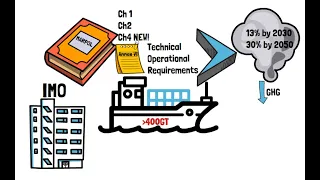
[Music] good day and welcome to the Sea trade Maritime podcast my name's Paul Bartlett and I'm a correspondent on sea trade maritime news today we're going to be talking about upcoming IMO carbon regulations and the challenges that ship owners face oh ship owners operators and charterers face a new working environment as carbon accountability and emission profiles enter the regulatory mix from January these new IMO regulations embodied in the Energy Efficiency existing ship index eexi and the carbon intensity indicator CII come into Force as part of Marple and X6 on November the 1st 2022 and will
apply to Cargo row packs and cruise ships from January the 1st 2023 e e x i applies to all vessels of 400 gross tons or more trading internationally and CII applies to ships of 5 000 gross tons and above also trading internationally the pressure is already on however as ship owners and operators should have drawn up new ship Energy Efficiency management plans s-e-e-m-p by the end of this year s-e-e-m-p part three as it is known will become effective from January the 1st and by then we'll need to have been confirmed with the appropriate flag administrations
or their recognized organizations a key element of s-e-e-m-p part three is the carbon intensity indicator CII a measure of a ship's carbon dioxide emissions per cargo capacity and nautical miles sailed from 2024 All Ships to which the regulations apply will be assessed and issued one of five ratings from a to e the first three categories a to c are acceptable with a as best d and e both require improvements however the CII is a dynamic rating unlike the Energy Efficiency existing ships index which is a one-off measure of a ship's carbon dioxide emissions per transport
work based on design CII takes into account ship operation and over the second half of this decade the carbon dioxide thresholds defining each of the five categories will tighten this has significant implications for owners and operators ships that are rated D for three consecutive years or e in a single year will require development of a corrective action plan that is part of seemp part 3 and then has to be subsequently approved by the relevant flag Administration or its recognized organization classification societies have been offering assistance on preparing for this new era since before the middle
of the year they have clarified how the monitoring reporting verification mrv and Imo data collection system requirements can be met and many owners have already had their seemp part 3 applications approved or submitted however sources believe there is still a significant number to be submitted over the closing weeks of this year there are questions over the suitability of the regulations for certain ship types to address this issue the methodology to calculate the carbon output from a ship's transport work will be based on different measurement metrics the annual efficiency ratio for example is a measure of
the emissions per deadweight nautical mile and will be used for ships where cargo is weight limited for ships with cargo that are space limited the parameter is likely to be capacity growth ton distance because gross tons are of volumetric unit one gross ton is 100 cubic feet in terms of efficacy the regulations are considered by many to fall short of requirements there are ultimately no sanctions for non-performance this many agree is almost certainly a result of the Imo's consensus-based approach to new regulations but it leaves frustrated many at the sharp end of the industry there
is no point in having a framework which cannot be enforced they argue classification societies have already noted different owner operator strategies many high-profile industry leaders have addressed the requirements with significant resource commitments and due diligence others though have failed to adopt a sound review of ships performance and appear to be relying on a far more casual approach this is more than unfortunate it adds to the shipping industry's many critics and accusations of doing too little too late when it comes to emissions performance it also generates criticism of the IMO a UN agency which is the
sipping industry's own self-policing body critics argue in the European context for example that the Imo's initiatives are nowhere close to the carbon reduction requirements necessary to meet the trading blocks fit for 55 package this is a set of proposals to revise existing EU legislation and introduce new measures to ensure that the EU can reduce its greenhouse gas emissions by 55 by 2030. this is a waypoint set by the EU for achieving climate neutrality by 2050 both the shipping and Aviation sectors are included in the project as far as the regulations go they are not comprehensive
so we'll have a look at that next year the IMO will meet to discuss ways in which its drive to improve shipping's carbon performance can be made more resilient but once again the diverse interests of its 175 nation state members are likely to hamper progress and generate more disquiet among the shipping Industries increasingly frustrated Observers among the issues that will be discussed are ways in which requirements under the CII regulatory framework can be strengthened and enforced more discussions are also likely to be held on how certain ship types may require correction factors owing to their
operational profiles feeder container ships and parcel tankers are examples these ships are virtually never fully laden but are rarely empty they spend significant periods working Cargo in frequent Port calls and compared with ocean-going ships deployed on Long Halls they clock up relatively low distances they can be regularly stationary in Port and their voyages are usually short such an operating profile is likely to result in a low CII rating despite the fact that such vessels fulfill an essential role in global Supply chains there are other complications too LNG carriers perhaps being one of the most obvious
there are more than 240 vessels in the 630 ship deep sea LNG Fleet that house steam turbine propulsion systems compared with other engines types these are heavy consumers of Bunker Fuel and for this reason the ships trade at a major discount to LNG carriers with other propulsion systems there are also older LNG tankers without boil off Management systems or re-liquifaction plant on board all vessels built to recent designs have such systems enabling them to use LNG from their cargos as fuel earlier vessels without this technology May sometimes have to vent gas to the atmosphere methane
is 80 times more dangerous as a greenhouse gas than carbon dioxide over a 20-year period experts predict that the Steamers and early generation LNG carriers which still make up more than half of the fleet today are likely to fall into the lowest two categories of CII d and e even if they make it into the lowest of the three acceptable ratings C when they are first assessed they are likely to sink into either D or E categories as the decade progresses and the CII framework becomes steadily more stringent however as a result of Russia's war
in Ukraine energy security is right at the top of many consuming Nations agendas particularly in Europe today there are about 260 LNG carriers on order with deliveries now stretching until 2027. LNG construction yards are full and there is no elasticity of supply the upshot of this LNG backdrop therefore is that every single LNG carrier will be needed whether as a trading unit or as a potential conversion candidate for floating storage or floating storage regasification purposes to boost importing countries LNG reception capacities the new regulations also pose a legal Minefield lawyers warn of both commercial and
legal challenges arising under different Charter contracts as a result of the Imo's new carbon efficiency framework the carbon intensity indicator CII could potentially affect or even cut through the fundamental principles of some Charter parties as well as the relationships between the contracted parties themselves in some instances legal disputes could well be the likely outcome particularly in time Charters the main issues Center on the fact that the characteristics of a ship are within its owner's control but its operation within a charter depends on Commercial considerations and the ship owner's customer the charterer the charter can decide
on speed within the ship's capabilities the size of a cargo Consignment and the voyage route this in turn could have a bearing on prevailing weather conditions delay at congested ports and so on lawyers also point to the retroactive assessment of CII ratings it's the operation of a vessel performing under a certain Charter contract causes it to slip down in its CII rating it could lead to a decline in the ship's value and even a fall into unacceptable D or E categories meanwhile slow steaming deviation and smaller cargo Consignments all have the potential to improve a
ship's CII rating but they also have scope to place the owners and charterer in breach of their contractual obligations perhaps the most important factor is that so far there are no penalties or restrictions but poor performance under CII the most important deterrent on poor performance so far is a commercial one ships in CII categories D or E are unlikely to command the same Charter rates as similar ships in a b or c this is an entirely New Field of maritime law in which there is no precedent so what do the lawyers say well their advice
at this stage is for owners and Charters to adopt a collaborative approach to ensure that the vessel itself and its operation under the charter party both contribute to the best possible CII rating of course there are plenty of sound relationships between owners and their customers but there are many contracts in which poor relations between parties Prevail and shipping is a notoriously litigious business [Music]