so against this historical and legal analysis one should note that there are three remaining territorial disputes between Israel and its neighbors the first relates to the Golan Heights so so this is our first territorial dispute the syrians claim full-fledged sovereignty over the Golan Heights demanding the full Surrender by Israel of the Golan heits in contrast Israel claims full-fledged sovereignty over the Golan Heights treating it as an Israeli territory under Israel's sovereignty the International Community by and large sides with the Syrian position insisting that Israel cannot acquire sovereignty over a territory through the use of force
not withstanding the fact that such a use of force self-defense use was justified under international law so by and large and I would revert to this issue soon the International Community is siding with the Syrian position and with the Syrian Sovereign claims over this the Golan Heights it is interesting to note that as we would see in another session under Israel's Constitutional Convention when you have a direct intentional and irreconcilable conflict between international law and Israeli law Israeli law should Prevail and hence the Golan law of 1981 which propos the facto to Annex the Golan
Heights should take priority over any principle of international law and all Israeli organs including the Israeli Supreme Court treat the Golan heits as part of the Israeli territory and as a part of the Israeli sovereignty but one should remember and we saw that in the session devoted to International treaties that under international law a country may not invoke internal rules as a justification for nonadherence with international law and hence Israel relies on Israeli law in order to perpetuate it or justify its claim over the Golan heits while interational law would claim that such Reliance is
is not legitimate because the principle of the inadmissibility of acquisition of territory through the use of force should Prevail and and such principle plays in favor of the Syrian claim so the first territorial dispute with with relation to the Goan Heights is quite cut clear under international law despite Israel's claim international law by and large supports the Syrian position of Syrian sovereignty over the entire Golan Heights the second territorial dispute is much more complicated under the international law and this is this dispute with with relation to Jerusalem as you may remember the British M it
over Palestine called for the establishment of a national home for the Jewish people in Palestine but without referring explicitly to Jerusalem but the M it was never implemented or fully implemented the partition plan as you may recall called for a third distinct entity namely Jerusalem which was meant to be a separate entity subjected at least for 10 years to an international Administration but again the partition plan was never implemented and Israel's position which I believe is well founded is that the partition plan is no longer binding when the independence War erupted Jordan took control of
East Jerusalem including the old city and the holy sides purporting to Annex East Jerusalem again the annexation was not recognized by the International Community alongside this Israel took control of West Jerusalem purporting to Annex it again the annexation was not recognized at least not forly by international law the Armistice agreement of 1949 divided East and West with a green line but again the Armistice agreement at least initially was meant to be only an administrative line only an administrative border as opposed to a permanent recognized binding borders under international law and then at least formerly the
armis this agreement does not provide us with an answer as to the legality of any annexation of Jerusalem or any answer with respect to to whom Jerusalem belongs under international law in 1967 Israel invaded East Jerusalem and liberated or occupied it you would would choose your own ter genology the military action in East Jerusalem was followed by the adoption in 1967 of primary legislation which attempted to unite Jerusalem both EAS and West under Israel's control and sovereignty and this was followed by the adoption by the Israeli parliament of the 1980 basic law Jerusalem which declared
jerus Jerusalem to be the United Eternal capital of the state of Israel and hence Israel chose the highest form of legislation basic laws which are the highest form of legislation under Israeli constitutional law in order to declare and reinforce its sovereignty over the entire United Jerusalem the International Community including the United Nations security CC Council opposed such an attempt and the security Council condemned Israel's unification of Jerusalem and Israel's exercise of sovereignty over the unified Jerusalem and the International Community including the security Council insist that Israel has no sovereignty over Jerusalem now the oslaw codes
again fail to provide us with an answer with respect to the legal title over Jerusalem under international law because again as you may remember Thea defer the issue of Jerusalem like other sensitive issues to fi final status negotiations so we are left with an international dispute under international law with very conflicting positions Israel insists on full-fledged sovereignty over the entire United Jerusalem including the old city and including the holy sites while the Palestinians claim that they are willing to compromise and accept full-fledged sovereignty over East Jerusalem including the holy city and including the holy sites
the International Community by and large and I would revert to this issue soon attempt to advance a resolution of the conflict over Jerusalem a resolution that would treat Jerusalem as the capital of both countries both Israel and Palestine West Jerusalem serving as the capital of the state of Israel and East Jerusalem as the capital of the of Palestine or of the envisage Palestinian state by and large the International Community is not willing to accept until now Israel's Sovereign claims over Jerusalem although de facto the International Community at least the Western Community is willing to accept
the facto Israel sovereignty over West Jerusalem so my tentative conclusion so so far is that we have until now two territorial disputes the first between Israel and Syria quite clearcut under international law the second dispute in relation to Jerusalem between Israel and the Palestinians a very complicated political religious and legal dispute where international law does not provide us with clearcut and answers to those complicated questions the third dispute yet again another complicated dispute of the international Law relates to the West Bank as you may remember the Mandate instructed Britain to establish a national home in
Palestine including the West Bank but the Mandate was never fully implemented then the partition plan treated the West Bank as part of the envisaged Arab state but the partition plan again was never implemented and Israel insists on the fact that it has no binding Force after the independence War Jordan took control of the entire West Bank and in 1950 it purported to Annex the West Bank but again annexation was not recognized under international law in 1967 Israel forces invaded the West Bank and took control of the entire West Bank but as opposed to the Golan
heits Israel never purported at least not forly to Annex the West Bank and Israel is willing to accept the fact that it controls the West Bank under the LW of bigant occupation we would link those issues with issues of LW of bigant occupation in our session devoted to the laws of bent occupation so Israel has this very nuanced legal position under International with relation to the West Bank whereby it accepts the fact that it is subjected to the laws of deligent occupation but it still insists at least politically that it has legitimate claims over the
West Bank again the oslaw Accords do not provide us with a resolution to this conflict because as you may remember the oslaw cords provide only a temporary regime of area a b and c without fully resolving on a permanent basis the territorial dispute in relation to the West Bank so again we are left with a territorial dispute with very conflicting views Israel claims that it has legit legitimate rights over the West Bank and it and those rights should be negotiated in direct negotiations between the Israelis and the Palestinians in contrast the Palestinians claim that they
have full-fledged Sovereign rights on the basis of the right of self-determination over each and every Mill meter of the West Bank and as I would elaborate soon the International Community and major International organizations by and large side with the Palestinian position so putting aside this very minor dispute between Israel and Lebanon with respect to the shaba Farms we analyzed three territorial disputes the first in relation to the Golan heits the second in relation to Jerusalem both east and west and the third with respect to the West Bank H some words are warranted with respect to
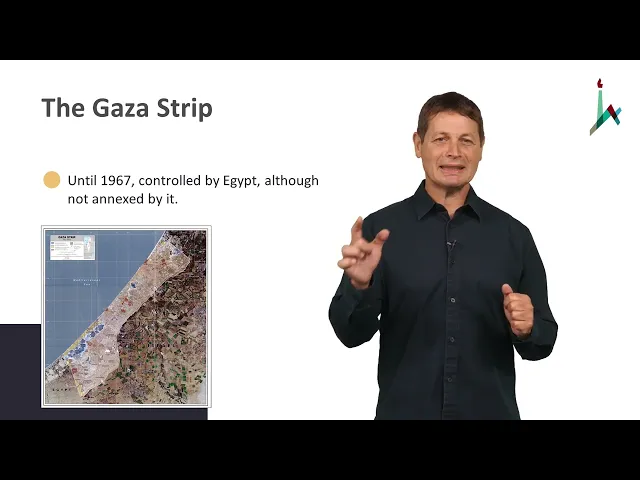
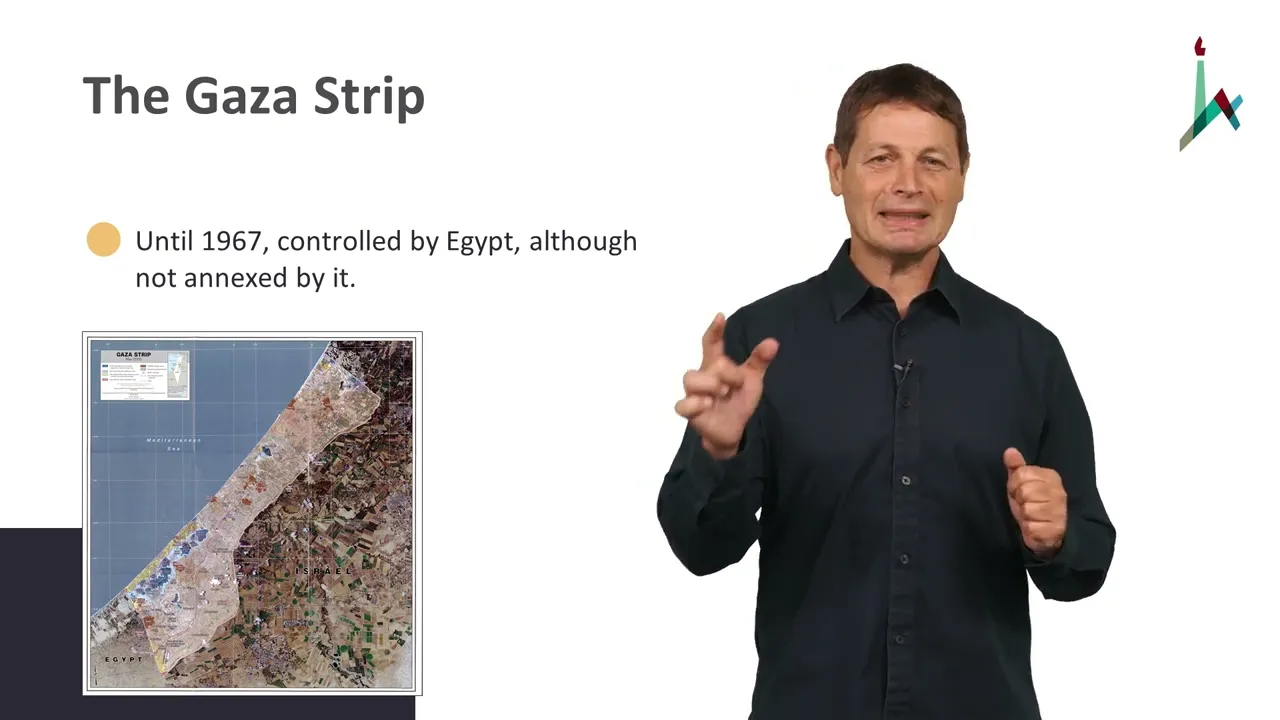
the Gaza Strip as you may remember until 1967 the Gaza Strip was controlled by Egypt but Egypt refrained from annexing the Gaza Strip in 1967 Israel invaded the Gaza Strip but again refrained from annexing the Gaza Strip holding the Gaza Strip under the law of beligan occupation Israel actually withdrew from the Gaza Strip first from the Gaza City under the oso Accords and then in the summer of 2005 when Israel unilaterally disengaged itself from GA from the entire Gaza Strip and and hence today there's no physical civilian or military presence of Israel in Gaza and
Israel doesn't claim any Sovereign or territorial rights Visa V Gaza and hence at least formally Gaza is not the fourth territorial dispute because there's no dispute that Hamas controls Gaza Israel left Gaza and Israel does not claim any Sovereign rights over Gaza having said that as you would see in the session relating to the L of bigant occup a there are very complicated legal issues relating to the question as to whether Israel is still despite its withdrawal subject subject to the laws of bigant occupation but this relates to the question whether is Israel is bound
or not bound by the laws of bigant occupation this is not a territorial dispute as such because Israel as I mentioned withdrew from the Gaza Strip does not does not have any presence in the Gaza Strip and does not claim and his Sovereign rights over it in relation to our analysis of the disputes relating to uh the West Bank Jerusalem and to to Gaza I wanted to add an important footnote and this footnote relates to Israel's position with respect to Palestinian statehood Israel refuses to recognize Palestine as a state based among other factors on the
fact that according to Israel the Palestinian Authority or Palestine does not meet the four prerequisites of the Monte Vio convention so Israel refuses to accept the claim that Palestine as such is a state Israel is willing to accept with respect to the West Bank as supposed to East Jerusalem and Gaza the application of the laws of bigant occupation but it adopts a very Nuance sophisticated political position by arguing that its subjection to the law of beligan occupation ation does not derogate from its legitimate Sovereign claims over the West Bank claims that should be settled in
direct negotiation between itself and the Palestinians so in this session I attempted to provide you an historical and legal analysis of the territorial disputes between Israel and its neighboring countries dealing with Israel's recognized borders under international law we dealt with the British mandate we dealt with the partition plan we dealt with with the armis this agreement with the Six Days War with the various Peace Accords and we were left with three territorial disputes one relating to the Golan Heights the second to Jerusalem and the third to the West Bank adding to this complexity the issue
of Gaza which again I insist on reinforcing the fact that Gaza is not a territorial dispute as as such I wanted to conclude the session by sharing with you some of the more recent international events that project or reflect on those territorial disputes and I would deal with some of the major cornerstones there starting with the advisory opinion of the icj relating to the legality of Israel's construction of the wall in the West Bank and this advisory opinion which we would analyze during our session relating to the laws of bent occupation the icj insisted on
treating the West Bank including East Jerusalem as occupied Palestinian territory hence the icj provided strong support orbe it in a an advisory opinion as opposed to a judgment a very strong support to the Palestinian position of framing the entire West Bank each and every millimeter of the West Bank including East Jerusalem as occupied Palestinian territory by implication The Advisory opinion was willing to kosher Israel's acquisition of territories during the 1948 war and hence the icj provided its advisory opinion based on the green line another interesting development came from Luxembourg when in 2010 the European court
of justice had to address indirectly issues of territory when it was asked to adjudicate a trade dispute relating to the export of Israeli products produced in the Israeli settlement of MIM and there the European court of justice albeit in some implicit terms treated all territories conquered by Israel during the 196 seven as territories that do not belong to the state of Israel so the court treated the Golan hites the West Bank including East Jerusalem as non-israeli under international law this judgment of the European court of justice was followed by a declaration in 2012 by the
European Union and the European Union declared that any future agreement between it and the state of is would have to include a provision that would state in unequivocal terms that the agreement does not apply to occupy territories I territories beyond the green line so again the European unions like the icj treats territories beyond the green line as occupied territories it is interesting to conclude from the perspective of the European Union that the same European court of justice in 200 and 19 in the pagot Judgment insisted on the fact that Israeli products producing the settlements and
exported to the European Union should be should have labels explicitly stating that those are settlement products and the court Justified this conclusion by insisting on the fact that those territories are not under Israel's legal sovereignty under international law so the European Union general approach is in is treating Israel's Borders or Israel's recognized borders according to the green line another important development came in the year of 2012 when the UN General Assembly recognized Palestine as a non-member state this recognition was based on the Palestinian application and the Palestinian application was based on the green line and
hence you can see yet another intern National Organ providing support for territorial claims based on the green line a another important development came in the year of 2015 when Palestine exceeded the Rome treaty and was part and became part of the IC later on in the year of 20021 the IC came to the conclusion that it has an authority to investigate actions and omissions committed not only in the Gaza street but in occupied Palestinian territories again basing its judgment on the green line another International organ and another International resolution that provides support for H territorial
claims that do not overlap with the Israeli position is the UN Security Council resolution of 2016 the resolution 2234 which treated the West Bank including East Jerusalem as occupied Palestinian territories and called the UN members to differentiate between proper Israel and O occupied territories controlled by the state of Israel two additional major developments which are more political as opposed to Legal are the decisions in 2018 of the Trump Administration to transfer the US Embassy from Tel Aviv to Jerusalem it is true that this decision did not enter into the precise settlement of of borders within
Jerusalem but it has at least political implications where the major superpower establishes its Embassy in Israel in Jerusalem another development was in 2019 when the Trump Administration under a presidential Proclamation recognized the Golan Heights to be under Israel's sovereignty again it's a political declaration as such and I believe it has no legal implications as such because it does not overlap with the overall position of of the International Community so in the session I shared with you some of the main legal issues main legal challenges and some of the main legal answers to Israel's borders under
international law although I must admit as a lawyer that international law and and real politic do not overlap because if we saw in this session that by and large the International Community attempts to advance a resolution of the conflicts based on the Green Line This is international or real politic would would not necessarily allow such a resolution because of internal political positions in Israel so one should understand that the fact that international law by and large refers to the green line does not necessarily mean that the any future resolution would actually be along the lines
of the green line thank you very much