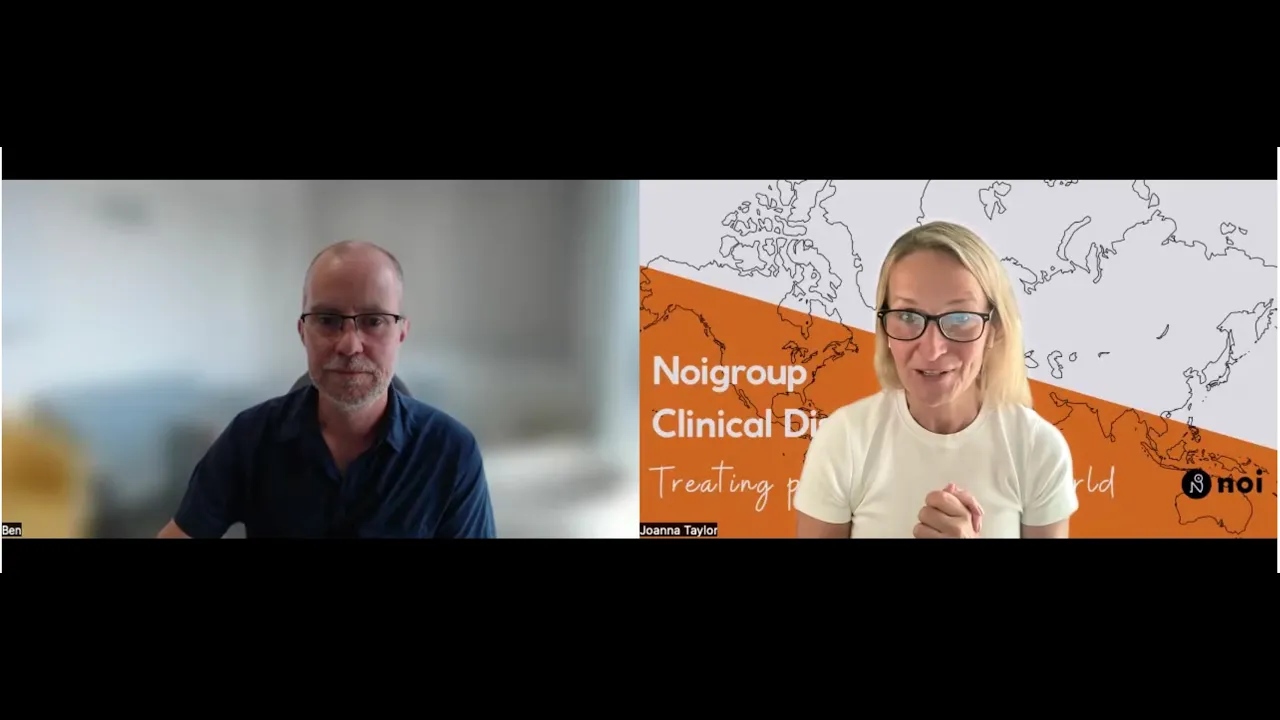
we run out of time. So, okay, welcome and a very warm welcome to this Noi Group clinical discussion. My name is Joanna Taylor and I am director of Noi Group Europe and I am joined this afternoon by Noi Group teacher and my very good friend Ben Davies, Dr Ben Davies.
Welcome Ben. Hi, Joe. Hi, everybody.
So, for those who have uh missed any of Ben's previous sessions, Ben is an advanced practice physiootherapist specializing in persistent pain and rheumatology. He brings over 20 years of experience teaching explained pain and has a gift for making the complex neuroscience accessible and immediately applicable. So, Ben, it's great to have you back.
Would you be kind enough just to tell the audience what it is that you are currently working on, please? Uh so I work in Bath in the UK. I work at the Royal National Hospital for Rheumatic Diseases and we have a specialist the only center in the UK for axial spondal arthritis.
That's a a rheumatological condition that leads to spinal stiffness and we have a residential course that people can come and stay with us on site and it's a multi-disiplinary team of physios, OT's podiatrists, a psychologist and the medical team who try and equip that person to live well with axar. um for all their life because it's a lifelong condition. Fantastic.
Thank you. Uh thank you for sharing that with everybody. These sessions are all about giving you a taste of explain pain and how to practically use it in the clinic.
Some of you will have already done an explain pain course and for those of you who have, this session will reinforce what you have already learned. But if you're new to explain pain, this is going to give you a little taste of what we cover in the core course. So, Ben has an upcoming two-day explain pain online course on the 9th and 10th of July.
And if anybody is interested in attending or finding out more about that, we're going to give you some details about that at the end. So, just hang back and you can find out more then. So, just a couple of things to mention.
We're going to be talking for about 20 25 minutes. If you have any questions, please drop them in the Q&A or in the chat and we'll get to as many of them as you can. And if you want to watch the recording of this session, I'm dropping a link to the clinical discussion group where it will be uploaded a bit later on this afternoon.
And there are about 60 other of these videos there too. Um and Ben does many of them on a whole range of different topics. So it's a great free resource.
Please do go and subscribe, like, share it with your friends, um colleagues, and um it it's a great place to go and find out loads about what we cover in Explain Pay. So today we're talking about when pain doesn't match the scan and how to reason through no cplastic pain. I knew this was going to be popular, Ben, when when we released it.
We've had a lot of signups, so that's great. Um, it's the clinical reality that many clinicians face. You have a patient sitting in front of you with significant pain, but their scans don't reflect it or are even completely normal.
So could you explain what is going on neurologically when the pain doesn't match the imaging? Um for all the clinicians on here, it will depend of course the kind of clinician you are, your profession, your work setting. But I guess part of our confidence is understanding what different scans show and what different scans don't show.
Um and maybe if you mean by scan let's broaden that kind of imaging and and the idea of objective imaging that medical medical services might provide. So in X-rays are brilliant at bones but that's pretty much all they show. They'll show osteoarthritis, they'll show axar, they'll show erosions from rheumatology, but they'll show nothing else.
MRI scans can be asked to show all the soft tissue. So we can look at disc bulges and we can really good at finding age related changes as you get older that they're normal. They're really good at finding the cancers and the tumors and the fractures and the TBS, but but they don't show pain.
CT is different. Again, nerve conduction studies will show that is this nerve carrying information at certain speed, but it doesn't show how much information is that nerve carrying. So I think as clinicians we've got to have some confidence in understanding all those different modalities and depending on where you sit, which modalities are you likely to come across.
What modalities, if any, has your patient had in their journey to get to you. I think we should know what scans and imaging show and we should also have some language about what they don't show. So MRI scans is I suppose the most common example.
You have a pain somewhere in your body and you want medical services to image it. This will show me the problem, won't it? I' I've got to the scan.
I've paid for the private scan. This is the answer. Now I'm going to get that report and have that follow up with a clinician that says this is the problem we were looking for.
And a clinician and people may well have had this experience when you go, it's good news. You've got a normal scan. Bugger thinks the patient.
I really wanted the answer to why I've got this pain and now you're telling me there's nothing to see this. What do you mean it's normal? Okay.
Well, scans don't show they show that you don't have cancer, you don't have a fracture, you don't have ankyloin spondylitis, you don't have TB, but they don't show many things. And one of the things that none of these modalities show is pain. They don't show the activity in the nervous system.
and they don't show the experience of that nervous system. And I think we've got to have some language about articulating the pros and the and the cons and the fitting this into the bigger clinical picture, which is I suppose one of your later questions. How do we fit the imaging into the whole jigsaw of the person sat in front of us?
Their story, their experiences, their symptom, descriptions, locations, what works, what doesn't work. blood test perhaps different kind of medical imaging in some way but a different kind of objective testing imaging is part of that jigsaw it's not the whole so we've been able to articulate that okay um so the next the second part of the question was what is going on neurologically when the pain doesn't match the imaging So I think what is the kind of pain that that person's experiencing? We will have these labels and as you said JOC plastic I'm going to come back to in a second.
No plastic perhaps is this newest term IASP defined it I forget a few years ago four or five years ago this definition new a new form of pain a new subcategory of pain the categories of pain clinicians on this call are probably most familiar with noceptive something's happening in my tissues you know the more I stretch this tissue pretty much the more it hurts the more I put my hand on a hot plate the more I heat my tissues up the more I cool my tissues down if those extremes of temperature carry on this is going to do me damage. Inflammatory noceptive pain. I've got inflammation in my tissues that are stimulating nerve endings that are sending messages that's making me feel achy and stiff and and I pay attention.
Those patterns are going to have those that problem is going to have a certain pattern. Where does it hurt? What are the provocative factors in that person's experience?
You know, if I do this, it hurts. If I don't do that, it doesn't hurt. It hurts in the joint or at least it feels like it's in the joint.
So these are patterns for noceptive mechanisms. Neuropathic nerve related more likely to be related to the pattern that nerve supply like ulna nerve distribution. You could all now hit your funny bone.
It's not a bone. It's a nerve. That gives you a certain distribution that is on the nerve.
A certain nerve root impingement in your neck will give you a certain pattern into your arm. a certain patternish, it's unlikely to look exactly like the textbooks. And those neuropathic mechanisms tend to give certain descriptions.
People will say, "This pain burns. It itches. It feels like water's running down my arm.
It feels like something's running up or down my arm, on my skin, pins and needles, numbness. We'll leave central mechanisms, but we will allude to them. But um no plastic mechanisms are when this peripheral nervous system has become more sensitive than the default normal.
So I've got nerve endings in here. I've got receptors that are sensitive to temperature, high temperature, low temperature. They're not usually sensitive to warmth.
Put my hand in a warm bath. that doesn't stimulate no receptors and needs to be a hot bath or a cold bath. We have a level of sensitivity that if you like we've evolved through life where we are paying due attention to our body through our experiences but that peripheral sensitization that peripheral awareness can be upregulated and the I guess the uh neurobiology is that the receptors at the ends of these neurons the number of those of those receptors gets turned up.
we produce more of them. The cell bodies that sit all the way up here produce more proteins that are nerve receptors, they travel down through the neuron. They get to the end of the neurons and they get inserted into the terminal branches.
So your your immediate sort of senses out in your tissues instead of being three out of 10 on a sensitivity scale are now four out of 10 on a sensitivity scale, five out of 10 on a sensitivity scale. The pattern for this is everything begins to sort of be a bit more sensitive. It isn't so much pull to an extreme and it hurts.
It's this this now hurts. Even just moving my thumb, even thinking about moving my thumb, even the touch of light light fabric on my clothing or on my bed sheets produces a noxious message that then of course you've got the whole spinal cord to consider. And then what the brain receives and what the brain interprets by that.
It's peripheral sensitization. We'll often think about that as as inflammation is inflammation chemicals or injury creating peripheral sensitization. But it's that the receptors have become upregulated.
Our periphery is now more sensitive to what might well be normal information about our body. Brilliant. Thank you.
Thank you for the the distinction between no susceptive neuropathic and nosuplastic. I think it's still these terms are still relatively not all you know the nosoplastic is still relatively new I think and that was really really useful to understand the distinction and I think also it's really important that clinicians recognize you know we read textbooks we come to courses like explain pain and and there's sometimes the suggestion that if you like what is the pain mechanism for this person can we define the mechanism I know David Butler would say look actually and people like Laura would say look all of these are mix all of these processes are happening when I have a pain experience some stuff is probably happening in my tissues and my nervous system neuropathic mechanism something's happening in my nerve and it's crossing my spinal cord so central mechanisms are part of that even if it's this acute you know provocative pain test and my brain's receiving that so my brain is relevant am I super anxious about this bit of my body. Am I not bothered at all?
Am I, you know, what's going on up here? I think as clinicians, we need to rather than use the word what pain mechanism, but what's the predominant what's the sort of main pain mechanism, but you're going to have neuropathic mechanisms to happen with everybody. You're always going to have a spinal cord contribution and you're always going to have an emotional attention to the body or attention away from the body, a level of anxiety, a level of confidence, a level of selfefficacy.
You're kind of trying to work out where's the predominant mechanism about treatment. That big brings us on completely to the next question and and that is about how do you assess and reason through whether a patient's pain is noceptive, neuropathic, no plastic or a mixture of all three. Where where do you start with that kind of thing?
So things like patient descriptions, you know, really listening to the person, those slightly throwaway words perhaps people might say, it sounds ridiculous, but it feels like answer running down my arm. Yeah, I've heard I've heard that hundred times. Let me normalize that for you.
You know, that really indicates this is predominantly perhaps neuropathic. When someone says, "This pain is all over my body. All these scans you've done for me are normal.
" Um, they've alluded to childhood trauma and adverse childhood events and difficult upbringings. we're gonna and their mood really has an impact on their pain and stress really has an impact on their pain and drugs really don't or drugs of all flavors don't really impact on their pain. We're going to kind of think do you know what I think this is predominantly central mechanisms that doesn't mean it's all in the brain.
It doesn't mean it's all in the spinal cord, but predominantly if you like that's where I need to aim treatment, but we've got to be mindful of the periphery as well for no plastic pain. And perhaps this is really common in things like fibromyalgia. Again, it's going to be some degree of widespreadness.
It's going to be some degree of lack of almost like sensitivity to testing. If you're a physio, you're an osteo, you're a chiropractor, if you're doing manual therapy, if you're physically assessing the person, they're normal. Their nervous system is normal.
It works. It's not not working. In fact, it's almost overworking.
So things that sort of sense check, how sensitive is your nervous system? some of those objective markers or objective tests or things that we do to people to elicit what we think of as truthful information can be really useful. But it's the patient story.
It's the normality of things like scans which won't show no plastic mechanisms and it's the in it's the implication of your physical assessment probably finding that lots of things hurt. Yeah. Yeah.
Thank you. That's fascinating, Ben. Thank you very much.
Um, and this brings us on to probably the the bit that people often find the most tricky, and that is how we explain nasoplastic pain to patients um without how do we do that without reinforcing that it's all in your head or frightening them? Uh what are some of the key key points that we need to think about for this? I mean I know on these calls these these webinars before jobs I will have said something similar but I think first of all it's that val validation to the person that what they're experiencing is what they're experiencing that that sense of trust that they need in you as a clinician.
Um, they need to know that you have listened, that you've understood, you've acknowledged all the impacts that this is having on them. One second. Have a quick drink.
I think you may have said this before, Ben, but we but that happens a lot in these webinars because there's always repetition. I mean, it's all linked, isn't it? And sometimes we go into a lot of depth on this one subject.
In fact, I think we've done a session in a lot of depth just on how to uh it's not all in your head, but we'll just we'll just cover this at a high level today. Thank you. Okay.
Yeah. I mean, acknowledging, validating, ensuring an empathic relationship, I think, is key. Without that, you'll get nowhere.
Yeah. So, that's probably front and foremost. When they've come with the scans, that's the title of this session, is it?
they've come with those imaging studies being equipped to say look these are the good things this shows no damage no no cancers no tumors however what it doesn't show is the reason for this pain now that doesn't mean it's not real and I would just be overt and say this doesn't mean it's not real this doesn't mean this is imagine psychatic all in your head what it's really good at doing is ruling out the nasties but it doesn't it doesn't show this so in your jigsaw we've got pieces here that are useful and pieces here that are maybe need to we need to fill in the gaps now. Yeah. Um the story the whole almost the whole life story of that person who's come to you, you know, they may have had a trigger that's initiated this pain experience or at least it's brought them to your clinic.
Could be a longerstanding pain experience, but what's their what's their history? What are their patterns of the thing things that make this worse? If it doesn't have that clear mechanical aggravating and easing factor pattern, if it doesn't have a clear 24-hour dal inflammatory pattern, stiffness in the morning and eases with movement.
If it has an unpredictability about it or its aggravating factors are things like stress, mood, certain people, certain places, these things would be the things that would make you your clinical spidey senses go this feels like it's moving towards a noslastic predominant mechanism. And they may allude to again depends on your profession, but it may allude to their moods or have you got ways of un asking about people's moods? Whether that's through questionnaires, whether that's through just simply asking, "How's this affecting you emotionally?
Are you feeling worried about this? Are you feeling sad about this? You feeling in control or out of control?
" You know, these empathic person- centered questions that can just elicit an understanding of their mood state. And perhaps lastly, has there been trauma? And we're here.
We're talking emotional trauma, social trauma, bullying, workplace trauma, sexual assault, good parenting as a kid, poor parenting as a kid, attachment, all of the social security, financial security, all these things. Just understand that setting that the person's in their life setting because that's again sliders when those things are kind of off optimum. You might think of them as sliders that take you towards these nosy plastic and central mechanism more so.
Yeah, I love the way that you um gave that sort of conversation starter if you like, which is, you know, you you look at the scan and you know, this is good news and scans don't show everything. And that gives you sort of the in, doesn't it, with the patient into talking about the the noplastic pain and uh the different types of pain that could be presenting that wouldn't show on a scan. Yeah, it is tough though.
I mean definitely we don't this these messages don't always land. We certainly who say well if the ordinary MRI scan is normal can I get a super duper MRI scan you know super high resolution type idea and I think many people really struggle with this idea that why can't you see it? Yeah.
If you can, you know, if you can build supercomputers and you can put man on the moon and you can go to the far side of the moon, all these things, why why can't we see this problem? I'm really curious to know that if somebody does say that to you, Ben, this is sort of tied in with our last question really, which is for clinicians that are seeing this kind of thing regularly. What's a really practical clinical tip for somebody that says, "Can I have the super scan?
" What do you say to to your patients if they come to you with that? I think you can you can sort of say look at the end of the day pain is an experience you know in the same way that me sat on this f second floor room looking at across bit of car park and the Dyson cancer center over there like I'm experiencing this and we don't know how we experience things we don't know how we are conscious in the moment we don't understand human function to the level that we can kind of understand consciousness and conscious experience so I think maybe we've got to say look This is a gap in our knowledge. We do not understand this fully.
What we do know is all these things contribute and in some way our system is super good at giving meaning to all of these all of this relevant input. It may be that your system's giving meaning and that if you like the end result of that decision- making is this situation you're currently in is somewhat threatening and the best thing to do about this is to warn you about that threat by producing a pain experience. Doesn't mean it's not real but it means it's complex.
So if we can unpick all these things that are sort of contributing to that sense of needing to be on alert and that might be psychological things that are outside of your scope, my scope, we need psychological support. It might be social support. We might be thinking about housing and job security and and caring roles.
How do we help that person bring that level of sensitivity down? Yeah. Yeah.
Brilliant. Thank you. That's great.
Great answer. Um there's a really brilliant question here actually from Beth Owen. Um and she says, "Do you explain normal age related changes?
" Yeah, totally. Absolutely. Uh and you know I I don't have the figures to my to my head or my hand but yeah absolutely Bethos you know on a 56 year old you'll find disbulges in 80% of people who have never reported back pain.
You know I'm 52. I don't want to have the spine. An MRI of my spine.
I've never had one. It's going to tell me stuff I'd be better off not knowing. So, absolutely, normal age related changes, I think, are great phrases to use.
And make a bit of a joke about it. Oh, these these radiologists always say degeneration. That sounds such a scary word, isn't it?
What they mean is change is normal for your chronological age. And of course people are surprised that actually those changes become observable 30s onwards not just 60s onwards but like certainly in a time in life when people don't feel old. That's a comfort isn't it to to just mention that that the changes start from your 30s but the less fear around it in your 30s than there may be say in your 80s.
I tend to make some jokes about it like you know your face is a little bit more lined than it used to be. your hair's a little sprayer or you've got less of it than you used to be. Those are painfree age related changes safe.
Yeah. Kisses of time. Did Beth have another question?
I've not got the Q&A. I think it was a statement really. And Beth says, "I don't feel it's helpful for a patient to believe there's nothing wrong, i.
e. their spine is perfect. The reality is changes are very present since teenage years.
" That's pretty much Yep. Exactly what Ben's just said. Um and management is maintenance rather than fixitative.
This helps the mind if the patient engages with the body. Yeah, that's really that's really true. I like that last bit engaging with the body Joe because I know you've sort of got practical almost like you know how do we manage this and I think it's that engaging with the body.
I think when people have got no plastic pain or pain that is predominantly no plastic let me rephrase to follow my own advice. You know, it's really common that people have become aversive of or avoidant of, you know, day-to-day life, exercise, stretches, things that are provocative because you haven't got a clear explanation. Really sensibly.
You don't want to make it any worse. So, you don't want to do the wrong thing. So, what do you do?
You, you know, life gets smaller and and the map of your life gets a little bit smaller. I think as clinicians a hugely important part of our role there's lots of parts to managing maybe no plastic complex pain but a physical thing is how do we get them to engage in their body again use their body again in that sweet spot I know Tasha Stanton will talk about the sweet spot for OA management like not too little not too much where's the sweet spot where's that Goldilocks zone of just the right amount of movement And that could be Pilates based, yoga based, ta based, it could be in the gym, it could be weight training, but it's like not weight training like you did 15 years ago or 20 years ago, but recognizing this is where you are now. And the fact that these imaging things don't show fractures and im arthritis and bad things is you're really unlikely to do yourself any damage.
You're highly likely to flare pain up if you overdose that exercise. But if you can just find that right level, and that's where our clinical expertise and guidance perhaps is crucial, you butressed up the education and the sort of physical rehab, exploring your body, getting fitter, getting stronger, but that there's something and I don't Joe, I don't think this is being researched, that confidence in the body. Yeah.
that subtle confidence in the body where you just begin to kind of go I've got I can do this and I can have control over grading that exercise slowly but surely back and then life gets a bit bigger and social connection perhaps becomes an option and work becomes an option and perhaps some of those other contributors can sort of be down reggulated at that point. Interesting. Yeah, I hadn't thought of that.
Really interesting. Uh thank you Ben. Uh Irene we have time for your last question uh just before we finish.
And Irene says is arthritis different to age related changes? If osteoarthritis no I'd say that's pretty much synonymous. I mean you can have clinically significant if you like age related changes.
We'd call that there you go you've got an osteoarthritic knee with no joint space and knee replacements appropriate. But that's a sort of women, I think, when you're at the lesser end of the spectrum. Just being able to say, "You've you've got the spine of a 50-year-old.
Brilliant. That's exactly what I'd expect, assuming they're 50. " You know, that's that's great.
There's nothing sinister about this. There's nothing catastrophic about this. But no, I think you should recognize and validate that of course the body changes.
This is normal, but it isn't predictive of necessarily pain or function impediment or need to overprotect and to stop hobbies and sport and work and social life. Yeah, brilliant. Thank you very much.
Imaging to full circle Joe. The imaging is one part of this picture, one part of the puzzle. Yeah.
And I think that is the important thing here is to sort of remove it as being the main part of it. Uh because there's all the other there's all the other information that is part of uh what's presenting in front of you and helping your patients to understand that it is just one small part of the process of uh diagnosing and rehabilitation. Fantastic men.
Thank you so so much. really enjoyed that and I think everybody that's watching has really enjoyed because they've all stayed. You can always tell questions.
Thank you for giving up lunchtimes or breakfasts or late evenings. It's really appreciated. Yeah, thank you.
Um, so for any of you who are interested in doing a deeper dive with Ben, I'm sure you've got a sense today of his teaching style and just how completely knowledgeable he is about absolutely everything. You can ask him anything. And no, I mean that seriously that he does have a real skill for making complex understandable.
Uh so if you are interested in spending a couple of days with Ben going into all this uh in a much deeper way then he has an explain pain course on the 9th and 10th of July. Could you just tell people Ben if you don't mind what they would expect to come away with if they were to spend two days with you in July on an explain pain online course. I think we try and bring uh whoever comes we try and bring everybody up to a kind of level of the big picture of pain starting with I've touched on this like trying to understand how we're conscious trying to understand these discrepancies where people can have minor injuries major pain you can have major injuries but no pain how does that work uh we think about the biocschosocial model and um mature organism model frameworks to think about these pain pain mechanisms we do then go into central natural mechanisms and neuropathic mechanisms and noisyeptic mechanisms.
So we kind of go into the the science of what leads to those pain predominant mechanisms and threaded through that there's nuggets Joe there's nuggets of you know how do you say this to a patient what's the metaphor what's the drawing you might come up with what's the analogy that you might use to to help clinicians talk to patients about these things recognizing that patients don't need the science patients need the the kind of utility of this knowledge and they need to put that knowledge into into practice in some way. So, it's a sort of some I think of it as an old school explain pain course. It's brilliant.
I've sat in on um a lot of Ben's courses and one of the things I really like about the way Ben teaches is that you come away with so many practical examples. you know what to say, how to explain this, how to explain pain, but what to say to your patients, how to explain really difficult com uh concepts in simple terms. Just tons of examples threaded throughout the whole course that keeps you they it keeps you engaged and so many ideas to go away with practically into your own clinical practice.
So the link is in the chat. uh we will send the link out to this recording um afterwards and again there'll be the link to the course if you want to go and have a look on there and see if it might be for you then um also we will there are lots of other clinical discussions with Ben on the YouTube channel go and check those out if you have liked what you've heard today thank you Ben thank you for sharing your expertise with us and thank you to everybody who has joined us live in this clinical uh discussion for spending the last half an hour with us and if you're watching on replay. Thank you for watching also and we look forward to seeing you again in the nots so distant future.
Thanks very much everybody. Thanks Ben. Take care.