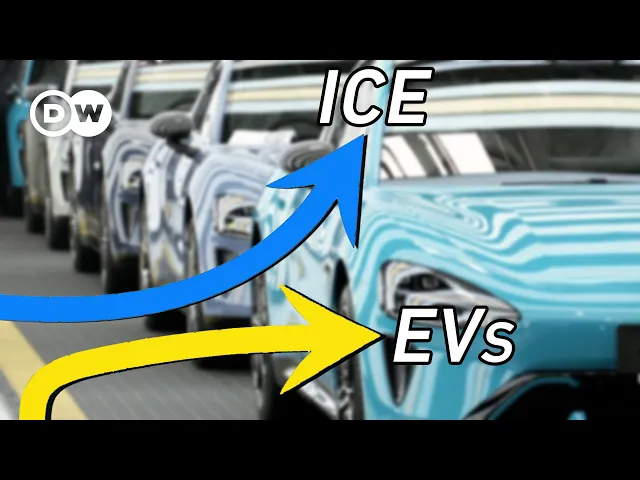
Think electric vehicles are taking over? Well, think again! Internal combustion engines seem poised to make a roaring comeback.
Though EVs are still grabbing the headlines… "Electric cars are having a moment. " "The demand for electric vehicles is booming worldwide. " "Sales of electric vehicles are projected to boom over the next few years.
" "The EV boom is here to stay. " So why are drivers and car makers doubling down on ICEs, despite the climate crisis? "The world is waking up and change is coming, whether you like it or not.
" Fueled by a modern-day gold rush, companies and governments poured billions into the EV market, driven by grand promises of a cleaner, greener future. But now, as EV sales plateau, some of the industry's biggest players are retreating from their ambitious promises. Europe’s biggest carmaker, Volkswagen, is considering closing factories for the first time in its history.
Electric vehicles from China are cutting into its market share, and high energy costs make manufacturing in Germany uncompetitive. "The big party that this industry has enjoyed -- and from which German manufacturers long benefited -- is over! " "I don’t think anyone had ever thought that the once-in-a-century transformation of the auto industry would be a straight line!
There will be peaks and troughs! " But it's not just a German problem. Other European carmakers face similar headaches, like Renault.
"The truth is we are not yet on the right trajectory to achieve 100% electric cars by 2035. If customers don't follow us, we're all responsible. We need to cut costs.
" "The global EV share in terms of sales is slowing down and customer adoption rates are not as high as expected just a few years ago. " The result: Ford is axing its electric three-row SUV, and delaying a next-gen pickup. Plus, it's committing to future gas and diesel models, citing a lack of consumer interest in fully-electric cars.
This sudden shift casts doubt on the sustainability and the immediacy of the EV revolution. Are we witnessing a retreat from overly optimistic promises? Is the widespread adoption of electric cars truly feasible, or a dream too far?
Switching to EVs aims to cut carbon footprints, reduce reliance on limited resources, and fight the climate crisis. The vision was clear: electric vehicles would be the ultimate solution to our environmental woes. "The European Green Deal was born out of this necessity to protect our planet….
Take the electric vehicle sector. It is a crucial industry for the clean economy with huge potential in Europe. " Major players like the US, China, and the EU have implemented laws and incentives to boost EV adoption, aiming to phase out ICE vehicles by 2035.
But this transformation isn't merely a technological shift; it's a complex dance involving geopolitics, economics, and infrastructure. "Electric mobility has a very high probability of becoming the main form of propulsion. And if you miss out on this window of opportunity, by sticking too much to the old, then that might become an existential problem even for the large giants of the industry.
" EVs looked to have a bright future. Worldwide, sales just kept growing -- until 2024 when they started to stagnate. Plug-in hybrids and ICEs saw a resurgence.
Big car brands read the writing on the wall -- and began walking back their ambitious EV targets. In Germany: new EV registrations are set to fall for the first time, by just under 14 percent, in 2024. That's mainly because subsidies and tax breaks were rolled back.
These play a direct role in EV adoption. “The recent decline in e-vehicle sales, month over month, certainly has been influenced by the main factor: the reduction of government subsidies in many markets. Because they made the products very attractive – not only from the hard figures, but also from a psychological effect.
” "In Europe or in Germany, we're seeing that plans for EVs are being scaled back or slowed down repeatedly. Of course, this is also related to the current slowdown in sales, since you don't want unsold cars standing around on your parking lot. " Shifting to EVs isn't as straightforward as it seemed.
There are two major hurdles for EV adoption. "The prices are a little bit high for EVs, and people are choosing to deal with that in the marketplace. You know, they're choosing other solutions.
The product offerings are outstripping the EV charging infrastructure available. " But it’s not all doom and gloom. Projections suggest that EVs could make up 50% of global passenger car sales by 2035 and 70% by 2040.
However, ICE vehicles won't disappear overnight. Their long life cycles mean they'll be on the roads for decades to come. While the likes of Canada, South Korea, and the EU have set ambitious targets to phase out ICEs, the US and China have yet to commit to specific timelines.
Despite initiatives like the Biden administration's funding for EV infrastructure, the reality is that building these systems takes time. In Europe, countries like Germany and the UK have modified their EV mandates due to political changes, highlighting the complexities of this transition. China, on the other hand, is aggressively pushing for EV adoption, leveraging its huge manufacturing capacities and state assistance.
“So the situation in China has greatly or is greatly influencing the world's car market, because it demonstrated, on one hand, for how many applications electric vehicles are now a proper alternative for consumers. ” For legacy carmakers, cheap Chinese EVs have been a wake-up call. In the US and Europe, governments are fending off Chinese imports with tariffs.
But in these two mass markets, that's making affordable EVs less affordable -- putting another dent in EV adoption. “And you look at China, which is the world's largest car market, and they've been going gangbusters on EVs as well. And so you look at these two markets that are going EVs, and then you look at the US market and say: Well, okay, if we're going to be competitive in that space, we need to be looking at EVs as well.
” The tariffs are seen as protecting traditional automakers, whose EVs are big and pricey. Most offer no entry-level electric cars for under 20,000 euros -- unlike their Chinese competitors. Governments around the world are tightening fuel economy standards and setting ambitious targets for EV adoption.
By 2031, automakers in the US must ensure their fleets average 50. 4 miles per gallon, up from the 49 miles per gallon required by 2026. Meeting those goals will require that 35-56% of vehicles sold be fully electric by 2032.
But such policies change with each new administration. “I think you could see some of those policies reversed or changed, like the EPA regulations could change, which might slow down the transition from ICE to EVs. So the automakers would be required to sell fewer EVs to offset the ICE vehicles.
” Legacy automotive brands such as Mercedes, GM, and Volkswagen are struggling to break with old values and rethink their business models. They're developing new strategies in response to market dynamics and consumer preferences. “That is where it's a good position to be in, where your factories can build both: BEVs, but also high-tech, electrified combustion vehicles.
So we have that flexibility in our production system, but we're also readying a next generation of vehicles. " Mercedes and VW have put the brakes on their plans to be fully electric by 2030, reflecting a broader industry trend. This strategic pause allows them to further refine their ICE models while keeping an eye on consumer attitudes towards EVs.
"If you're a well-run company, you try to match supply with demand. Overbuild the EVs and there isn't a demand for them means they sit on the lots. .
. " “The long-term vision for Volkswagen Group is still electric. But that speed that will take us from point A to the future would be dictated by that speed between consumer and infrastructure.
" Volkswagen has earmarked tens of billions of euros for the development of internal combustion engines. This shift is driven by consumer hesitancy towards EVs, their high cost, concerns over charging infrastructure, and range anxiety. Some models flopped, too.
Adding to VW's woes are weaker sales in China. There, the brand is seen as old school: entertainment and fun designs are lacking. So, the carmaker is slashing production at its first all-EV plant.
“We were the lodestar. Now we've gone from being an important lodestar to an important seismograph. ” The Zwickau plant in Saxony has produced electric cars exclusively since 2020.
VW invested 1. 2 Billion euros to convert the factory. "Technically, we're in a position to build 360,000 units a year.
Currently, our output is around 240,000. ” That means one-third fewer cars are leaving the factory. An entire shift has been eliminated.
Among the employees, concern is spreading. So brands are balancing their push for EVs with continued investment in ICE and hybrid technologies. Still, if they miss the gold rush that is the new EV market, they may never recover.
“I don't think that we are many years away [from] where we not only have price parity between ICE and battery electric vehicles, but the electric mobility even becomes cheaper. ” Ford is also hedging its bets. Instead of EVs, this plant in Canada will build F-Series Super Duty pickups.
Ford is spending $2. 3 billion to install assembly and integrated stamping operations at its complex in Oakville, Ontario. The world's biggest car company has adopted a cautious approach to EVs.
Known for its hybrids, Toyota only recently entered the EV market with the bZ4X, which had one of the worst debuts imaginable. "Finally go electric! " “It’s a Toyota!
” “Many of the companies see the hybrid as an interim or a transitory solution. " But it doesn't look like Toyota will be abandoning internal combustion engines anytime soon. They see the future as being ICE plus electric.
Along with Mazda and Subaru, Toyota calls this a . . .
'multi-pathway approach'. The focus is on refining ICEs, so they can be used with electric motors and e-fuels for carbon neutrality. "Because Toyota is a full-line and global company, we cannot leave anybody behind.
That is the determination we have. In that sense, we have this approach called 'multi-pathway' and we have to take it. " Toyota is focused on maintaining a range of powertrain options to meet varying consumer needs.
For decades, Toyota's Corolla has been one of the world's best-selling cars. As EVs gain traction in developed countries, less industrialized regions still rely heavily on ICE vehicles, due to cost and infrastructure constraints. Toyota has bet big on hybrid and ICE technology, an approach that works for them.
At least for now. "But the big danger is that you overestimate the potential in this, I would say very ripe and mature technology, and that you forget to invest in the future. " We'll have to wait to see if Toyota’s gamble pays off in the long run.
The future of internal combustion engines isn't a simple narrative of obsolescence. Despite the global push towards electrification, ICE vehicles will remain relevant -- especially in regions with slower EV adoption rates. The long life cycles of ICE vehicles mean they'll be on the roads for decades, and ongoing technological advances are making these engines more efficient and powerful.
The industry is moving towards a diversified approach to propulsion, balancing the benefits of EVs with the continued development of ICE and hybrid technologies. “What we are seeing now is a slight dent, right, on the road to electric mobility. Because to whomever you talk in the industry, in the medium term, the paths towards a sustainable mobility will in many, many, many use cases, be an electric one.
"We shouldn’t doubt. We cannot stop progress of technology, okay? And electric cars will be the dominant technology in Europe.
" So, will electric vehicles really kill the internal combustion car? The answer is a soft no, but the shift to EVs is inevitable, driven by environmental imperatives and technological advances. Though, as we've seen, ICE vehicles will keep running strong, particularly in regions with slower EV adoption rates.
Yet carmakers slow to switch gears in this ever-changing market could find themselves stranded by the roadside and out of gas! What do you think? Combustion engines: Yes or No?
Let us know in the comments below!