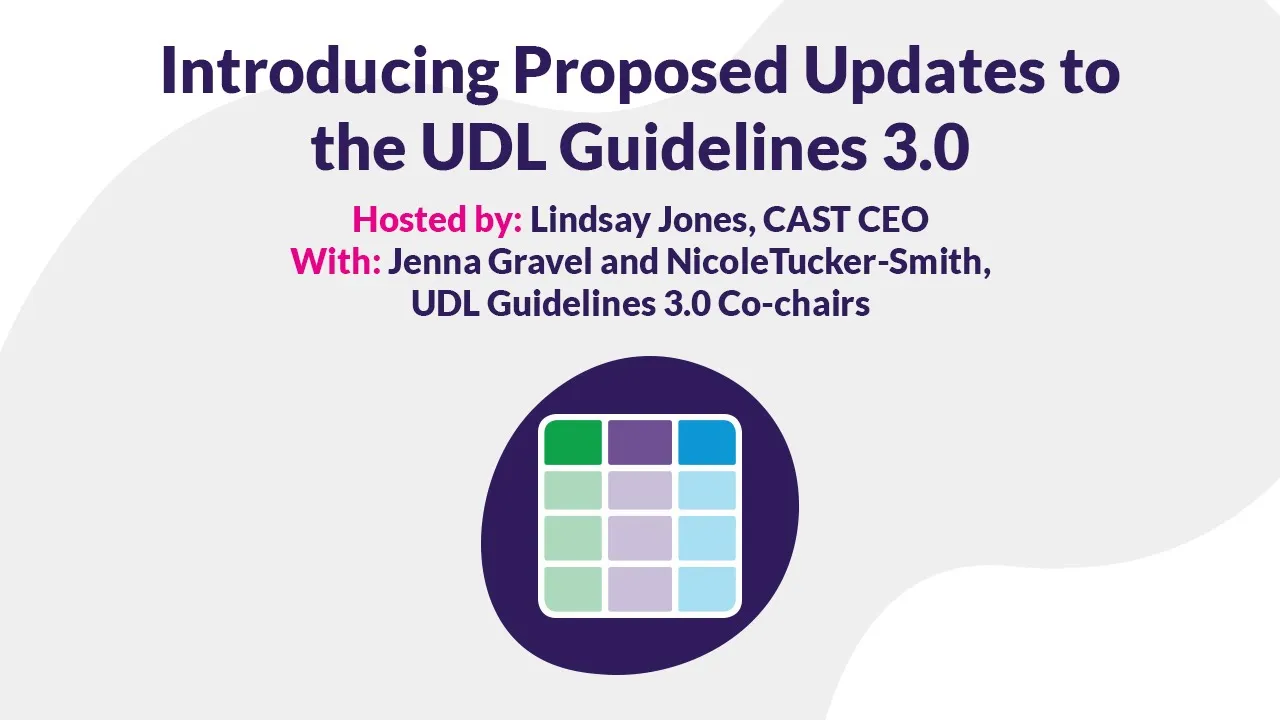
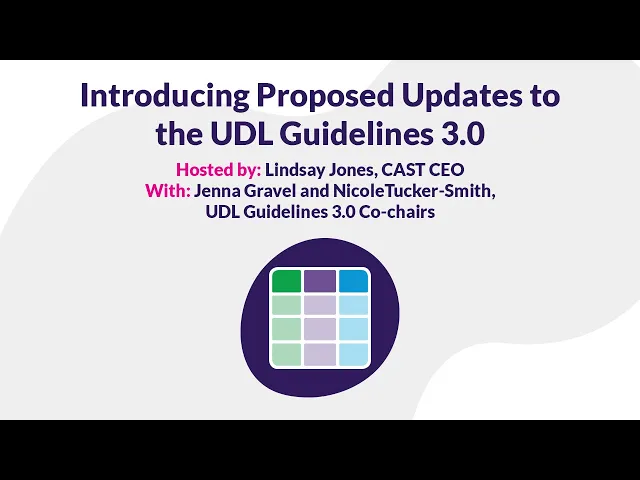
- Wow, welcome, everyone. It's so exciting to be here with you today. Welcome to CAST's webinar on the introduction to the proposed updates for UDL Guidelines 3.0. I am so excited to be here with you. After four long years, we have a final draft of UDL Guidelines 3.0. Woo! This is great. If you don't know me, my name is Lindsay Jones, and I'm the CEO of CAST. The Guidelines 3.0 process started in 2020. It's been underway, it had been underway for two years when I joined CAST in 2022, and it will come to a close
this July at our UDL-Con event, which will be in person in Sacramento, California and online. We hope you can join us there. I'm opening today, and then I'm passing it to our two other amazing co-chair speakers, Jenna and Nicole. If we can see that slide please so folks know who will be moderating and presenting. There we all are. So very shortly, you will be hearing from the two co-chairs of this effort, Jenna Gravel and Nicole Tucker-Smith. If we can pull it down. I have some thank yous to start with. I wanna start by thanking those
two amazing leaders of this work. Jenna Gravel, Senior Research Scientist here at CAST, and Nicole Tucker-Smith, one of our national faculty members and a tireless advocate for UDL all over the world. Thank you both. I also wanna thank Leila Lester, our project manager extraordinaire who kept things on track and kept everyone here at CAST moving this forward. I wanna thank all of our team at CAST. I also wanna thank the members of our Advisory Board, our Young Adult Advisory Board, and our Guidelines Collaborative. So many people have contributed to this process, and we are grateful
for all of their time, their energy, and their effort. Finally, I wanna thank David Rose, who, alongside Jenna and Nicole personally kicked this update process off four years ago. Thank you to David and our entire CAST board for their ongoing commitment to end investment in this process. Speaking of David and our board, I can't host this webinar today without letting you know that CAST is celebrating a big birthday this year. It is CAST's 40th anniversary. CAST was founded in 1984, and when David Rose, Anne Meyer, Skip Stahl, and Grace Meo started CAST 40 years ago,
they had a simple but revolutionary premise. Children aren't broken, the environments they're operating in aren't well-designed. They started working with nine students with very significant learning disabilities, cognitive disabilities, and physical disabilities. They used technology to change the design of their learning environment and their learning experiences to make it more flexible, and they had incredible success. Each one of those young people went on to accomplish things that no one thought were possible for them. One of them, Mason Barney, came to speak to our CAST team just a few weeks ago. Today, he is an attorney, a
husband, a father, but as he said, everyone thought he would fail. Most people, as he said, just wrote him off. Now he is thriving. Change the design, unlock the potential. So at that point, our founders naturally said, "How can we scale this? "How can we reach more people to change their lives also?" And Universal Design for Learning was born. Its core concept is a fact of neuroscience, that all of our brains are as different as our fingerprints. Variability is the norm. If you're on this webinar, you know that the UDL framework, rooted in neuroscience, remains
the same, and that the guidelines are a tool that we use, and they help us implement the framework. They're options to trigger thinking about ways to make materials and environments more flexible. The first guidelines, Guidelines 1.0, came out in 2008. They're a design thinking tool to help us find barriers to learning. Here at CAST, we've updated them, as our speakers will talk about today, continually, and we will continue to do so as we learn more. And at CAST, we work on research and practice, but we are rooted in research. It is especially important that this
updating process involve both qualitative and quantitative research. Jenna and Nicole conducted hundreds of focus groups. We received survey responses from 6,000 people in 120 countries. In addition, we hired an outside researcher outside of CAST, Dr. Mary Margaret Hughes, to help us ensure that our research base was fresh, expansive, and up-to-date. Our next webinar on this topic will be devoted to research. Mary Margaret will join us and will fill us in, alongside Nicole and Jenna, about this extensive process. So the premise at the heart of founding CAST, the idea that people are not broken, the design
must change, remains our guiding light today. Through research and practice, we continue to work to design environments and learning experiences that unlock potential in all learners across the lifespan. And this is represented by our new mission statement, which guides our work going forward. Thank you, Leila. CAST leads, inspires, and convenes a global community to design equitable, inclusive learning experiences through our Universal Design for Learning framework. This is what we are working toward every day. If you can pull that slide down, I have just two last calls for action before we get to the meat here.
First, we could use your help. UDL is a framework. It isn't an isolated intervention. It isn't like an intervention that apply 30 minutes of a reading program with fidelity every week for six weeks and then test it. UDL happens in the complex and educational environment around us where there are many factors at play. Evaluating a framework is complex, and it calls for new and different approaches. We are excited by the calls in the United States from our Institute of Education Sciences that are asking us to think about how we can evaluate learning in new ways.
And at CAST, we're working with researchers from Harvard, Stanford, University College London, and others to ensure that our research field evolves and that we include community voice and think critically about how we understand the many complexities that are present in an educational environment. If you are interested in this, please reach out to us. We would like to engage with you. My second, final call to action is about the global nature of this work. I was privileged to spend the last week in Paris at UNESCO's headquarters for meetings with the UNESCO education team and over 200
members of a global community focused on inclusion. These discussions were wide-ranging. They involved researchers, teachers, principals, nonprofit leaders, and policymakers. It was a joy and a privilege to be with so many dedicated professionals, thinking about, how can we redesign education to support variability? Guidelines 3.0 are still mostly U.S.-centric, but they are a bridge to the future because they grapple with issues people across the world face just like us, right? Language, gender, race, poverty, ethnicity, things we are thinking about here in the U.S., but are also very present globally. We can learn a lot from each
other. If you are interested in joining with us in this as we look forward to the future, please reach out. We are excited to engage with you. With that, I have a final housekeeping note. We have a lot of people registered, so we're using the Q&A feature today. This will allow us to save your questions and be sure we can present them to Nicole and Jenna at the end of the webinar. So we'll be dropping some links in the chat, but please put your questions into the Q&A. Okay, thank you for being here and being
a part of our learning journey and our learning community. With that, I'll hand it over to our main presenters, Jenna and Nicole. - Hello, everyone. We are so excited to have this conversation today. This is Nicole Tucker-Smith speaking, and I am honored to serve as one of the co-chairs for the UDL Guidelines 3.0 work. My day job and what helps me understand just how important this work is, is I serve as founder and CEO of Lessoncast where we focus on inclusive practices and equity in curriculum. These goals for today are about focusing on the updating
process, helping you see what have we been doing for these past four years, why this work is so important. We also want to help share with you the plan for launching UDL Guidelines 3.0, the official launch at the UDL-Con this July. We are going to share with you some of the proposed updates for UDL Guidelines 3.0, and we are going to share with you how you can share your feedback with us. So, first, let's talk a little bit about our process. And thank you, some of you may have noticed that we have a link in
our chat to join the social media conversation or information in our chat, I should say, to join the social media conversation. So we're going to spend most of our time talking about the update, but we think it's important to have background information about our process. We started this UDL Guidelines 3.0 process back in August of 2020. August of 2020. And we announced that we were launching this updating process as part of the symposium. Go ahead and go to the next slide. And as we explained in that launch process was that this update was really part
of an evolution of the UDL Guidelines. We are part of a continued evolution starting back in 2008 with Version 1.0, and it was intentionally named Version 1.0 because we knew that it was going to need to be updated and revised as the community grows and as the research grows. Then we have Version 2.2, or 2.0, 2.1, all the way through 2.2. Now, this new update process, Version 3.0, is specifically focusing on intentionally attending to identity, culture, and individual and systemic bias so the UDL Guidelines can be a more inclusive framework for designing equitable learning environments
and experiences, really working towards that updated mission statement of CAST. And so our specific goals. Because everyone, well, most folks know that in true UDL fashion, we have to be clear on our goals and flexible in our means, right? And so we have clear goals for this particular update, knowing that the guidelines are going to continue to grow and evolve. But this update has been focused on creating an inclusive, community-driven, and research-based process to update the UDL Guidelines. We're specifically focusing on addressing systemic barriers to learning opportunities and outcomes and how the UDL Guidelines can
prompt educators and learning designers to remove those barriers. We're also building our awareness and addressing barriers, gaps, and biases that may be within the Guidelines themselves in order to support individuals and communities in designing learning experiences where every learner is welcomed and honored. All right, let's go to the next slide. Thank you. - And I can take it from here, Nicole. Hi, everyone. My name is Jenna Gravel, and I have been involved in the development of the UDL Guidelines since the very first iteration that was launched back in 2008. So I am just so thrilled
to co-chair this updating process with Nicole and to be joining all of you today. So thank you for being here. As Nicole mentioned, we have been committed to a community-driven process since the launch of this effort back in 2020. We knew that we could not engage in this process alone. From the start, we have prioritized listening and learning from practitioners, researchers, and young people themselves. As Lindsay mentioned at the start of this webinar, we've launched and convened an Advisory Board made up of external scholars and practitioners whose work focuses on equity through a variety of
dimensions including race, socioeconomic background, language, disability, and gender. We also launched and convened a UDL Guidelines Collaborative that brought together CAST staff representing different branches of our organization as well as representatives from within the larger UDL community. And, finally, we have a Young Adult Advisory Board made up of young people, ages 18 to 22, who are just so eager to share their ideas for designing more equitable and inclusive learning spaces. And in our home base document, you'll find links to learn more about the members of each of these groups. And we have just been so
grateful for the opportunity to learn with them throughout this process. And alongside the Advisory Board, the Guidelines Collaborative, the Young Adult Advisory Board, more and more individuals have been connecting with us to stay involved in this effort. So the image on the slide is a map of the responses from 6,327 people from 120 countries around the world who have signed up for our UDL Guidelines newsletter. And we just think this is such a remarkable response and really a sign of the growing momentum and energy that's been surrounding this process and growing from the start. We're
guessing that many of you who have signed up for our newsletter are joining us today, and we just wanna thank you for your support of this effort. And for those of you who have not signed up for our newsletter, you can consider joining us. You can sign up using this Bitly, bit.ly/cast-newsletter. And the link to sign up is also in the home base document, along with this image of the map, if you wanna explore that on your own. And alongside our commitment to this being a community-driven process, we have also been committed to this being
a research-based process. We've been conducting focus groups with a diversity of individuals in order to learn from their perspectives, their lived experiences, and their ideas for updating the UDL Guidelines. So so far, we've held 42 focus groups with 181 volunteers. And these volunteers include teachers and instructional coaches, professional development leaders, faculty members, researchers, and more. And we are just so grateful to everyone for their generosity with sharing their ideas. And we've also grounded our process in the existing literature through two different phases. So with the leadership of our team member, Dr. Mary Margaret Hughes, we've
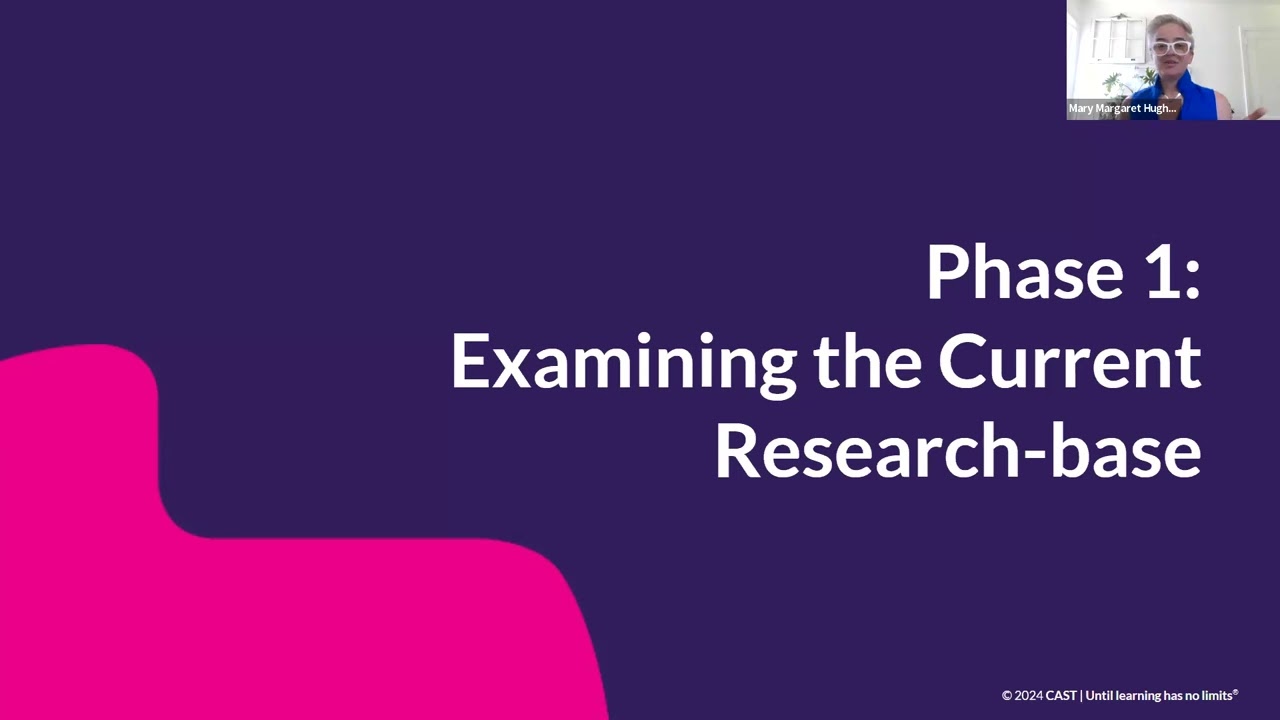
examined the current research base listed on the UDL Guidelines Research pages to really understand the balance of different research fields, methodological approaches, epistemological approaches, and author positionalities. And as part of this process, more than 1,200 articles have been reviewed, and you can find a link to these research pages in the home base document. And as we've been reviewing this current research base, we've really been considering the following questions. First, which, if any, dimensions of equity are included in the existing research base for the UDL Guidelines? Then we're thinking about, whose perspectives and whose lived experiences
are represented? And also thinking about, whose perspectives and lived experiences are missing? And the second phase of this work has focused on expanding the research base. We've been working with Dr. Mary Margaret Hughes and conducting literature reviews to bring in new perspectives from fields such as disability studies and asset-based pedagogies and using this expanded research to inform our updating process. And now to bring it all together, if we can go to the next slide, please, Leila. We've used all that we've learned from the Advisory Board, the UDL Guidelines Collaborative, the Young Adult Advisory Board, focus
groups, and reviews of the literature to inform our synthesizing and drafting phases. So throughout all of 2023, we developed first drafts of all nine UDL Guidelines. Each draft went through several rounds of feedback. Our CAST team members offered feedback via monthly UDL Guidelines 3.0 staff meetings. Our Advisory Board and Guidelines Collaborative offered feedback via our bi-monthly meetings. The Young Adult Advisory Board has been offering feedback on high-level themes. And last month, we shared a summary of proposed updates for public comment. And we wanna extend a big thank you to all of those who have shared
your comments with us on that summary document. And we've used all of the feedback we've gathered through those first drafts, as well as continued reviews of the literature, to develop a full draft of proposed updates for UDL Guidelines 3.0. And this is what we are so excited to share with you today. The full draft offers an explanation of proposed updates, and for each proposed update, we offer a description of the update itself and a rationale that includes representative quotes to really center practitioners and other community community members' perspectives. We also include some representative themes to
go along with those quotes. And then we also have examples of research that support the update. So the full draft will be circulating for public comment through April 15th, 2024, and we are just so eager to learn from your reactions to this draft and your feedback. And, finally, we are so close to being ready to launch UDL Guidelines 3.0 this summer. Again, we'll be collecting your feedback on the full draft through April 15th. We'll then work on synthesizing feedback and updating the draft throughout the spring. And then we will also be completing the process of
updating the UDL Guidelines website. And then we will get to celebrate this next iteration of the UDL Guidelines at CAST's UDL-Con International at the end of July. - All right, I believe it's the moment we've been waiting for. We are thrilled to introduce the proposed updates for UDL Guidelines 3.0. And first we want to start with some overarching updates, if we can go to the next slide here. So as Jenna has mentioned, as we've engaged in focus groups and have been diving into the research, we have several themes that have surfaced, and we wanted to
start with those overarching themes that have been part of this Guidelines 3.0 update. One is recognizing the need to emphasize identity as part of learner variability. The who in the learning, along with the why, which is connected to engagement, and the what that is part of representation, and the how which aligns with action and expression. The who was essential. And we are also acknowledging that individual, institutional, and systemic bias shows up as barriers to learning. These guidelines have been updated to support educators and designers in addressing those barriers due to bias. We are also recognizing
the need to value interdependence. One of the criticisms that came up was that the Guidelines 2.2 were too individualistic and didn't value interdependence and collective learning enough in order to really create an environment where every learner is welcomed and able to thrive. And then lastly, well, no, not lastly, but one of the last bullets on this slide is that we are shifting, we're looking to include updates that help shift from teacher-centered language to learner-centered language. And so if you take a look at the link that has just been posted in the chat, you can get
the summary of updates for UDL Guidelines 3.0. This is the summary document to help set the stage. But then we have the proposed updates for each of the guidelines and then the bulleted items that come underneath. What you see here, or what is available here, I should say, is an image of the proposed updates to Guidelines 3.0 as a graphic organizer. Also on this image is a watermark that says draft because we are releasing this as a draft, and it is open for public comment until April 15th. Now, this link to the graphic organizer is
also included in the home base document. We are giving this to you so that you can take it, digest it. There are hyperlinks for a detailed explanation as to the rationale for the proposed change if a change is being proposed there. While we would love to discuss in depth each and every one of the proposed updates, we don't have quite enough time today, and we know that you need time really to be able to read, digest, have time to think about questions and share them. That's why we have this open comment time available to you.
What we are going to do today with our time together is to zoom in on a few of our focus updates to give examples and also to share with you some of the overarching structural updates. So let's take a look at a few examples that we want to show, highlight for you, highlight, I should say. - Yes, so the first example that we wanna highlight is kind of zooming in on principle, the principle of multiple means of engagement. In the current UDL Guideline 7, Provide Options for Recruiting Interest. And we're proposing an update here to,
Options for Welcoming Interests and Identities. As Nicole mentioned, emphasizing identity as part of variability was a really strong theme that emerged from individuals' feedback as well as from our reviews of the research. And this proposed update will more fully honor and sustain learners varied in intersecting identities and the many strengths and assets that learners bring to the learning environment. And we think that this quote from one participant really illustrates the strong call to more fully embrace identity. That participant shared, "I don't see anything in the Guidelines "to point them to consider the student's backgrounds. "It's
not explicitly pointed at. "How do you address all of the variabilities "that the learner brings?" And alongside learning from feedback from individuals, we've also drawn from extensive research to develop this proposed update, such as Gonzalez, Moll, and Amanti's research on funds of knowledge, Ladson-Billings' research on culturally relevant pedagogy, and Paris & Alim's research on culturally sustaining pedagogies. And in the full draft, you'll find that we've included full citations for examples of the supporting research that we've been drawing from. Now, one thing that you might also notice is that there are some structural changes with this
proposed update as well. And these are actually overarching structural changes that we're proposing. The first one, all of the current principles and guidelines begin with the word provide, in the current Version 2.2. And there was a concern that the word provide makes the UDL Guidelines feel really teacher-centric, that the Guidelines could be interpreted as a set of approaches that adult practitioners do for learners as opposed to supporting learners to explore and construct their own learning. So we propose removing the word provide from all three principles in all nine guidelines to signal that the UDL Guidelines
are a tool that can be used by learners as well as educators. And the second overarching kind of structural update that you might be noticing is we're also proposing to remove the numbering of the UDL Guidelines. So right now with Version 2.2, that version offers two different representations, one with numbers and one without. However, the representation with the numbers is out of sequence due to shifts in previous iterations of the UDL Guidelines. So there's a lot of concern that this kind of unsequenced numbering is causing some confusion among the UDL community, especially for practitioners who
might be new to UDL and wondering why these numbers are out of order. So to address this confusion and to anticipate future iterations of the continued evolution of the UDL Guidelines, we're proposing to remove the numbers. And, Nicole, I will hand it over to you to share our second example of a proposed update. - All right, thank you, Jenna. All right, so the example that Jenna showed focused on a guideline from the principle of multiple means of engagement. This second highlight here focuses on a guideline within the principle of multiple means of representation. So let's
take a moment to consider our current Guideline 2, Provide Options for Language and Symbols. Now, other than removing the word provide, we are actually not proposing a specific change at the guideline level, but rather we're proposing a change at one of the bulleted items that appear underneath the guideline. Now, these bulleted items are commonly referred to among those within the UDL community as checkpoints. And during this process, we received lots of, lots of, lots of feedback that the idea of checkpoints prompts educators and learning designers to think about these items as a checklist, and that
it's confusing, and that it is misleading in terms of thinking about, "Oh, I have to do these things in this order." When in reality, those bulleted items are meant to serve as prompts for educators and designers to consider. So while the word checkpoint doesn't actually show up on the graphic organizer, it is commonly referred to, especially on the website, we are proposing that we move away from the word checkpoint and replace it with the word prompt to highlight that these are prompts for us to consider as we're designing accessible, inclusive, and equitable learning environments. So
now at the prompt level, we are proposing a new prompt. This update suggests proposing the prompt, Address Biases in the Use of Language and Symbols. And I would like to share with you one of the quotes. "Do we need a checkpoint "that prompts learners to check "if or how their language is inclusive? "Are we examining stereotypes within language?" And there are some examples of supporting research here. Again, in the documents that you have access to, there's a much longer list of the research that is being considered and included here, and that in of itself is
also being built upon. So as we think about adding this checkpoint, we recognize that this overarching theme to consider how we address bias specifically, and in this case within the use of language and symbols, was needed in order to support educators in examining issues like use of ableist language or words rooted in oppression. So that's one new proposed update within the prompts level under the guideline, Provide Options for Language and Symbols, and we'll share one more example of a proposed update. This third example falls under the principle of multiple means of action and expression. And,
well, there's a slight typo there. This is Guideline 6 not 3. So it's Guideline 6. We're getting rid of those numbers. That's the proposal. The proposal will get rid of those numbers. But this Guideline 6, the current Guideline 6 under action and expression is currently referred to as Provide Options for Executive Functions. Provide Options for Executive Functions. Now, this proposed update, we need to explain, and it's explained fully in your supporting documents that you have there. This proposed change is due to the need to restructure the way that executive functions currently shows up in our
current 2.2 version. So as of right now, in the 2.2 version, executive functions shows up as one box underneath action and expression. And that one box containment for executive functions does not actually align with the research or the neuroscience, which recognizes that executive functions actually spans each of the three neural networks. And so in order to accurately portray the role of executive functions, it is now spanning the bottom row, executive functions has actually been elevated, and then this particular guideline focuses on the portion of executive functions related to action and expression. So our proposed update
is Options for Strategy Development. And here we have a quote. "How do we convey the message "that although the thing you're doing "might part of action and expression, "but it's also very much part of engagement?" Because if we go to the next slide here, one of the things that you'll see is that, and we're not going to go into details about all of these, but if you see across the bottom row, these are all related to executive functions. In Version 2.2, there was some confusion because self-regulation is part of executive functions. And so in order
to accurately represent the science and also to more properly support educators in designing informed, inclusive environments, now Options for Strategy Development is one of the proposed updates, as well as updating the three guidelines that go across the bottom row of the UDL Guidelines graphic organizer. Now, I've probably left you quite a few questions. Jenna may have done a better job, but I'm sure there are questions that we want to take a moment to address. And so we will pause here. - Hi. (Lindsay laughs) I would love to share some of the questions with you that
have been coming into the chat. Thank you so much to everybody for putting them in. First of all, I do wanna say, somebody just noted, put a very great question. There have been some concerns on the webinar with captioning. We're working on that. Captioning's working for one of our speakers and not Jenna. So we're trying to fix that. In addition, someone mentioned ASL interpreters, and I wanna thank you for bringing that up. That's a great point to raise for us. We don't have that, as you can see on today's webinar, and it's a good thing
for us moving forward in the future. And we definitely will be committed to having that as we go forward. So one of the questions that came in was specifically about the field of disability studies education and how that has influenced these new updates of the guidelines. So I wonder if you can speak specifically to that point, and you may wanna reference the future webinar, but could you speak specifically to how disability studies education has influenced the updates? - I can jump in and and start us off, and, Nicole, please feel free to jump too. But
I think the whole field of disability studies has just been instrumental in supporting us through this updating process, that this was an area of the research that the current version of the guidelines really hadn't expanded into yet, and really thinking about disability as identity. That's been a huge piece of the ways that we're thinking about expanding this updated version of the UDL Guidelines. As Nicole mentioned, that was a really big theme when we were conducting focus groups and when we were learning with our advisory boards and the Guidelines Collaborative, kind of thinking about, where does
identity fit into the guidelines, and how can we make the guidelines really emphasize the notion of identity and the ways it impacts teaching and learning? And disability studies and the literature that we've been reviewing there has really supported us, at least we're trying to make that feel really emphasized in this version. - And I think if you take a look at the document that lists the research, you'll see a great deal of the citations coming from the disabilities studies field. - Right, and we will have a webinar, our next webinar will be really deeply focusing
on the research that is included in here. So another question came in. "UDL is frequently confused "with the unsupported theory of learning styles. "Have you updated research within this "to make it clear that UDL does not promote this idea?" This is a great question. We get this all the time. So thank you so much to Kara for bringing that forward. Jenna and Nicole, how would you answer that one? - Well, part of this updating process is also updating the UDL Guidelines website and the supporting materials that go with it. I cannot tell you how many
times as a member of the national faculty and as somebody who presents across the globe around Universal Design for Learning, UDL, and the confusion of learning styles is there, it's real, I get the question all the time. When we get that question frequently, that means we need to update our supporting documents to help address that question. So we recognize that that is a frequently asked question. We are updating our materials in order to address that and including the research to explain why learning styles is not supported and what does it mean to then design for
learner variability, how that's different. I also recently did a little two-minute video about learner variability and how it's not learning styles because we get that question so much. So robust materials will be included, whether it's a short two-minute video or a multi-chaptered, you know, research paper to go along with it. But we are recognizing the areas of confusion, and that's also something that we've been noting in this updating process. Anything else, Jenna? - I think you got it, Nicole. Good job. - So here's another question. We see that some folks are curious to learn more
about the graphic organizer update and just kind of going into how you made some decisions there. I guess one beginning question there. Some people are saying, "Is there an alternate, "have looked at or thought about ideas "for an alternate format to the graphic organizer?" Some people, of course, have trouble digesting it in that format, as we know we wanna offer options. So maybe let's start there. - Yeah, that's such a great question, and that has come up in a lot of the focus groups and, again, the work with our advisory boards and the Guidelines Collaborative,
that right now the current graphic organizer is very rigid. It's also kind of emphasizing like a linear way of thinking about the Guidelines. But we know that the Guidelines can kind of be mixed and matched and overlapped according to the learning goal and how are we working to reduce barriers and increase access. So we have had lots of encouragement from people to think of other representations of how we might be able to really kind of model that interconnectedness or the kind of woven nature of the different guidelines and checkpoints, but that we're now updating to
call prompts. So we would really love to learn from your ideas. I think for today and for this first draft that we're offering you, we started with the graphic organizer just to kind of start with a representation that we're all familiar with. But we would love to think about other ways to represent the Guidelines. And, really, I think it's a great design challenge to think about, the guidelines are messy and interconnected, and how might we represent that? We would love to work with all of you and think that through. - And actually, Leila, if you
wouldn't mind going to Slide 22, just went back one, so that we can reference what we're talking about by the graphic organizer. So this represents, commonly it's what is currently shown as, the three columns, a column for each principle, and then there are three guidelines for each principle. And one of the things, so Jenna hinted at it, but we recognize the need for alternate representations. We also think that someone out there, or probably many of you out there probably have great ideas, and we didn't want this to be a five-year process. So now opening it
up to... This is another a great time for you to offer feedback when you share maybe some alternate representations for how we can do this. And I think because we have some time too, we did want to mention that in the current 2.2 version, on the sides of the graphic organizer are little tabs that say Access, Build, Internalize. This proposed update does also recommend shifting away from those tabs. Also, you don't really want to have the text written vertically like that. But really to show this idea of moving between agency and access. Access, we're always
about accessibility, but also it's about learners having full agency. - Hmm. So you actually just, both of you in those answers, referenced two other parts of the graphic organizer question that came up. I think we saw some interest in whether you were thinking of different words, if there were other ideas around the word prompt that you're now moving to. And then also I think we've seen some people who have used sort of the access, previously found it very helpful to use Access row, Build row, Internalize row. And so will we still think about that as
three rows, and how would you label the middle row? It sounds like, no, you're gonna be talking through more in a continuum from Access to Agency. And so I think that's a really good point. We need to kind of think about, how are we gonna make that shift, and what does it mean for that middle row? So that's one we definitely need to think about and kind of respond to. But another question, another series of questions have come up that I wanna make sure we address, and that is the use of the words, nurture, joy,
and play. How would you think of those in a higher ed context, in a workforce context? Can you just describe a little bit more about what the thinking is there and the use of those words throughout the lifespan? - There is so much research out there around, so much neuroscience, I should say, out there around the connections between joy and learning for every human being. Play is not just for children. I don't know how many folks remember Fish! way back when and was trying to get people to build more play into adult learning activities. But
this is actually something that's come up, especially as we are moving through and beyond, hopefully, the repercussions of the pandemic. Some of what was lost was the joy because we've been losing a sense of really self-efficacy, and there has been a great deal of research about how we connect joy to learning around discovery, around developing expertise creates a sense of joy, how this is related to the dopamine that's needed in order to want to sustain effort and persistence. So joy and play, they are not just for children. They are for every human being who considers
themselves a learner. And so we'll make sure that we include not only in the UDL Guidelines website, which we'll be continuing to develop. We have references, citations, we are including, this is a research-based process, we are also going to include stories. What does this look like in an elementary context? What does this look like in a high school context? What does this look like in a workforce development context? What does this look like in higher education? And then also when you think about higher education, there was joy there, right? There was joy in learning, and
that's why most people go to college, right? I think so. But Jenna, what do you think? - I'm also just reminded of one focus group that we conducted where the participants were also emphasizing the importance of joy for educators, that we wanna come to our jobs as educators feeling joyful and feeling that we have this kind of playfulness to be able to be innovative and to be curious with our learners. And I just really appreciated that because I think when we were first starting to think about this as a new addition, I was definitely thinking
about that from the learner perspective and learners from K-12, but also in higher education, also in the workforce setting. But to be thinking about it from that educator perspective really resonated with me as a former teacher. I wanted to find joy in my role as a teacher, and so I think I kind of love the flexibility of this proposed edition as well. - Great. I wonder, we've got a couple of other questions, and one of them, which I think is so absolutely on the top of our minds after the pandemic in particular and the way
that education, the format changed so dramatically. "Do the new guidelines include an invitation "for instructors to consider modality, "so online, onsite, or hybrid "based on a consideration of access and disability justice?" Can you just talk a little bit about whether you considered some of those options and if they might appear in here? - So we are definitely, especially as we are thinking about the Accessibility row, thinking about how we consider different modalities, there's only so much we can include at the guideline and the prompt level. But, again, as we give examples, and the research, honestly
the research does come from multiple modalities, including online, different ways in which people engage in learning. And that might be something that we can also highlight a little bit more when we talk about the research in our next upcoming webinar. Also, the question about prompts, we didn't answer that question about, "Were there other words considered?" Yes. Lots. But we can only put forth one at a time. Now if, let's say, when people give their feedback, we get other... And there was no word that was chosen just because one person said it, right? We were looking
for themes, but, honestly, this is an ongoing process. So we welcome the suggestions. - Great. So we'll try to get two or three more questions in here. One of the questions that we wanna go to is a follow-up from the earlier statements around learning styles. "So was any consideration given "to softening the language on providing options "and moving towards language "that highlights the importance of variety? "As we all know, "it's easy for critics to say, 'UDL means choice,' "which means learners can avoid tasks "that challenge them "and/or take the path of least resistance?" So is
there anything in here that really sort of honors the learner in that way, that shows the scaffolding needed for choice, and then the belief and trust we put in the learner to deeply understand how they learn and move forward in their education? - I really appreciate that question, and I think that was a big theme across the focus groups that we were doing and the literature reviews is, how are we putting the learner in the center and really honoring what's best for that individual learner? And I think some of the changes or proposed updates were
trying to take away certain verbs that signaled maybe teacher-led or educator-led. So we've done a lot of thinking around like particular verbs and what they might imply. And so we've been thinking more about, in the current Version 2.2, words like provide or words like offer. Those are words that to us and to the individuals who we talk to, those were signaling educator-led. So we've paid really careful attention to the goals themselves, or to the verbs themselves, and making sure those verbs could be thought of as educators or learners themselves engaging in. So I would say
that's one way that we were really kind of focusing on centering the learner in this update. I think another thing that's on our mind that we'll be able to share a little bit further in the development once we start working on updating the UDL Guidelines website is a lot of people have shared that on our current UDL Guidelines website, there isn't really an introduction to the Guidelines themselves and how to use them. And so I think a lot of people learn about UDL and recognize, "Oh, yes, UDL is goal-driven." So we're offering different options and
supports in service of the learning goal. So according to some learning goals, certain options might not be appropriate. And that piece about goal-driven kind of seems to be missing in the UDL Guidelines website. It's like we need a little introduction to welcome practitioners into the Guidelines and really be supporting how we might use them. I think on the UDL Guidelines website right now, there's some great FAQs. We have a section on the website talking about how we can use the Guidelines as a tool, but Nicole and I, and we know from lots of other people
through focus groups, would love to have something a lot more welcoming, some sort of introduction to bring people in and get them excited to start experimenting with the Guidelines. - And I just wanted to highlight a few examples, Jenna, that you mentioned. Like, there really was very careful attention to each and every word. Also thinking about shifting away from language that could prompt educators to think in a more deficit framing. So an example would be under goal-setting, there previously was the word appropriate, setting appropriate goals. And that use of appropriate can shift someone into thinking
about, "Oh, well, these students get these goals." And so we wanted to not necessarily encourage drawing down a path that could be seen as deficit framing. The other thing is that, as Jenna mentioned, the framing around how we use the tools, how we use the guidelines to support the work, really what has surfaced is the idea, and this is a balance that really was leveraged by the Young Adult Board, in that whoever's designing that environment, they do have the greatest responsibility to have options available. It's not about doling out options, it's about designing environments where
options are available. They have the greatest responsibility, but everything should not revolve around the educator. And we are working to create that opening information to help people understand and be able to apply in that way. - Yeah, I think that's really important. I think one of the things that we really always wanna focus on is this assets-based approach, right? And so that has, I know, been top of mind for everyone with this. Well, many of our questions as we come to the end are about what happens next. So do you wanna shift to share some
of those next steps? - That sounds great. Yes, so before we sign off, we did just wanna highlight some next steps, what we'll be working on. Please be sure to sign up for our UDL Guidelines 3.0 newsletter. Again, the link to sign up will be in the home base. And we just want to emphasize, again, that we are just so eager to learn from your comments on this full draft of proposed updates. And really the feedback that so many of you have offered to us throughout this whole process has just been so essential to the
community-driven nature of our process in this effort, and so we really look forward to the feedback that you'll be sharing with us. So we encourage you to share that before April 15th. - Absolutely. So just to be really clear, April 15th, we're gonna close this feedback. We have all your questions today, which are so helpful. Thank you so much for joining us on this webinar and putting them forward. Continue to do that. We will be summarizing and making some final changes to these Guidelines and then putting them out in the end of July at our
UDL-Con. Initially, there was a question... Oh, and we'll be having a webinar in June to really look at the top questions that came up, to meet with Mary Margaret, and to really go through kind of how research impacted this, what's in there, what isn't. And so that'll happen in June. And then we'll release the final Guidelines in the end of July based on all of this feedback. The Guidelines are continually iterating and updating. So, again, I wanna say that these guidelines involve so many more features and important things that are there for our entire audience
around the world. They are much more responsive, they are less U.S.-centric, but they still remain that, we still need to be focused on and learn from our partners all over the globe. And we are a learning organization and very open to that. So two ways we learn, if you wanna go to the next slide, please. Join us. We will learn at our UDL-Con International. We're excited for this meeting. We have certain number in person, and we will have individuals online. You can get information about this on our website. I understand today there were some issues
with the Bitly. I just wanna make sure everybody knows we'll be putting that out on social media if you were unable to get to that. It will be on our website and in other places. But we would love it if you would come and join us at this UDL-Con. Join us in conversation, talk to us about this, and let us know. A portion of that meeting will be discussing these guidelines. We have a lot of other incredible topics, and we really hope this is almost a festival of sorts of all of us just bringing talk
about joy and play. That's our goal. We're gonna try to make sure it's a unique experience and really about connecting and sharing new and innovative ideas. So we hope we see you there. And then finally, we have a real, in the next slide, you guys, we're giving our first set of awards. If you remember from our mission statement, one of the things we wanna do is inspire. And to inspire, I think it's inspiring to see people doing incredible things and amazing work. So we have awards that we'll be giving this year to lift up some
of those stories and just incredible examples of what's possible. So please, if you are doing great work, nominate yourself. If you know someone doing great work, nominate them. We have one for research, one for practice, and one for design. You can find all the information about them on our website. We'd really love to be able to come together as a community, and we will be doing this every year going forward. So I wanna say thank you. I will give it to Jenna and Nicole to actually sign us off. But a big thanks to everyone for
being here with us today and being a part of this journey. It's a learning journey, and we are with you on it. So thanks so much for joining us. Jenna and Nicole, any final thoughts? - I just wanna say there were so many great questions that we didn't get a chance to answer. We will discuss amongst ourselves about how to answer some of them between now and June webinar, but then also more in-depth ones in June, particularly questions around professional learning. We received the questions, and just because we didn't get to them today, we will
be able to follow up. - Thanks so much, everybody. We're really excited to learn from your feedback on this draft. - Thank you. - Yeah, with that, thank you for joining us. More to come.


![Upbeat Lofi - Deep Focus & Energy for Work [R&B, Neo Soul, Lofi Hiphop]](https://img.youtube.com/vi/THh4fT0O7IY/maxresdefault.jpg)



![Upbeat Lofi - Power and Energize Your Workday - [R&B, Neo Soul, Lofi Hiphop]](https://img.youtube.com/vi/ONcY0BM5EAg/maxresdefault.jpg)