Welcome to the mini-lecture on the ccdA/ccdB toxin-antitoxin system! By the end of this video, you should be able to: Define the components of a toxin-antitoxin system. Outline the mechanism of CcdB toxicity and CcdA anti-toxicity in the cell.
Explain the significance of negative selection with ccdB. The two components of the system are the toxin and the antitoxin, both of which are proteins. The toxin produces a toxic effect in the cell, leading to cell death, by targeting an important cellular system.
This effect is prevented in the presence of the antitoxin. The antitoxin binds tightly to the toxin protein, preventing it from interfering in the cell. The antitoxin is an intrinsically disordered protein that is easily degraded.
Therefore, expressing the antitoxin alone is not a problem for the cell, but cells not expressing the antitoxin will quickly be depleted. In the presence of the toxin, the antitoxin also binds to the promoter for the toxin gene, providing transcriptional repression and therefore lowering the concentration of the toxin in the cell. This is a secondary mechanism to help prevent toxicity.
So, why do cells have this system? Research shows that this system ensures that the cells maintain the plasmid encoding the operon, as cells that lost the plasmid were quickly killed. In the ccdA/ccdB, or “control of cell death” A and B, system the toxin is ccdB, and therefore the antitoxin is ccdA.
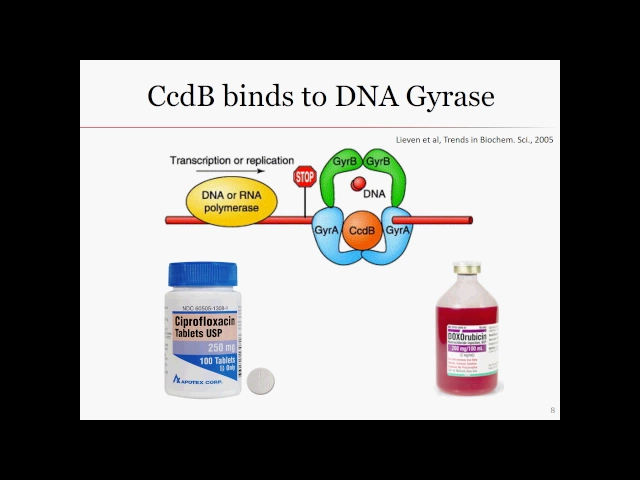
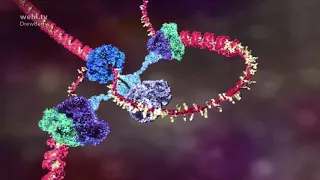
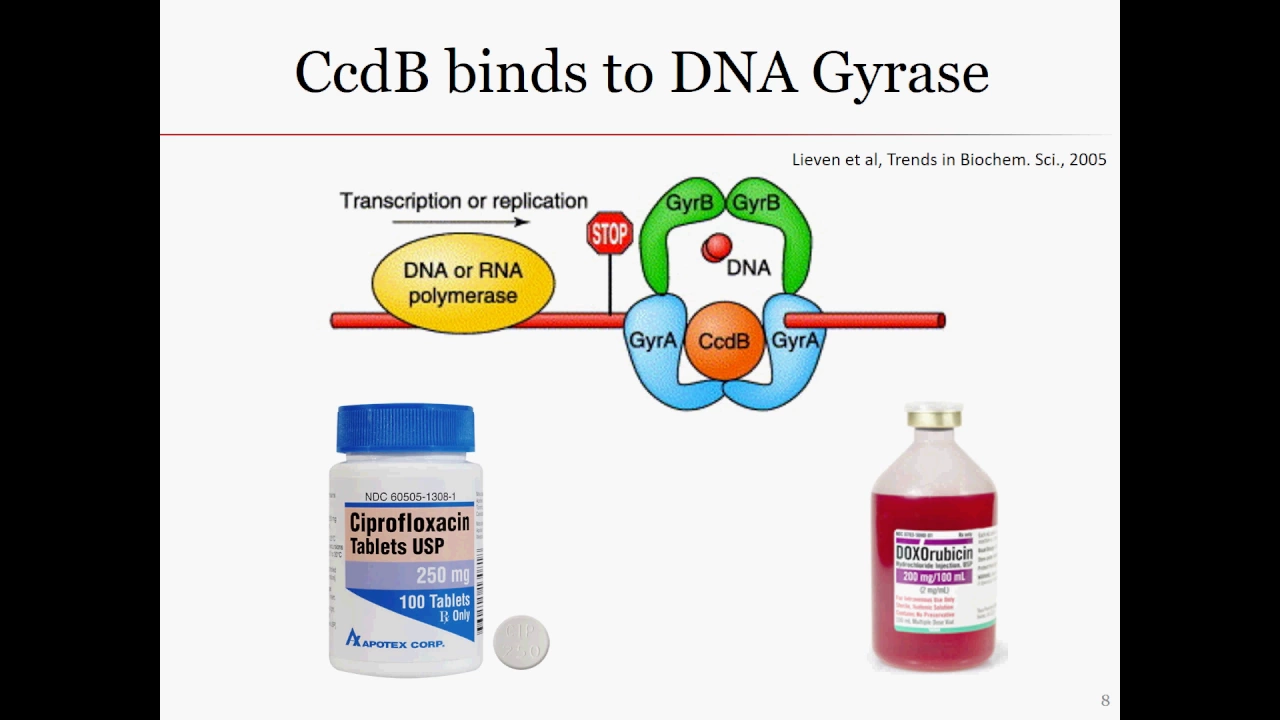
The target of CcdB is the enzyme DNA gyrase in bacteria. Gyrase works by creating a transient double-strand break in the DNA to allow another double-strand of DNA to pass through this “gate. ” This is useful for maintaining supercoiling of the genome, and for untangling DNA during replication or cell division.
CcdB works by binding to gyrase in the enzyme-DNA complex, thereby trapping the enzyme on the DNA and holding open the double-strand break. The direct interaction of CcdB with Gyrase can be seen in the crystal structure on the right, with the CcdB in green and gyrase in blue. When gyrase is trapped on the DNA, replication can no longer occur.
This prevents the cells from being able to propagate. This is actually the exact same mechanism used by the antibiotic Ciprofloxacin and the chemotherapy drug Doxorubicin to prevent cell propagation! The CcdA antitoxin works by binding very tightly to CcdB.
The CcdA interaction domain is shown here in green, and the CcdB dimer is in shades of blue. Although small, CcdA is able to change the conformation of CcdB to prevent interaction with gyrase. This interaction is so strong that CcdA can also remove CcdB that is already bound to gyrase!
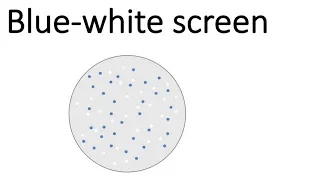
In our cloning project for CaMPARI, both the pENTR4 and pDEST15 starting vectors contain ccdB! This gene will be replaced by CaMPARI in a successful cloning reaction. If the digestion or cloning reactions were not successful and the ccdB gene remains, any cells that take up that plasmid during transformation will be prevented from replicating and will not form colonies.
We are able to propagate the original pENTR4 and pDEST15 vectors by using a special bacterial strain that contains the antitoxin, CcdA. Hopefully, you now feel that you are able to Define the components of a toxin-antitoxin system. Outline the mechanism of CcdB toxicity and CcdA anti-toxicity in the cell.
Explain the significance of negative selection with ccdB.