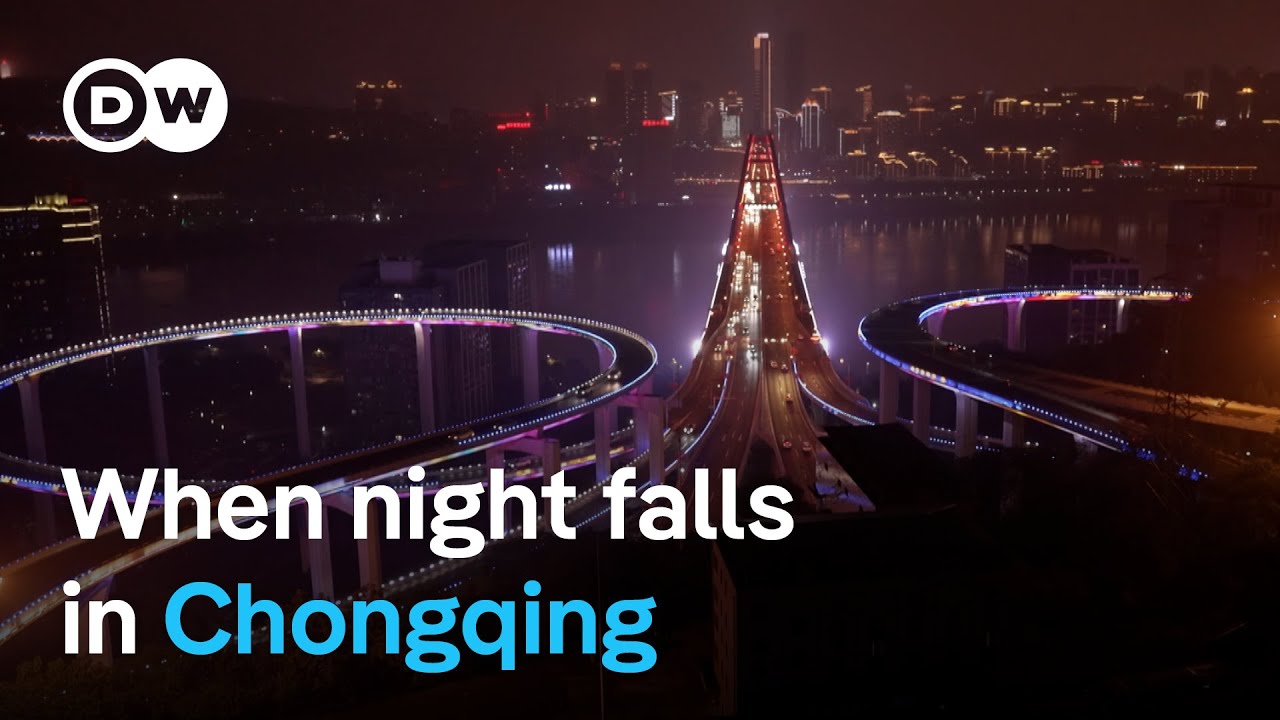
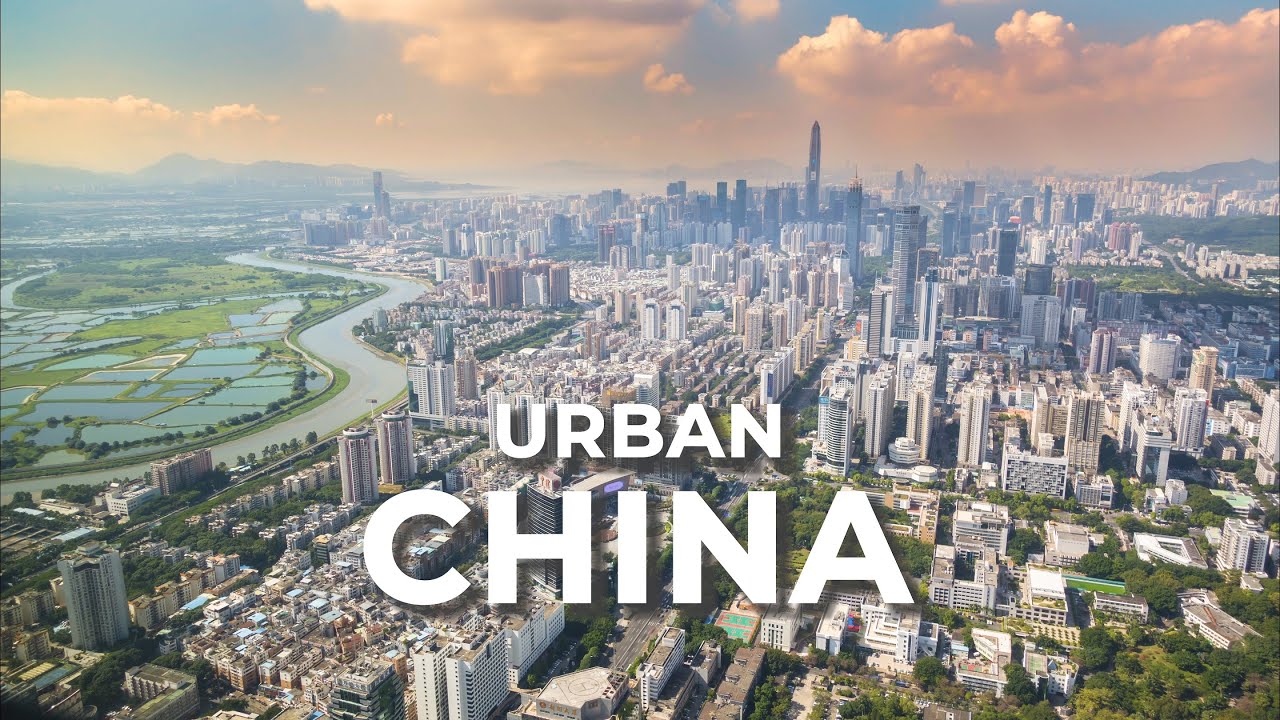
[Music] chongqing in western china the new mega city of the 21st century the fastest growing metropolis in the world an estimated 30 million people live here and around 1 000 people are moving to this urban center every day in their quest for work and somewhere to live urbanization breaks like a tidal wave over the one sparsely populated landscape constant immigration forces the city upwards and the increasing traffic slows down movement within it the city threatens to collapse under its own enormous size but what is the root cause and what alternatives are there [Music] chinese mega
cities grow from the margins they are the product of a mass migration the likes of which has never been seen before from all parts of the country but above all from the poor west of china peasant farmers settle on the outskirts of the large cities [Music] from these satellite settlements they set off early each morning to find work in the city if they succeed the improvised settlements grow and the city continues to expand people do shocking things to themselves in order to change to an urban life they endure terrible housing situations they endure the loss
of privacy they endure living beside superhighways and and and sewage lagoons and and airports they endure constant noise terrible smells crime the danger of physical harm to the self they work in possibly long hours at very bad jobs entirely because there's a gamble that they're taking usually not on behalf of themselves but on behalf of their children the migrants want to become citizens of the cities so that their children can go to school there education is the precondition for a better life and thus the mega city on the banks of the yangtze continues to grow
inexorably like most metropolises of the world it grows around a city in which banks offices and company headquarters are highly concentrated the city becomes a magnet for migrants embodying the idea of success and prosperity that immigrant district the arrival city is the core machine of the cultural and economic operation of the city you cannot imagine new york city or london or paris without those cities being networks of people who've arrived from some other part of the world who are tran using the space around them using the resources around them using the networks that they create
amongst themselves to transform the city and create new economies to create new middle classes to create new forms of culture new forms of food new forms of living new forms of dialect and language and so on the the basic vital life of the city is the arrival city it's not a sideshow it's the main machine that makes cities run if a city stops having a rival city district you know that it's a dead city that's going to be either collapsing or becoming a museum devoted to its former self doug saunders theses are already affecting the
way city planners of the 21st century work there have been attempts in the past to prevent mass migration and to view informal settlements as a temporary phenomenon his research has led to the acceptance that they are the starting point of further open growth in the city centers an integral part of a city the influx of more than one thousand people each day makes any kind of planning very difficult traffic has become an existential problem in urban areas for most chinese a car is a symbol of status and prosperity cities like shanghai try to regulate traffic
by raffling car registrations the public transport system always lags behind the demands of a fast-growing city in china everything's happening and happening uh so fast so there is no planning or architecture design in a proper approach i would say it's in chaos so for architects and even planners we cannot control it even our government very strong strong one cannot control it so for us it's like a reaction to do what is happening so it's always behind the schedule only around half of the 31 million inhabitants of this largest city in the world actually live within
the city boundaries the other half live in the surrounding areas from there many millions of people travel every day into the city center where offices are concentrated where people build work and consume by night in the glamour of the neon lights the magnetic attraction of the new megacities becomes tangible compared to the hardships in the countryside this glittering world must seem like paradise this panorama is a symbol of the hopes and aspirations of all the migrants for a better future and it is this hope that has led to the explosive growth of mega cities the
world over chongqing is the largest and most powerful among them a new new york in asia [Music] taking the high-speed train from shanghai to beijing this vast country flies past during the more than 1 000 kilometer long route the entire country is transformed and this transformation seems to imitate the tempo of the train everywhere new factories and settlements are springing up new cities are being born and new traffic the country is turning into an urban society the shift is palpable when you race across the country beijing could be the first city in the world that
is literally suffocating in its own traffic the new districts are structured in concentric circles around the old urban core arterial roads are constantly being added to cope with the growing traffic but it is never enough traffic is regulated but the excessive amount is beyond regulation the reason new districts do not have the same attraction as the old organically involved center with its forbidden city and its nearby parks in planning the new cities it's imperative to learn from the example of the old quarters this demands one of china's world-renowned architects chinese architects have very little time
to reflect they take part in the urbanization process without taking a moment to think about it i think with such a rapid development we have lost many interesting aspects that we could have done better if contemporary chinese architects had paid more attention to the natural environment or had thought more about geography about topography about climate and most of all about the things that are unique to chinese culture and very different from western culture like the impressionistic and half abstract spirit of art then our cities would have many more unique characteristics [Music] the chinese language has
no word for city it knows only the village and now the mega city places like old beijing had their feudal palaces surrounded by the hutongs districts made up of a large number of one or two-story houses lining narrow streets this courtyard house is a multi-generational house consisting of several buildings arranged around a central inner courtyard in chinese these hutongs are also given the english term courtyard house pe ju reconstructed this house in beijing's old center you're gonna there is the chinese culture which is so different from western culture there is a different approach a different
way of seeing and then there is china's natural landscape the chinese natural landscape is in my opinion very different from western landscapes [Music] landscaping elements like trees and water are essential components of the old residential areas of beijing [Music] districts consisting only of houses and streets are not reconcilable with chinese tradition according to pesju the tradition of neighborhoods in communally used residential areas are aspects some of the most modern chinese architects are trying to reintegrate into their work for them the hutungs are a benchmark a kind of archetype that planners need to consider in the
much larger and more densely planned new city districts that are now being built how cities can develop when they fail to observe this scale can be seen in the residential districts of ordos a recently built million strong city in inner mongolia [Music] this is what progress looks like when it goes wrong the new ordos was supposed to be china's dubai a metropolis in the desert in fact what it is is a collection of eight lane highways skyscrapers and luxurious apartments but hardly any people [Music] instead of the three hundred thousand for whom this new district
was planned a mere five thousand people have settled here [Music] it's a ready-made ghost town and there are several of these here in china once again the dilemma of new chinese cities is revealed they have no time to grow organically they are built here in the middle of the desert too soon or too late and often lack a true center a center is something one of china's new architects has now designed for ordos urdus belongs to mongolia culture like no man cultural we can say local culture but the local terms come from mainstream culture and
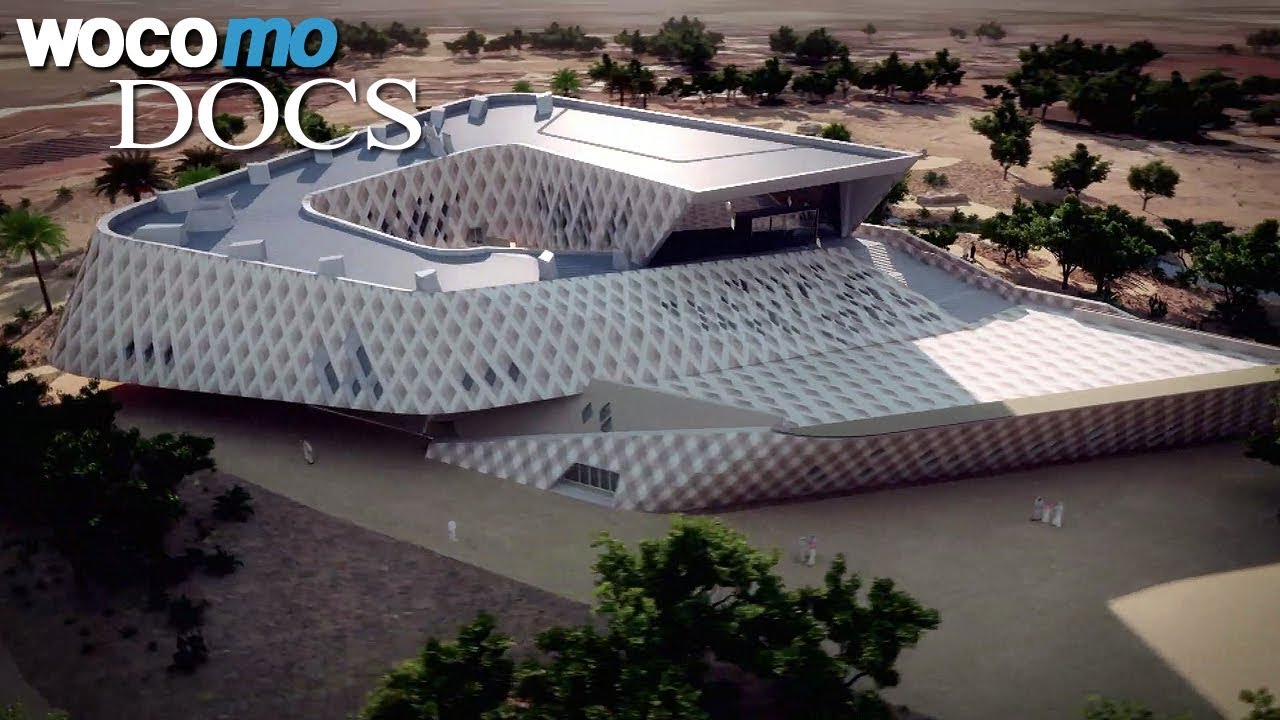
the local people they say the local government they don't want to become local culture they also want to merge into the modern culture so i think they were in the crisis like in the process of modernization how they express themselves this museum is designed to become the new center of ordos it stands like a cross between a gigantic tent and a battered spaceship in the middle of nowhere in a city with a future i was thinking maybe we should just put something so abstract has no reference no reference to the time and the any other
culture just pull there maybe something new will you know well or come to this object so so we did this um a bubble or spaceship like form look very futuristic so it doesn't look belong to earth anywhere in on this verse [Music] upon entering this elegantly curved spaceship for the 21st century you're initially overwhelmed by the spaciousness inside by the height the light the generously curved stairways [Music] this building could also be the town hall of a city that believes in its own future it is a fantastic space its many floating walkways reminiscent of the
film metropolis [Music] and it also has the feel of a very high tent whose stability is only secured by the internal girding and struts the small and large dents are like bulges in a tent caused by the wind and we have two sunlight like this one here one on the other side and inside is lobby and the main building is solid because the cold weather over there so during the day you don't need any artificial lighting in this museum in the public space i see this building as a generator maybe something new will happen in
the future because currently [Music] you can say this building is good it's belong to local or not belong to to this local but no answer you don't know yet the museum is supposed to function as a magnet to bring together what beforehand was unconnected there's still a lot of space in this new city in the far north of china the museum is the symbol of the future positioned so that you can see it from afar and to know you have arrived in the city of ordos [Music] the bay of hong kong you could say that
hong kong is the mother of all asian mega cities it is the blueprint for urbanization that began here and in tokyo during the 1960s [Music] this is where the characteristics of all agent metropolises were delineated high density and permanent reconstruction raising the issue of structure and balance in these vertically exploding cities [Music] these issues have fascinated renowned german photographer peter bialabrezki over many years he photographs major and mega cities and calls them the neon cities of our time what he is searching for and what attracts him is the chaos the density the cramped conditions everything
appears to be inhomogeneous however there must be an underlying structure it is after all the living environment for several hundred million people in china alone when you're here like this you could get the impression that it is a place in transition buildings that are only 20 years old are torn down and replaced by new ones and as a european who lives in a house that is around 100 years old and where everyone thinks this will probably still be fine for another 100 years and when we see that as a positive you could become a little
confused by that but i think that that perfectly epitomizes the fact that we are always dealing with impermanence we cannot stop time that is intrinsic to life things are constantly changing and here such change becomes extremely tangible and visceral i don't believe that is a bad thing perhaps on the contrary perhaps people here are essentially more flexible than those in europe because we always think everything will remain the same it simply won't [Music] compared with european metropoles like rome vienna or madrid with their homogeneously evolved city districts there is an extremely high density here there
seems to be no room for public spaces and parks instead everything is functional living working travel and cramped chaos but what this chaos represents above all despite the noise in the dirt his vitality that is what bialobreski tries to capture that is the reason why he climbs up onto roofs or onto the platforms of high-rise multi-story car parks seen from a distance this city looks like a graphical patchwork like a three-dimensional variable construction kit it is easy to forget the dimensions involved it is an enormous city and many thousands live here within this grid work
for which there is simply no counterpart in europe the density is palpable in these photographs they freeze fragments of the inexorable process of becoming they are transfixed images of a chaotic vitality [Music] it's a little bit as though the city were being reinvented here this principle we have in europe that someone came along one day laid down his bundle at the river's edge and then others came and settled followed by the traders then a city wall was built that kind of growth happened here instantly here in hong kong a building has to recoup the investment
after 12 years after that it is taken as a given that it can be demolished whereas in europe it takes 30 years [Music] hong kong has long been one of the biggest tourist attractions and one of the richest cities in the world a paradise for the rich man as the saying goes in china a global finance center that has long ago outgrown its cheap manufacturing reputation what you still feel in hong kong is its incredible vitality the marked will to improve oneself through education in housing in prosperity within a very confined space that's why hong
kong is today considered a kind of role model for the development of all chinese [Music] megacities you can see here in a time shift what began all over china only 20 years ago the explosion of the cities the epoch of raging urbanization [Music] if [Music] separated from hong kong only by a river and a metro line la shenzhen the city with the highest per capita income in china [Music] until the beginning of the 1980s shenzhen was a small town with only 30 000 citizens it was then declared a special economic zone and as the little
sister of the larger hong kong it grew to become a city of more than 10 million people and it is continuing to grow the city is an international business center but the living quarters of the new arrivals are clustered like vertical mercado sticks shenzhen ii is a city that is constantly building its prosperity and success are being translated into ever new improved and higher altitude living quarters and so the city has to tear down what has only stood for perhaps five or ten years this is it is simply an expression of a massively growing population
that simply has to go somewhere they aren't doing anything other than what we do consuming providing for themselves but you can bet they release less co2 than we do i think what we find strange is simply the speed with which this is [Music] [Music] this transformation has something monumental about it and so the photographs of peter bialabrezki have an unintentional pathos they are like documents of or testaments too a city that knows no rest [Music] i think that photography is inherently a medium that captures the time it is reporting on that is so to speak
when it takes the phenomena of its time seriously so to that extent the documentary aspect of it what it captures always becomes a contemporary witness too so that in 40 years time we will see that's what it was like [Music] as europeans it is this constant coming and going that leaves us clueless but how could it be done differently how can you plan a perfect city like paris with this level of growth peter biallabreski tries to capture that monumental upheaval that creates a mega city the pace and the power have something theatrical about them with
its exploding cities china will change the culture of the 21st century it has the will to be in the forefront in the vanguard of the international competition among urban centers in the global economy [Music] nothing symbolizes this more than the competition to build the highest skyscrapers that has spread throughout asia here in shenzhen the ping gong international financial center is under construction it is scheduled to be completed by 2016 and will be 660 metres tall [Music] shenzhen will then have the edge compared to competing cities like shanghai and chong jing but probably only for a
few years [Music] size and height symbolize economic power and progress and are the reasons for the constant fight for aerial mastery among the asian mega cities shenzhen long ago overtook hong kong in terms of population both cities together comprise one of china's economic centers and the magnetic pull of this twin city and all the people leaving the countryside continues to this day the expansion of the city demands a certain structure cultural buildings should take on this function for the metropolises [Music] the chinese state declared that all new million size cities should have at least three
of these and so shenzhen has built one of the most exciting museums in the world [Laughter] [Music] the design museum was here first when i began my design this planning zone was built with large-scale commercial buildings and so in this context the question was raised as to how a cultural building as a meeting place for people could be differentiated from other rather trivial commercial buildings [Music] spectacular buildings for the public raise the prestige and the value of the surrounding areas the same goes for europe the pompidou center in paris or the guggenheim and bilbao have
provided a new identity to entire city districts we managed to integrate the building by using diffusely reflecting materials on which for example only the shadows of people approaching the building are reflected the changing sky whether in the morning or at midday or evening as well as other changes in the environment all become visible on the building i call buildings like this disappearing or invisible buildings i think that is a method rooted in chinese culture concealing oneself with these two motives we have succeeded in making the building harmonious sometimes highly noticeable and sometimes almost invisible the
design has something wonderful about it it is suggestive very sensual and at the same time a meditative form not a ufo but rather a thought an idea an idea that people can return to a certain harmony and find balance in this new world and can still feel secure and encouraged when they see this form and experience the space within gliding through it like a cloud the design museum by pejo is built for the future and at the same time it creates a bridge to a spirituality rooted in china's past the museum is a self-contained structure
but if you go inside you have a sense of unlimited space the curvature of the building is perfect in itself it's like in the work of the american artist james terrell with his installations he wants to create an infinite space in order to irritate customary human perception you would present industrial works of art like cars on the floor but in our case cars can float in the space and the people they too can float because there is no scale and no real boundary it feels as though instead of walking on the ground you are floating
through the space [Music] in paris or bilbao the new museums attract millions of visitors every year it will take a while before this effect can be seen in china but in comparison to european cities shenzhen is a product of the turn of the century [Music] perhaps pejo's museum will soon become a destination where one can find peace without losing touch with the world of the 21st century this university campus lies somewhat outside hangzhou a city about 200 kilometers southwest of shanghai hangzhou is the center of an entire metropolitan region the city proper has over 8
million inhabitants yet few people have ever heard of it in europe one of china's most significant architects lives here with this campus he has provided a form of counter design to a city that is condensing itself vertically he picks up on traditional forms of chinese architecture unapologetically using old materials like wood and tiles which he combines with concrete iron and steel to create a traditional modern form [Music] i think that for people's lives it is important to live in harmony with history and tradition for example on tv you often see a scene in which someone
has lost their memory you see that almost all of our cities have lost their memory that is a terrible situation and that's why we talk about history and tradition they are an essential element in our daily lives [Music] the road is a straight in the old center of hangzhou the architect had no professional license at the beginning of his career and so he was not able to plan any large projects so he spent almost 10 years doing modest restorational work every day he would go to the building sites with the craftsman and learn everything he
could from them about construction and materials supervised by him the zhongzhang renovation project set out to prove that you can successfully combine all districts of the city with new buildings [Music] i see my work as applying traditional techniques to modern buildings traditionally because of the statics you can only build to a height of six meters but with the ningbo museum we built up to 24 meters that is the challenge how can you use traditional experience but at the same time satisfy the technical demands of a modern building and so take that experience to a higher
level [Music] wang shu restored all sections and combined them with new concrete constructions the project aims to inspire a radically different way of thinking about large-scale planning old buildings are not intrinsically bad and are also not inimical to modern usage that is what the architect wishes to demonstrate [Music] another new housing development in hangzhou has caused a furor throughout the world it looks like a pile of stacked building blocks like shipping containers only on closer inspection you see they are single family homes stacked on top of one another [Applause] a problem that often comes up
with high-rise buildings is you don't really know where you live you just know that you live somewhere in an abstract that's why i wanted to design a new type of high-rise in which you can clearly define where you live so i stacked 200 courtyards traditional courtyard style houses on top of one another and the result was a high rise with courtyards the idea was quite simple even if you live 100 meters up in this house you have the distinct feeling of living in a two-story house if you are standing outside in front of the house
you can show your friend look see up there where the osmanthus tree is growing that's exactly where i live so you can really show other people exactly where you live [Music] around 800 people live in these six apartment buildings that have a concave form as well as appearing layered the housing complex references the motif of a traditional southern chinese city but it is condensed into a modern housing form it's my aim to create a kind of neighborhood feeling in the faceless modern high rises people see their neighbours again they see yes actually over there in
my neighbor's garden there is a new tree being planted and on this side of the apartment they are receiving visitors and drinking a tea together in the garden you will see that i'm building the houses with curbs that means you can see much more of those living across from you you can see each other as neighbors that is the key to my design [Music] the city of ningbo is a six million strong city in the highly populated area around the yangtze river estuary [Music] ningbo 2 is a very young and extremely fast growing city the
apartment high rises grow like mikado sticks into the sky and everywhere large new business districts are springing up somewhat outside this new center down by the river lies an unrepossessing new build that seems to blend into the old building structure like a warehouse it is the ningbo museum of art also designed by wang xu back then i imagined that we had to integrate the old harbor into the design and my hope was that the museum would keep alive the memories of the people who lived around this old port they used to take the ferry from
here to shanghai one of the sacred mountains that's why my design has two bridges as though one could still leave here by boat i want to keep those memories alive and i don't want my museum to distort those memories [Music] in a park directly opposite the new build high rises stretching to the sky wangshu has created an ensemble of pavilions and tea houses they too combine modern usage with old materials they want to express that even in this time of limitless growth simplicity and modesty are also possible they underline the fact that there is also
room for a quiet architecture that represents the future [Music] all buildings have a kind of inner strength they appear like physical manifestations of a will to differentiate perhaps solely to demonstrate that there can be a different way of doing things i'm very interested in the cities that have not obstructed the view to the open horizon in contrast our new cities all consist largely of high rises and they obstruct the view of the landscape paris is wonderful to this day you can recognize the topographical differences in the city i want to give people just that feeling
too of finding themselves in front of a broad horizon [Music] large cities are like tremendous force fields compressed they concentrate millions of people in a confined space they focus their energy and will which is why cities have always been synonymous with the progress of [Music] civilization in the era of urbanization the direction and quality of this progress is being decided above all in the cities of asia in the exploding centers which we call mega cities [Music] so do [Music] you