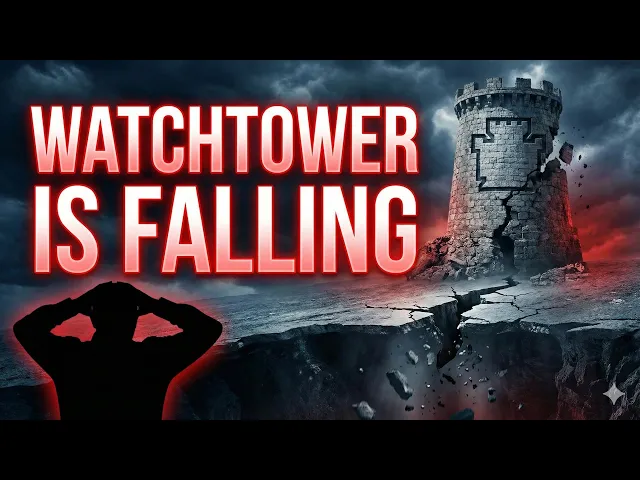
The end of an empire rarely comes with a big dramatic explosion. It's more often a quiet crumbling, a slow, grinding erosion of power, authority, and belief where the foundations crack long before the walls ever fall. For over a century, the Watchtower Bible and Track Society, the organization that governs Jehovah's Witnesses, has projected an image of divine authority and absolute certainty.
They've sold themselves as a spiritual fortress, completely shielded from the shifting sands of the outside world. But today, that fortress is under a siege it can't possibly win. And the cracks are getting impossible to hide.
From the outside, courts around the globe are handing down multi-million dollar penalties, not for matters of faith, but for institutional negligence that has allowed horrific abuse to fester in the shadows. And from the inside, a crisis of faith is brewing. The leadership is making unprecedented rapidfire changes to doctrines and practices held for generations.
Changes that smell a lot more like corporate damage control than divine revelation. On the surface, it might look like business as usual. The organization still prints its magazines, holds its meetings, and claims millions of followers.
But when you connect the dots between staggering legal defeats in the secret panicked changes happening behind the scenes, a very different picture emerges. These aren't just isolated problems. It's a feedback loop.
It's a systemic crisis where external pressure is forcing internal changes that in turn chew away at the very authority the organization needs to survive. This is the story of how a religious giant that once seemed untouchable is now facing an existential threat and how its empire is quietly crumbling from both the outside in and the inside out. The first and most visible crack in the Watchtowers foundation is the relentless storm of legal battles it's losing across the world.
For decades, the organization successfully hid behind arguments of religious freedom and clergy penitent privilege to shield itself from any real liability. That shield has been shattered. Courts aren't just going after individual abusers anymore.
They are holding the organization itself, the Watchtower Corporation and its leadership, accountable for creating and maintaining the policies that allowed abuse to happen in the first place. Let's be clear, this isn't about theological disputes. This is about institutional responsibility.
It really kicked off in California, which has become a legal ground zero for the Watchtower. In 2012, a jury hit them with a massive $28 million verdict in the case of Candace Ki. Kanti was abused as a child by another member of her congregation, a man the elders knew had a history of molesting kids.
The organization did nothing to stop him from being alone with children during ministry activities. While that verdict was later reduced to about $2. 8 $8 million in damages.
The core finding of negligence was upheld. The court's message was loud and clear. The Watchtower had a duty to protect a child from a known predator during church activities.
And that was a seismic shift. The courts were saying that the Watchtower couldn't just claim its activities were purely religious and therefore immune. They had a real world legal duty of care.
Then came the 2015 case of Joseé Lopez, also in California. A court awarded him $13. 5 million after finding the Watchtower organization failed to protect him from an abuser who had been recommended as a mentor by congregation elders.
The judge in that case didn't mince words, calling the Watchtower's actions reprehensible. This wasn't just a failure to act. It was about the organization's judgment and its direct role in putting a child in harm's way.
The Watchtower's legal strategy has often been one of stubborn defiance, and that has backfired spectacularly. In a series of cases in San Diego between 2015 and 2018, the organization was slapped with over $2 million in sanctions for what one court called abusing the discovery process. They repeatedly refused to turn over their internal files on child abuse allegations, a database that likely contains the names of thousands of alleged abusers across the United States.
They fought tooth and nail to keep these files secret, but the courts didn't see it as a principled stand for religious privacy. They saw it as a cavalier and defiant refusal to obey the law and find them thousands of dollars a day, not for the abuse, but for the cover up. Ultimately, many of these cases were settled confidentially, which let the Watchtower keep its damning records out of the public eye, but it cost them millions.
And this pattern isn't just in California. In 2018, a Montana jury slammed the Watchtower with a $35 million verdict with $31 million of that in punitive damages. In that case, a known abuser was removed from the congregation only to be quietly reinstated a year later, which allowed the abuse to continue.
Although the verdict was later overturned on a legal technicality about who the proper defendant was, the jury's message was unmistakable. They weren't just trying to compensate the victim. They were trying to punish the organization for a policy they saw as reprehensible, a policy that prioritized the institution over the safety of a child.
These massive verdicts, even when they're later reduced or overturned, send a powerful message. They are a declaration from society that the Watchtower's internal policies aren't just morally bankrupt, but legally negligent. The International Front is just as grim for the organization.
The 2015 Australian Royal Commission into institutional responses to child sexual abuse was a watershed moment. The commission investigated Jehovah's Witnesses and uncovered a horrifying truth from their own internal records. They had identified 1,06 alleged perpetrators of child sexual abuse within the organization in Australia since 1950.
The number of victims was far greater. And guess how many of those 1,06 alleged abusers had been reported to the police by the organization? Zero.
The commission's final report was a brutal indictment of the Watchtower systemic failure. It blasted the organization's reliance on the two-witness rule, a scriptural interpretation that demands two eyewitnesses to prove a wrongdoing, which is cruy and dangerously misapplied to cases of secret abuse. It called their internal punishments weak and found that their policies left perpetrators at large in the community.
The Royal Commission laid bare the truth. The Watchtower's policies were never designed to protect children. They were designed to protect the organization from scandal and legal trouble.
This legal pressure is now striking at the very heart of the organization's power structure. For years, the Watchtower has hidden behind a complex web of corporations, making it tough to pin down who's really in charge. But that's changing.
In a landmark ruling in New York in November 2024, an appellet court affirmed that the governing body of Jehovah's Witnesses itself can be sued as a distinct legal entity. In the case RKJWO versus Watchtower, the court rejected the governing body's attempt to dismiss the lawsuit, finding that it could be sued as an unincorporated association. The lawsuit alleged that the governing body creates the sexual abuse policies, controls elder appointments, and supervises the entire hierarchy.
This is a devastating blow to the leadership. It means the men who sit at the top of the pyramid in Warick, New York, first eight, then 10, and now 11 of them, can no longer comfortably hide behind corporate shells. The Child Victims Act in New York and similar laws are opening the floodgates for decades old cases to be brought directly against the men who allegedly created the policies that let abuse flourish.
Another bombshell lawsuit was filed in late 2025, the Stella Doua case, seeking no less than $100 million in damages. The complaint alleges horrific abuse by a circuit overseer in Brazil and crucially asserts that the Watchtower and the governing body orchestrated a global system to contain abuse reports instead of reporting them to authorities. It directly targets the institutional policy of routing abuse reports up the chain of command, often with instructions for elders not to contact police as a feature, not a bug, of their system.
The Empire isn't being attacked by apostates. It's being attacked by judges, juries, and royal commissions who are using the organization's own policies and internal documents as exhibit A. Each lawsuit, each verdict, each sanction chips away at their money, but more importantly, it chips away at their moral authority.
How can an organization claim to be God's sole channel on earth when secular courts are consistently finding it negligent in protecting the most vulnerable members? This external assault is creating a level of pressure the organization has never faced before, and it's forcing them to make changes. But as we're about to see, the solutions they're rolling out are only making the problem worse.
If the legal battles are the external assault on the Watchtower Empire, then the internal decay is the crisis of faith and governance eating it away from the inside. For decades, the organization's strength came from its rigid control and the absolute certainty it gave its followers. Every rule, every doctrine was presented as coming directly from Jehovah God, passed down through his faithful and discrete slave, the governing body.
To question any of it was to question God himself. But in the last few years, from roughly 2023 to now in early 2026, we've seen an astonishing series of rapid, almost frantic changes to some of the most visible and long-standing rules. And if you're a current or former Jehovah's Witness, you know this pace of change is completely unheard of.
The organization calls it new light, but to any objective observer, it looks less like divine revelation and more like a corporate rebranding campaign driven by panic. Let's start with the biggest operational change in decades. The decision announced in late 2023 to stop requiring publishers to report their preaching hours.
For nearly a century, the monthly field service report was the key metric of a witness's spirituality. Your hours were tallied, averaged, and published. If you failed to turn in a report, you were labeled irregular or inactive.
It was a powerful tool of control and a source of immense pressure and guilt. Then suddenly, it was gone, replaced by a simple checkbox to say you had shared in the ministry at all. The official reason, it was a loving provision to ease the burden on followers.
But let's connect the dots. This change came as growth in many western countries had flatlined or was declining. It also came as the organization was under legal fire for the amount of control it has over its members.
By loosening the most obvious metric of control, the hourly requirement, the organization may be trying to create legal distance to argue its members are just volunteers and it can't be held responsible for all their actions. It's a move that gives them a better number to report publicly since almost everyone can now be counted as an active publisher while at the same time giving them a potential legal defense. That sounds like a corporate strategy, not a spiritual one.
Then came the clarifications on shunning. In March 2024, after decades of enforcing a brutal policy of total social isolation for anyone dysfellowshipped or disassociated, the governing body suddenly announced it was now okay to say a simple greeting to a shunned person at the Kingdom Hall. This was framed as a merciful tweak.
But again, look at the context. This change was announced right as the organization was in a legal fight with the government of Norway. Norway had revoked the Watchtower's national registration and state funding, arguing its shunning practices violated human rights, especially for children.
After losing in a lower court, the organization appealed. An appeals court did overturn the dregistration in March 2025, but the case went to Norway Supreme Court and it did not seem to go well for Watchtower. Though the verdict won't be known for a few weeks yet, it seems awfully convenient that just as they're in court trying to prove their shunning policy isn't a human rights violation, they suddenly clarify it to sound softer.
This wasn't a spontaneous act of mercy. It was a calculated legal maneuver. It was a PR move designed to appease a secular government.
And the changes kept coming faster and more surprising. Beards, once a sign of rebellion, were suddenly allowed in late 2023. Women who had to wear skirts or dresses to all religious events were suddenly allowed to wear dignified pants in March 2024.
Higher education, long discouraged as a spiritual death trap, was reframed by governing body member David Splain in August 2025 as a personal choice, a dramatic softening of tone. To an outsider, these changes might seem trivial, but for someone who has lived their entire life by these rules, they are earthshattering. Generations of men were counseledled, held back from privileges, or judged as spiritually weak for wanting a beard.
Women followed a strict dress code their whole lives. Young people gave up on college dreams because they were told it would displease Jehovah. And now, with a quick announcement on JW broadcasting, the rules are gone.
The justification that there was never a scriptural basis for them in the first place. This creates profound cognitive dissonance. If the rules were never scriptural, why were they enforced so rigidly for decades?
Was the previous light not from God? Was the leadership just enforcing man-made traditions, the very thing they accuse other religions of doing? It forces followers to face a terrifying possibility that the men of the governing body aren't infallible channels of divine truth, but are just fallible men making up rules and then changing them when they get inconvenient.
Even core doctrines are now being revised on the fly. In late 2023, the teaching about the separation of the sheep and the goats from Matthew 25, a cornerstone of their end times theology was changed. For decades, they taught this judgment was happening.
Now, during the preaching work, your response to a witness at your door could seal your eternal fate. That belief gave the ministry its life or death urgency. The new teaching, the separation will happen in the future during the great tribulation by Jesus himself.
This one change completely deflates the urgency of the preaching work. If people can still be saved during the tribulation, then the work is no longer the immediate rescue mission it was sold as. This combined with getting rid of the hourly reporting has fundamentally changed the identity and motivation of the average witness.
Now, let's look at the numbers. The Watchtower's 2025 service year report covering up to August 2025 is a masterclass in corporate spin. They celebrated a peak publisher number of over 9.
2 million and a 2. 5% increase in average publishers. They highlighted big growth in Africa and Asia.
On the surface, these numbers seem to contradict any idea of a crumbling empire, but the headlines rarely tell the whole story. The most glaring number in the entire report is the memorial attendance. 20,635,015.
While that sounds huge, it's a drop of nearly half a million people from the year before. The memorial is the single most important event of the year for Jehovah's Witnesses, and it's the one time they actively encourage inactive members, family, and interested people to come. A drop that big is a major red flag for waning interest and influence.
Plus, that headline publisher number is now almost meaningless. With the new checkbox system, someone who just mentions the website to a co-orker once a month is counted the same as someone who spends dozens of hours preaching. In the United States, for example, while the average publisher count went up slightly, data shows that the number of congregations has been falling for three years straight.
The number of Bible studies, the engine of future growth, has also been declining for three straight years in the US. What we're seeing isn't expansion, but consolidation. They are managing a decline, not celebrating real growth.
They're putting a positive spin on numbers that under a little scrutiny reveal weakness, not strength. This internal decay is a quiet crisis. It's the erosion of trust, the undermining of authority, and the planting of doubt.
The leadership is trying to patch holes in the ship, but the patches themselves are dissolving the hole. Every adjustment made to fend off a lawsuit or stop members from leaving is just more evidence that this organization isn't divinely directed, but is a human institution trying desperately to stay afloat. This is the core of the crisis.
This is the central argument. The external legal assault and the internal doctrinal decay are not two separate problems. They are two sides of the same coin, locked in a devastating feedback loop that's speeding up the Watchtowers's decline.
The empire is crumbling because pressure from the outside is causing cracks on the inside. And the cracks on the inside make it more vulnerable to pressure from the outside. Let's trace the cycle.
It starts with external pressure. A court in California, a jury in Montana, or a royal commission in Australia exposes the organization's systemic failure to protect children. They hand down multi-million dollar verdicts and publish brutal reports.
This creates two immediate problems for the governing body. A massive financial hit and a catastrophic PR nightmare. Their carefully built image as a uniquely moral and divinely guided organization is shattered in the public square.
So, how do they respond? They can't admit they were wrong. That would be admitting the faithful slave was unfaithful.
It would destroy their entire claim to authority. So instead, they act like any other corporation in crisis. They change their policies not because of a moral awakening, but out of strategic necessity.
This is where the internal decay begins. To fight the legal battle in Norway over shunning, they clarify their shunning policy to make it sound less cruel. They need to argue they aren't a high control group.
So, they tell their members they no longer need to report their hours. They want to appear less strange and cult-like to the outside world to attract new people and slow the exodus. So, they suddenly allow beards and pants for women, things they condemn for decades as worldly.
Each of these changes is a direct reactive response to outside pressure. It seems the legal department and the PR department now have more influence over new light than the theology department. The coordinators committee, which handles legal matters and urgent crises, appears to be driving policy.
The organization is being forced to adapt to survive in a world that is finally holding it accountable. But here's the crucial part of the feedback loop. These very changes designed to solve one problem create a much deeper one.
They destroy the faith of their most dedicated followers. Think about it from the perspective of a lifelong sincere Jehovah's Witness. You've sacrificed everything for this organization.
You didn't go to college. You alienated family members who were dysfellowshipped. You dedicated thousands of hours to the ministry.
You did all of this because you believed without a doubt that the governing body was speaking for Jehovah. You believed their direction was perfect, loving, and unchanging because it came from an unchanging God. Then in just a couple of years, you're told the hourly service requirement, the bedrock of your spiritual routine, is no longer necessary.
You're told that beards, which you were taught to see as a sign of spiritual weakness, are now perfectly fine. You're told that the foundational doctrine of the sheep and the goats, which gave your preaching work its ultimate meaning, was wrong. And the reason for all of this, that the old rules were never really scriptural to begin with.
The unavoidable conclusion is devastating. Either the leadership was wrong for decades or they're wrong now. Either they were enforcing unscriptural man-made rules then or they're abandoning God's standards now to please the courts and public opinion.
Either way, their claim to be God's exclusive, infallible channel is shattered. This realization fuels internal disscent. It gives power to the doubts that many have pushed down for years.
It validates the arguments of apostates who have been pointing out these contradictions all along. The changes meant to save the organization become the most powerful evidence against it. This leads to more people leaving, not in a loud protest, but in a quiet fade.
They stop going to meetings, stop reporting service, and just drift away. This weakens the organization from the inside. It cuts down on donations, lowers morale, and creates an atmosphere of uncertainty.
That half million drop in memorial attendance in the 2025 service report is a tangible symptom of this quiet exit. And this brings us right back to the beginning of the loop. A weaker, less unified organization with a less motivated membership is even more vulnerable to external attacks as more former members speak out.
They provide more ammunition for lawyers and journalists. The organization's desperate attempts to look more mainstream and less controlling just make it look weak and indecisive, emboldening its critics. The more the organization changes its doctrines to protect itself legally, the more it proves to its followers that its guidance isn't divine, it's corporate.
It's a death spiral. The external legal crisis is forcing a series of internal identity crises. And those identity crises are fueling a loss of faith that will in the long run be far more destructive than any lawsuit.
The empire isn't being conquered. It's being hollowed out from the inside by the very actions its leaders are taking to save it. We've connected the dots.
We've traced the path from the courtroom to the Kingdom Hall. We've seen how multi-million dollar lawsuits for concealing child abuse are directly linked to sudden changes in dress codes, ministry requirements, and even core doctrines. The picture that emerges is not one of a divinely guided organization receiving new light.
It is the picture of a 20th century religious corporation built on absolute control, colliding with the 21st century world of accountability and information, and crumbling under the impact. The external assault from legal systems has exposed a history of negligence and secrecy, costing the Watchtower not just hundreds of millions in potential liabilities, but its priceless moral authority. In response, the internal leadership has descended into a frantic series of reactive changes that reveal a crisis of confidence at the very top.
These changes, meant to patch the crumbling walls, have instead poisoned the faith of the people inside, creating a feedback loop of decline that now looks irreversible. The Watchtowers empire is quietly crumbling. Not because of one big event, but because its core premise that a small group of men in New York has an exclusive monopoly on divine truth, has been proven false by their own actions.
Their desperate attempts to adapt for survival have become the most compelling evidence of their own fallibility. They're changing the rules of the game while claiming the rule book was written by God, and their followers are starting to notice the contradiction. But this isn't just an academic analysis of a declining institution.
We have to end by remembering the human cost. For every lawsuit, there are victims whose lives were shattered. For every doctrinal U-turn, there are millions of people who built their entire lives on the previous truth.
People who sacrificed careers, education, and family relationships based on rules that are now being casually dismissed as non-essential or unscriptural. There is a profound sense of betrayal felt by those who gave everything to a cause they now see behaving like a cornered corporation, prioritizing brand management over truth and legal strategy over love. The real tragedy of this crumbling empire isn't the fall of a publishing house or real estate portfolio.
It is the devastating human cost for the millions of sincere, dedicated people who are left standing in the ruins of their faith, forced to reckon with the reality that the unshakable foundation they built their lives on was in fact made of sand. The story of the Watchtower is still being written, and these developments raise huge questions about the future of the organization. What do you think these changes mean?
Are they a sign of a genuine course correction or are they the desperate moves of an organization in crisis? I truly want to hear your perspective, especially if you have personal experience with these issues. Share your thoughts in the comments below.
Let's keep this important conversation going. And if you found this analysis valuable, please consider supporting the channel so I can continue to produce in-depth reports like this one. Also, if you haven't already, be sure to watch my in-depth documentary, From Kookie to Cult: The History of Jehovah's Witnesses.
It takes you step by step through how this organization went from a strange group of kooky ideas to a high control cult that holds absolute power over its members' lives. Click the icon in the corner to watch that now. I'll see you there.
I wanted to pause for a second to ask for your support by becoming a channel member of the channel by clicking the join button below. It starts at a whopping $4 a month. If that won't break the bank for you, it helps me be able to produce more content like this.
If it would break the bank for you, by all means, just keep watching. Thank you in advance for your generous support.