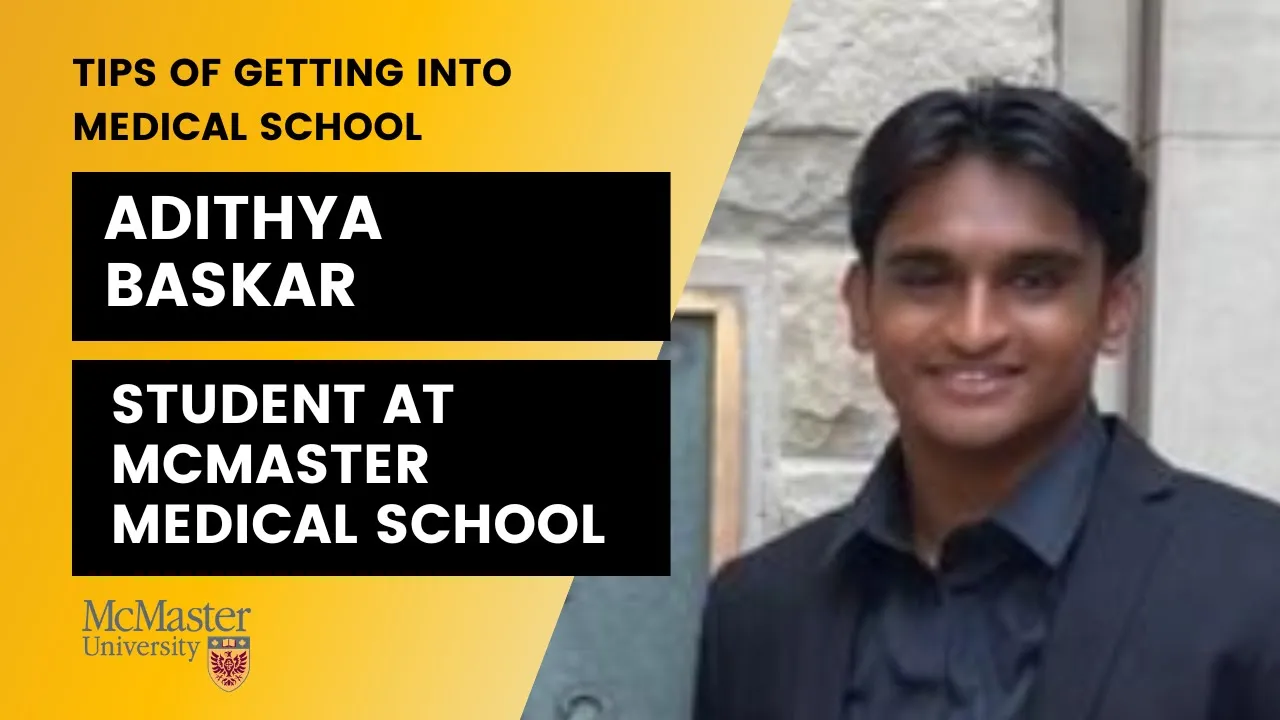
foreign we're so excited to have you on today's episode and to learn more about your career Journey let's jump right into the first question then Aditya let's start from the very beginning how did your post-secondary experience lead you to where you are today I'm just taking a brief introduction to myself my name is Aditya Bhaskar and I am a first year medical student studying at the Michael G Degroot school of medicine at McMaster so for my post-secondary background for my undergrad I did my degree in medical Sciences at the University of Western Ontario and the
reason I decided to pursue that degree was just in high school I was always a big fan of like all my stem classes I really like biology and I was especially keen on human physiology so I just decided you know this is probably the program that is most likely to help me like really felt my interests so I decided to do that degree and throughout my years there I did all the required courses and then I decided to do a specialization in microbiology and Immunology so I did an honors thesis in that and then I
decided to apply to medical school and I got in this year so in terms of like applying to medical school it's like a pretty standard I would say a traditional background so I don't have anything special to say on that but one thing I did want to talk about is something that I feel that is quite overlooked in a lot of people is a post-secondary experiences especially in medicine is the social aspect of it so in Western I felt that I had a really good opportunity to network with a lot of people that were interested
in medicine or even just like outside of medicine as well which I think is important because um what I first started going into this I didn't know whether I wanted to do medicine like I have a lot of options right and I wasn't really sure what I wanted to do I just knew that I really enjoyed the subject right so looking into it I didn't really know what my job options were apart from medicine or maybe research and having all these opportunities to talk to people I talked to a lot of people about dual degrees
in business as well and seeing all these other opportunities has allowed me to really explore what I wanted to do and that really ended up solidifying my decision to end up going into medicine I think it's also just important to have a strong social network because the application process for medicine is really demanding and it can be very difficult if you don't have strong social support so I feel that especially for a lot of people that are thinking about pursuing medicine they think they have to really be on the grind because if they're not studying
all the time someone else is going to take their spot in medical school that's no pressure for that I think it's more important that you build these social networks have social support so you don't end up burning out you really solidify your decision on whether you want to pursue medicine and ultimately just makes the experience a lot more fun yeah definitely that's I agree with you said that that social network can be really important at times at the at a good time to discourage yourself from burning out and even have passed off to Raj to
ask the next few questions so for the second question I'd like to ask you what really motivated you to pursue a career in medicine and how did you decide that medical school was the right path for you when I first started going into post-secondary education I wasn't entirely sure on whether I wanted to pursue medicine uh for me it was it was always just the subject right the subject was what really drew me there I was like oh I really want to study uh human physiology on a study sciences and let's just see where it
goes from there right so while I was in university uh in my program a lot of people do pristine medicine so I just did a lot of similar activities as them just to kind of explore medicine as a pathway so I did a lot of clinical volunteering at a nearby hospital like St Joseph's Hospital I volunteered in their long-term Career Center at Mount Hope so it was stuff like that that really kind of uh Drew my interest a bit more so I would say like my decision was like a amalgamation of many different aspects that
just made me feel that medicine was right for me so the clinical aspect rewarding and in terms of subject I really enjoy critical thinking and I wanted to look at a job where in the future I would be able to always critical think always use my expertise to problem solve in in the subject of human physiology right so I tried research as that would be another career where you do use that same critical thinking skills in that subject but ultimately I felt that while research was interesting it just didn't really feel right for me so
I guess just networking talking to a whole bunch of people looking at other options I just realized you know medicine was likely what would be the best for me as ultimately it was what allowed me to pursue the subject that I wanted to study for my entire life it put me in a position where I would have oversight and allow me to critically think and I would say that it just was a lot more fulfilling for me than a lot of other career opportunities that I looked at for the next question I'd like to ask
you now that you are in medical school we can go over your past experience and talk about how was your experience in studying for the MCAT and the Casper test and how did you prepare and what were your key takeaways from the experience so the MCAT that is the big test that everyone dreads everyone that's applying to Medicine they're always really scared about the MCAT and like studying for the MCAT is definitely a challenge um I I think the key takeaways is that it really depends on you as a person what your learning style is
uh and I think you have to try and modify it or just adjust what people tell you to do to make it optimal for you so in terms of my as usual I started like with the same resources that most people do which is the Kaplan full review it's like a volume of seven books I believe which gives you the full insight into everything you need to know on the MCAT it's a huge read it takes a long time to get through all of it but for me one area in which I differed from a
lot of other people was that I didn't spend a lot of time reviewing those books because of course I took on my degree gave me a lot of insights into a lot of the subjects that I touched on in these books and I felt that doing a deep dive of the books would be wasting my time just because I felt like I already had a lot of insight into a lot of the subjects so what I did was I went through the books I uh made sure to look over what I thought I knew what
I didn't know I just came over the sections where I thought I had enough uh information especially the sections on like immunology and microbiology since my specialization was in that field I felt that I had a lot more knowledge than I needed for the MCAT so I made sure to only study the areas that I felt I would be weakened so for me I've always felt that I learned better doing rather than reading so a great resource that I used for my studying was called uworld which is a subscription-based service which gives you access to
a large amount of questions that are on the MCAT and going through that you get a good idea of what types of questions you will see on the MCAT how difficult they'll be and what knowledge is really more pertinent to the MCAT because there is a lot of different a lot of content to cover on the MCAT and not all of it is as common and as important as other information so a doing some practice problems gives you a much better insight into what you need to know for the MCAT than just reading the books
in my opinion so I only spent a short amount of time studying the actual Kaplan books and I spent a lot more time doing the the practice problems on New World which gave me much more insight into what I needed to work on which areas I knew very well and just how the MCAT would be in general so I'd say what worked for me was doing a lot more practice problems through EU world and also like a full-length test as well like if you go onto the aamc website which is the company that runs the
MCAT they sell a MCAT preparation package which gives you access to four full-length tests plus an extra practice test so you have a access to a total of five full-length MCAS for free so I think that's also a great resource to get a better holistic view on the MCAT because it generates tests based on what section you want to work on but it won't give you like an entire full-length MCAT so also not expressing the full-length MCAT test throughout your studying is also very important just so you have a good idea of how you're doing
in the MCAT overall how much time you're taking in each section do you have enough time to finish all the sections it's just overall a really good way to get into the testing mind exit so I would say overall for me not as much time studying the actual books as other people tell you to and more practice problems but again that's because that's what works for me if you are a person that learns a lot better through reading the textbook then maybe that is something that you can focus on or if you're a person that
learns really well from someone else explaining Concepts to you maybe seek out people that have written the MCAT before people that are in med school for example or even YouTube is a great resource so you can find a lot of information there Khan Academy so the best of the key takeaway for me is knowing yourself really well know how you learn know how you are most liked to succeed on the MCAT and just make sure you plan your studying for the MCAT based on that because the MCAT there's no one telling you exactly how to
study it's all based on your self you create your own study plan so just modify it based on your strengths so that's what I would say for the MCAT for the Casper on the other hand so that's a bit different because Casper is more of an Ethics based test so for that I feel like a lot of people that go into medicine have a pretty strong ethical basis so for a lot of them it won't be that difficult to know how to answer these questions it's more so just learning the proper structure and what exactly
the test markers are looking for so for that I just do some reading see what people say are generally good answers what people say are poor answers and make sure you kind of Follow That formula for me I didn't do a lot of the other courses available online which allow you to look at good answers and write your own answers and have it marked by someone else but for me I personally just talked to my friends showed them my answers had them Market as well as some people who I knew were in medical school and
based on that I felt like I got a pretty good understanding of what exactly they're looking for on the Casper test so I guess my key takeaways overall is just know yourself really well know what works for you and just ensure that you modify your study plan to allow yourself to have better and best success great insights of that yeah a lot of things that work for some people may not work for other people so find your strengths may be the best way to move on for my next question I'd like to ask you what
do you envision the next few years of your life will look like in medical school very busy a lot of work but it's a great opportunity to kind of explore kind of balance yourself within like studying and the work and just having a social life so far for me it's been a bit of an adjustment from undergrad but it's not too bad my classmates are very social we go out a lot but there's also a lot of content for us to study so it's just understanding that balance is kind of what you do while you're
in med school but in terms of like what exactly I'll be doing in my program so McMaster has a three-year medical school program rather than a four-year and basically what that means is we don't get Summers off so I'll be here for the next three years straight but for our first year it'll mostly be uh a lot of content based lectures and a lot of tutorials where we look into cases so for for the first year I'll just be a lot of class-based learning second year I'll have more opportunities for shadowing so we have a
pre-clerkship electives which is where we go for a week or so a shadow a doctor in which we're interested in and then we kind of get a good understanding of whether other that specific area of medicine is what I'd want to pursue right and then afterwards near the uh middle to end of second year I would say is when we start doing our clinical rotations and that is where we go in we had a set uh we're basically like almost working in a hospital you're there for a certain number of weeks uh they give you
a schedule on when you have to come in and that kind of gives you a really good understanding of what it'll be like to work in that field and whether that specific specialty is what you want to go into afterwards near the beginning of third year I'll be applying for residency while also continuing my clinical rotations so the clinical rotations they go pretty much for the rest of my med school career or like the next all of third year but at the beginning of third year is when I'll be applying for residencies and I'll decide
what Specialties I think I might be interested in and apply to those and then near the end of third year you go in for interviews and then you might get a place into Residency program that you like maybe not it just really depends right so in the first year a lot of classmates learning and second so there's a lot more shadowing and a lot more practical learning very great insights I'm pretty sure all the listeners listening in for medical school advice would really appreciate the key takeaways that you've given I'm going to pass it back
to Sophie now for the last question thanks Raj and thank you Aditya for all of those really great insights so our last question for you today what specific tips would you have for someone trying to get into medical school and do you think there is a specific skill set or mindset that is required I wouldn't say there's a specific skill set our mindset that is acquired but I I think a good uh piece of advice that I have for anyone applying to that school is just to relax and don't be too critical of yourself uh
like I mentioned earlier like a social aspect of your life is very important to being able to um pursue your better Journey because it is a very long and ruling Journey a lot of people think of doctors as being very type A and they're always working always grinding and while that is the case for some of my classmates for a lot of us we are more like type B we're a bit more relaxed we enjoy our lives as well I'm not saying if you are someone that's more type 8 you will be able to perceive
medicine but I think having that balance is really important because it is a very long journey you're going to be doing this for the rest of your life and if you're already feeling like you're going to burn now it's very likely that in the future you will eventually burn up so it is important to have some bounce in your life and it doesn't necessarily have to be a very social if you're not a very social person I'm not saying you have to go out every week with your friends uh if you have something that you
really really passionate about outside of school like a hobby then you know make sure you uh invest some time into that don't overlook that hobby just because they feel like you need to grind for medical school make sure you balance your life and physical health like if you like to work out that's very good eating well it's all really important to just take care of yourself to ensure that you have really good success going into medical school yeah definitely I would say that's a great takeaway for our listeners it's important to invest in yourself just
as you're investing in your schooling as well so that's the last question that we have here at Divya I just want to thank you so much for being a guest on the cast today I'm sure our listeners will really benefit from all of the wisdom that you've shared today and we really appreciate your time




![#32 - Tom Leung, MSc PhD [Undesigned Path], Founder, BenchSci](https://img.youtube.com/vi/Ic-8C2NW45k/maxresdefault.jpg)
![DAX Filter Context Basics [Full Course]](https://img.youtube.com/vi/Rpa8mDH7mes/maxresdefault.jpg)