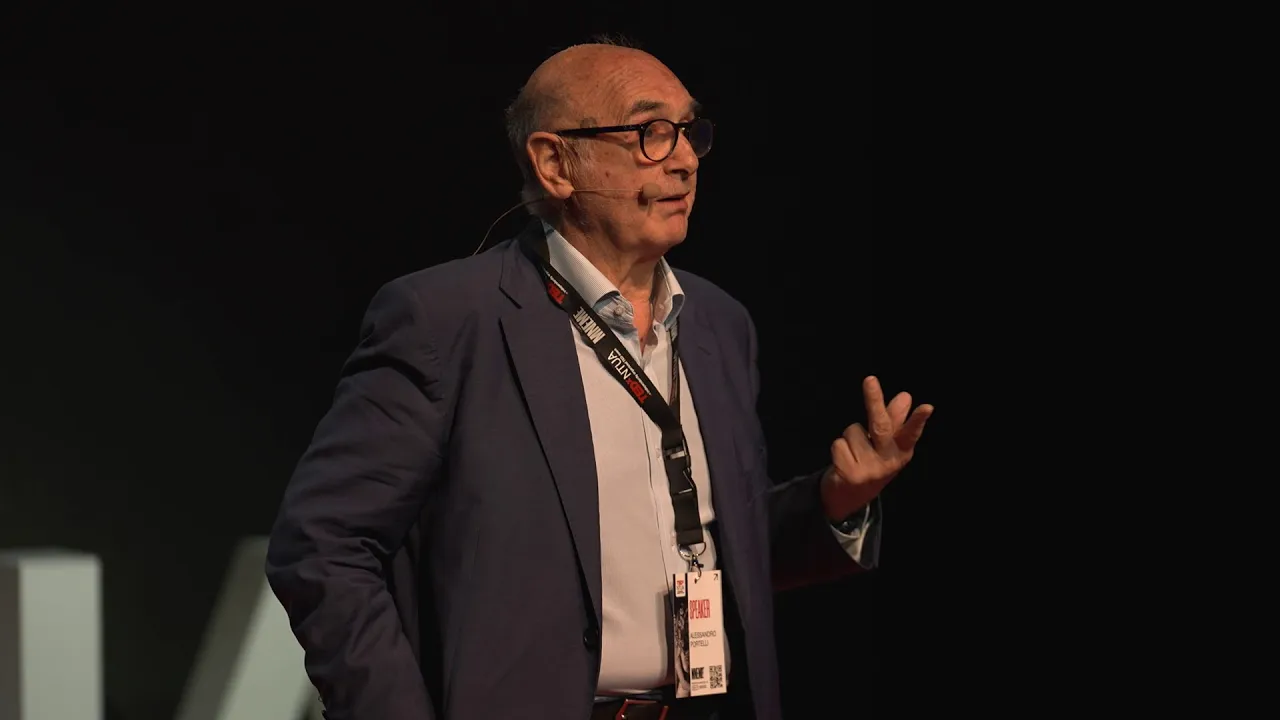
[Music] [Applause] well good evening and I'm on the one hand I'm very excited to be here this wonderful occasion in which students young people are running the show for once and um on the other hand I'm sorry that I am only able to uh share my thoughts with you in a in a foreign language which is foreign to both of to all of us but I hope we can communicate um the word that appears up there says n and I'm going to share with you a few thoughts about memory and a few thoughts about the
ways in which we uh collect document recognize study analyze one of the approaches to the study of memory is called oral history oral history consists basically in a practice of fieldwork you go out with a tape recorder or with a digital recorder today and you ask people just common people everyday people uh to tell you about the ways in which their lives uh interjected history so basically there are three uh key words to this conversation memory uh the uh relationship between the the past and the present biography the relationship between individual lives and social Collective
public history and dialogue the conversation between the person that is being interviewed and the person that is interviewing her or him I will start with memory I'm not a historian I used to be a teacher of American literature and one of the Great American Writers William Faulkner has a famous phrase in which he says the past was not dead it wasn't even past so memory is exactly this the fact that the past does not just belong to the past but the past is a presence in our time I don't know how many of you are
Bruce Springstein fans but uh a song like the Ghost of Tom jod means exactly this uh it's a metaphor of how the history of the past is present and acts in in our time so because basically when you do an interview uh you're do you can do an interview on uh an event that took place in uh 1944 but if the interview is in is done in 20023 then it's it's a document about 44 but it's a document of for of 2023 and it tells you what 44 means in 23 because the way we remember
the way we conceptualize the way we imagine the past has an impact on the way in which we act in the presence an example one of the historical events that I studied uh was uh a massacre uh a mass murder perpetrated by the Nazi occupiers in Rome in 1944 uh in which they killed 335 civilians as to terrify the uh the city and show the the city that the price for resistance was very high so the memory of this massacre uh has been sort of an official memory in a in a country that claimed that
our democracy uh was uh based on the history of anti-fascist and anti-nazi resistance all patriotic memories it sort of became ritual uh of course we all care for this but okay we know suddenly the memory changes meaning and it changes meaning because now we have an avowed fascist who is the prime minister of Italy so the memories of anti-fascism which were sort of an official memory in until 1995 become an oppositional memory today and the presence today of anti-fascist memory is a powerful force in the political scene in contemporary Italy so this is um the
meaning of the uh other the phrase the the past is not even past the past is active today the uh second keyword is biography I come from a um in high school the high school that I went to uh was called the classical High School one of the key subjects was classical Greek which I barely remember but I can't help noticing that half the words amusing come from Greek so biography the history that we read in books the uh or at least the history we used to read in books uh was not the history of
common people it was Kings generals battles huge events however uh all of these huge events have an impact on individual lives and uh on the one hand I mean you can't have a war without common soldiers you can't have a a war that does not affect individual lives an old lady a texi worker in uh in the town of terney where I grew up used to tell me you know World War I was fought up in the mountains World War II it was fought right here because they were bombed so uh we were also involved
she says and and one of the things that we do in this in this approach in this oral history method is uh how people have been involved so say take the massacre that I was talking about okay they killed 335 men uh the victims were came from all walks walks of life pedlers generals um young old Jews uh Gentiles atheists Communists uh uh Christian democrats liberals the only thing they had in common was that they were all men this means that those who were in charge of uh survival like feeding the children and memory are
mainly women so this is a history of women even though in history books it's a story of men men Nazis sazi soldiers killing men but in memory it's a history of women women trying to survive after the massacre and survival was uh was something they' never been asked about this so uh because of course you know we learned that the historical event is what happened to I'm talking about this one example this lady whose husband was killed and uh and to her the historical event is the death of her husband to me the historical event
in oral history is how did she live after that and she has an incredible story because she talks about you know she didn't even know I was recording because she didn't think this was uh official this was history and she talks about how hard it was for her to get a pension after the massacre and this was not a historical event for her and then she says and in order to get that pension I had to make the rounds of offices and institutions and places and everybody thought that I was at their disposal so I
said see dialogue madam what do you mean and she says I mean what I what you know I mean she means that she didn't she was an old lady she had only gone to the third grade in School no education she didn't have the words to say sexual harassment but she had the experience and she would and she did not know then that her experience of sexual harassment was a historical event because she had never been taught that there's such a thing as women's history as social history is the history of sexuality and one thing
that that uh story did for me was it made me ashamed because as long as we're talking about the Nazis massacring all these men I'm not a Nazi I'm anti anti-nazi so it has nothing to do with me apparently it does because the Nazis were European Western Europeans just like me came from my own culture uh but when she talks about men thinking that young widows were legitimate prey then she's talking about me not because I that's what I think but because that's a culture that's a male culture in which many of us were raised
so this takes us to the third example to the third question dialogue I used to teach African-American literature but one of the first interiew that I did with an African-American lady in in Kentucky the United States she says uh she kept talk she talked in circles she began by giving me the you know the common place things you know we're all against races and blacks and whites together and then she raised the stakes and she started talking about more difficult things at one point she says uh my great-grandparents were slaves incidentally she had a hard
time uttering the word slaves they were s slaves which when you're talking about oral history the oral is crucial her relationship with the memory of slavery was all concentrated in the fact that she couldn't even say that word and then she says and they told the stories that went down through the family and because of what I've Been Told no white person has ever done anything to me but because you're white I don't trust you and the question was see in an interview an exchange of gazes you look at each other uh the question is
not just who is this person I'm talking to the question is also who am I because you're you're facing difference it's facing otherness and you implicitly read finding yourself so here I am white male European middle class talking to a black woman workingclass American uh plus religious differences and everything why should she trust me uh meaning that we have so much in common but one difference one of the basic difference we don't have in common is the color of our skin and I may be an anti or think I am anti-racist and everything but the
moment the color of our skins becomes a matter of life and death can I can she trust me or can I trust myself because I've never been in that situation can I trust myself so she was challenging me and this is so important in the work of our history because you're having a dialogue with otherness and one of the thoughts that I had that day was well okay say this was 1938 and suddenly all the Jewish kids in my class disappeared because that's what happened in 1938 in Italy would I do something would I think
something or would I just be indifferent or would I keep Qui I don't know I don't know so this is what uh a facing otherness in the course of field workor does for you and she says this lady uh my grandmother always told us no matter how good they look no matter how good they talk white people there's always going to be a line and I wondered okay she says she she can trust me but she's spending two hours of her life to talk to me and then we did another interview another four hours so
why basically because she trusted me enough to try to spend some of some time in her life to explain to me why she couldn't trust me and and there was all there's always going to be a line what she was talking doing she was talking across that line I was on one side she was on the other side and she was talking and I was reminded of what I learned in school how do you say talking across Dia dialogue dialogos the real meaning of dialogue is exactly this The Exchange the sharing of thoughts across a
line of difference so this is really what oral history is about we cross a number of boundaries the boundary between the present and the past the boundary between individual life and Capital H history the boundary between ourselves and otherness and uh we learn a lot we learn a lot of history but we learn a great deal about ourselves because if you I've always felt that if you come out of one of these interviews and you're not changed well you have been wasting your time and I honestly hope that I haven't been wasting yours thank you
for your PA