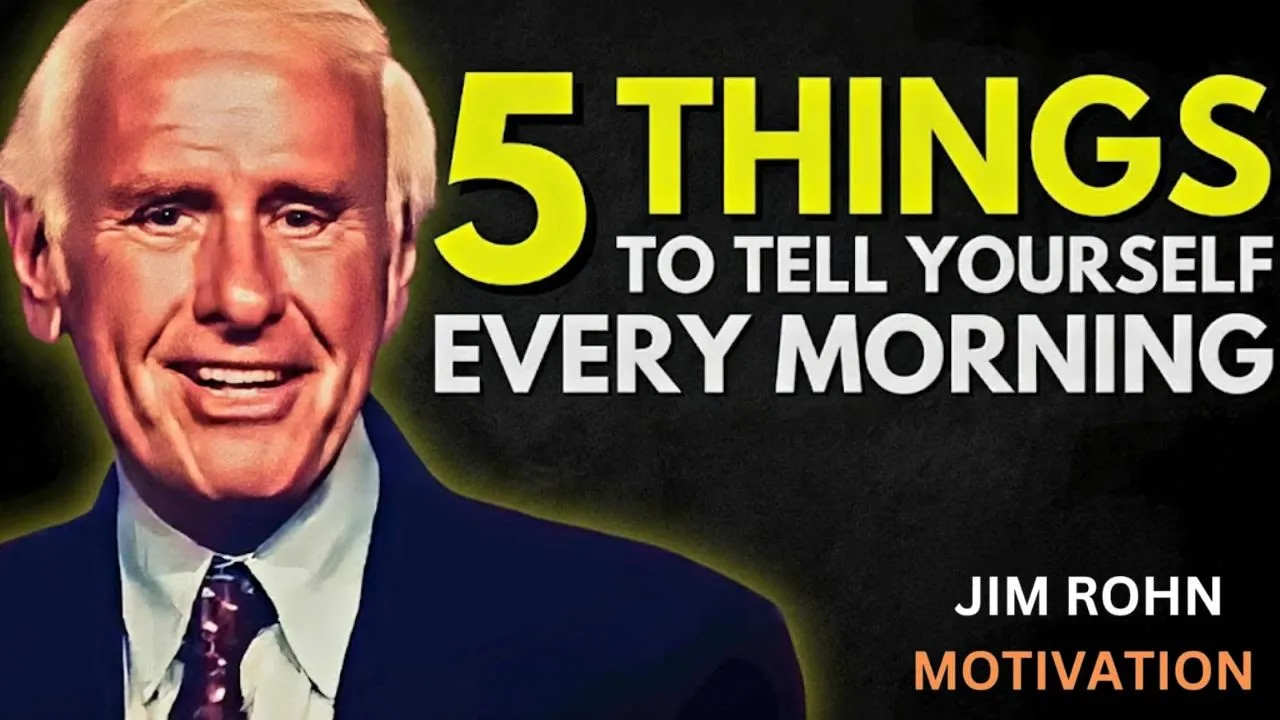
Every morning we face a choice. We can wake up and just start moving, letting the day lead us where it wants. Or we can set our course.
We can take a few moments to say certain things to ourselves. Words that set the tone for our day. Words that align our minds, our attitudes, and our actions with our best intentions.
Now, I don't mean affirmations that are empty of substance because that's not what gives us the fuel we need. It's not about repeating feel-good words. No, I'm talking about powerful phrases grounded in truth, principles, and real intention.
These are words you say to yourself that remind you who you are, where you're going, and what it will take to get there. Imagine this. Every morning, you say these five things to yourself, setting a foundation to build a day that matters.
Each phrase is a brick. Each one a little bit of strength, a little bit of wisdom. You build that wall brick by brick.
And soon enough, you'll find yourself standing behind a fortress, a fortress of purpose and resolve. It's that kind of structure that holds up when things get tough, that keeps you grounded when the winds of life blow strong. And the beauty of it is when you say these things every day, you're not only reminding yourself of the best version of you, you're stepping into that version one morning at a time.
It's like taking your thoughts and aligning them with the actions you're about to take, setting the course before you walk it. This habit is one of those small disciplines that over time makes a big difference. Each phrase has power, and each one has its place in building the day you want.
These words guide your energy, shape your choices, and remind you of what you're capable of. They act like a compass, steering you through the day's distractions, challenges, and temptations, keeping you focused on the path you want to walk. The goal here isn't perfection, but direction.
It's about building momentum one morning at a time so that when you reach the end of your day, you can say, "Today was good. Today was purposeful. " So the first thing to say to yourself each morning is, "Today I take responsibility.
" Now responsibility is one of those powerful words that shapes everything else. When you start your day by taking full responsibility, you set the stage for real power. Because here's the truth.
You cannot change the wind, but you can set the sail. Responsibility means owning that sail, adjusting it, and not blaming the wind, the sea, or the boat. It's understanding that no matter what comes at you, you get to choose your response.
And my friends, that's real freedom. See, one of the most liberating things you can realize in life is that your circumstances don't define you. What defines you is how you respond to them.
Responsibility isn't about fault or guilt. It's about control. It's recognizing that you and only you steer your ship.
And by saying, "Today I take responsibility," you're setting an intention to own your choices, your actions, and your attitude for the day. You're saying that whatever happens, you're going to respond in a way that aligns with your values and your goals. Now, some people spend their lives in a mindset of blame.
They're quick to point fingers, quick to find fault in circumstances, in other people, in the world around them. But here's what I learned over the years. Blame may feel good in the short term, but it leaves you powerless.
The moment you say it's their fault, you give away control. You're essentially saying, "I can't change this because it's not up to me. " But responsibility, responsibility gives you power because it puts the control back in your hands.
When you take responsibility, you're no longer waiting for the world to change. You're setting yourself up to make changes within yourself. Does this mean I have to handle everything perfectly?
That I can't ever slip up? Not at all. Taking responsibility doesn't mean you won't make mistakes.
It doesn't mean you won't have days where things fall apart, but it does mean you own those moments. You recognize them, you learn from them, and you get back up. Taking responsibility means that when you fail, you don't fall into shame or self-pity.
Instead, you look at what went wrong, ask what you can learn from it, and then you adjust your course. It's like being the CEO of your life. A good CEO doesn't blame the economy or the competition when times get tough.
No, a good CEO steps back, assesses the situation, and makes changes. They take responsibility for the outcome because they know that's the only way to lead effectively. So when you say to yourself, "Today I take responsibility," you're stepping into that role for your own life.
You're becoming the CEO of your day. You're making a commitment that whatever happens, you'll meet it with maturity, with resilience, and with action. Now, why say it in the morning?
Because that's when your mind is fresh, unclouded by the day's events. Morning is when you have a chance to set the direction before the distractions come. Imagine it like setting your internal compass.
When you say, "Today, I take responsibility," you're tuning your mind, aligning it to look for solutions instead of problems, to focus on actions instead of complaints. This single commitment made each morning helps you to notice when you start slipping into blame. It's like a reset button reminding you to pull back from negative thoughts and stay focused on what you can control.
And here's the real magic. When you take responsibility, you stop waiting for the perfect circumstances to act. You see, some people put off their dreams, their goals, their best intentions, all because they're waiting for the right conditions.
But here's what I've learned. There's no perfect time. And the conditions will never be just right.
If you want progress, you've got to work with what you have and do what you can. And that's exactly what responsibility does for you. It gives you the courage to act today, right where you are, with whatever resources you have.
Responsibility also keeps you grounded in reality. It's not about wishful thinking. It's about looking at where you are and saying, "Okay, here's the situation.
What can I do about it? " It means acknowledging both the opportunities and the limitations and then making the best of it. It's a mindset that says no excuses.
And when you bring that mindset into each day, you start to see results because success isn't about waiting for ideal circumstances. It's about making progress inch by inch, step by step in the real world. So when you say, "Today, I take responsibility.
" It's not just a phrase, it's a declaration. It's a way of telling yourself that come what may, you're going to stand up and face the day with courage. It's a promise that you'll own your choices, that you'll handle the setbacks, and that you'll keep moving forward.
And my friends, when you live with that kind of responsibility, you don't need anyone else to motivate you. You don't need the perfect plan or all the answers or even ideal conditions. You just need to know that you'll do the best with what you have.
and that's enough. Taking responsibility is also contagious. People around you notice it.
Your friends, your family, your colleagues, they'll see the way you handle challenges, the way you step up, the way you don't complain or blame. And that has an impact. When you live with responsibility, you inspire others to do the same.
You become an example, a light that others can follow. And before you know it, you're not just improving your own life, you're contributing to a culture of accountability, of resilience, and of growth. So each morning as you wake up, take a moment to say it with conviction.
Today I take responsibility. Feel the weight of it, but also feel the power. Recognize that by taking responsibility, you're freeing yourself from the limitations of excuses, from the traps of blame, from the prison of waiting for the right time.
You're saying to yourself, "Today, I own my actions, my responses, my choices. " And with that mindset, you walk into the day empowered, grounded, and ready to make a difference in your own life. Responsibility is where it all begins.
It's the cornerstone of everything else you'll say to yourself in the morning. Because if you don't take responsibility, the rest doesn't have a place to stand. But when you do, when you take ownership of your day, your choices, and your actions, you're already halfway to winning the day.
It's the first step, and it's a powerful one. Next, the second thing to say to yourself each morning is, "I am capable. " Now, this may sound simple, but don't underestimate the power of these words.
I am capable is a declaration of your own potential. A reminder that no matter what lies ahead, you have what it takes to face it. Think about it.
In a world full of doubts, challenges, and setbacks, how often do we pause to tell ourselves, "I am capable. " We live in a society that bombards us with reasons to feel inadequate. There's always someone faster, smarter, wealthier, always some comparison that can leave us feeling less than.
But when you start each day by affirming your capability, you're grounding yourself in the truth that you have the skills, the determination, and the strength to meet whatever comes your way. Saying I am capable each morning isn't about boasting. It's not about arrogance or overconfidence.
It's about acknowledging the strengths you have. There's a saying, all the resources you need are in your mind. And that's true.
You have within you everything you need to face life's challenges. And by saying, "I am capable," you're giving yourself permission to trust in that. You're reminding yourself that though you may not have all the answers yet, you have what it takes to figure them out.
Capability doesn't mean perfection. It doesn't mean you won't face setbacks or make mistakes. It simply means that you believe you can handle those setbacks, learn from those mistakes, and keep moving forward.
You're not saying you'll get everything right. You're saying you'll give it your best shot and if necessary, try again. It's an attitude of resilience.
When you start your day with, I am capable, you're setting a tone of self-belief that doesn't waver when things get tough. You're not relying on luck or perfect conditions. You're relying on your own inner strength and resourcefulness.
Now, capability is a muscle. It grows stronger the more you use it. And like any muscle, it's strengthened by consistent effort.
When you say, "I am capable every day," you're conditioning your mind to see challenges as opportunities rather than threats. Instead of shrinking back from difficulties, you start to approach them with a sense of curiosity, wondering what they can teach you or how they can help you grow. When you adopt this mindset, you start to see obstacles as stepping stones.
And I'm telling you, that's one of the most powerful shifts you can make in life. When you see difficulties not as things to avoid but as things to embrace because they make you stronger, smarter, and more resilient. Self-doubt is a powerful thing.
It's sneaky. It often starts small, but if you feed it, it grows. And soon you're questioning not just what you can do, but who you are.
Self-doubt can paralyze you if you let it. But each time you say, "I am capable," you're shrinking that doubt. You're cutting it down to size.
You're reminding yourself that yes, you may have fears. You may have challenges, but they don't define you. Capability is a choice.
It's a decision to believe in yourself, even when the world gives you reasons not to. Think about the times you've achieved things that once seemed out of reach. Now remember how at one point those things seemed difficult, maybe even impossible.
But somehow through perseverance, focus, and resilience, you made it. That's capability and action. And the beautiful thing about capability is that it's cumulative.
Every time you face a challenge and overcome it, every time you push through a difficult situation, you're adding to that reservoir of strength inside you. Sometimes people ask, "What if I'm not good enough? What if I can't handle it?
" And I always tell them, don't be so quick to doubt yourself. Just because something is hard doesn't mean you can't do it. Hard things often make us better.
Capability isn't about ease or comfort. It's about finding the courage to act despite difficulty. It's about digging deep and trusting yourself enough to keep moving forward.
You'll surprise yourself with what you can do if you just give yourself the chance. When you say, "I am capable," you're also setting a standard for yourself. You're saying, "I'm not going to shrink back from challenges.
I'm not going to let fear, doubt, or worry hold me back. I have everything within me to make today a success. " And here's the thing.
Once you believe you're capable, you start acting like it. You start tackling problems with more confidence. You start taking on projects that maybe you would have avoided before.
and you start putting yourself in situations that stretch you, that grow you. That's the real beauty of this mindset. It opens doors because you're no longer afraid of what's on the other side.
You know that come what may, you'll be able to handle it. Capability is also about growth. It's not a static thing.
Just because you're capable today doesn't mean you've reached the limit of what you can do. In fact, true capability is recognizing that you're always a work in progress, always learning, always developing. When you say, "I am capable," you're committing to that growth.
You're saying, "I'm ready to improve, ready to learn from my mistakes, ready to become better. " Capability doesn't stop. it expands.
And that's why saying it each morning is so powerful. It's a daily reminder that you're not finished, that you're still growing, still moving toward your potential. And I'm telling you, when you believe in your capability, it affects every part of your life.
It influences your relationships, your work, your health, your goals. People are drawn to those who believe in themselves, not because they're arrogant, but because that belief is magnetic. It's inspiring.
People want to be around someone who faces life with confidence, who tackles challenges with resilience, who doesn't crumble in the face of difficulty. When you say, "I am capable each morning," you're becoming that person. You're setting an example for yourself and for others of what it looks like to live with self-belief.
So every morning, say it and mean it. I am capable. Let it remind you of the strength within you, the resilience you've built, and the potential that lies ahead.
Capability isn't about knowing all the answers. It's about believing you can find them. It's about trusting that whatever life throws your way, you'll rise to meet it.
And that, my friends, is a powerful way to start each day. Okay. Next, the third thing to say to yourself each morning is, "I am grateful.
" Being grateful is one of those foundational mindsets that can transform not just your day, but your entire life. It's like the lens through which you see the world. When you wake up and say, "I am grateful," you're choosing to focus on what's good, on what you have, on what's working, instead of on what's lacking, what's broken, or what you wish was different.
And that single shift in perspective can make all the difference. Now you might wonder why focus on being grateful. Why is it so important?
Because being grateful puts your mind in a state of abundance. Instead of feeling like you're always in need, like there's something missing, being grateful reminds you of all the things you already have. Your health, your family, your skills, the opportunities ahead of you.
When you start your day with I am grateful, you're grounding yourself in a mindset of sufficiency, of fulfillment. It's a powerful antidote to the endless chase for more, more, more. Being grateful is also one of the best ways to combat negativity.
Life is full of challenges, setbacks, and frustrations. But if you can look at those challenges through a lens of gratitude, you start to see them differently. You begin to see that even the tough times have something to offer.
That even in difficulty, there's a lesson or a silver lining. It doesn't mean that everything is perfect. It just means that you're able to find something valuable in every situation, even the hard ones.
And here's something remarkable about being grateful. It multiplies. When you're grateful for the little things, you start to notice more of them.
Your mind is trained to look for blessings, for things to appreciate, for reasons to feel content. And the more you look, the more you find. It's like a snowball effect.
Soon you're seeing things every day that bring you joy, things that make you feel blessed, things that lift your spirits. This isn't just some abstract idea. There's real power in shifting your focus.
The studies are showing that people who are grateful are happier, healthier, and more resilient. Why? Because their minds are focused on what's right, not what's wrong.
When you say, "I am grateful," you're also setting yourself up for resilience. And think about it. If you approach life with an attitude of gratitude, then even when things go wrong, you're more likely to find a way to keep going.
You're more likely to say, "All right, this is a setback, but I'm grateful for the opportunity to learn. I'm grateful for the chance to get better. It's the difference between being crushed by a challenge and being able to rise above it.
Being grateful gives you a solid foundation. It grounds you in what matters, in what's good. And that's a powerful place to stand when life gets tough.
Now, being grateful isn't about ignoring reality or pretending everything is wonderful. It's about finding something good, something real, even in the midst of challenges. It could be as simple as being thankful for another day, for the chance to work on yourself, for the people in your life, or even for the lessons you've learned from past struggles.
Being grateful doesn't require that everything be perfect. It just requires that you look for what's valuable. And when you start your day by saying, "I am grateful," you're making a commitment to look for that value.
Being grateful also has a way of improving relationships. When you're grateful, you're more likely to see the best in people. You appreciate their qualities, their efforts, and even their flaws.
Instead of focusing on what someone hasn't done or where they fall short, being grateful helps you focus on what they bring to your life. It helps you see the good in others and to be more forgiving, more understanding. When you say, "I am grateful in the morning," you're priming yourself to see the good in the people around you.
And I'm telling you that makes for better relationships, better connections, and a better life. And don't forget that being grateful also opens doors. When you're thankful for what you have, people sense that they're drawn to that energy.
They want to be around someone who sees life through a lens of appreciation, someone who isn't constantly complaining or focusing on what's wrong. Being grateful makes you magnetic. It creates a positive atmosphere around you and that often attracts opportunities, people, and experiences that add even more to your life.
There's a story I love about a man who would say thank you to everything. It didn't matter what it was, he'd say thank you. If something good happened, he'd say thank you.
If something bad happened, he'd still say thank you because he believed there was something to learn or some blessing hidden in it. People thought he was strange at first, but over time they noticed that he seemed happier, more peaceful, more grounded. Why?
Because he wasn't waiting for life to be perfect, to be happy. He was finding happiness in what he already had, in the lessons, the experiences, the small joys that life offered him every day. So when you say I am grateful in the morning, you're setting a tone of appreciation, you're telling yourself that no matter what happens today, there's something to be thankful for.
And that gratitude becomes a guiding light. It gives you strength. It gives you perspective.
And it makes the day just a little bit brighter. Imagine going through the day with that kind of mindset. Instead of rushing past things, you notice the little moments.
You appreciate the small victories, the kind words, the simple pleasures. Life is made up of these moments. And when you're grateful, you start to see just how rich and full each day can be.
It doesn't mean you don't have big goals, but it means you're not waiting to reach them to feel fulfilled. You're finding fulfillment in the journey itself, in the people you meet, in the growth you experience, in the lessons you learn. Being grateful is also a powerful form of humility.
It's a way of acknowledging that you didn't achieve everything on your own, that there are people forces and opportunities that have contributed to where you are today. By being grateful, you're recognizing that you're part of something bigger. You're appreciating not just what you've done, but what you've been given, what you've experienced.
And that kind of humility keeps you grounded. It reminds you that life is a gift, that each day is an opportunity, and that there's always something to be thankful for. So, every morning before you rush into your day, take a moment to say it, I am grateful.
Let it sink in. Let it remind you of all the good in your life. Let it bring to mind the people who support you, the opportunities you have.
the lessons you've learned. Gratitude isn't just a word. It's a state of mind.
And when you start your day with it, you're setting yourself up to see the world in a brighter, more appreciative light. You're grounding yourself in abundance, in peace, and in resilience. Gratitude can be practiced in big ways and in small ways.
You might take a moment to think about what you're grateful for or to say a quiet thank you for the new day. You might write down a few things that come to mind. Whatever form it takes, let it be real.
Let it be meaningful. Let it be a way of acknowledging that despite life's ups and downs, there's something valuable in every day. Next, the fourth thing to say to yourself each morning is, "I am focused on growth.
" When you declare that you're focused on growth, you're choosing a path that leads to continual improvement. You're telling yourself that you're committed to becoming better than you were yesterday, even if that growth is slow or challenging. It's about being a little bit stronger, a little bit wiser, a little bit more capable each day.
When you're focused on growth, you're not looking for perfection. You're looking for progress. This simple phrase shifts your mindset from seeking comfort or security to actively embracing change and the learning that comes with it.
Growth is a journey, not a destination. It's an ongoing process. And when you start your day with a focus on growth, you're setting the stage to look for lessons, to seek opportunities to improve, and to step outside your comfort zone.
See, comfort is easy. Comfort feels safe, but comfort doesn't lead to growth. It keeps us in the same place.
Growth on the other hand requires discomfort. And when you say, "I am focused on growth," you're giving yourself permission to be a little uncomfortable, to try something new, to stretch your limits. You're committing to learning from mistakes, to picking yourself back up after a fall, and to keep moving forward no matter how tough things get.
Growth requires you to be humble enough to admit there's always more to learn. It's about acknowledging that while you may know a lot, there's a whole lot more out there. By focusing on growth, you're staying open-minded, willing to learn from everyone and everything around you.
You become like a sponge absorbing knowledge, experiences, and lessons that come your way. Every challenge becomes an opportunity to expand your understanding. Every setback a chance to build resilience.
That's the beauty of growth. It turns every experience into something valuable, something that contributes to your evolution. When you start each day focused on growth, you're less likely to be derailed by failures or disappointments.
Instead, you begin to see them as stepping stones as part of the process. Growth isn't linear. It's not a straight path, and it's not always pretty.
Sometimes it's two steps forward and one step back. But if you stay committed, if you keep saying, "I'm focused on growth," you'll find that each day, each effort adds to your progress. You're building a stronger foundation, a deeper understanding, a greater capacity to handle what life brings your way.
A growth mindset also brings with it a sense of resilience. When you're committed to growth, you're not easily discouraged. You're not stopped by setbacks or held back by fear.
Why? Because you know that even if things don't work out perfectly, there's still something valuable in the experience. Growth teaches you to embrace the unknown, to take risks, to face challenges head on.
Instead of fearing failure, you start to view it as part of the process, as something that can teach you, shape you, and make you better. It's a mindset that says, "Whatever comes my way, I'll learn from it. I'll grow through it, and I'll be better because of it.
" And here's something interesting about focusing on growth. It attracts new opportunities. When you're actively learning, improving, and expanding your skills, people notice.
Opportunities come to those who are constantly improving themselves, who are willing to adapt, who are committed to excellence. Life tends to open doors for those who are ready and willing to step through them. By saying, "I am focused on growth," you're preparing yourself for those opportunities.
you're building the skills and and the mindset needed to make the most of them when they come. Growth also requires patience. It's easy to become frustrated when you're working hard, but not seeing immediate results.
But by focusing on growth, you remind yourself that progress takes time. You're willing to put in the work to make small improvements day by day, trusting that over time those efforts will add up. Think of it like planting a seed.
At first, you don't see much happening. But as you water it, as you nurture it, that seed begins to sprout, to take root, and eventually it grows into something strong and beautiful. That's what growth is like.
You may not see the results right away, but if you stay committed, they will come. Saying, "I am focused on growth," also means you're not comparing yourself to others. Growth is personal.
It's unique to each individual. When you focus on growth, you're focused on your journey, on your progress. You're not looking around to see how far ahead or behind others might be.
Comparison can be the thief of joy, but a growth mindset keeps you centered on your own path. You're not in a race with anyone else. You're simply striving to be better than you were yesterday.
And that's a powerful place to be. Growth is also about embracing challenges. When you tell yourself, I am focused on growth, you're preparing yourself to face obstacles with a new perspective.
Instead of avoiding things that are hard or unfamiliar, you start to lean into them. You recognize that it's often through the toughest experiences that we grow the most. Think about the times in your life when you've been stretched, when you faced difficulties.
Those are often the times that have taught you the most, that have shaped who you are today. When you focus on growth, you're choosing to see challenges as opportunities to develop strength, wisdom, and resilience. A focus on growth also keeps you adaptable.
Life is full of changes, some of which are out of our control. When you're committed to growth, you're better equipped to handle those changes, to adapt, and to find ways to thrive no matter the circumstances. You're less likely to be thrown off course by unexpected events because you see them as part of the journey as new experiences that can add to your personal development.
Growth makes you flexible, able to bend without breaking, able to adjust without losing your core values or your direction. Each morning when you say I am focused on growth, you're setting a high standard for yourself. You're choosing not to settle, not to remain stagnant.
You're committing to live a life of continuous improvement, to keep pushing your limits, to keep seeking new knowledge and experiences. You're telling yourself that there's always more to learn, always room for improvement, always a chance to become a better version of yourself. And that commitment to growth, that dedication to becoming more is what ultimately leads to a life of fulfillment, purpose, and impact.
So each day, remind yourself, I am focused on growth. Let those words inspire you to take on new challenges, to seek out new experiences, to learn from every situation. Growth isn't always easy and it isn't always comfortable, but it's one of the most rewarding journeys you can embark on.
With a focus on growth, you're not only improving yourself, you're enriching your life, deepening your relationships, and building a future that aligns with your highest potential. When you make growth a daily focus, you start to see the world differently. You notice opportunities where you once saw obstacles.
You find lessons in places where you once felt frustration. You begin to realize that every day offers you a chance to become a little better, a little wiser, a little stronger. And over time, those small steps add up.
They lead you to places you never thought you could reach, to achievements you once thought were out of your grasp. Growth isn't about speed. It's about direction.
It's about making sure that day by day you're moving closer to the person you want to become, to the life you want to live. And by saying, "I am focused on growth," you're setting yourself on that path every single morning. It's a commitment to live with intention, to take ownership of your development, and to keep reaching for your potential.
Next, the fifth and final thing to say to yourself each morning is, "I am in control of my attitude. " Attitude is that invisible force that determines so much of how we experience life. It shapes how we respond to challenges, how we interact with others, and even how we see ourselves.
And here's the key. While we can't always control our circumstances, we can always control our attitude. By saying, "I am in control of my attitude," you're reminding yourself that no matter what happens today, you have the power to choose how you'll respond.
Attitude is a choice. Every day, every hour, every moment, we get to decide how we interpret what's happening around us. We can choose to be positive or we can choose to be negative.
We can choose to see the best in others or we can focus on their faults. We can look for opportunities or we can focus on obstacles. And that choice shapes everything else.
When you say, "I am in control of my attitude," you're reminding yourself that you have the power to make this choice deliberately rather than letting circumstances or emotions dictate your mood. Now, why focus on attitude? Because, my friends, attitude is often the difference between success and failure.
It's the difference between someone who overcomes adversity and someone who's defeated by it. It's what keeps you going when times are tough. What lifts you up when life tries to pull you down.
With the right attitude that you're resilient, you're unstoppable. You're equipped to handle anything that comes your way. But with the wrong attitude, even the smallest challenges can feel insurmountable.
Saying, "I am in control of my attitude," is like setting an anchor for yourself. No matter what the day brings, you're committed to responding with positivity, with patience, with resilience. And let's be real, life isn't always going to go smoothly.
There will be days when things don't go as planned, when people let you down, when unexpected challenges arise. That's life. But here's the beauty.
Even when everything else feels out of control, you still have control over one thing. Your attitude. And that control can make all the difference.
Think of it this way. Your attitude is like the color of the lenses you wear. If you wear dark, gloomy lenses, the world will look dark and gloomy no matter how bright it actually is.
But if you wear bright clear lenses, you'll see the light, the possibilities, the opportunities, even on the tough days. By saying, "I am in control of my attitude," you're choosing the lens through which you'll view the day. You're choosing to see life with clarity, with hope, with determination.
Attitude impacts your relationships. The way you treat others, the way you respond to them, and the way you interact all come down to attitude. When you have a positive attitude, you're more patient, more understanding, more willing to listen and learn.
You're able to see the best in people, to appreciate their strengths, and to forgive their weaknesses. This makes you someone people want to be around. It draws others to you because they sense that you're a source of positivity, of encouragement, of light.
A good attitude doesn't just improve your life. It enriches the lives of everyone you come into contact with. And here's something I've learned over the years.
Attitude isn't something you set once and forget. It's something you have to renew throughout the day. You might start your day with a positive attitude, but then something happens.
A setback, a rude comment, an unexpected problem, and suddenly that attitude is put to the test. This is where the real work happens. It's in those moments, those challenges, when you remind yourself, I am in control of my attitude.
You take a deep breath, refocus, and choose once again to respond with patience, with positivity, with strength. Attitude determines the quality of your inner life. It's easy to go through the motions of a day, but without the right attitude, even the best experiences can feel empty.
While with the right attitude, even simple moments can be filled with meaning. When you choose a positive, resilient attitude, you're cultivating a sense of peace, a sense of joy that's independent of your circumstances. You're building an inner world that isn't swayed by every little thing that happens around you.
I'm telling you, this isn't always easy. Life will test you. There will be days when it feels like everything is working against you.
When your patience wears thin. When frustration and anger bubble up. But those are the moments when this commitment becomes most powerful.
By saying, "I am in control of my attitude. " You're preparing yourself for those tests. You're reminding yourself that no matter how challenging the situation, you can choose to rise above it.
Attitude is deeply connected to gratitude. Gratitude reminds you of what's good, of what you have, of what's working. It grounds you in abundance rather than lack.
And from that place of gratitude, it's much easier to maintain a positive attitude. It's easier to be patient, to be understanding, to be resilient when you're aware of all the things you have to be grateful for. Another important aspect of attitude is that it's contagious.
People can feel your attitude. They can sense your energy. If you walk into a room with a positive can do attitude, people pick up on that.
They feel encouraged. They feel inspired. They feel uplifted.
On the other hand, if you walk in with a negative attitude, it brings everyone down. This is why great leaders are known for their attitude. They don't let their emotions or circumstances dictate how they show up.
They choose their attitude and that choice influences everyone around them. When you say, "I am in control of my attitude," you're not just making a commitment for yourself. You're setting an example.
You're showing others what it looks like to live with resilience, with positivity, with strength. You're becoming a source of encouragement for others, a reminder that no matter what life throws at you, you have the power to choose your response. And that, my friends, is one of the greatest gifts you can give.
Attitude has a powerful impact on your goals and achievements. When you approach your goals with a positive, resilient attitude, you're more likely to take action, to keep going, to persevere even when things get tough. A negative attitude, on the other hand, can make even the smallest obstacles feel overwhelming.
It's easy to give up, to get discouraged, to let doubt take over. But with the right attitude, you stay focused, you stay committed, you keep moving forward. You see setbacks as temporary, as opportunities to learn, as part of the journey.
And that attitude is what ultimately leads to success. So each morning, say it with intention. I am in control of my attitude.
Remind yourself that no matter what happens today, you have the power to choose your response. You have the power to stay positive, to stay focused, to stay resilient. You have the power to set the tone for your day, for your interactions, for your experiences.
And that choice, that power is what will carry you through no matter what comes your way. With a positive attitude, you're prepared for whatever life brings. You're ready to embrace the day, to face challenges with courage, to interact with others with kindness, to pursue your goals with determination.
You're ready to live fully, to be present, to make the most of each moment. And that, my friends, is a powerful way to live. As you step into each new day, take a moment to center yourself with these words.
Remember that you're setting a powerful intention each morning, an intention to live purposefully, to bring out your best, to align your actions with your values. These are not just words to say and forget. They're reminders of who you are choosing to be and what you're working toward.
Life is full of distractions, unexpected challenges, and even moments of doubt. But when you start your day with clarity, with purpose, with reminders of your strength and values, you're better prepared to handle it all. You're bringing your focus back to what you can control, to the perspective you choose to carry and to the growth you're willing to pursue.
These moments of quiet reflection each morning give you the foundation you need to create a day of intention, resilience, and meaning. Each morning is an opportunity, a blank canvas. With these words, you're not only setting a positive tone for yourself, you're also preparing to contribute your best to the world around you.
Think of these morning moments as your chance to set your compass, to remember what truly matters, and to step into the day with confidence and clarity. It's these small intentional acts of alignment with your values and your vision that build a meaningful life. one day at a time.
And by starting each morning with these powerful words, you're choosing to step into that life with purpose and with strength.