-God, it is too early. -Yes. -I love you.
-I love you, too. -Have a good trip. -Thank you.
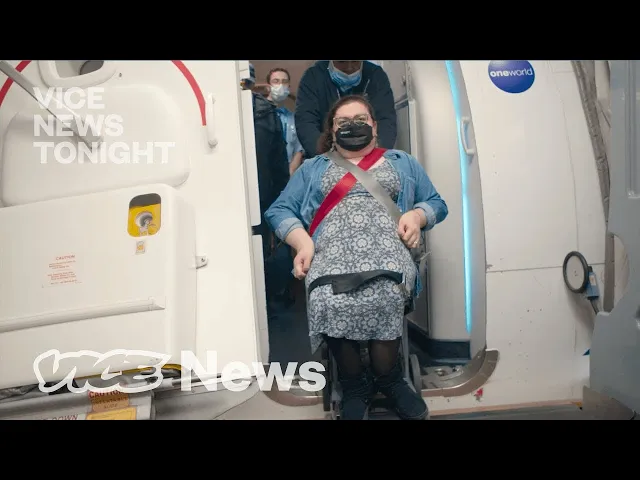
Chances are, if I have a flight, I'm getting ready to leave about six hours in advance. How are you this morning? -Going to the airport can feel like a nightmare for just about anybody, but for Emily Ladau and millions of other people who use wheelchairs, the horror is real, with one indignity after another.
-Thank you. You too. -Every time I go through security, I am essentially turned into a bit of a sideshow.
And then I'll go through this invasive pat-down process with everybody watching. -Yeah. -Alright.
-And then what happens once you get to the gate? -When I finally get to the gate, I have to wait until a gate agent shows up. -No, this is not foldable.
No. No. I know.
Um. . .
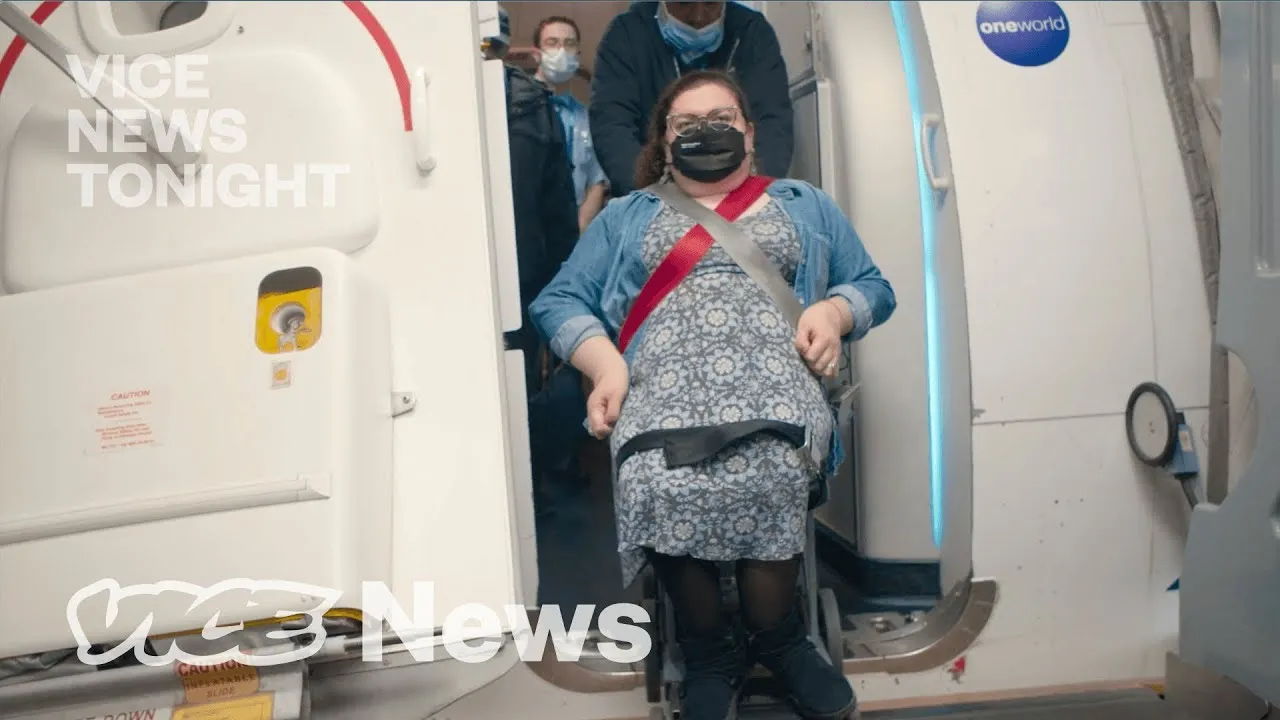
When they get ready to board, they say, "First we have to get the wheelchair on," as if I'm not actually a person. I'm just this big piece of inconvenient machinery that they have to get on the plane. -That must not feel good.
-Nothing about flying ever feels good for me. I never feel quite so much like a burden as I do when I'm getting on an airplane. -But even worse than all that's required to get on the plane can be what happens after landing.
Because wheelchair users don't just entrust their lives to the airlines -- they also have to hand over their custom-built medical equipment, which, in Ladau's case, costs upwards of $30,000. -Oh, my God. It is broken.
-Is that not the chair? -Oh, no, no. That's supposed to be firmly on here.
And. . .
Okay. Alright. I'm going to try not to have a complete freak-out right now.
I have some duct tape. And we are going to duct-tape it. -The U.
S. Department of Transportation says last October, airlines were damaging an average of 35 wheelchairs and mobility scooters every day. Travelers with disabilities have repeatedly gone viral during busy travel times, sharing their experiences on TikTok.
-I knew that this would happen to me eventually because it happens to friends of mine every. . .
day. You're essentially breaking our legs. -How many people have to go through this physical and emotional trauma before something changes?
! -Do you have AirDrp, honey? -I sure do.
-Okay. We can AirDrp it to an iPad. And then we can put that in the claim.
-Okay. Yeah. -Ladau had to spend over an hour talking to airline representatives, rearranging her transportation, and scheduling a repair tech who could come to her hotel the next day.
What does flying mean to you? -In theory, it should be a way for me to be on a level playing field with people who don't have physical disabilities. Because the world should be just as open to me as to anyone else.
But flying, to me, is also an incredible barrier right now. It feels like an obstacle that I'm expected to figure out how to overcome. The world should not become small because you're disabled, and yet it does for so many people.
Why do we have to fight every single battle just to get to where we want to go? -The Americans with Disabilities Act essentially says accessibility isn't just about convenience. It's a civil right.
One of the many things the act requires is for buses, trains, and boats to be equally accessible to everybody by providing things like ramps, lifts, or designated wheelchair spots. But what the ADA doesn't cover is airplanes. Because when the act passed in 1990, airlines managed to stay under a slightly older, less rigorous legislation called the Air Carrier Access Act, which notably doesn't require wheelchair spots.
And according to advocates like Michele Erwin, that's a good starting point for changing the hellish nature of flying with a disability. -We were the first organization and still the only organization to crash-test wheelchairs for commercial flight and is the catalyst to a lot of work now being done for a wheelchair spot on airplanes. Are you gonna go to dinner?
-Yeah. Food court. -That sounds yummy.
-It'll be great. -[ Laughs ] I was on a flight with my son, and I had a terrible experience. I, as the caregiver, was expected to not only take care of my son, but then to also go back to the jetway and take care of his wheelchair to be stowed as luggage.
And my son is completely paralyzed. And I now had to leave him on the airplane as a toddler by himself. And I just thought that I can't believe I'm expected to do this as a caregiver.
-What is your group, All Wheels Up, proposing as a solution? -What we envision at All Wheels Up a wheelchair spot to look like is what you would find on city buses today or your trains or even Disney rides. There's a wheelchair spot.
And that's what we would like to see on airplanes. -Buses, though, are a lot different from airplanes. Would something like this be safe?
-Absolutely. So, the wheelchair restraint systems that are on metro buses actually pass a 20-G crash test. And the airplane seats that you and I sit in today are crash-tested at 16 Gs.
And so we did do crash testing at an FAA-approved testing facility, and we proved that a wheelchair spot would be technically feasible. -One of the designs Erwin tested belongs to Hank Scott, who knows that getting airlines to make any changes is never just about proving it's safe. -We wanted to show the airlines that they can accommodate people in wheelchairs on the plane without any loss of real estate or any loss of revenue.
When this seat goes from a double to a single, passenger's still paying. When the person in the wheelchair comes on, they're still a passenger, they're still paying. They just happen to be in their own seat, not in the airline seat.
I'll show you how it works real quick. Basically, removal leg. Slide it over.
Place there to park a wheelchair. -Wow. -That's it.
-Why is there so much momentum now? -We understand the argument that used to exist -- not a lot of space, aircraft already designed, it's a lot of money to redesign them. But people are fed up.
And the challenge has been that real-estate question, and so that's why we're addressing the real-estate question so that we're not asking them to give up money -- just time and effort. -It's hard to imagine airlines ever introducing wheelchair spots without a mandate from the government. And there's one person who, maybe more than anyone else, could make that happen.
-In July, we released our Bill of Rights for Airline Passengers with Disabilities so that you know exactly what rights you're entitled to and so that we can better hold airlines accountable. -We've had legislation protecting passengers with disabilities for nearly four decades now, and yet thousands of wheelchairs are damaged, broken, or lost every year. How is this still happening?
-What we've been focusing on is strengthening the regulations and the rules that are possible under the law. One thing we recently did was the Passengers with Disabilities Bill of Rights, which begins with the fundamental right to being treated with dignity and respect, but also has very specific things like the ability to request and speak to an informed expert that the airline has to provide. .
. and then, on the back end, our ability to enforce when airlines fail to do that. -The Bill of Rights you just mentioned, though, is just a summary of existing laws, though, right?
We're two years into this administration. Is that the biggest accomplishment when it comes to accessible flying? -Well, I would point to the regulations that we're developing right now.
And, frustratingly, they can take a long time to work through the system, but we're gonna have more coming out this year in 2023 that I think is gonna make a big difference. -Do you think airlines should be required to allow passengers to stay in their wheelchair when they're flying? -It's clearly the direction we need to move in.
You look at so many examples of passengers getting to their destination without their wheelchair working, and that is like arriving without your legs for any other passenger who isn't a wheelchair user. It's not something that can happen overnight, but it is what we're working toward. -If wheelchair spots on planes are approved as safe by the FAA, would you introduce a mandate for airlines to have them?
-Absolutely. I think it's part of what it means to make sure that air travel is accessible. You know, you look at something like the ADA that, you know, now, it's hard to imagine life without something as basic as curb cuts that benefit not just wheelchair users, but, you know, as a new dad pushing a stroller or anybody pulling a Rollaboard bag -- that was at one time viewed as an unreasonable or unworkable expense.
ADA changed that. But, you know, we're decades since the ADA was passed, and there's still a long way to go. -You need help, ma'am?
-Yes, I do. -How are you doing? -Hi.
Good. How are you? -What time you boarding?
-2:00. -Oh, you have plenty of time. -I like to leave a lot of time, yeah.
Flying home from Portland to New York, I got a notification that I was upgraded to first class, which was incredibly funny to me, because you can't lift the arm on the side of the seat, so I can't even get into first-class seats. Every staff member came over to talk to me, and they said, "Oh, we were supposed to be on the lookout for you. We were supposed to offer you to go to the first-class lounge.
And can we get you anything? And do you need anything? " And I said, "I don't want perks.
I just want to know that my wheelchair is gonna make it. " It's really amazing what happens after an airline knows that they've done something wrong, as opposed to just avoiding doing something wrong in the first place. -How long did it take for the wheelchair to get fixed?
-My chair is still not fixed, and it's been more than a month. I have been driving around with a broken wheelchair held together with duct tape and tire wraps for a month. There is no other method of transportation where I am asked to give up my wheelchair.
Whether I am on a bus or a train or in my car, I am always with my wheelchair or sitting directly in my wheelchair. There is no reason why the same cannot happen on an airplane. ♪♪ -I've been in the prison.
I've seen that it wasn't built to facilitate dangerous men. I've seen the videos of the prison break, where some of the prisoners managed to smash through a wall in seconds, and it's almost paper-thin. Why would a school be used as a location to hold ISIS members?