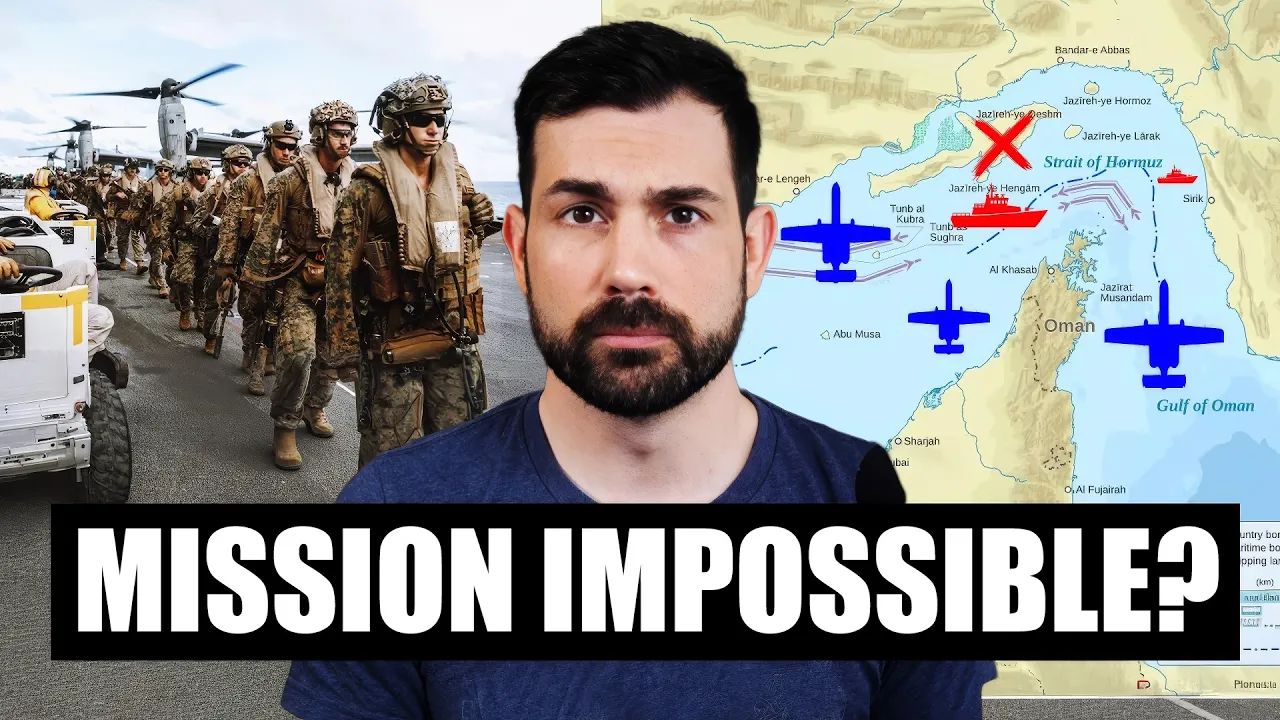
Today we're going to examine how the US military is deploying new tactics in an attempt to forcefully reopen the straight of Hormuz. And on the other hand, we'll analyze the strategies that the Iranian IRGC are using to keep the straight closed. We're going to untangle the confusing mixed signals.
On the one hand, the US government is signaling a peace deal is near while at the same time moving ground troops closer into position. What does it all mean? The entire outcome of the war now hinges on this battle.
Because with the straight close, 20% of the world's entire oil supply is cut off for the first time ever in history. Which means entire countries from Europe to Asia are suddenly operating on a ticking timer that's counting down before reaching economic collapse. Close enough.
Welcome back, the Crusades. The IRGC is not running a traditional maritime blockade of the straight with a bunch of ships sitting out in the water. They are deploying a layer denial strategy of drones and mines that spread out from the coast.
So far, they've struck over 20 commercial vessels, which has dropped traffic to essentially zero ships that aren't already pre-authorized by the IRGC to pass. Iran's strategy is simply to cause enough economic damage to America's partners that they pressure the US and Israel to accept very unfavorable negotiated peace terms from Iran. Maybe Iran asks for reduced sanctions.
Maybe they ask for control of Cuba. Who knows? But that's why in mid-March, the US military started using a new strategy in an attempt to reopen the Straight of Hormuz.
They began dropping the new GBU72 advanced penetrator bombs for the first time ever on these coastal locations here. These 5,000 lb bunker buster bombs hit multiple fortified targets along Iran's coastline, digging deep into the earth and exploding. Part of the US government's goal with these strikes is to pressure Iran to agree to reopen the Strait of Hermuz, which is something they could claim as a victory.
They're targeting here for three strategic reasons, I think, that we'll get into. First, because so far the main weapons that Iran has managed to hit commercial oil tankers with are short range unmanned surface vessels or USVs. They're cheap and they work against targets that are naked and defenseless.
According to naval expert Hi Sutton, he believes these seaborn drones are responsible for most of the damage done to tankers in the contested waterways so far. But these weapons have the downside of needing to be launched from close proximity near the shores. Take a look at this section of the straight of Hormuz here.
Notice how there are multiple tiny islands. You've got the Hormos, you've got the Lark, and most importantly, the Casham Island. This is where the headquarters of the IRGC's deep underground bases are located, and it's where they launched these attacks from.
Why do they need to hit from close range? Because oil tankers move at about 18 mph or 30 kmh, which sounds very slow, but it's fast enough that they're difficult to target from long range. The reason for this is Iran lacks GPS guidance and they lack the type of sophisticated seekers for hitting moving tankers.
There is a misconception that Iran is blocking the straight when it's more accurate that they're simply making it too dangerous to use for ships aligned with the United States. If only 3% of Iran's munitions hit ships, that's still too high of a risk for commercial shipping to accept. These munitions are depending on old school radio waves.
Basically, it's a cheap, dirty, effective method, but it forces the IRGC to get into a close-range fight. Strategically, what that means on the bigger picture is that the US military doesn't need to clear the entire country of Iran to reopen the Straight of Hermuz. The US needs to clear a threat of about 300 m or 500 km of coastline and roughly 35 mi inland to control the straight of Hormuz.
And this is because if you look at the topographical map of Iran, a steep mountain range begins once you go a little bit inland from the straight. This geography makes it difficult to launch line of sight attacks from here. Question is, why doesn't Iran just sit back and launch long range attack drones at the straight from 500 km away?
For example, Iran's Shahed attack drone has a range of over a,000 km, 620 mi, but they would have a very difficult time targeting commercial ships with these that are on the move. And this is because Shahed drones are mostly only effective against a fixed point. Chaheds are programmed to hit a static location like a building in Bahrain that's not going to get up and move anywhere.
Most Shahed attack drones cannot guide themselves onto a moving target. What that means from a tactical perspective is that it narrows down the amount of possible locations where the IRGC can launch attacks against the strait to this kill box here. So much killing going on here.
These Iranian short-range launches are much more difficult to detect by surveillance compared to the larger ballistic missile launchers that send off a huge giant signature. So, these drones can be fired remotely or they can have a low enough visible signature when they're fired that they're able to escape American retaliation. They are SPDs, silent but deadly.
Now, the exception to this is the IRGC's anti-ship ballistic missile stockpile. These weapons have a much longer range and they're much more capable and they can home in on moving ships. So, the question is, where does the Iranian IRGC store these anti-ship missiles?
And what do you know? They're located in underground facilities along this same coast and on these islands here that are being hit. And why is that?
Because they are lowflying sea skimming missiles to avoid interception. So they cannot be fired over mountain ranges to then hit moving ships in the straight which limits the geography that these anti-ship missiles can be fired from. And that's the second reason why these coastal sites are being smashed and hit and hammered in March.
Because Iran's anti-ship ballistic missiles are a niche weapon system, their holographic card levels of rare. Iran is only estimated to have around a hundred of them. The IRGC has been saving this more sophisticated weapon to attack any US naval vessels if they tried to escort oil tankers through the straight or if they tried to get within 200 m or 350 km of the coast.
This is why the US Navy has so far maintained standoff distance from the coast. As the fighting over the straight continues, Iran officially denies that there are any negotiations with the United States government to end the war. All these geopolitical mixed signals should be familiar to anyone who's ever dated someone with a personality disorder.
So, the Iranian forces are using fast attack boats to get in close and launch these drones. Which brings us to the third dimension of the battle for the straight of Hormuz, which is the intercepting mission. To do this, the US is bringing the old trusty reliable dusty A10 Warthog out to target Iran's Mosquito fleet of fast attack boats.
It's a slowm moving jet that does make it vulnerable to all kinds of anti-aircraft fire, but Iranian air defense has been seriously significantly degraded enough in the south to allow for the A10 to fly. At about $19,000 per flight hour, it's about half the cost of running F-35 missions, and it uses lowcost 30 mm rounds to target those fast attack boats. It's been upgraded to fire air-to-air missiles against drones as well.
On the other hand, the slow speed of the A-10 also translates to higher fuel efficiency and longer loiter times over the objective so they can hang out and wait for any possible targets. Taken together, I think these two tactics appear to be shaping operations to clear the path for an option for an amphibious ground invasion of the northern coastline of the straight of Hormuz if they wanted to. The A-10's deployment is a clear indication of future ground operations on the coast because its appearance alone proves that close air support for infantry is possible here.
The straight is only about 20 mi wide or 34 km wide at its most narrow point between Iran and Oman. And the lane is just like a two-lane highway with room for only about one seane in each direction. But the problem is clear.
Even though it's a narrow AO, so far, America has hit 9,000 targets in Iran in the whole war, and they've hit over 140 of Iran's naval vessels, according to the US military themselves. But despite all these Tomahawk missiles, bunker busters, and A10 strafing runs, it's unlikely that this will be enough to limit the threat in the straight of Hermuz enough to reopen traffic. The Islamic Republic of Iran would have preferred to not close the straight of Hermuz in the first place.
Their initial strategy that we saw was using ballistic missiles in an attempt to inflict economic pain on their adversaries. But those ballistic missile launches were largely destroyed by F-35 fighters. As of today, 330 of Iran's estimated 470 total ballistic missile launchers were destroyed, leading to a downward trend of only about 5 to 10 ballistic missile launches a day.
So, what we're now seeing is the second option that they're having far more success with. They are wagering that it is inflicting more pain on the United States and its allies economically. US bombing efforts so far have not been enough because by mid-March we saw shipping insurance rates for the strait increase by up to six times the amount over the previous week.
So that's roughly a quarter of a million dollars more. Ships don't want to run the gauntlet because no one wants to take that hit and cause a major ecological disaster of an oil spill that their company is on the hook for. This means that reopening the straight of Hormuz remains a problem with likely one solution, ground troops.
And that's why in mid-March, we saw the US military ordered two Marine MEUs to the Middle East. The first MEU arrives Friday, March 27th, while the second half is about 3 weeks out from being in position in Sentcom. They bring F-35 fighters.
They bring more air capacity, but they also bring ground troops. and together they have about 5,000 Marines with amphibious assault capabilities to conduct what's known as joint forcable entry. Joint forcible entry is to gain a foothold somewhere, in this case on the shore, to clear the path for follow-on forces.
On top of that, there are increasing reports that headquarters elements from the 82nd Airborne Division are already deployed to the Middle East, which is typically an indication for planning of larger operations. These two units and their capabilities suggest that they're planning to capture and hold Car Island, possibly the coastline around the straight of Hormuz. Now, the US government could of course declare victory tomorrow, an attempt to end the war.
But in the meantime, the most recent strikes have changed their targets. The Air Force is now hitting IRGC ground troops. They're hitting IRGC infantry and tank units located in central and southern Iran.
These are the Iranian ground troops that would be responsible for responding to any type of amphibious marine landing near the straight of Hormuz. It is not for certain it is just an indication of what may be to come. A long-term bombing campaign could maybe work, but the US doesn't have time on its side.
Even with the release of strategic oil reserves that can stabilize prices temporarily, it appears like most nations like the Philippines that just issued that just issued a state of emergency, Pakistan and many other nations only have about 30 to 90 days of usable buffer before shortages cause significant impacts to their economy. Because the only way to quickly and completely prevent the IRGC harassing fire on commercial ships is to have troops on the ground who can instantly respond as QRF, quick reaction forces 15 minutes from any launch site. These are known as poo sites or point of origin where the drone launches come from and ground forces would be required to have a more granular surveillance that's necessary to find those kind of launches.
However, on the other side, this relatively small fighting force would be highly exposed and vulnerable to incoming fire. An important little known aspect to the battle for the Straight of Hormuz is the efforts to destroy the IRGC's drone and missile production plants. In theory, this would deprive them of the ability to harass the strait.
But there is a new problem that many people are not aware of. Iran is now shipping in weapons from safe havens outside their border. Similar to how Cambodia was a safe haven during the Vietnam War, there are multiple countries that Iran ships weapons in from.
So even if missile and drone production facilities are destroyed within Iran's borders, Iran can still obtain new weapons. Since 2022, the IRGC first started setting up these attack drone production facilities a few stops down in Tajjikhstan. These weapons transit through Usuzbekiststan and Turkmanistan by rail and road networks.
In fact, on March 18th, a large convoy of over a 100 trucks moved in from Tajjikstan to Iran with its contents unknown. They claimed that it was construction materials, but the inventory was unusually undeclared. They followed a well-known Central Asian transit route that Iran has been investing in heavily for over the past few years.
This is the same route that Iran ships weapons to Russia and Russia ships weapons to Iran from. It's also where Iran has attempted to mitigate the damage of closing the straight of Hormuz because this supply route, the middle corridor, was being built up as an alternative route for Iran to ship oil to its allies in China. If the route was completed, it would allow Iran to shut down the straight of Hermuz whenever they wanted, restricting oil to the US's allies while still pumping oil to its allies.
And this is why we saw a major escalation in the war in Iran when in mid-March, the IDF blew up ships at the major Caspian Seap port in northern Iran. And this attack totally destroyed Iran's ability to ship in weapons from here. This was the first time that the IDF had struck this far north in Iran.
And you can see how the Caspian Sea here connects Iran to Russia by water. So IDF fighters hit the port of Bandar and Zali after there were reports that Russia was sending them munitions through here. China sent attack drones, ballistic missile production material, and they were in talks to send high techch anti-ship missiles prior to the war.
China had just opened their first major train corridor with Iran in 2024 here. But even if that corridor is shut down and physical weapons are reduced to the IRGC, they still have other forms of warfare that they're using. We saw commercial oil tankers started reporting their systems going haywire in the straight.
Safely navigating these narrow paths isn't easy. You can't just wing it. It requires sensitive sailing equipment.
And that's why a little known aspect of the battle over the straight is Iran is now deploying new forms of electronic warfare. Commercial vessels heavily rely on GPS systems to avoid collisions in these congested waters. They're not built with all these redundancies to easily detect when their automated systems are being jammed.
So some tankers don't even carry paper charts with them anymore, which makes them even more vulnerable to jamming or GPS spoofing. So sailors have said that if you don't have charts and you're being spoofed, you're more than a little screwed. Key to understanding the battle of the straight of Hormuz are these UK MTO reports that you might have seen while scrolling around.
UK MTO is actually one of the most important but least understood players in this entire war. They attempt to untangle the electronic and explosive attacks here. It's a British run UK Royal Navy coordination center that's based in Dubai.
They do realtime threat reporting for the Strait. like basically air traffic control for tankers in war. They create a shared operating picture of the street.
So militarygrade Iranian EW signals have completely blocked some navigation systems and fooled them into following false dangerous paths. The IRGC broadcast these signals over a wide area. They turn jammers on for a while.
It caused some chaos and then they relocate before an American missile homes in on their location. All without even expending a single munition. Iran knows that they can't stand toe-to-toe with US and Israel.
So instead, they go after these softer targets and and it's had some success because even a proposed 20 billion dollar maritime reinsurance fund that the US announced on March 6th isn't enough to get ships moving again. And they don't need physical missiles or EW attacks because Iran has thousands of sea mines to make a mess of the straight. The US Navy prioritized hitting these mine laying vessels early in the conflict, sinking more than 16 by mid-March.
But the IRGC also deploys them by truckmounted rockets, which makes finding every last one of these things even harder. According to HI Sutton's Covert Shores website, the IRGC has at least two main varieties of naval mines that lurk near the seafloor, and they listen for engine noises above them. Once they hear the right kind of pre-programmed acoustic signature, they explode or they chase after the target like a torpedo.
These are much harder to detect than the old-fashioned floating mines. They can be set to only target ships with a certain speed range, which means they ignore warships, for instance, but activate when oil tankers move through the area. The IRGC uses their minds to confine shipping to an even more narrow channel.
They use airborne drones then to identify ships and make sure only the vessels that Iran wants to let through are allowed to pass. In response to the escalating mission, the Pentagon is now asking Congress for an additional $200 billion dollars to achieve a monumental task and they're moving in a third aircraft carrier. My personal read on the situation is that part of the reason I believe the US military wasn't fully prepared for the level of Iranian counterattacks on the straight of Hormuz is that these assets were not moved into place before the initial wave of the attack was launched.
From an operational point of view, you would already want to have these assets in location if unless you expected the war to end quickly. And when wars do not end quickly, it puts strain on the fighting force, which leads to mistakes and accidents or worse. The USS Gerald R.
Ford carrier that was on station was just pulled off combat duty when a fire broke out in the laundry room that destroyed the sleeping quarters for 600 sailors. The ship has been on near continuous deployment for almost a year now from Venezuela to Iran. And early reports indicate that the Navy's investigating a number of different reasons why the fire could have happened.
They reported it wasn't from enemy fire, which the US is normally very transparent about. However, it's unclear if possibly one of the sailors and the crew started the fire as sabotage in protest for the ship's deployment being continuously extended almost twice as long as normal deployments are. The problem with the US naval escort mission is that while the US warships are extremely capable in the tight confines of the straight of Hormuz and following predictable paths as they escort slow commercial ships, all of their advanced radars and longrange interceptors lose their advantage.
Altogether, naval escorts seem like a difficult mission to me. On March 19th, seven of America's closest allies signaled that they might be warming up to the idea of joining a coalition to reopen the Straight of Hermuz. But the joint statement stopped short of actually committing naval vessels to a coalition.
Deploying a naval vessel into the strait is a risky move. So is setting the precedent that Iran can cut off a fifth of the global oil market at will. And the skies above Iran remain a threat because a US F-35 had to make an emergency landing after returning from combat missions in over Iran.
Sentcom said that the aircraft landed safely and the pilot is in quote stable condition. And that specific language indicates to me suggests that the pilot was wounded, likely significantly. Soon after, the IRGC claimed responsibility and posted this unverified video allegedly showing one of their surfaceto-air missiles hitting the F-35 in question.
At first, I thought it was an AI video, but after looking closer and comparing it to other footage from Iran and Houthi fights over Yemen, we see the same sort of thermal imaging system at work. Iran has several domestically produced air defense systems that use these kind of passive infrared sensors instead of radar to home in on their targets. This video seems consistent with that kind of system.
It explains why the F-35 seemed to be taken by surprise and didn't pop any decoys, but the jury is still out on whether the video is real or not. We know that the F-35 has multisspectral stealth coatings that reduce infrared signature to this kind of specific attack. So, the fact that the F-35 jet allegedly shows up just as bright as any other jet in this video seems unusual.
The fighter kept going and it made it back to base. Was it struck by falling debris from a missile, an anti-aircraft missile, or a man pad? It's unclear.
If a full SAM site missile had hit it, it would likely wouldn't have made it back home. Either way, hitting an American stealth fighter jet at all might be seen as a morale victory for the IRGC. In the background of all of this combat, a diplomatic battle is being waged.
President Trump said that he would hit Iran's power infrastructure, which is a civilian target. This is a map of Iran's power plants all over the country. The president threatened to hit the largest one first.
Then the US government came back and claimed that productive negotiations with Iran meant delaying the attack by 5 days. Iran has denied these talks happen and the IRGC threatened to hit Israel and the US military power generation if that happens. So what all of this tells me is that there are still many steps of escalation that this war can still climb.
Both sides are so far purposefully holding off on attacking many types of infrastructure like water desalination because many of the Gulf countries depend on those plants for fresh water. This would be the third or so time that the US would have attacked Iran during negotiations. So, it's not unlikely that this is a stalling tactic to buy time for American ground forces to get into position.
Past conflicts with Iran have reached settlements, which means it's not an impossibility, though. If the US government declares victory and stops bombing, they're likely looking for an off-ramp that'll reopen the Straight of Hormuz. Unless diplomacy can reach a peace agreement, escalation to American ground troops on the coast of Hormuz would probably be required to clear the threat and reopen traffic.
Moving troops into position could be a negotiation tactic to just have that credible threat there, though. Personally, I do not doubt the capabilities or skills of US ground forces to accomplish this mission. What I find more concerning is what would come after that.
Are US troops going to be required to occupy Iran's coastline indefinitely? Because without regime change, the strait will come under constant attack again once US forces leave. And cutting off funding to Iran's conventional army may cause desertions, but it may take months or years to starve off the IRGC, the fanatics who depend on the regime to stay in power anyway.
So cutting off their funding may not cause them to lay down arms for a long time, which is why I remain skeptical of this as a long-term solution. If you want to learn more though about why Russia and Chinese infantry are now switching their primary rifles and ammo type to a next generation squad weapon similar to America's XM7 68mm NGSW. Click this video here or check out this playlist right here.
I'm your average infantryman Chris Cappy. Ending transmission.


![[임재적예배/판교274기도실] 레비스탕스(LEVISTANCE)](https://i.ytimg.com/vi/iSsgbVkocYw/mqdefault.jpg)