welcome back before the break we talked about uh article 33 of the UN Charter which list the various mechanisms uh for peaceful settlement of dispute under international law and we have divided these um mechanisms into two major clusters one is the Diplomatic and the other are the legal uh forms of settlement let me say a few words on the Diplomatic dispute settlement uh mechanisms um there is I said great Variety in them there is also great flexibility but there are some prototype mechanisms that uh are are worth uh being becoming familiar with at least to
some extent one is negotiation which is essentially exchange of communication between parties to a conflict uh by the way negotiation also has um some role in determining uh sometimes it's it's merely the corridor to the dispute settlement venue because uh parties have to negotiate exchange communication about how they're going to resolve the dispute is it through arbitration is it going to court is it through mediation and they often negotiate the decision of how to uh proceed uh going forward uh but negotiation is often on the substance of the conflict itself it's often first stage and
if negotiation fails they would go to another uh stage negotiations could be uh Direct it could also be indirect uh it could involve uh Med third parties uh that would uh provide their good offices to the parties namely they would pass messages from one party to the other uh there is also um a system of exchange of communication before a dispute arises which is called notification or consultation when a party is about to engage in a in certain measure like building a new d Dam on a river which may have implication for the other party
the downstream country on that uh on that River uh and before they are actually um executing the project they will provide a communication they will issue a a a a a warning or they will alert the other party about their intention and that party could then respond and uh and and and make comments or or request or raise objections so while this is all this is not really strictly speaking dispute settlement because the dispute has not Arisen yet it still uses the same format of exchange of communication in order to prevent dispute so some of
these dispute settlement mechanisms are sufficiently flexible not only to resolve disputes but also to prevent disputes now mediation uh is is a form of uh negotiation which involves a third party that third party could um simply transfer messages from one party to the other uh and provide good offices but sometimes the mediator could be more uh more active uh the mediator could actually raise new ideas for the parties to consider uh the mediator could also um pressurize the parties to accept uh to accept a certain outcome it could also uh sometimes uh reward or punish
parties if they do not uh accept an outcome so we have for instance a very famous mediation by President Carter in the um Israel Egypt peace agreement from 1979 uh where uh the United States was essentially part of the peace agreement and uh in return to the parties um uh providing uh agreeing on the terms of the peace including the withdrawal of Israel from the Sinai desert uh the Americans have agreed to uh basically um uh deploy a peacekeeping mission uh International observers in that area that was evacuated and also to help Israel fund the
transfer of um air Airfield basis uh from uh the Sinai desert into the the Israeli desert the netive so this is a a way in which a mediator could actually sweeten the deal for the parties and also provide certain guarantees a third type of mechanism uh that we have seen active especially in the early 20th century is the mechanism of inquiry uh uh which is suitable for circumstances in which the dispute at hand arises from uh a certain incident over which uh the facts are are not agreed upon uh we've seen this for instance in
the early 20th century concerning a number of uh Maritime incidents so ships colliding in the high sea or a ship being arrested by a state ship from another state uh and the actual facts that were surrounding this specific dispute were contested by the two flag states of the of the respective ships uh so one way to resolve the conflict uh that emerged between them was to appoint a commission of inquiry that would actually get the facts straight so a neutral objective Commission of inquiry with third parties they would investigate the incident they would publish the
report and on the basis of that report after the facts have been clarified the two parties would be able to um to basically come to terms with one another pay compensation or what have you uh we are seeing inquiry these days uh extensively resorted to in the context of um of human rights law where it is often the case that before the Human Rights Council uh would uh would issue a recommendation on a certain country situation they would appoint a fact finding committee which serves as a sort of commission of inquiry to uh visit the
place in question to determine the facts and to help the uh the council uh thereafter establish uh the legal standards that have been uh violated or not uh the fourth and final mechanism which I will deal in this context is conciliation which um is a mechanism which I've alluded to before uh before the break in in relation to the Yan Mayan uh conflict uh conciliation is a process by which the parties are actually formally arguing before a third party which could be a conciliator of or a commission of conciliation uh these uh conciliators hear the
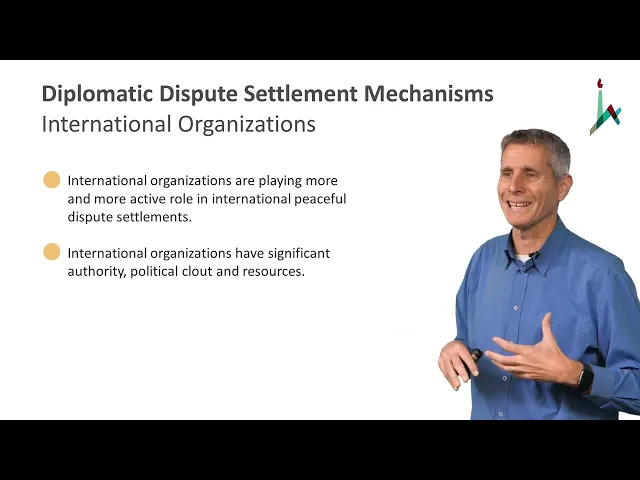
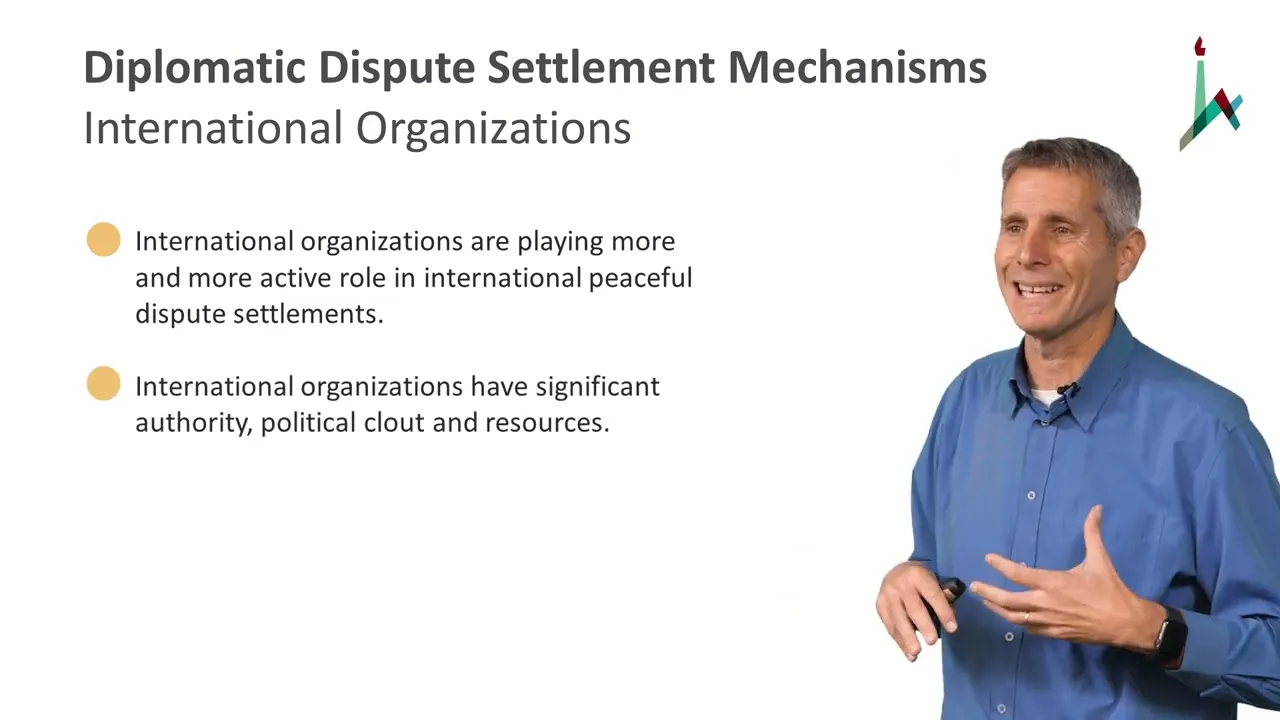
arguments of the parties about the interests that are at stake the legal rights that are at stake the facts that are at stake and thereafter they uh generate a report which uh includes recommendations as to what they consider to be the the just outcome uh and the parties are then at Liberty to accept or reject this uh um this proposed outcome article 33 does mention explicitly the role of regional agencies and the role of the security Council in resolving disputes and indeed what we are seeing increasingly in this field is that International organizations are playing
a more and more active role in international peaceful dispute because International organizations there are many there are hundreds of international organizations they have significant authorities but they also have significant political clout and also resources and they often uh facilitate when we're talking about specific regime so when we're talking about the United Nations they often facilitate uh dispute resolutions in in conducive ways so the organizations themselves can lender good services for the parties and the Secretary General is often mediating in conflicts uh even in one prominent case a conflict between FR France and New Zealand over
the drowning of Rainbow Warrior uh which is a green piece uh boat that was sabotaged by French secret agents when it was docking in New Zealand so uh the the uh Secretary General served as actually as an arbitrator in this case which is quite exceptional uh but more often perhaps International Organization serve as opes for the creation of specialized mechanism so the international criminal Tribunal for Yugoslavia for instance was a court that was established under the opes of the un uh there are many commissions of inquiry that the Human Rights Council has established as I
said before in order to investigate specific conditions around the world and the security Council uh in its uh in its ongoing activities effectively serves as a dispute settlement settler uh and and one perhaps leading example which we mentioned in another unit is resolution 242 the resolution that was adopted after 19 the 1967 war in the Middle East which in a way introduces a road map for the parties to pursue uh if they are interested in actually uh concluding peace so it was not a binding resolution but it still uh provided the parties with services which
could be T them out to conciliation moving on to the other side of uh of the Spectrum which is uh legal legal forms of uh dispute settlement and here uh one sees uh two uh specific mechanisms or two sets of mechanisms one would be arbitration mechanisms and the other one would be uh forms of judicial settlement essentially International courts um as I said before what's uh what's uh common to all of these mechanisms all arbitration bodies and all uh International courts is that we are talking here about a third-party settlement a binding third party settlement
we're talking about uh a fixed uh uh legal uh process and we're talking about decisions which are based on legal reason uh but arbitration and judicial settlement are different in in some key respects the most important factor is the degree of control by the specific parties to the dispute over the the process that we will see so when one is dealing with arbitration the identity of the arbitrators will be determined by the parties where it's in a court the court pre-exists the conflict the court is there and the parties have limited if any control over
the composition of the bench same goes for procedure the parties are able within an arbitration to uh to determine the rules of procedure of the arbitration uh to what extent it will be based on oral evidence on written evidence where will the proceeding take place how long will they take what sort of rules of admissibility would be uh would be relied upon Etc when you go to a court uh again it's a it's a fixed menu the the parties have limited control over the way the court operates and uh in terms of um the arbitration
versus courts there is a key issue which we should we expand upon later and this is the issue of jurisdiction which means what are the legal powers of the institution Visa the conflict at hand so with regard to arbitration typically the sequencing is that the first the dispute has arisen and then the parties would go to arbitration because arbitration is not a permanent Forum it's a forum that is created ad hoc by parties in order to deal with a specific problem with a specific dispute uh so that typically means that uh arbitration bodies only have
retroactive jurisdiction they can only deal with disputes that had Arisen before their Creation with courts this is very different I mean the courts are fixed bodies and they often uh exist uh way before the conflict uh was uh was emerg and therefore they are more available on a shorter time span in order to address urgent cases for instance than arbitration bodies so this would be beg the question why would parties go to court and not to arbitration one would imagine that the countries would like to uh have as much control over the process over the
questions over the composition of the judges or the the arbitrators um as possible so the question is what is the what would be the advantage of going to court over arbitration and and the answer is that as I said before it's often very hard for parties in a state of conflict to agree about anything certainly to agree about uh very specific issues such as procedures Rules of Evidence composition of judges because there is often this Zero Sum gay mentality and one party thinks that if they would choose if State a chooses one arbitrator uh which
they deem to be favorable to its position then State B has to object to that same uh appointment because uh it would be necessarily bad for it and the same would go for procedure Rules of Evidence uh framing of the question what have you so the transaction costs not only in the uh in the in the in the material sense but all in the more um in the more political sense are much higher with regard to arbitration when you go to judicial settlement uh it's pre-existing uh it could be done much quicker with much greater
ease um and as I said before you could also start the process in a much more speedier fashion finally you could also say uh that uh since International courts are often embedded in international institutions the international court of justice for instance is embedded in the United Nations then when you go to a court you you in a way uh also buy in to a system that could enhance The Prestige of the decision could help you enforce the decision could affect your standing within the same regime so so there would would be also these sort of
considerations as to whether you're looking for a more or less enforcable decision that would shape the decision whether to go to arbitration or to judicial settlement but not all arbitration uh uh bodies are the same and all not all arbitration processes are the same and in fact we have within the world of international arbitration we have three uh paradigmatic modalities for how arbitration is uh is is exercised uh one is what we call adoc arbitration which will be probably the default for uh which is the most familiar one you have two parties they are in
a conflict uh a specific dispute has arisen and they wish to go to arbitration uh they establish an arbitration panel the arbitration panel issues its award this is how the decision is called and the parties are then required to comply so for instance Israel and Egypt after the peace agreement uh had a Fallout on the issue of where precisely does the border between the two uh run on the on the Red Sea Coast uh surrounding a small piece of land called taba uh Israel and Egypt both claimed that it falls on their side uh and
they appointed uh a commission an arbitral panel to determine the the actual delineation of the of the Border specifically they were asking them where uh specific pillars existed in Pre 1948 um era and uh the arbitrators uh found in favor of Egypt Israel complied with the decision and the dispute has terminated so this is uh the standard form in which adhoc arbitration operates uh but uh there are and I've implied this before sometimes there are um uh arbitrations that fall within a a certain pattern so for instance uh investment arbitrations they're often very much similar
to one another in the sense that you have um you have a state uh and a whole state and you have a foreign investor and the state does something that harms that foreign investor they may expropriate the proper they may change the level of uh taxation on investments they may introduce a new environmental regulation that Chang changes the terms of the investment uh they may devalue their currency there could be a lot of issues that would affect the the investment environment and investors would be ke to protect their investors and they would also like to
uh before actually going into a country they would want some re re re reassurance that if something goes wrong they will have um a venue before which they could actually make their claim so one could have thought about creating an investment courts but states were not interested uh and neither were um investors particularly interested they they are more accustomed to work in the world of arbitration uh the solution was to to establish something which is uh halfway between a court and an arbitration panel and this is an arbitration institution so what what was created under
uh a 1965 treaty uh on the protect on the establishment of the on the international uh center for the settlement of investment dispute uh the the convention on the settlement of investment International settlement of this of investment dispute under the hospices of the World Bank uh what was agreed upon that uh the World Bank would establish an arbitration institution called The International Center for the settlement of investment dispute and that um institution would be uh the the the venue uh in which arbitrations would take place concerning investment disputes between host countries that have accepted this
agreement and investors holding the nationality foreign investors holding the nationality of other states that have accepted this uh convention uh the institution what it what it does it really facilitates the arbitration it hosts the arbit ation it has lists of potential arbitrators it has a Secretariat to support the arbitration it also has Provisions in the convention on enforcing the arbitration award so in a way it um it eases the access to arbitration process it lowers the transaction cost because the terms of the arbitration are already pre-agreed upon by the parties in the convention and they
they can deviate but but through mutual agreement and they also produce because everything is happening within the same place uh they are also producing greater harmonization between uh different Decisions by arbitrator so there is now an exed International Center for settlement of investment dispute case law we we know more or less where how they're going to decide cases and that uh renders the environment for Investments a little bit more stable and finally the third modality that we have are the Claims Commission the Claims Commission are a particular form of ad hoc arbitration uh what we
are dealing here is again not with a flow of cases uh that uh emerge over time but rather with one large boost of cases that happens out of a very specific event such as war or revolution uh which generates a lot of injuries a lot of harms for specific individuals again following certain pattern so for instance after the uh 1979 Islamic revolution in Iran I mean thousands of American investors fled the country and lost all the property they had in that country which was expropriated or damaged by the events Etc so the United States refused
to actually uh release um uh funds Iranian funds it had in its banks until the Iranians would agree to compensate the American citizens for their harms that they suffered uh but the question was with each specific American citizen or American company what exactly is the harm someone has to quantify the harm the harm needs to be proven in in a process which is akin to a legal process so the way they actually handled this is through the establishment of what is called a Claims Commission which is an arbitral tribunal that would hear not just one
case involving two parties but would hear in the case of the Iran us claims tribunal thousands of cases where almost all of these cases are brought by US citizens or us companies against the government of Iran there have been also a few cases going in the other direction but the this uh this is um it's not a permanent body like a court because it only deals with one set of events that have occurred in the past but it's also not the same as an ad hoc tribunal because it deals again not with a single case
like an ad hoc Tribunal DS but rather with thousands and Cas and cases and we have seen similar claims commissions a similar Claims Commission also established after the 1991 Iraq war where again many foreign citizens suffered significant harm as a result of Iraq's occupation of Kuwait this brings us to the end of this first part of the unit on International Peace uh peaceful settlement of disputes in the next unit we will be discussing the role uh and history of international courts their jurisdictional powers and some of the specific challenges they are confronting in settling international
disputes