Hello, we are living in a truly fascinating period from the point of view of knowledge because all the news that gradually emerges and which is almost even difficult to keep up with, forces us to always ask ourselves new questions about the history of man: therefore, ask ourselves questions is not only a right but a duty as we obviously do with ancient texts. Now we also see it with some curiosities even with illustrations that help us a lot to reflect on the presumed certainties we have. Sometimes when we reason on the Bible we reason on large systems and then in reality we realize that sometimes a line is enough, a small step is enough, a small story is enough to make us understand, without the need to make great theological, philosophical or metaphysical reasoning, make us understand how things were probably on a daily basis.
Here we are in the second Book of Kings, chapter 1 it starts like this "After the death of Ahab Moab rebelled against Israel" Now, Ahab was a King of Israel, husband of Jezebel who was a princess - his name among others would have also the meaning of Baal's lover - and this king, prompted by his wife, devoted himself to the cult of the so-called phoenix deities and Moab is said to have rebelled against Israel. Moab was a people related to Israel because they descended from Abraham's nephew Lot and the interesting thing is that this story of the struggle between Moab and Israel finds an extra-biblical confirmation, an extraordinary confirmation of which we have already spoken which is the Mesha stone. Mesha was king of Moab who tells precisely of this story, that is of the contrast he had with those he calls "those of Yahweh" and tells of his victories and the sacrifices he made.
I have talked about the Mesha stele for a long time, I have gone through it line by line in the official translations in this book here and it is interesting why? Because this stele represents a historical, archaeological, extra-biblical confirmation of the biblical stories. This first line, which is apparently so insignificant, actually carries with it a value that is extraordinary also because the Bible speaks of Mesha, in fact it speaks of it here in the following chapters therefore Mesha is a king known from the Bible and he is a king known from archeology therefore there is this cross-confirmation because he made sacrifices, or rather he asked for rites in which sexual activity was involved.
Often the Israelites abandoned Yahweh to go to Baal-peor recalled by the Moabite women to celebrate these sexual rites and Yahweh obviously punished them harshly. Baal-peor was then transliterated into Balfegor and became the Belphegor of medieval demonic tradition and therefore one of the little devils. In reality he was one of the Elohim of the time, one of Yahweh's rival Elohim so much so that here it says "Go and ask Baal-zebub" another divinity, another Elohim who in fact is defined here as the Elohim of Ekron - Ekron was a citizen who part of the Philistine pentapolis - and therefore this king of Israel sends to consult this Baal-zebub, now Zebub is an epithet that is translated as, therefore Baal-zebub lord of the flies, in reality it seems that it is a definition that the Jews they used with a certain sarcasm because "zebuv" indicated the Principality therefore Baal-zebub meant lord of the Principality, therefore a powerful Elohim who among other things was also linked to the power to heal as well as others in the so-called deities of the time.
We recall that in the Bible there were the so-called Rafaels which means "El who heals" therefore, let's say, specialized Els, we will say, in the medical field. So he sends, Ahaziah sends his men to interrogate this Baalzebub to find out, in short, to have the possibility of recovering from this accident that occurred to him when he fell from the window in Samaria. But an angel of Yahweh said to Elijah the prophet "Come on, go to meet the messengers of the king of Samaria and tell them: Is there not an Elohim in Israel that you should go and consult Baalzebub Elohim of Ekron?
" That is, here, once again, Yahweh and this Phoenician Elohim are placed on the same level. You don't say: that other one doesn't exist or that other one has no powers. They say: why do you go to that other one since I 'm here?
And this is one of those simple, immediate, frank, I would say almost naive statements that make us understand how the Elohim were put on the same level. Even this king of Israel goes to consult another because evidently, let's say, due to the incident that had occurred to him, he trusted that other one more. Then the messengers go and then return to Ahazia and Ahazia says to him "Why have you returned ?
Is there a God in Israel that you should send to consult Baal-zebub, the God of Ekron? " Here in the Bible the term Elohim is always used. Then it happens that Acazia sends a group of 50 men, they meet Elijah, Elijah invokes the intervention of Yahweh who burns them with a fire from above.
This is repeated a few times until the last group instead, let's say, is saved, is pardoned but Ahazia who therefore has no way of having contact with this Elohim healer, dies. So here we are really faced with one of those stories that appear to be fairy tales, which appear insignificant but which actually help us understand how the Elohim were considered: that is, they were all considered, at least those of this level, absolutely equivalent thus like the Elohim of Moab, the first one we mentioned, was an Elohim who reigned over one of the relative families of the Israelites. So here we really have another picture of the distribution of the power of the Elohim in that territory: Elohim who fought each other, had the same characteristics, had the same prerogatives and also had substantially the same powers, so we are facing a situation which appears very clear.
Among other things, the speech of Elijah who then fights, has a clash, has a challenge with the so-called prophets of this rival Baal, what does he do? He manages to win this challenge in a very clever, very wise, very wise way. Elijah manages, through his knowledge, to set fire to an entire altar made of stone with the victim on it, which the prophets of the Baal, that is of the lord, of the rival Elohim of Yahweh, fail instead.
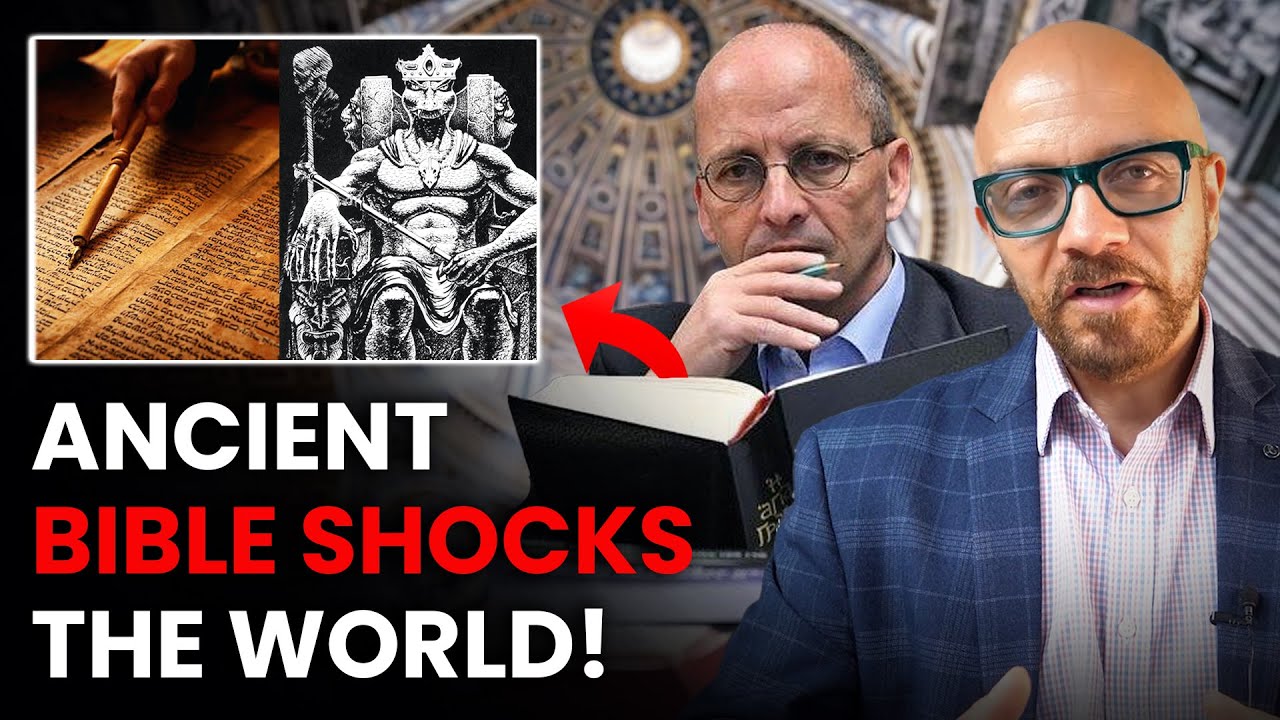
So these types of stories are the ones that, beyond the great discourses of theology or metaphysics or monotheism, are the ones that help us understand everyday reality and show how the biblical authors actually spoke of these things with absolute tranquility , but there is more, there is a curiosity. Here, at the opening of the Book of Kings, a woodcut is published: this woodcut is from 1625 and represents precisely on this side the fire falling from the sky invoked by Elijah while on this side there is the representation of Yahweh and look somewhat as Yahweh is represented. This woodcut has been placed in a Pope-approved version of the Bible that had previously been approved by Pope Sixtus V, and Yahweh is represented comfortably reclining on a celestial chariot i.
e. a flying chariot with wheels. So we are in 1625 and, with absolute tranquility, God was represented in this way, that is, on his half-wheel, which we have talked about many times.
The interesting thing is that this woodcut belongs to a period in which Europe was witnessing - starting from the previous decades, therefore from the end of the 1500s - a series of phenomena that took place in the skies and which were graphically represented. I am thinking, for example, of the flying spheres in the sky over Basel; I think of the flying cylinders in the skies over Nuremberg; I think of that beautiful image of a flying object that was seen in the skies of Arabia and that was published in a book published in Basel if I remember correctly in 1577 and of this I was lucky enough to see a copy from a restorer. So we are faced with representations of celestial phenomena, what we now call UAP, i.
e. therefore unidentified aerial phenomena, which the Pentagon has told us about and, let's say, the Pentagon has cleared them, that is, finally, it has given us the possibility to ask questions and finally it has given us the opportunity to review even the ancient texts in the light of what they told us without having to listen to those simplistic answers that were given to those questions that now instead require true answers, concrete answers, hypothetical answers that have relevance with reality: that reality that the ancients represented to us with what we would even say perhaps excessive naivety but which for them was nothing but realism because they did not pose the problems that we pose today and therefore they recounted things as they saw them without need to have to hide them as unfortunately it was done with us until very recently. Now, however, the situation has changed, we have already seen it, and therefore even simple stories like these can be revised in the light, let's say, of new hypotheses, new awareness and new possibilities for asking questions that open up a truly fascinating world for us.
Bye, thank you and see you next time.