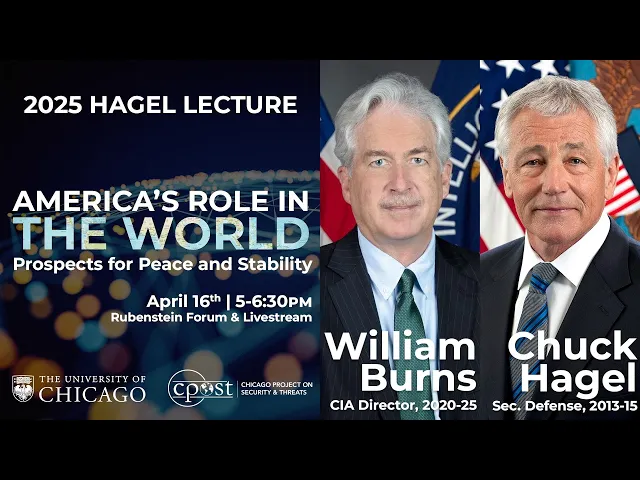
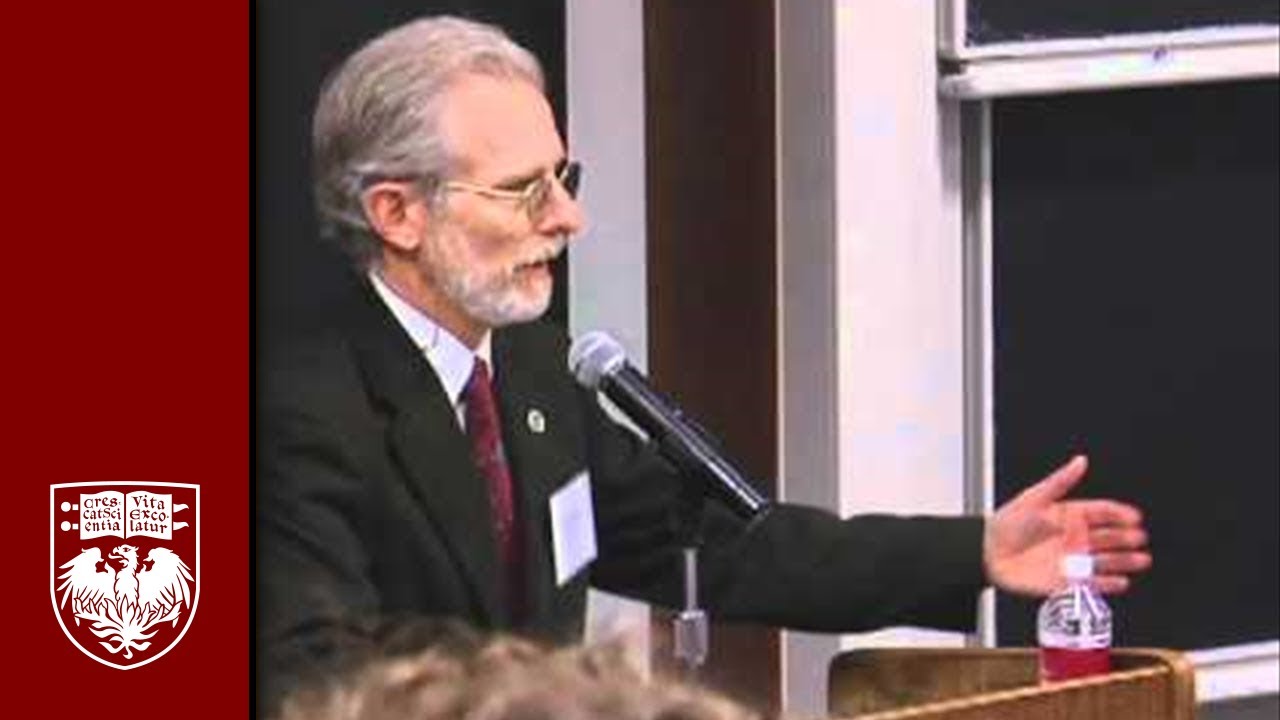
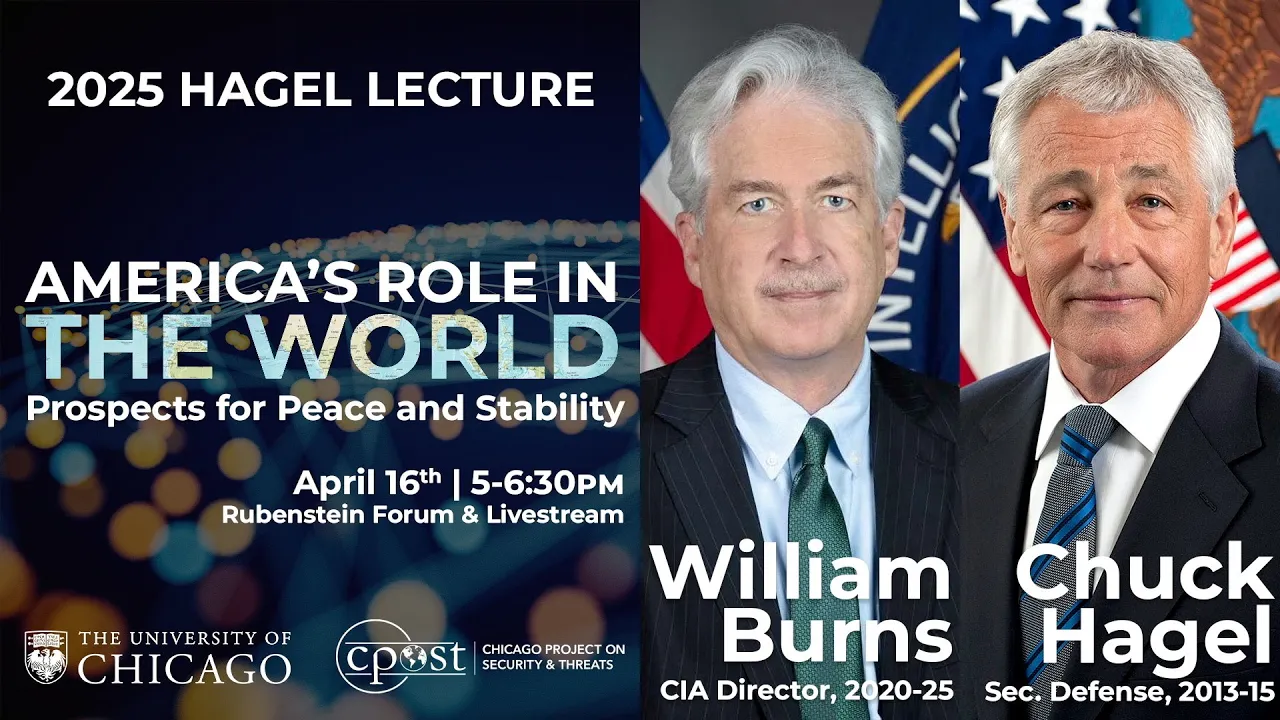
Hello welcome to the 2025 Hegel lecture at the University of Chicago A thank you to all of you who are here at the Rubenstein Forum this evening for tonight's event and to all those joining the live stream broadcast especially members of the US military in Europe and around the world I am Paul Post associate professor of international politics at the University of Chicago The Chicago Project on Security and Threats of which I'm an affiliate is a nonpartisan research center at the University of Chicago dedicated to advancing scholarship on international politics security and economic relations that
advances peace and prosperity It does so by focusing on research questions that pertain to security broadly defined about which scholars know as yet relatively little Most importantly the knowledge gained from studying the topic has the potential to Impact policy decisions that enhance the security of the United States nations and peoples around the world SEO seeks to give voice to the heart of our country on important issues of American national security and tonight's event is an important example SEPOST is proud to sponsor tonight's Hegel lecture on civil politics and international security The Hegel lecture series was
established in 2019 in collaboration with Secretary Chuck Hegel SEPOST and The University of Chicago to promote open and informed debate on current fall foreign policy and national security challenges facing the United States and their implications for the country as a whole At this moment we cannot think of a better pair of individuals to participate in this year's lecture Specifically we are pleased to have in conversation with former Secretary of Defense Chuck Hegel former Decar Director of Central Intelligence William Burns Both have been highly invested in understanding American foreign policy and role in the United States
and in the world In a moment my colleague Professor Pap will more fully introduce Director Burns At this time I would like to introduce Amanda Woodward Dean of the Social Science Division at the University of Chicago and the William S Gray Distinguished Service Professor of Psychology Dean Woodward has been a leading supporter of Sepost and the Hegel Lecture and is with great pleasure that I introduce her now Thank you everyone Good afternoon and welcome Welcome to everyone who's here with us in Freedman Hall and welcome to everybody who's joining us by live stream Um on
behalf of the division of the social sciences I'm pleased to welcome you all and to welcome this event I have to say this is one of my favorite events of the year and I'm just delighted uh to have to have um Everybody here with us Each year the Hegel lecture named in honor of former Senator and Secretary of Defense Chuck Hegel provides important uh opportunity to discuss timely questions challenges and potential solutions uh from internationally renowned voices uh that encompass the social sciences As many of you know Secretary Hegel served as the 24th Secretary of
Defense from February 2013 until February 2015 He is the only Vietnam veteran and the first enlisted Combat veteran to serve as Secretary of Defense During his tenure he directed steps to modernize America's partnerships and alliances advance the rebalance in the Asia-Pacific bolster support for European allies and enhance defense cooperation in the Middle East He also led major initiatives to improve the lives of service members and their families Prior to that Secretary Hegel served two terms in the United States Senate from 1997 until 2009 representing The state of Nebraska He's a graduate of the University of
Nebraska at Omaha and he served as a distinguished professor at Georgetown University Now many of you like me will recall the really vibrant and robust discussions that the Hegel lecture has brought to us in prior years Um starting with Secretary of State Maline Albbright former US Ambassador to Russia Michael McFall and former uh DHS Secretary Jay Johnson for this year's event I'm really Delighted to welcome Secretary Hegel and Director Burns Thank you each for joining us on campus today to share your insights and your knowledge And now I would like to introduce uh the moderator
of this evening's event uh professor Robert Pap a professor in the department of political science and a faculty director of SEO Professor Pap works at the intersection of national policy and basic research including the study of political violence public endorsement of Violence and social prejudice Most recently Bob has worked extensively to understand the violent dangers to our democracy while continuing his um ongoing work on international security strategy related to the Middle East and other regions Now many friends and donors to SEPOST are among us this evening and I want to join Bob in thanking you
for your support It's been so important to fuel the research that's been going on for more than a decade now We're really grateful for your partnership in creating opportunities like this evening's event And now I'll turn it over to my good colleague Bob Pate Thank you Amanda for that kind introduction Welcome everyone Tonight we have an exciting program and I think you're really going to enjoy it As you just heard SEPOST asks the tough questions about America's national security Our Hegel lecture is a bright Jewel in SEPOS's ground and we are delighted that Secretary Hegel
has allowed us to form this series in his honor Thank you very much Chuck for doing that Thank you very much We are also proud to have so many of the supporters of SEPOST here some of whom have come from quite far to be here uh tonight And I won't go through and name all of them here I'm sorry I can't do that Uh but I do want to thank um some of the biggest longtime supporters that We have who really made an effort to be here Uh I would like to thank Bill Obenshane one
of the co-chairs of our SEOTS advisory board Thank you very much And I would like to thank Fuel Nagar who is another co-chair of our sepost advisory board And I just want to say that it's really a pleasure uh for someone who I first met Fouad when he was in undergrad Dartmouth and to see him flourishing This is what all us professors really Want to see and to see this happen is just absolutely tremendous Um there is no better person though to help us understand the tough issues today than former director of Central Intelligence William
Burns His list of awards and honors is just incredible Born into a military family Director Burns has combined extraordinary intellectual strengths with public service almost from the beginning as a valid Victorian of his high school class A Marshall scholar after graduating college and entering the foreign service in 1982 swiftly rising through the ranks of what is an extraordinary 30-year career in the foreign service and state department Indeed his ex his his his career in public service culminated not once but really three times so far in the Bush administration as the ambassador to Russia from 2005
to 2008 and then culminated again in the Obama administration as deputy secretary of State from 2011 to 2014 and then culminated for a third time as CIA director in the Biden administration and things may not be done yet Almost anyone would be glad for just one of those highlevel achievements much less all three under both Republican and Democratic administrations rare bipartisanship in any era possibly only rivaled by Chuck Hegel But what makes Director Burns truly extraordinary are not his titles But his impact Director Burns has been at the center of more secret high-level talks by
the United States with foreign leaders than perhaps anyone over the past 20 years It is more than fitting that he entitled the book he published in 2020 as a memoir and maybe there is more coming um back channel For example he has directly engaged Vladimir Putin on Ukraine held key secret talks with Iranian officials that led to the US and Iran nuclear deal in 2015 conducted back channel discussions with senior Chinese leaders on Taiwan in the wake of the spy balloon crisis and held crucial negotiations in the Middle East including uding negotiations with Hamas leading
to the recent ceasefire and release of hostages just months ago God only knows who else he's talked to because we need to remember as the director of the CIA most of what he does is actually secret for his extraordinary contributions to American foreign policy and security Director Burns has received three presidential distinguished service awards and the highest civilian honors from the Pentagon and the United States intelligence community Now please join me in welcoming Director Burns to the University of Chicago as our fifth annual Hegel lecturer Got it Just one Second So as you could expect
we're going to discuss some tough questions about America's security Um and I want to start with Ukraine And this is fitting for several reasons Not only is Ukraine obviously very important and Vladimir Putin uh you're going to hear a big story in just a moment but in 2005 I think it was this is uh when um uh then US ambassador to Russia Burns um met with Chuck Hegel Uh he had met him before of course but in Moscow And this Wasn't just Chuck Hegel but there just I think it would be good for you to
know that there's actually not just policy but there are personal relationships that get built And this is one of the big things that I hope at some point in the answer to this question you'll be able to refer to because aside from all the details of inside we really would like to talk about the days when we used to get along Um but here's where I'd like to start with Ukraine Uh so in your Book Director Burns you describe a stunning private conversation you had with Russian President Vladimir Putin in March 2008 Just as Ukraine's
membership in NATO was becoming a serious issue as you recount Putin said and I quote this from your book and this is Vladimir Putin's words "No Russian leader could stand idly by in the face of NATO membership for Ukraine We would do all in our power to prevent it." Now 15 years later Putin invaded Ukraine and the Russia Ukraine war has been the most devastating in Europe since World War II with 700,000 Russian military casualties according to our Secretary of Defense Lloyd Austin in January and 400,000 Ukrainian military casualties according to President Zalinski in December
So here are my questions that I'd like to ask both of you to help us understand Was Russia's invasion of Ukraine always inevitable or could we Have done more to deter it and what is at stake for America's security in this conflict well first it's great to be here with all of you Great to be at the University of Chicago an institution for which I have great respect And um I really am delighted to share the stage with a public servant for whom I have great respect and admiration Chuck Hegel Um yeah the quote from
Vladimir Putin brings back lots of memories He'll never Be confused with Mr Congeniality Um um you know on on well first on Putin then on Ukraine in answer to your questions I mean you know over the years as I wrote in that book I found Vladimir Putin to be a a combustible combination of grievance and ambition and insecurity He is relentlessly suspicious not a big believer in the better angels of human nature He's a big believer in control and intimidation and getting even And you know over the course of the Quarter century since I've known
him because I served twice in in Moscow as a diplomat from 2005 to 2008 as ambassador I watched as um you know as his grip on power tightened as his circle of advisors narrowed into a pretty small group of people who either shared his very hard views of the world and of Russia or at least had learned a long time ago it wasn't career enhancing to question his views and in the meantime I also watched as his risk appetite and His sense of destiny uh deepened as well and nowhere was that sense of destiny a
um clearer or you know more brutal than with regard to Ukraine Putin I've always found has a singular fixation on controlling Ukraine and its choices Uh Putin does not believe that Russia can be a great power in his eyes or that he can be a great Russian leader without controlling Ukraine And you know as as you know I moved into my last job as director of CIA By the fall of 2021 we Could see very clearly and we had collected some you know truly remarkable intelligence across the US intelligence community about his plans to invade
Ukraine And tactically I think he saw the winner of 2021 2022 um as as an opportunity Um he was convinced that Ukraine is a weak and divided country Um he used to say I've heard him say this many times that you know Ukraine is not a real country He saw it as a kind of historical and Cultural appendage of Russia I remember one time him making that argument to then Secretary of State Kandi Rice when I was ambassador in front of a roaring fireplace in a daca outside Moscow Um Putin's disposition was not much improved
by the fact that Gandhi was wearing heels and so towered over him in front of the fireplace Um but but he he was absolutely convinced of that and tactically as I said he thought Ukraine would be an easy mark at that point He Didn't have a great deal of respect for President Silinski which turned out to be a vast underestimation of that very courageous leader um he thought the Europeans were distracted by political transitions and elections in France and in Germany He thought the United States in the wake of COVID was focused internally and you
know after a very difficult withdrawal from Afghanistan he thought he had modernized the Russian military to the point where it was Capable of quickly subduing the Ukrainian military He thought he had sanctions proofed uh the Russian economy Um and it turned out that a lot of those assumptions were very badly flawed But he also saw that moment towards the end of 2021 as a moment when his strategically his window was closing to control Ukraine in part because of what he had done in 2014 in annexing Crimea Um he could see the movement of Ukraine Towards
the west toward western institutions um and he wanted to arrest that and he decided to use force to do that You know the issue of NATO membership as I pointed out when I was ambassador in Moscow was certainly a noalgic one not just for NATO membership for Ukraine a neuralgic one for Putin and for many in the Russian political elite but by the beginning of 2022 when he launched his invasion it wasn't the only reason in my View at least that he launched that invasion Um it was one of a number of reasons but the
bigger concern was that he believed it was an entitlement for Russia to control Ukraine Um and that Ukraine belonged in Russia's sphere of influence which we may dismiss as a very 19th century view of global politics but it's very real in Putin's mind at least Um and so he saw that as a moment when he both needed to act and could act And you know when I when I wrote from Moscow As ambassador um you know that NATO membership for Ukraine was a red line in the eyes of Putin and many in the Russian political
elite I was doing my job which was to make sure policymakers in Washington understood uh the depth of conviction on Putin's part Wasn't an advocacy as to whether Ukraine should be in NATO or not be a NATO Um but I think by the by the time he launched his invasion this was about More um even than the issue of NATO membership It was about the reality that he thought if he did not control Ukraine that this would ultimately be a threat to Russia And for him the idea of a sovereign prosperous healthy democracy in Ukraine
on Russia's border was a threat because it would undermine as he saw it the deeply repressive political system that he had created And so there were a lot of factors that led to that invasion But you know ever since I've Known and observed Putin that singular fixation with controlling Ukraine and its choices um you know left a very powerful impression on me That's some depth Thank you very much Um Chuck um just to build on uh what Director Burns is talking about could you help us understand uh and you've been involved with dealing with with
Putin uh Crimea 2014 So so of course uh you Secretary of Defense right at that point in time but Can you help us understand what's really at stake here in this conflict for America well everything that Bill has said I agree with Um but before I answer the question I want to thank Bill for coming in and doing this Uh there's no one that I've worked with over the years that I have more regard for respect for and admiration for than Bill Burns the jobs that he's had on behalf of this country You just named
three of them but but uh There are so many other jobs that he had big jobs on behalf of the country and and he's done them all spectacularly well Um I go back to what Putin has said more than once the the worst thing most disastrous thing that's happened in the world in the last 100 years was the implosion of the Soviet Union and and Bill talked about that in some detail Uh he has always been set as Bill said on resurrecting that as much as he can He's not going to resurrect all the 16
Soviet Republics But you start with Ukraine because uh if you look at the history of Russia I mean Russia actually started in Kev u centuries ago and then and then moved out and it is I think by most Russian standards it is part of Russia and that's the way they see it and he being a KGB officer where he got his start and and I think very much defined uh by that uh has always in particularly seen Ukraine as the most important piece To get back for Russia Bill also made the statement I think is
it's that's correct but important in understanding that this it's more than just Ukraine and um he um he sees I think a weakening of the West and and this is I'd say this even before Trump got elected in for the second time I mean when you look at Trump's first term and and what Trump said about NATO and it's weak and they've lived off the United States this This guy Putin is a very clever guy and he he sees all of those dynamics and dimensions as cracks in the the the western powerru structure Uh Ukraine
since 1992 when it first became an independent country has had internal problems and and Bill referenced to some of those and corruption is not been one of the the most or the less important ones Uh but in Zalinski the Ukrainians uh elected Someone who was totally different than anybody they've ever had leading that that country for obvious reasons and it he miscalculated in many ways But here's where I think it's most important to to give some analysis to that miscalculation Uh I always have believed that an independent nation a free nation which Ukraine became in
1992 um uh should always have the ability to make their own decisions for their own Reasons And I apply that to the issue of NATO Um could maybe we have done some things over the years to uh deal with that reality Uh maybe maybe not But but you can't compromise away freedom if you believe in freedom and and your democracy was founded on freedom and we have a constitution and we're a nation of laws A free country is a free country and that means everything that goes with That and the citizens decisions to make their
own decisions and their right to to make those decisions whether it's NATO or European Union uh joining those institutions or not So I know there there arguments on both sides of that but but I I'll end this way um what what Bill said and and I think his points about there are a lot more issues involved here than than just the one the one simple one uh is is Exactly right Uh and what he's done too Putin is is he has he's become a Stalinist figure in Russia I mean he controls everything in Russia everything
And uh that's not what we had hoped the United States and the world had hoped uh after the implosion of the Soviet Union And we we had hoped that Russia would turn to a uh to a future that would give its people more opportunities more freedom And Uh it didn't And unfortunately um how that gets turned around when it gets turned around if it gets turned around I don't know But in the meantime there's a lot of danger yet to play out uh with the f dealing with Russia for the future Can I but I
and just add three really quick things I promise they'll be quick I mean the first is on the what's at stake question because I think from Putin's point of view right now he's while while it is smart to Engage in negotiations to see if this conflict can't be brought to a just conclusion beginning with a ceasefire Putin's not in any rush on negotiations right now because he is as determined as he was in February of 2022 um to subordinate to subjugate uh Ukraine to Russian national purposes And even beyond that you know his strategic aim
here is to try to create a fissure between the United States and our European allies And you know some of That is already from his point of view entrain now anyway given the you know the fractious nature of the new administration's relationships with our allies already So you know he's focused like a laser on those two objectives And as I said I don't think he's going to be in a hurry to reach the end of a negotiation because he he still believes for all the mistakes he made especially in the first year of the war
uh that time's on his side that he can grind Down the Ukrainians and wear down the rest of us He's always thought in my experience that Americans have attention deficit disorder and we'll move on to some other issue So I just wouldn't underestimate that conviction And more broadly what's at stake here is a pretty important principle of international relations People can disparage you know the liberal international order or whatever term you want to use but one of the core principles one of the core Rules is that big countries don't get to swallow up parts of
smaller countries just because they think they can So if you're Xi Jinping looking at Taiwan you know some years down the road or the South China Sea you know the consequences of what's happening Ukraine as important as Ukraine itself is as it should be um go far beyond Ukraine far beyond even European security This is one of those rare plastic moments I think uh on the international landscape That come along you know maybe a couple of times a century the last one I mean I experienced the end of the Cold War but it was really
the end of you know World War II and the creation of the post-war order And if we're playing without a net without any set of rules you know you're creating opportunities for people like Putin Now second thing I'd say very briefly is that I am intensely proud of the role that the agency I was proud to lead for four years has played in Ukraine Um you know we were the only agency that stayed on the ground in Ukraine from before the invasion through the invasion to afterwards Um the intelligence we collected and have shared with
the Ukrainians has been enormously important to their ability to defend themselves It was enormously important to President Biden's ability to put together a strong international coalition and you know the president's decision to do something a little novel To declassify some of our secrets in a very careful way so we didn't betray sources and methods of intelligence to deny Putin the ability to create false narratives which I had watched him do over the years because he had all sorts of what are called false flag operations that he wanted to create um at the end of 2021
beginning of 2022 in eastern Ukraine to be able to try to blame the Ukrainians for provoking a conflict And so I think the very careful and Disciplined declassification of some of those secrets um you know turned out to be a very important tool of state craft as well And so as I have huge respect for the courage and tenacity of Ukrainians um but I have that same admiration and respect for what CIA officers have contributed over the course of the three years of this war The last thing I'd say is your story about August 2005
when then Senator Hegel came to Moscow My Family and I had been in Moscow for less than a week I think by that point Um and at the same time Senator Dick Lugar and then Senator Barack Obama were separately visiting Moscow as well So I remember the dinner we had at Spaso House which is the grand you know residence of the US ambassador in Moscow And I remember how considerate you as well as Barack Obama and Dick Lugar were to our two daughters and we're just getting ready to start a new school Then The next
morning I remember Chuck set off to Siberia I think Lake Ball and Obama and Lugar made an interim stop at a place that was you know where the United States was supporting the destruction of Soviet nuclear warheads or now Russian nuclear warheads and route to Ukraine They ended up getting detained with their US military aircraft in this Russian city on their way to Ukraine Basically the local officials were trying to extort an exorbitant Landing fee But I had visions of the shortest tenure for any American ambassador in Russia And I remember having to wake up
the first deputy foreign minister from his slumber in a DACA on a Sunday afternoon who finally sprung the two senators on their plane Fortunately they were two very even killed senators and so my job was intact But anyway that's what I remember Well I headed for Siberia So I was nobody Yeah Nobody What the hell to Go to Siberia why' you do I went to Siberia because of u I wanted to see Lake B in that area because of exploration oil exploration and so on But very interesting trip But uh Bill uh and Mrs Burns
were very gracious that night to us because all of a sudden I'm there and he told me to come and I no I'm I'm not going to come and disrupt your family No come come for dinner Then the doorbell rings a half hour later than is Obama and Luger So we had one Hell of a party that night I you and I still I still remember this image of Barack Obama who was then a very junior senator not very well known walking a red red square with his Chicago white socks cap on and nobody nobody
thinking much of that too So that that changed a few years later Luger came for the vodka I think that was what I think as you can see there used to be quite a bit of bipartisanship Um so we could go on but it folks in About 15 minutes we're going to turn it over to questions from the audience so you can follow up on on this but I want to shift over to the Middle East and especially Iran an area that both of you for decades have been deeply deeply involved in Um but I
just want to focus in on the issue of Iran and a nuclear weapon because this can fundamentally change the architecture in the Middle East as you both know so well And uh you also uh both were in the Obama Administration at a truly crucial point and truly crucial uh positions Uh so Director Burns uh before becoming CIA director under President Biden you were at the heart of the secret negotiations with Iran that led to the nuclear deal in 2015 So not just a kind of another person Um and that led to the successful removal of
97% of Iran's enriched uranium Uh Secretary Hegel uh you were a defense secretary during these years when all Kinds of issues with Iran and whether or not this was going to go south would directly impact you uh not to mention American interests But what I'd like to really ask both of you to reflect on with this particular uh issue is what are your thoughts about the benefits and risks of the 2015 nuclear deal and could you help us understand why the US was able to make a deal with Iran in 2015 but not again during
the Biden Years sure I'm glad to start And yeah I did um help lead the secret talks with the Iranians over the nuclear issue through most of 2013 which helped produce the comprehensive nuclear agreement that was reached about a year and a half later Um you know that agreement both the interim agreement we reached at the end of 2013 and then the comprehensive one um neither of those were perfect Um in my experience in the Middle East over the Last 40 years perfect is rarely on the menu Um but what it did do in my
view anyway was significantly constrain Iran's ability to break out from a very limited civilian nuclear program to a weapons program Uh it imposed a series of quite intrusive verification monitoring measures that would enable us and others in the international community to see if the Iranians were trying to treat to cheat and to weaponize as well I I think and I said This at the time I was out of government by this point that it was a mistake for the first Trump administration to pull out of that agreement at a time when you know for all
the other threats that this Iranian regime creates And it's not just about the potential for a nuclear weapon It's also about the support for a variety of terrorist groups across the Middle East the active plotting to assassinate American former leaders as well as you know current leaders as well So you know this Iranian regime poses huge threats and huge dangers to the United States However I think on the nuclear program it's a good thing that the current administration seems to be re-engaging um in negotiations Um they will be very tough I in my own experience
which is where most of my white hair came from negotiating with Iranians it is not an easy task There's some very fundamental questions that have to be addressed at some point in The negotiations like you know do the Iran does the Iranian regime come out of this as they did in the comprehensive nuclear agreement with a very limited domestic enrichment program to enrich uranium for civilian purposes or do you try to eliminate that entirely prime Minister Netanyahu of Israel has talked about the Libya model where you know 20 years more than 20 years ago I
was involved in those negotiations too you know we persuaded uh with a great deal Of pressure Moar Gaddafi to get out of the business of terrorism and to give up what was a rudimentary nuclear program basically lockstock and barrel I don't personally think that this Iranian regime is going to agree to no to zero domestic enrichment Um and again in the comprehensive agreement that was limited to under 5% which is what you need for a civilian program not for a weapons program Um but you know that's going to be one of the big challenges But
I think You know to hold out for the Libya model uh is virtually to ensure that you're not going to be able to negotiate an agreement There's lots of other things that you can do to tighten the screws on this Iranian regime I can't imagine that you wouldn't want to talk about some of those regional issues that you wouldn't want to insist that this Iranian regime can't continue to plot you know against American political figures and leaders So this may be a more expansive effort At negotiations but I think it's a good thing at least
to pursue it right now uh because you know the the risks of military conflict in the Middle East are always quite considerable as well and this is a moment when this is the last thing I'd say the Iranian regime is weakened in a lot of ways as much bravado as you hear from their economy is in considerable difficulty the so-called axis of resistance from Bashar al-Assad's regime in Damascus to Hisbala To Hamas has been badly weakened over the course of the last couple years in the case of Assad he's no longer with us in Syria
which is a very good thing for the people of Syria who suffered under his rule Um so so there is an opportunity here I think but it's going to require some you know very hard-nosed diplomacy patience and persistence So so well I would I would add to what Bill said first generally speaking uh that was a significant accomplishment um The deal that uh he put together that Bill and others and and signed off on 2015 and one of the reasons it was so significant o over over over many but for the first time it would
allow American inspectors into Iranian facilities in Iran M uh the second thing that I always thought was one of the most important parts of this agreement that got very little play was it opened up Iran It opened up Iran economically So So you You had Europeans flying in and out of there on trade and different possibilities Uh what could could we bring Iran why that why was that important for the young people the next generation to see that who are who are not enthusiastic supporters of the Ayatollah Uh but they've got no options now They've
got no choice now But this gave them options to open uh to see this opening Now it it wasn't going to change things in a year but it w it was going To change things so many things like that u that got facilitated that were consequences uh of the deal that was made especially consequences of the bigger pieces of this Now uh two as Bill knows because he negotiated it two aspects of that deal did not get addressed but he didn't have any choice One was was missiles the other was terrorism And the Iranians and
Bill agreed and we agreed Uh all right let's get this piece done The biggest Piece most important piece the atomic uh weapon the subtifuge u uh issue and so on and so on to to enhance their nuclear capabilities in fact cut their nuclear capabilities to zero That was the big one We we could then develop the trust and confidence we needed to get to the next two steps That never really was was defined or explained very well in the United States I didn't ever think but they were so important to get to the next step
I Think President Trump made a huge mistake in what he did in the in his first term and now as Bill said it's going to be a lot more difficult Uh even though Iran is is in a weaker spot Uh but in in some ways uh they're they're forced dangerously into a corner and I think we've got to be very careful uh with that how how that comes out So th those would be just some additional points I would make to what Bill's already said and and I think They actually lead to a a bigger
question I'd like to ask both of you to reflect on Um each of you have been in these high level positions uh uh for a long time uh and of course also in the Senate uh before um and you have also looked back uh and I'd like you to look back and reflect on what are the major lessons that you've learned about how American power whether it's in the form of military power or our intelligence advantages and diplomatic Advantages are best used to advance enhance America's national security Well I would say um fundamentally you start
with the most basic elements of um any relationships in life Uh whether it's human to human u it doesn't make any difference And that's trust and confidence And you you have got to build trust and confidence with within the the realm of alliances of partnerships You need Partners This nonsense about America first and we don't need anybody else The reason America has been able to project power since World War II all over the world is because of our alliances Quite frankly if we didn't have the relationships that we've got around the world to to base
our assets put our troops put our ships put our planes CIA all the other assets we have we couldn't have projected the power that We do as as powerful as we are Uh so alliances and the strength of those alliances give us options and I go back to a point that Bill made uh and how he addressed partly your question about uh what Putin wants to do Putin wants to dismantle and see that the postworld war II world order is dismantled Uh because if you accomplish that if then you break that alliance that America has
dominated and has been so good for us Yes it's been good for Other countries too but it's been good for the world There's been no World War II no nuclear exchange more people are free than ever in the history of man More people prosperous more people educated We've got problems We're going to have more problems Yes But it's how we managed those problems through collective security NATO through the United Nations through all the the agencies that came about as a result of of the world that we reinvented with our Allies after World War II for
all people not just America And so I think uh we we we don't want to underestimate how critical that's been And in answer to your question what's what's important here as as you as you move forward here you you've got to to have have those those basic tenants of trust and and confidence rule of law um freedom of navigation for example And the other thing I'd say and then then Bill's got some More intelligent comments I'm sure But um you've got to understand that that the world is made up of different interests but all those
interests are interconnected Tariffs our economy trade they aren't just about economic issues They're they're about political structures They're about security defense uh global strategy relationships there and everything is interconnected That's the world that we live in We're not going backward It's it's going to Get even more interconnected And I don't care what a president says America first because we're alone and so on and so on and we'll make America great again and the rest of the world's on their own You You don't want that world You you don't want that world where America is not
the leader of the world and doesn't have the confidence of and trust of most nations because it's like nature Nature abhores a vacuum and There will be a vacuum and somebody will f will fill that vacuum Do you want China to fill it and and I think we better think through those things I just two things I mean the first as Chuck said is that you know you have to understand the international landscape that exists at this moment The United States is no longer the only big kid on the geopolitical block in the way that
at the end of the cold war we were I still believe we have a better hand to Play than any other country any other power But we have to understand that we also have to understand that what sets us apart from lonier rivals like China and Russia at least today is the fact that we have a network of allies and partners We have the ability to work with them as well as with our rivals to try to set rules You know whether it's about how do we deal with the existential challenge of climate change how
we deal with pandemics how we deal With the revolution in technology and the ways in which artificial intelligence are going to transform everything from the intelligence profession you know all the way through the way people live work fight and compete So it's it's important to understand just as Chuck said that at this moment on the international landscape those alliances and partnerships are more important than ever uh to the United States The second And final point is that to get to your question about the different tools of US national security whether it's defense and the US
military or diplomacy or intelligence or development you know it really is important for us to focus on how we bring those different tools into balance so that we're not overemphasizing military tools in some instances and underemphasizing diplomacy so that we're continuing to invest in all of those tools which is why I think It's crazy to dismantle the Agency for International Development You have to continue to invest in all of those tools because it's by putting them together um in a thoughtful and sensible way in which we guard against the dangers of overreach We guard against
the dangers of overemphasis on one of those tools at the expense of the others That's the way in which on this very combustible and competitive international landscape you know we're able to promote American Interests American values It's by making common cause with allies and partners So I'm sure the audience is bursting with questions And this is going to be the last question I'm going to ask And while they're answering we're going to have our SEO students There are two microphones here And so if you want to ask a question start to signal to the students
because we're going to try to get as many in And um uh what I'd like to do is just go from you know one Microphone to the other So please start to do that But the final question I'd like to ask each of you is in some ways maybe the toughest question of all which is uh what kept you up the most at night oh well I mean I found in my especially in my last job four years as director of the CIA that a certain amount of interrupted sleep comes with the territory Um I'd
say two things I mean first honestly I can point to terrorism or any number of you know individual Issues that matter enormously But honestly what kept me up at night um was concerned about the officers that I was doing my best to lead because as director of the CIA you know leading a group of really admirable Americans who are doing very hard jobs in very hard places around the world I could help anticipate risk I could help mitigate it I could not make it go away because there's no such thing as a zerorisk environment in
that profession So that Kept me up at night The last thing I'd say what literally kept me up at night is about a year ago I guess um I I agreed and what I thought was a good idea at the time to take part in the last overnight exercise of what's called the special operations training course which is the first course that new CIA operations officers take Thought it was a good idea This ran from like 8:00 p.m till 6:00 a.m about 3:00 a.m in the deep dark woods of Virginia I wasn't so Convinced Um
but it turned out to be a really remarkable experience because I watched the newest officers at CIA learning not just the tools of the trade but also to look out for one another the importance of teamwork which is crucial in any of the national security professions that we've been talking about here And you know as I watched over the course of that long night I could see them developing that commitment to teamwork and that sense of It You know many of the officers had extensive military backgrounds There was one you know really fine officer a
woman in her early 40s a mother of four who had no military experience but she contributed just as much to that exercise as anybody else The exercise culminated about 5:00 in the morning in a simulated hostage rescue mission led by you know Delta team from Fort Bragg or Fort Liberty in North Carolina uh who came up and they had been told There were a group of CIA officers led by someone impersonating a senior CIA officer who had been taken captive by a hostile force So it was worth the price of admission to see the very
impressive young army major coming up the stairs and seeing a real life CIA director tied to a chair So that that literally kept me up at night Well that's didn't expect that Jack what what was keeping you up at night and you Sleep better now um the fact that Burns is not CIA director that any longer I can't sleep I mean I'm drinking more nowadays Um well this may be a a little out of the area of we've been discussing but but not really Um what keeps me up more than anything else and and it
it did even when I was Secretary of Defense and when I left the Senate I was co-chairman of the president's intelligence advisory Board So I saw all the intelligence for four years um is the and it gets to what Bill's talking about is the quality of our people consistently that that we've had in our government doing these these these jobs that that we take for granted and I mean we're not all cut out to be CIA director and uh or a major and the Delta Force and not at all but Um but but the quality
of our people in our democracy has been so key to the success in the freedom of our country And I think we tend to uh not recognize that very often And and especially now with the political environment we have in this country to castigate government people as lazy and stupid and they don't they don't deserve any consideration Um boy that's dangerous And because that plays into an authoritarian hand that You don't want And these people who do all these different jobs CIA Pentagon all all the jobs that we have in our government to make our
lives better and and make our our system freer and sustain that freedom They're critical to the future of our democracy So I mean it's I'm an optim I'm an optimist I always have been but I'm a realist too And and I think for the first time we're being forced to make and this not may not be a bad idea or or Or reality of what we're dealing with it We're being forced to take a look at ourselves in in very critical ways which um I think will come out of this Okay But but it's it's
a bit unnerving I think for for a while That's great So we're going to go to questions Uh let's see Start here Uh Art is in the middle Keep your hand up so I know that student and then we'll get somebody over here in a second No Okay There you go Thank you both for your time So this question goes to both of you One thing that I'm interested in in right now is how the US withdrawal from Europe specifically will be uh will will will change the dynamic between China and Europe And you uh
sir mentioned how nature ahores a vacuum uh and based on your experience I'm interested in whether you think that China has a viable strategy to pick up the pieces that the US drops in Europe whether the Belt and road initiative would be a viable tactic and uh if not what challenges or opportunities you perceive China and Europe to face in the near future Well I'll go ahead and start and Sure U Well I think China is applauding everything that's going on and I think China is probably asking itself my god what good fortune Um there
are no in my mind there are no questions there that there will be Severe consequences if we if we see the western alliance unravel uh or NATO specifically but NATO is just a part of that of that western influence because it's it's the one democratic influence that the world has looked to since World War II I mean you you've got other countries in the world in other regions and continents that that some are Democratic but not not like Europe and the United States and Canada And you start to unravel that there will be severe consequences
in the world and it will play to the benefit of of authoritarian leaders and governments like communist China and and Russia No I all I would add is I think in many ways the Chinese leadership now sees a target-rich environment in the sense that you know the the strain in US European ties creates an opportunity at The very moment where in recent years I think we saw a number of our European allies becoming more concerned about everything from predatory Chinese trading practices to you know the way in which China has supported in quite significant ways
Russia's aggression in Ukraine So just at that moment you know the strains in that alliance create some opportunities for for Xi Jinping and the Chinese leadership Okay So um uh let's see Rick why don't You will come Rick ben will come up Director and Secretary um Chuck I actually just joined your advisory council I want to flip a question uh about what keeps you awake at night You've both made an in compelling articulate case for how we need relationships we need experience we need state craft None of which I'm seeing that we have an isolationist
policy that makes no sense We're ignoring soft power in USAID We're blowing up alliances What Gives you hope if I may ask and if you can't tell me for the United States what gives you hope as sort of a endgame that would get us there at the moment because I'm pretty pessimistic Yeah Well I'll start and um you can finish Um what gives me hope is yes we have a constitution Yes we are a nation of laws Yes we have three co-equal branches of government The Architecture the structure all of that But but something more
important than that to me the people of this country I've always believed that uh Americans are good people Uh they're fair people Uh yeah I mean you can have differences of opinion left right We've always had that though Uh but and and and and not every American 330 million of us is a is an upright citizen I get that So I'm I'm not polyianish about this either Uh but I do believe in in our people and Um I think our people are trying to sort out some things right now And u you know we're we're
sometimes a bit naive that's gotten us in trouble And um that's yes partly the result of bad leadership of leadership not telling the truth to the American people um and other aspects of that But we eventually get it right But that all said here's the caveat We're living now at a time when We when we don't have the time uh to go back and self-correct And we've always had that time in this this country We got 27 amendments to the Constitution Two of those amendments we had to go back and get it right We we
finally decided Americans like to drink And uh uh so we we got that one right But we don't have the time now because the world is all about immediacy It's now now now And that's the real caveat to all the Strengths I think we have that gives me hope that that we're we're going to have enough time especially in a world of immediiacy to to self-correct because because once you lose for example what we've been talking about confidence and trust of our allies boy pretty hard to get that back pretty hard to get that back
if you can ever get it back and and uh our allies and our friends and partners they always have alternatives whether it's trade with China or whatever they may not be attractive alternatives but if they think that that we're not reliable and they can't trust us u and other things then they'll be forced to do other things and that will change everything And so um I say what I've said about my confidence and the reason I I have some confidence but also I'm very aware and open to the realities of what the challenges are Today
Yeah I mean all I would add is I think you're right to be concerned Um I think trust as Chuck said is something that takes a very long time to build it can be lost very quickly and can take an even longer time to rebuild I think reality is going to intrude in some of these issues I mean god forbid we face another you know global health crisis then you know investing in the National Institutes of Health starts to look like a pretty smart investment Rather than corroding it Um I do have a lot of
faith in public servants in this country having been one myself for almost four decades Um the institutions that I was proud to serve with whether it was at CIA or at the state department are apolitical institutions You know public servants want to be have their expertise respected They want to be trusted but they understand that elections change policies and they'll do their level best Within the bounds of their conscience um to to follow through and to try to implement policy choices But without that trust in them too I think you're asking for trouble And I
think the more time we spend you know going after an imaginary deep state the more likely it is that we're going to end up with the wreckage of a weak state a weak state whose institutions are less able to do all the kinds of things we've been talking about whether it's you know Invest in and nurture alliances and partnerships create rules that benefit the United States as well as others in the international community And that's what I think we need to be mindful of Uh let's see There's a lady uh a woman Yes you have
your hand right up I um can't quite check Sure Yeah No maybe not checked Um yes please Yes P Um my question is really what Poland and the Baltic Countries Ukraine i mean I think they'll be more vulnerable They're NATO allies And so you know I think Putin does take seriously what article five of the NATO treaty means which is that a sense of collective self-defense if the Baltic states or Poland as members of NATO are threatened But you know history has taught them to take those kind of vulnerabilities seriously too So um it's yet
another reason um to you know ensure That we continue to provide the support to Ukraine that's going to enable it to remain a sovereign healthy country and create the kind of leverage that you need to negotiate with Putin He is not a sentimentalist He he's got to be convinced that the cost of continuing this war outweighs the cost of an imperfect peace whether it's a ceasefire or something you know more ambitious than that And he's not convinced of that today And that's why I Think all of us the United States Poland the Baltic states as
well as Ukraine and all of our NATO allies have a deep interest in trying to strengthen that leverage not as an end in itself not designed to produce a military outcome on the battlefield but designed to produce a just diplomatic outcome which I think is still possible but we can't be naive as I was saying before about you know Putin's calculus and all this too because he is not in a rush at this Point and without feeling more pain at this point it's very difficult for me to see how you change his calculus I agree
with Bill over here please Thank you and good evening to Dr Burns and Secretary Hegel My question is I would like to kindly ask your opinion on the current administration's need to reorder our present world order It could be thought of and argued by some individuals that the recent tariffs were Utilized as a tool of negotiations for national security purposes by exacting maximum leverage at present to get concessions to um isolate China and their trade with other countries today Just wanted to ask your opinion and thoughts on that Sure I'd be glad to start I
mean on on China um listen I think there's good reason given the Chinese government's past practice of stealing intellectual property and you know erecting barriers To US trade um to apply tariffs selectively especially if you want to try to as the last administration discussed you know build a high wall around a small garden in areas like semiconductor and state-of-the-art chips which are going to matter enormously to the economy of the future for the United States But that's you know that's applying a scalpel not a chainsaw you know when you're talking about tariffs And I think
you know you have to be Really careful about the broader application of tariffs to allies and partners as well as rivals like China in ways that are going to undermine those alliance and partnership relationships too And so you know the administration has kind of gone back and forth on those issues but I was reminded of a quote from a mutual friend of ours Rich Armitage a wonderful public servant who just tragically passed away a few days ago But I remember he used to always Remind me in the State Department about the first law of holes
that if you're in one and you want to get out the first thing you should do is stop digging And it seems to me on that kind of chainsaw approach um it's worth remembering that law I I would just add to what Bill said is is this point um on China all the things that that that you want to address in whatever way you see China's Relationship with us and the inequities what Bill said the cheating the lying however way you you want to approach it you don't do it the way this administration is doing
it where you you cut off all of your own options um by essentially cutting off all your relationships with nations your allies and your friends u around the world is is what we're doing and which gives China the ability To gain ground with with the very people that have been the essence of the strength of the postworld war II world order the west as the nucleus and so so what's the strategy here I mean why are why are we just handd delivering to China the policy mistakes that we're making at a time that are critical
here uh it doesn't make any sense to me if you want And it goes back to Rich Armades's point If if you want to try to fix some of these issues then come at it in a smart way a a strategic way Have a strategy about what you're doing Um and and that brings in your relationships with your friends with your other partners Take for example uh our our two friends on the southern border and the northern border I mean Canada has been uh our longest strongest partner ally been with us on For everything anything
Uh I mean why are we doing to Canada in the saying the things that we're saying to Canada belittling Canada mocking Canada i mean what do we think we're gaining from that uh Mexico is different but it's really not I mean Denmark what we're doing there I mean Panama what we're doing there And and and then of course putting tariffs on everybody Um you know it just doesn't make any sense to me what we're trying to Accomplish here And thinking that they're all going to bend to whatever we say Uh well China's not going to
do that I mean it's pretty clear uh that that China's not going to do that And that that's the one big economy that that you're you're you're trying to correct some imbalance and and the the approach to to where China has been and is the approach they're taking versus our approach Well then let's be smart about it So I mean that that's That's where I come out on this And I don't think it's going to end well And and in the end this isn't going to hurt China Yeah it it's it's going to have a
it's going to be a problem for them in a lot of ways but you got to remember China is is a a communist dominated government Their countrymen have have no say They they've got a lot of time to play this out They've got no free press So so there's no constituencies out in in China today that are raising hell With their congressman and their senators at town hall meetings That's not the way it works for China So they they got a long long time to go on this what wherever they have to go on this
Yeah they've got issues They got economic problems They've got a lot of problems But uh what what they're betting is that we've got more and we're going to continue to have more and when they when they see us cutting Off our our own strengths our allies I mean that says to them that we don't know what the hell we're doing And then and that makes their own sense of uh and justification of their approach even more difficult and more difficult for us to ever try to to get this relationship back into some balance Uh so
let's try to get somebody kind of further up here because we've been kind of going into the middle so much So uh all the way in the back with that hand Yes right there sir Yes All the way in the back We'll go all the way in the back Yep Um so my question is on uh Russia and China Um there's been a a touted alliance between the two countries What credit can we give to that um do you believe the two countries could align on strategic objectives and economic economic objectives in the future um
and are they doing that today yeah I mean I I would take that partnership between China and Russia seriously Certainly as long as Xi Jinping and Vladimir Putin are running those two countries I think they've built what is much more than a marriage of convenience it's a genuine partnership uh based on a shared aim which is chipping away at an Americanled um international order Um I think there are plenty of examples of that recently You know China's support for Russia's aggression in Ukraine has been considerable everything as far as we Could tell before I left
my last job right up to the provision of actual weapons and ammunition but you know dual use items micro electronics the kind of things that Russia needed u to rebuild its defense industrial base and prosecute that war so I wouldn't underestimate the strength of the partnership now it's not an alliance relationship in the sense of the NATO alliance um but it's it's a strong and form for formidable partnership which Again underscores the point we both tried to make earlier about the significance of us continuing to invest in our alliances and partnerships I I would just
add to that re-emphasize what Bill said Their relationship is very much based on the common interest that each have but especially joining together to take down the leadership of the United States and in the process break the Western Alliance They don't like each other They they've got they've had a bad history not a good history at all Henry Kissinger understood that in the early 70s Uh and that's just a reality But when they but when they've got a common interest they can be very dangerous together and they are I mean there is a history too
There's a lot of historical mistrust between China and Russia You know the Chinese chafed at being the junior partner of the Soviet Union During the Cold War I'm confident the Russians are going to chafe eventually at being the junior partner of the People's Republic of China But as I said before I would not underestimate the strength and durability of the partnership today and particularly you know when Xi Jinping and Vladimir Putin are in the picture So we're going to try to squeeze in one more and I'd like to give it to somebody near the the
top up here So and I'm having a little problem With the light That's why I'm having a little trouble on this side So why don't we just go Yes As soon as you reach somebody there that's close enough Sorry as close as I could see Hi my name is Patrick Schmidt and I was wondering especially um for actually for either of you if any of you could comment on how far you think President Trump might be willing to go to compel an armistice in Ukraine uh on an armistice in Ukraine Well he's uh he first
started talking about this I if I recall in the campaign that he could solve this problem in a day and uh he could do it before uh he takes the oath of office Well it's been a little more difficult than I think he anticipated uh since he's been president what what's it been 30 days that he he's talked about a ceasefire and and we haven't quite seen quite seen Russia get very Close to that Uh I think um and in and Bill's going to have a better answer on this than me because he's been much
closer to it Um but what I've seen uh I I don't think Putin is particularly interested in any quick ceasefire It's not in his interest especially the way this administration has been moving toward the Russian position and saying the nice things about Putin personally Uh latest comment from the president yesterday about once Again Zalinski starting the war Um and the longer this this goes especially with the open question whether we're going to continue to support Ukraine and the West and NATO support of Ukraine That makes pretty clear to to Putin that u and he's what
he's doing He's continuing the bombing increasing that uh in the invasions Um no I think it's it's going to be a while here Um and I I'm I'm not very optimistic how This turns out Yeah I think I mean you know one of the things to watch is at some point this summer a lot of the pipeline of US military assistance that was generated in the end of the last administration is going to start to run out to Ukraine uh to support their ability to defend themselves Putin is banking on the fact that he thinks
maybe that pipeline isn't going to be sustained and then you know he has advantages on the battlefield Um I I Remember one of the I made 14 trips to Ukraine during the course of the war which is a mark not just of the significance that not just my agency but the United States attached to that effort but my pride in our officers and my commitment to the Ukrainians But I remember on one of those trips talking to a Ukrainian officer who had been involved in the battle of Abdka which is a small industrial town in
eastern Ukraine in the Danbos And you know he Was talking about what happens when you um begin to run low on ammunition He said you know he had one entire brigade at that moment which had a grand total of 10 rounds of 155 artillery munitions for a brigade of 2,000 soldiers Another brigade similar size had about 10 mortar rounds every day That's all they had And you know he described what happened at Adifka He said you know uh the Russians kept coming We ran out of ammunition and they overran us And you know that's I'm
Not suggesting that's the future on the battlefield I would not underestimate for a moment the courage and tenacity of the Ukrainians The Europeans are going to try to step up their support but I think it's going to be essential for the United States to continue to provide that support Again as I said before not as an end in itself but as a way of preserving the chances for a ne a just negotiated outcome in which both sides including the Ukrainians will have to Make some very hard choices Um but where it's possible at least to
conceive of an outcome that you know includes a ceasefire and armistice um which preserves what I continue to believe firmly is just in you know what Ukraine needs um but it's going to require a compromise but it's not going to happen unless that leverage is preserved not in dealing with Vladimir Putin So I think what we are seeing both in your comments and in the audience reflects the truly Historic nature of our time now I believe that the Tatonic plates that are moving the discussion of the end of the liberal order its dismantling we're seeing
the possibility of greater change in America's relationship to the world than possibly even the end of the Cold War This is that big of a moment I also think that it's important to just let the audience just to remind them that in World War II after World War II when we built the liberal international order we Had 50% of the world's GDP America was not where we are today We were half of the entire world's product Now we're a quarter So as things change this is really what's underneath I think a lot of the discussions
Would you like before we end to reflect on those comments yeah I mean the only thing I'd add is you know I still think we have a better hand to play as long as we're working with our allies and partners Yes it's true In 1945 the United States had roughly 50% of global GDP Today we and our European allies in Japan have well over 50% of global GDP China and Russia together have something like 20% So it's a strong hand to play but it requires us to invest in allies and partners and be mindful of
the fact that with them and even dealing with some leverage with our rivals in China and Russia we have an ability to set rules I know when anybody from Washington me or anybody else talks About liberal international order whenever I speak outside Washington people glaze over So whatever terminology you want to use the truth is it it it is in the interests of the United States to be able to set some basic rules of the road in a world which is far more interconnected than 40 years ago when I was a very young foreign service
officer when climate change and global health crisis or other pandemics pose huge challenges which require us Whether we like one another or not to try to establish certain rules and live by them And of course they need to be updated Of course American public institutions like the ones I served need to be reformed Anybody who's worked in government can tell you that more easily than anybody else But you've got to do it I think in a in a thoughtful way in a way that's respectful of the value of public service in this country Um first
of all I saw no eyes glazing Over when you spoke Um I would just add my absolute agreement to everything that Bill said Uh everybody in this room knows today is gone It's all about tomorrow It's always about tomorrow and we need to think that way and we need to act that way We haven't always but we've done it most of the 250 years of this country And I think we got another 250 years to go I don't think I'll be around but um Bill might be So thank you Well let's thank Everybody on the
stage Thank you very much And Chuck if you'll stand up One of the one of the big things that gives me tremendous confidence for the future is the ability to have dialogue like this thoughtful dialogue with the audience So thank you all very very much This is the real strength of America coming together and the fact that it's happening here in our heartland is so important And director Burns thank you so much for today Chuck thank you Thanks Bill And Let's thank you Before I also want to give you a little token of our thanks
as our fifth Hegel lecture And please everybody welcome or thank them again for all they've done Thank you Thank you Thank you so much That was just absolutely fantastic Really terrific Chuck You were just absolutely terrific Looks great