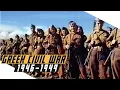
I sincerely hope that it’s uncontroversial to say that the struggle at the centre of the Cold War was… political. [sirens go off] As somebody who lives in the relative safety of the West, it is often taken for granted that political arguments can be rather benign with some even seeing the political game as a… well game. But underneath elections and pageantry, we participate in a debate over who does or does not have power.
Lives are at stake. And one stark example is going to be our story today. I’m your host David and we are FINALLY going to discuss a topic that I think some of our viewers thought we were just going to skip!
That’s right; the Greek Civil War. This is. .
. the Cold War. Alright friends, we’re going back to World War Two… Yes, I know.
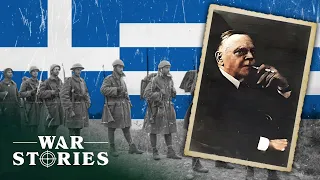
Again. The Axis powers took over Greece in 1941, which at the time was a monarchy under the ruler George II. Before the Axis could capture him, however, he and the Greek government escaped to Egypt forming a government in exile.
However, while they proclaimed themselves a government, and enjoyed recognition from the UK, they had no real ability to influence the Greek people. The new government the Axis set up to run Greece as a puppet lacked real legitimacy, mostly because of gross economic mismanagement. So.
. there was virtually no government in Greece that the Greek people took seriously. In such a situation, different groups rose to resist the axis occupation, backing a various range of political ideologies from those who wanted to restore the monarchy, to communists.
I have no doubt you already know where this is heading. The two major organisations to come out of this resistance were the nonviolent, until 1943 anyway, Defenders of Northern Greece or YVE, and the larger leftist National Liberation Front or EAM. The EAM had aimed at not only defeating the fascist occupiers but of replacing the monarchy as the government of Greece after the end of the war.
They not only campaigned against the Axis but tried to absorb and take over other resistance groups. Now it must be pointed out that the EAM was run by Greece’s Communist party, but throughout this occupation and struggle against the Axis occupation, it sold itself as more of a republican organisation. Their rhetoric was to build a broad coalition opposed to the monarchy and eventually form a democracy.
The Communist Party began its own military wing called the Greek People’s Liberation Army or ELAS, and Communist groups began to organise within the EAM’s ranks. Simple enough, right? Of course, this action did not go unnoticed.
At first, every resistance group got western support, especially the ELAS as it was the largest and most organised one in Greece. As the war drove on, the ELAS began to organise into less of a resistance group, and more of a real actual Communist military. The Allies began to worry that the army was falling out of their sphere of control.
In 1943 when the ELAS and EAM seized a massive stockpile of Italian weapons as the Italians left the country, the allies stopped supporting them altogether. The Allies actually prefered to let the fascist occupiers get a leg up rather than support a communist resistance. Their new resistance army of choice, they threw thier support behind would be the anti-communist National Republican Greek League or EDES.
Things broke down quickly between the two sides, and the EDES and EAM-ELAS began a shooting conflict. A tiny few even accepted help from the Nazis to fight the Communists. By 1944, the EDES had been pushed back into a small fragment of Epirus, the region of Greece just south of Albania.
The British forced a ceasefire, but the EAM-ELAS had the advantage in both numbers and supplies. This was not an easy truce. A brutal hunt began to find and execute collaborators.
Both civilian and so-called ‘security battalions’ emerged to fight the red terror tactics of the Communists. These security battalions also had a horrible reputation for mass executions of leftists, especially EAM leaders. So, yeah, not a fun time.
Now let’s pause a second to talk about the landscape of Greece. And no, not because we would like sponsorship from the Greek Tourist Board. Although that would be nice.
We need to consider the landscape because as we all know, geography has a huge effect on how war is waged. In the 1940s, Greece was a very rural country, and much like today its population and economy were focused on Athens. The rest of the country is relatively mountainous, but also has many islands.
If you were an occupying army, this would be a complete disaster. Just look to the most recent occupation of Afghanistan to show how mountainous regions are a haven for insurgents to base guerilla war. Now, mix in those islands as self-contained potential pockets of resistance.
It is a brutal combination. So, what does the political situation look like at this time? Well, the political situation on the ground in Greece was a mess.
The EAM began a rival government to the Axis collaborators, as well as the government in exile still in Egypt. It was called the Political Committee of National Liberation or PEEA. I know, this is a lot of Acronyms, and its a twisty turny story, but honestly, it was a confusing war with lots of twists and turns.
That’s probably why there isn’t a ton of videos on it. And also partly why it has taken us this long to get to our coverage of it! The PEEA had a lot of support among the Greek people and even the army.
They demanded to become the post-occupation government of Greece, stating that the government in exile had no legitimacy there for years. The Americans and British responded with suppression using their soldiers and some of the greek army loyal to the king. The whole struggle threatened to break out into a massive civil war, so instead of that, representatives from every faction met in Lebanon to sort out a post-war Greece.
Surprisingly, they managed to work something out. The Lebanon conference ended with an agreement called the National Contract and formed a new government. They were riding high on the Allies still having good relations with the Soviets.
It was 1944, and there was still a war to win, so everyone wanted to be friendly. And that’s the Greek Civil war. It all ended that quick and easy, be sure to check us out next time.
[credits start, abruptly cut to David eating a sandwich on set. Someone comes up to whisper in his ear] IT WENT FOR THREE AND A HALF MORE YEARS? ?
[David picks up a textbook, opens it and starts going through] Oh no, oh no no no [as he flips faster and faster] [David pauses, then looks at the camera] OK. So, I guess the war didn’t stop there. By 1944, the German troops were definitely getting pushed out of Greece.
The Soviets were advancing closer. They threatened to cut off not only supply lines, but possible avenues of retreat for the Germans in Greece as the Red Army and its allies knocked out occupied Romania, Yugoslavia, and Bulgaria. German troops evacuated Greece ahead of a British invasion.
And not the fun kind with the Beatles, the Animals and the Rolling Stones! By the time Allies arrived in Greece, partisan forces had already liberated most of the country in the wake of the German retreat. The British took the last holdout of German occupation, Athens, and a week later the government in exile, led by a Liberal leader named George Papendreau arrived to form the new government agreed to in Lebanon.
One promise he made was that the future of the Greek monarchy would be decided by a referendum, so in the meantime, the king remained in Egypt. SO. This government-controlled Athens, but as the Germans were swept out of the mountainous rural areas, the ELAS took de facto control of most of the country.
The only thing really keeping war from breaking out was orders from Moscow not to ruin the alliance fighting Germany at the time. BUUUUUUUUT as you’d expect, some didn’t agree. And this is where we’re going to look into one of the stranger 20th Century power dynamics, but one which is very important in the geopolitics of Eastern Europe.
Some Greek Communist Party leaders did not like Moscow imposing a ceasefire and didn’t want to get along with western leaders. Their relationship was closer with a Communist leader in Yugoslavia by the name of Josip Tito. And trust me, it’s not the last time you’ll hear about him on this channel.
Tito had spearheaded a communist takeover of Yugoslavia without much Soviet assistance, he believed that this form of independence was preferable to taking orders from Moscow. There are some rumours that friction in this period, which was discouraged by Stalin, were done because of influence from Tito. The government in Athens then decided to try and disarm the resistance fighters in favour of an official National Guard.
A plan was developed to simultaneously disarm both the resistance and the Athens government, but Athens rejected it, and what few EAM members there were in that Athens government resigned over the plan. Those who opposed the EAM began to set up right-wing militias such as Organization X waiting for the British to take control of the situation. The EAM responded by announcing a general strike, and the reorganisation of the ELAS.
200,000 demonstrators marched on Athens clashing with British forces and government police. The demonstration broke out into a firefight. Technically it’s disputed whether the police or the demonstrators fired the first shot, but what little hearsay there is tends to insinuate it was the cops.
There aren’t even accounts that say the demonstrators had guns. In this firefight, the police, British soldiers, and Nazi sympathisers killed over two dozen leftists and injured over a hundred. The incident sparked a period known as the Dekemvriana, a month of fighting in the streets between the EAM and the Greek government and its British allies.
The government lacked the weapons for such a prolonged clash, so they turned to Organization X, rumoured to have Nazi sympathisers in their ranks to suppress the leftists. Despite that, the EAM still seemed to be winning. On Christmas day 1944, Winston Churchill himself went to Athens to try and put an end to the fighting.
The conflict threatened a shaky political coalition at home, but they were unable to broker peace. The Soviets, still worried about maintaining the alliance decided to take a completely neutral stance in the conflict. The tide of the battle turned, and by January of 1945, the EAM was forced to surrender.
Scobie demanded the disarmament and the withdrawal of the ELAS from the countryside. They’d get amnesty for the fighting, and the Communist party could remain a legal, political party. Over the next year, however, right-wing death squads murdered and tortured thousands of communists, resulting in some of the now-dissolved ELAS to make small community defence squads.
This period is often called the White Terror. Because of this, and the deterioration of the wartime alliance as the Cold War began to settle in, the Communist Party took a more militant stance yet again. They’d no longer participate in the government and wished to start a new revolution in Greece.
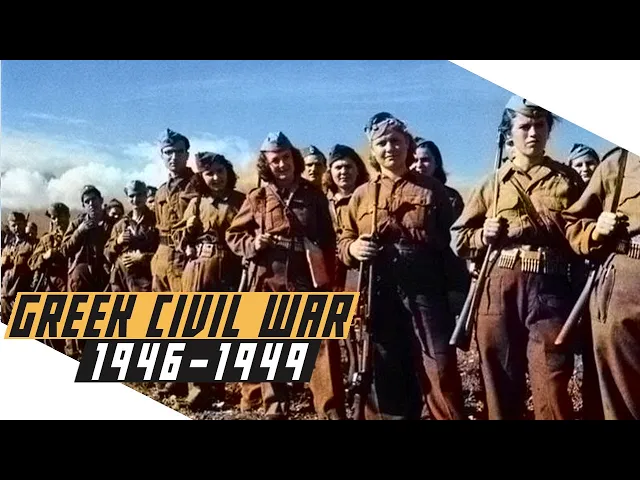
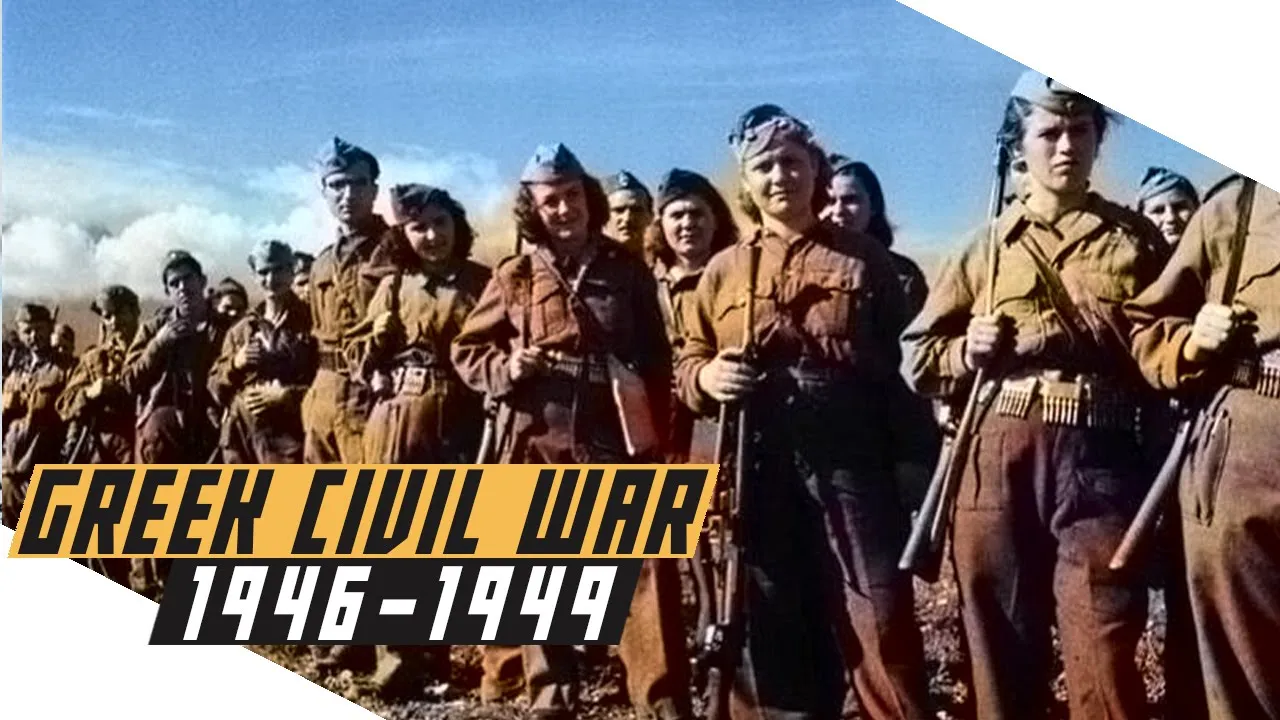
Ok, now we are finally going to talk about what is most commonly referred to as the Greek Civil War. Ex-ELAS troops moving in and out of Communist Yugoslavia and Albania organised a new Democratic Army of Greece or the DSE. Based over the northern border in Yugoslavia, they began to gather supporters to put together a new revolutionary force.
But the USSR still kept Greece at arm’s length. The real help supplied to the DSE came from Yugoslavia and Albania. The UK let the Americans know that with their own economy stretched so thinly as a result of the Second World War, there was little they could do to help prop up the monarchist government.
Truman saw Greece falling to communism and entering the Mediterranean as a way for socialist influence to flow into the middle east. Which is vital to the US because, you know, that’s where all the oil is. Truman decided to give money to both Greece and Turkey to avoid socialism from making it to the sea.
It was the first significant foreign policy move by the US as a response to something called Domino theory. A theory which posited that socialism in one country would then influence others to fall to socialism. Like… like dominos.
Get it? The thing is, the United States at this point was not really accustomed to giving countries on the other side of the world money to avoid a government they didn’t like. The people, but most importantly, Republicans in Congress would need to be convinced.
In a speech to a joint session of Congress, Truman spoke on the need to help free people and assist them against subjugation by using financial aid to stabilise their economies. This address worked, and $400 million of military assistance and economic support arrived in Greece and Turkey. It was a turning point in the history of the US, now on a course of more and more interventions into world conflicts.
And currently, the Greek government was now well supported to defeat the Socialists. It began as a guerilla war. The government went town to town in the countryside, so to speak, to find, arrest, deport, or kill any DSE partisan troops or any communist sympathisers who helped the DSE.
The government responded to their tactics by forcibly evacuating towns which might act as places of refuge. This was something they learned from CIA advisors. This conflict would escalate and escalate until a full-on war broke out in 1947.
The Communist party announced the formation of a rival government, and a revolution would begin. The DSE launched major invasions on significant towns to make a rival capital but succeeded in nothing less than the loss of their preciously few troops. Over the next year, the DSE would field a guerilla network of sympathisers and suppliers to a 20,000 strong army, up agains the government’s 90,000 troops.
By 1948, the DSE found themselves on the decline. The split between Tito and Stalin, which we plan to detail further in a future episode, led to Stalin taking a stance AGAINST the communists in Greece, stating the cause hopeless due to western intervention. Despite that, the majority of the Greek Communist party still chose to back Stalin over Tito.
It was contentious, and the communist cause in Greece was severely torn. The party went on a witchhunt for secret Titoists and threw them out of the party. Tito closed the border to the DSE, and no longer let them train in and base operations from Yugoslavia.
A major offensive by the government devastated DSE forces, and the few left had to leave the country for the USSR. The war was over, but Greece’s problems were far from done. The left and right of Greece continued to fight, resulting in events like a right-wing coup in 1967, making Greece a military dictatorship until the 1970s.
Even today, the left and right can clash with severe violence in times of instability in Greece, such as the far-right Golden Dawn during the Greek economic crisis just a few years ago. As you all probably know already, this struggle between left and right is at the core of the cold war and of even contemporary politics. When a fight is over who has access to power, who deserves the necessities of life, and who gets shut out from these things, people will fight and die for their beliefs.
And when we talk about the endless proxy wars and struggles which form the narrative spine that this whole channel is about, know that in the end, this is the tension at its heart. We hope you have enjoyed today’s topic and to make sure you don’t miss any future episodes, please make sure you are subscribed to our channel and have pressed the bell button. A big thank you to Tristan from StepBack History who waded into the complexities of the Greek Civil War!
We can be reached via email at thecoldwarchannel@gmail. com. We are also on facebook and instagram at TheColdWarTV.
To help us both keep the lights on and feed my children, consider supporting us on Patreon via www. patreon. com/thecoldwar.
This is the Cold War Channel and don’t forget, “The trouble with a cold war is that it doesn't take too long before it becomes heated.