Civil Code Article 1124 states: persons deprived of legal rights are minors, i. e. children, married women, criminals & the mentally disabled.
But you can see for yourself. . .
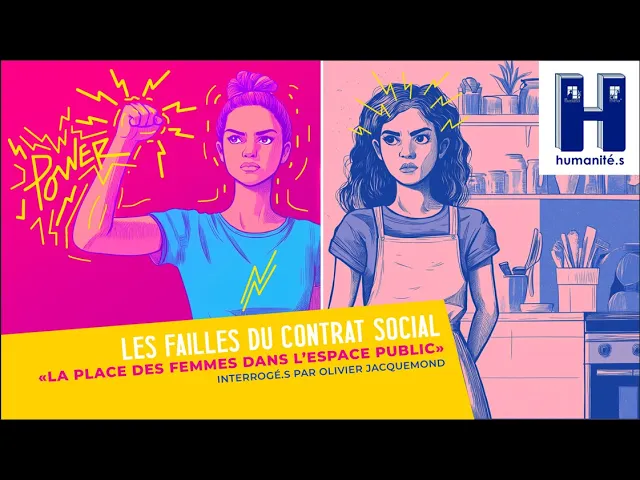
Today, we’ll tackle a third flaw in the social contract: women’s role and place in the public sphere. Or rather, how the public sphere was created without women, in the absence of women. We’ll refer to two books, Carole Pateman's The Sexual Contract and feminist thinker Geneviève Fraisse’s La Fabrique du Féminisme (The Feminist Factory).
And I'll be discussing this with Chara! Hey Olivier! Well?
All good, you? Great! I'm happy to see you again.
Me too. We're in a public place, an appropriate spot to talk about women speaking out publicly. We're facing a fresco in the 12th Arrondissement of Paris, a wall dedicated to human rights.
This year, Amnesty International commissioned artist Olivia de Bona to create a fresco on women's rights and the right to abortion. Here's her work. I think it's very appropriate to have a public artistic expression to talk about women's role in the public sphere.
It's perfect. Shall we? Let's!
Here we go. My introduction mentioned Carole Pateman's book The Sexual Contract, which should ring a bell. Most certainly.
Didn’t her book inspire Charles Mills to write The Racial Contract? Absolutely. You have an excellent memory.
How about a bit more challenging? Do you recall what Charles Mills addressed in his book? I think so.
He demonstrated that free and equal individuals are, after all, white Western men. He also demonstrates the invisibilisation of black and colonised people in the service of white supremacy. That's it exactly.
You had a structural system with equality between white men and people of colour, legitimised by the social contract, but that was also a way of hiding behind a racial contract, which was taboo, repressed, and yet also what really structured Western modernity and the great principles of the Enlightenment and other ages. -Human rights. .
. -Exactly. And it was a very fine analysis, based on the idea of Carole Pateman, in her Sexual Contract.
She was the first to say this. There is a social contract, but there is also a racial contract and a sexual contract. And the inequality visible between white men and people of colour is also visible between men and women.
And here we find a similar mechanism with an added subtlety: in theory, in the Declaration of the Rights of Man and of the Citizen, women are equal to men as citizens, even if they are not named as such, but they are part of the human race. However, they do not have access to full citizenship, and here's very simple proof of this: In France, women secured the right to vote in 1944, 1789-1944. It's a long, drawn out story, so citizenship, but not quite.
This is what the other author mentioned in my introduction, Geneviève Fraisse, called ‘exclusive democracy’. That's really interesting. Modernity, the French Revolution and the social contract make democracy more exclusive than exclusionary.
I'll explain. Perhaps, if I try to understand, it's the fact the texts are not officially excluding anyone? Because when we talk about citizens, we don't exclude women, but ultimately, the way it is interpreted is exclusionary because in fact it excludes women?
Yeah, that's it. If we were in an exclusionary democracy, it would be a regime where we could say: women have no access to public speech, women have no access to voting rights, women have no access to work, and no access to public responsibilities. That was never written.
Theoretically, women have access to the same rights as men, though it remains theoretical and abstract. Now look at the concrete situation, particularly the laws and rules in force, you'll see that there is a difference. What Geneviève Fraisse actually points to, which is interesting for progressive and feminist thought, are the very principles, which do not explicitly exclude women at all, and can thus be used in battles and struggles for rights to claim such and such a right.
I can thus claim access to a principle simply because I am not excluded from it. That's an interesting way of thinking about women's struggles in modern times. If you look back to 1789, first of all you have women who are citizens, but without citizenship.
You've already mentioned a few examples, but there are many others, so I'm not sure I fully understand. Yes, because I like this notion of being a citizen without citizenship, but that's when you look for solid proof of citizenship. We'll find a rather edifying history after 1789.
First of all, I'll point out that women's rights progressed just after 1789, because many feminists were involved in the Revolution and had an active role. One example is an extremely well known woman who is still praised, even today: Olympe de Gouges. We all learn about her 1791 Declaration of the Rights of Women and the Female Citizen.
That’s one example of a woman claiming full citizenship. Her fate, however, should sound the alarm because she was guillotined in 1793. That kicked off a phase of regression in relation to certain small revolutionary gains that were good.
Equality of inheritance rights. Divorce, the right to divorce, is not just about the right to divorce. It unshackles a woman from her husband's guardianship.
She regains her freedom and independence, a considerable feat. But after 1793, there was a downward movement which reached its apogee, if I may say so, because it's not really an apogee, it's not glorious. It's the Napoleonic Civil Code published in 1804.
I'll give you just one example. Civil Code Article 1124 states: persons deprived of legal rights are minors, i. e.
children, married women, criminals & the mentally disabled. But you can see for yourself how it treats women, who are clearly grouped with criminals, mentally disabled, and placed under the authority of a husband who is competent, rational, reasonable, and who can guide the family's affairs. That's the situation in 1804 and it's only much later that things got better, because if you look (I know it's always spectacular when you remind students of it), it's only in 1965 that a woman could seek a job by her own choice, autonomously, it's only in 1965 that she could open a bank account and therefore have a payment method and own her own property.
There are no surprises in the history of feminist struggles. I'm sure you're learning nothing. However, I'm surprised that it actually started with revolutionary ideals, so at the end of the 18th century, but in the end there's nothing revolutionary about what you described.
Yes, that's what's troubling, and where the work of the historian Geneviève Fraisse is really important is that she started from the texts. She read the works of the Enlightenment and thinkers who shaped the revolutionary idea and ultimately found no incompatibility between their revolutionary ideals and their regressive side in terms of women's rights. That's paradoxical.
It seems paradoxical. On top of that, it requires sophisticated reasoning because you have to explain the injustice, justifying it while also advocating equality. Take Rousseau.
Rousseau is brilliant, because he, as we know, is clear. He's like the father of autofiction, transparent and he tells you everything you need to know. At the same time, he's a liar, since he doesn't really practice what he preaches to everyone else.
Even in political thought, he'll say that we're breaking with the Ancien Régime, with its patriarchal system, inequalities, royal absolutism and royal arbitrariness, and we'll leverage equality and freedom for the general interest. We'll free ourselves from royal arbitrariness and advocate equality as an emancipatory principle. But he only sees this in the public sphere.
Because he also observed that everything at Versailles in the Ancien Régime was organised around the king: court society. There was no real distinction between family and public sphere at that time, everything was mixed up. Women had an important role too in the Ancien Régime.
Women, not all women of course, but certain influential women, certain women from the elite, had a crucial political role in terms of influence. Rousseau did not see that as a good thing. Even if it wasn't official, official roles, of course.
Exactly, they were not roles of public responsibility. But behind the scenes, in the salons, the drawing rooms, which were so influential, women really had a way of playing politics, almost clandestinely, or underground, but they had power. Rousseau viewed that as dangerous.
So we have to make sure that we leave women in their terrible place, by saying that, no, equality is all very well, it's perfect, you need that to be in politics and to have an emancipated vision, but that's not the place of women, who should remain in the private sphere. It's their sphere of influence and what they're good at. Men are thus in the public sphere, where they exercise responsibility.
They also have a privilege. Male privilege means being able to move from the private to the public sphere. They go home at night, and come and go as they please.
Women, on the other hand, were not in the public sphere at all. He could have proposed that women should also enter the public sphere, but he didn't. Not at all.
That's it. You're saying there's a fundamental contradiction here, but perhaps we can understand it if we go back a bit in time. In the 20th century, this distinction between private and public sphere appears in terms of work.
It's the men who work as breadwinners for the home, and the women are at home, doing a job, mind you, but a job that is invisible, namely domestic work; for free. There is no value to it. The labour thinker, and anarchist Proudhon would say: that's a very good distinction, because women, by taking care of education and family affairs, free up the minds of men to be able to handle public affairs because, you know, thinking about the general interest requires that you get away from constraints to get to grips with the big issues.
Thanks to the work of women, men can focus on the really big issues. It really is women serving men. Exactly.
In fact, they absorb the mental load that liberates men, so men can be good revolutionaries working for equality. It becomes more paradoxical when we look at an order that divides the family sphere from the public sphere. The same principles do not apply to both.
Let's go back to the other author I mentioned, Carole Pateman. She also shows us that modernity and the social contract have only created and consolidated existing inequalities, reproducing the patriarchal system we thought we overthrew. Let me explain again.
The king was the very top in the Ancien Régime. Our entire society is structured on this model. If it's not the king, it's the father who rules over the family.
During the Revolution, we said we'd cut off the heads of kings and fathers to create a horizontal society of brothers on principles of fraternity. Great, we made progress. Except that, in fact, women have still not acquired their autonomy and independence.
They're thought of in relation to men. First the father's authority, now it's the husband's. Fathers give husbands their daughters.
It's a currency of trade. They then become mothers, defined in relation to their children, and particularly the son who will succeed the husband and father, and whose education they must ensure. Women are thus always thought of in relation to men.
We return to the roles of daughter, wife and mother. Exactly. It's like in some English novels, or the Downton Abbey series.
The daughter or daughters are placed under the authority of the father, who sees a good match, a marriage that would be good: 'Daddy, daddy, daddy! ' We truly have that traditional role. And in fact, we think it's the Ancien Régime, but it lives on in other forms that have the appearance of equality, because the contractualist woman sees two adults who come together willingly and say I do.
. . Great.
But in a deeply inegalitarian system or order, in a patriarchal system, equality is only a façade. Because when a woman gets married, for example, she is already subordinate and submissive. Does she have an alternative to 'I do'?
Under the liberal and contractualist appearance really lies an unequal system legitimised by consensualism, and it is only a façade that in fact perpetuates inequalities, and perhaps even worse, by ultimately saying well yes, there is a difference between women and men essentially, but this distinction is ultimately contractual, and some will base it anthropologically by saying that in archaic societies, as anthropologist Françoise Héritier puts it, there was already binary opposition between the feminine and the masculine, based on opposing couples. Masculine-feminine Hard-soft Dr-wet Hot-cold Each dyadic term conveys its corresponding positive or negative value. And who gets the positive value?
The masculine term! You hit the nail on the head. -Everything positive.
. . -is attributed to man.
It's a social construct. Hard is masculine. Dr is also masculine.
Whereas, cold and wet are feminine terms. We can continue the reasoning with emotion and reason. Ah, you're very emotional, you're very sensitive, not necessarily a good thing.
Man, on the other hand, is endowed with reason and is able to stand back and distance himself. This distinction will underpin the very construction of the Republic, the republican order. In other words: men make the laws, and women make the rules.
Because they educate their children, so they instil values in them. Rousseau will applaud this as very good, because women are humble, sensitive and modest. They will thus convey good values to their daughters and sons.
They will thus shape the future citizens of tomorrow, i. e. the sons, to become fathers, to become political leaders.
So all's well. Yet I find it quite astonishing, because you said it was also part of archaic societies, which means there's something natural about it. I understand what you mean.
We should be very careful in this regard. As Françoise Héritier said, this inequality, this binary opposition between masculine and feminine, exists in every society. However, it's not natural.
Rather, it's part of a social discourse that was created by men to subjugate women, and what was constructed at one point can be deconstructed. To deconstruct it, we need to understand the mechanism behind it. Why have men put so much weight and importance on dominating women?
Why has this structural inequality emerged? Since we're still on Françoise Héritier, she thinks it's a question of procreation She will see that in fact the men cannot stand the fact that something such as procreation, the ability to beget sons, is given to women. It's quite a paradox, women are supposed to be inferior in the discourse as it has been constructed since antiquity, but they can beget men, which is the most precious thing for fathers, boys.
With the ability to procreate eluding them, they will have to turn what is perceived as their relative weakness into a strength. They will thus create values, a discourse and narratives valuing their own qualities over women's values to compensate, ultimately, for what they do not have. Simone de Beauvoir also uses the procreation argument as what establishes the inferiority of women.
Because this means that women are assigned to a biological destiny. They are not transcendent beings capable of removing themselves. .
. Or committing to other life projects. Exactly.
That's why she never had children with Sartre. They opted to devote themselves to their careers as writers and intellectuals, but not having children. For another feminist, Monique Wittig, it's an obligation to procreate, created by men in order to alienate women.
So you can have this type of argument that explains how inequality between women and men has developed over time. Another form of explanation, put forward by Freud and Carole Pateman, is women's desire to enjoy their bodies. It's a woman's desire for sexual possession.
The man will respond to his motivation, he's a predator. The term predator is popping up a lot lately. The woman is thus there to satisfy the man's desires.
It's interesting since it even played tricks on some feminists in the ‘68 and post-’68 era in the middle of sexual revolution and sexual liberation. Some of them felt that, far from liberating them, it recreated a form of domination, because it wasn't the fact of having multiple partners, being unfaithful or not submitting to the laws of marriage that would give women freedom. Ultimately, it wasn't sexual freedom and the sexual revolution, a very masculine, quantified type of desire.
You always need more, more, to come without hindrance, as soon as you want it and feel like it. Did women give in to that desire? Men decide, women dispose, that would be the principle.
Yes, it's a kind of evolved male domination. Exactly, you see that in fact procreation, sexuality, the modalities change, but it's ultimately the same thing, it's: we want to control the woman's body, and we can wonder if deep down, the fear isn't the fear of the woman. It's fear of women, of what they represent.
Rousseau expresses it, saying: yes, women must remain in their place and in fact the differentiated status of men and women is very important because that is the law of love, people must be different, otherwise they would just be friends. He is pathologically worried that equality could kill eroticism. Finally, you talk about the construct of male domination and inequality.
How can we deconstruct all this? What are the solutions? There are many feminist currents, many ways of thinking about this.
The question of procreation will lead to some very radical schools of thought. Monique Wittig, for example, says to stop having children. She advocates a kind of lesbian separatism.
Let's stick together, women, to break the heteropatriarchal model, because in fact there is no man worth having. Every man is caught up in this heteropatriarchal system, making it a system of domination. Let's just leave it.
Why not, it could be a way forward. It might not be the one I'd pick personally, but there you go, maybe, I'm speaking as a guy here. Another voice might say that since we want women's bodies, the division of sex is the essential point, why shouldn't we disturb gender?
We could move away from the question of biological sex to create culturally constructed questions of gender that cut across sexualities. That renders beings less definable. Queer is thus a transgressive category.
But Preciado also praises the trans and the monster that he is. We're in between, we're in the middle. If we can't be defined, we can no longer be subjugated.
It's another way out. There is another possibility perhaps, there are two others in fact, and that is the question of domestic work, recognising domestic work by saying that emancipation depends on this, on recognition of this work and equality for women even in the domestic sphere. Invisible work, yes.
This is a current of feminism known as materialist feminism, which is also close to Marxism. It defers the question of relations of production to the family. There's also everything going on nowadays.
We are in the MeToo era, witnessing a liberation of speech. So we need to be precise. It's interesting if you get the sense that the women are talking.
Maybe they've always been talking. They've always evoked the difficulties they go through. Perhaps their vocabulary is larger today because there is more freedom of speech and so listening to each other means that we are always refining our discourse and better understanding the mechanisms of domination.
But most importantly, they are heard. And listened to. In other words, speech reaches a space that did not exist in the past, when women were confined to the private sphere, the intimate sphere, and their words were not political.
Today, everything is political. This is also a legacy of 1968, but private and intimate speech becomes political, it is politicised. That's extremely important, because when you, your neighbour or your neighbour's neighbour says something as an individual, it's a testimony.
But from the moment that speech becomes political, it's no longer a question of an ‘I’, it's a question of a ‘we’. It's a collective. That's what the fresco we saw in the said, the phrase, for example, ‘I believe you’.
Saying ‘I believe you’ is not politically wise because there's no presumption of belief for a word, anyone can lie. But ‘I believe you’ means ‘I receive your word’, and around that word we form a ‘we’. That's interesting.
I've been teaching for years, and I've always said that you have to be wary of intimate speech, because it's not political speech. Public discourse is discourse in which we step outside ourselves as reasoning beings, capable of withdrawing from our position as singular individuals to think about and meet the other and the other's point of view. However, confined to one's own private words and testimony, you cannot reach political speech.
I think I was wrong, and this proves it. Public discourse, the public sphere has degraded. It's clear that political discourse is weaker today on the major traditional issues that used to be dominated by men.
Political courage, economics, the deficit, and so on. Nobody cares. However, the words spoken and expressed by women resonate far beyond women themselves.
In other words, everyone feels that there is something liberating and emancipating at stake, something that moves society forward. It's a common cause. That brings us back to political speech.
And frankly, I'm very happy to have been wrong. It's interesting to realise that it wasn't an egotistical remark, it's talk that advances social struggles. And it's essential to recognise it, above all.
Listen, that's how we make progress.