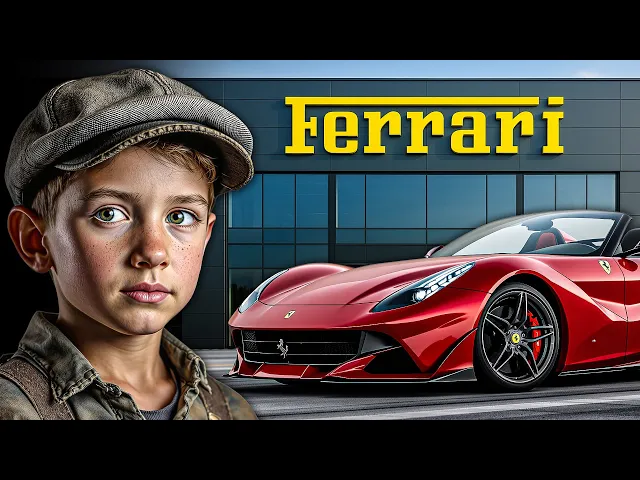
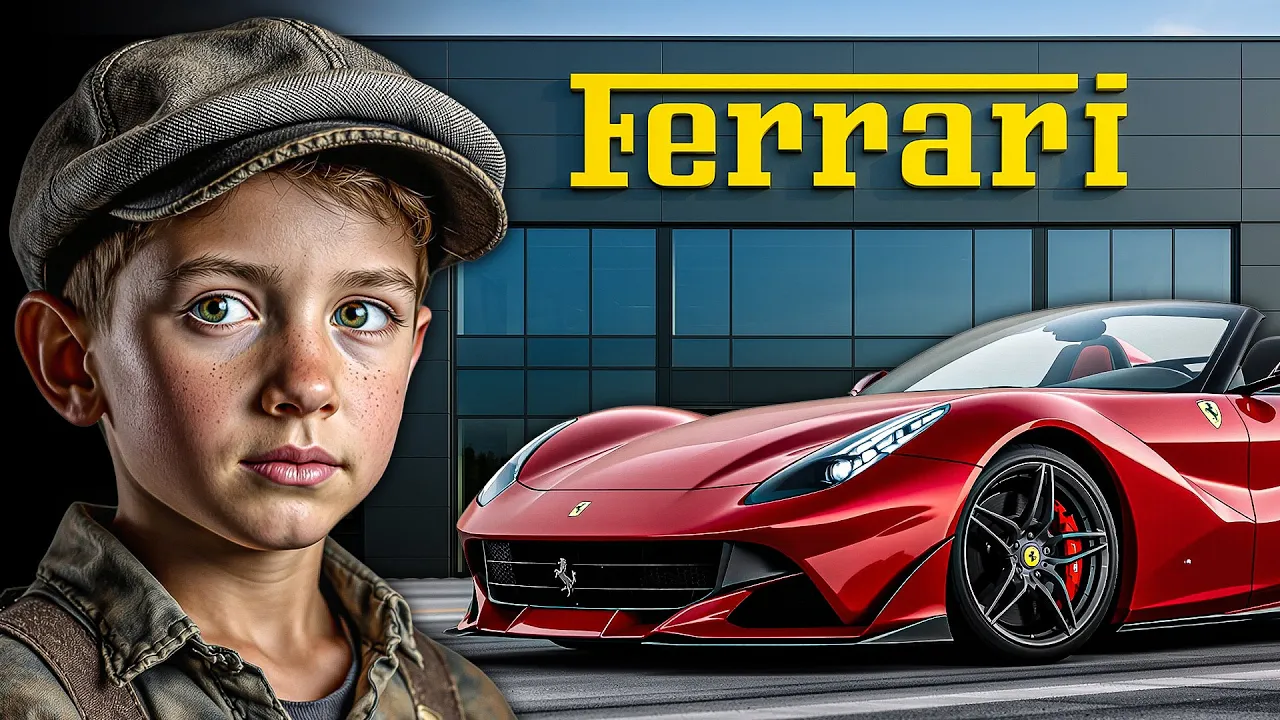
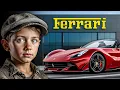
Ferrari is one of the most luxurious and iconic car brands in the world with an estimated net worth of around $85 billion. But behind the brand's sleek designs and incredible speeds, the company was founded by a kid who grew up in a family of blacksmiths, lacked formal education, and was once rejected from working at a car factory. During his teenage years, he lost his father and brother and with no money or connections, nearly became homeless on the streets of Turan, following his dreams of becoming a race driver.
Little did he know his relentless pursuit would lead him to build the most dominant racing team in motorsport and in doing so create one of the most fascinating car manufacturers in the world. This is the astonishing true story of Enzo Ferrari and the legendary brand that bears his name, Ferrari. [Music] Enzo Ferrari was born in 1898 in the ancient town of Modina in northern Italy.
While Italy struggled with poverty due to the country's instability, Enzo's father managed to run a successful blacksmithing business. Although this income allowed the family to live comfortably, Enzo knew early on that blacksmithing was not the work he wanted. During his childhood, the Ferrari family was among the few to own a small dead bhuton.
And this sparked young Enzo's fascination with cars. His interest grew even further when at age 10, his father took him and his older brother Dino to see their very first racing event, the 1908 Sirquito Dalona. At this time, automobiles were still a novelty in Europe, and racing was overwhelmingly dangerous.
Drvers competed on dirt roads with little or no barriers and virtually no safety equipment, making fatal accidents common. Despite these dangers, Enzo immediately knew this was precisely what he wanted to do in life. He wanted to be a race driver.
His dreams, however, were dramatically interrupted when in April of 1915, Italy entered the First World War. Duo enlisted in the army and Enzo had to roll up his sleeves to help his father at the workshop. Sadly, his father contracted pneumonia and a few days later passed away in 1916.
With him gone, the business became abandoned. And to make matters worse, Dena would also die that same year from an illness contracted on the front lines. At just 18 years old, Enzo's comfortable life was gone.
Jobless, penniless, and desperately alone, he took odd jobs to survive until he was drafted into the Italian army in 1917, where he was tasked with shoeing mules during freezing conditions. Shortly after, Enzo felt severely ill from a pandemic that was claiming the lives of tens of millions at the time, the Spanish flu. Fortunately, his early hospitalization allowed him to survive.
After the war ended, Ferrari returned home at the lowest point of his life. Haunted by the war and the loss of his family, he became determined to rebuild himself and follow his dreams to escape his harsh reality. So he traveled to the city of Turin, the center of Italy's automotive industry, with only one goal in mind, to become a race driver.
Upon arrival in Turin and with a letter of recommendation from the army, Enzo approached Fiat, one of Italy's leading automobile companies, asking for work. However, Fiat rejected him. And so, Enzo was forced to rely on his meager savings and wandered from one place to another until eventually finding a job at a small auto repair shop.
The shop's main business was to remodel war trucks into passenger vehicles. And while Enzo became familiar with mechanical tasks, he felt unfulfilled. Luckily, he would soon meet a friend who would transform his life, Ugo Civochi, a former bicycle racer transitioning into the automotive industry.
Ugo introduced Enzo to a new car manufacturer in Milan named CMN, where Enzo was hired as a test driver and delivery man. Although CMN was a relatively small company, they were building something that Ferrari desperately sought after, race cars. After several months, Enzo used all of his savings to finance an automobile.
And in 1919, he got his first race car at age 21, a CMN model 1520. Soon he debuted at the Parma Pogo de Burchchetto where he was up against some of the best drivers in Italy driving Fiats, Opals, Bugattis, and Alpha Romeo. Despite driving an outdated vehicle, Enzo managed to secure an impressive fourth place in the 3 L category and 11th overall.
Encouraged by the start, he soon entered one of Italy's most popular and dangerous races, the Targa Florio. Unfortunately, mechanical failures coupled with heavy rain and snowfall resulted in a disappointing last place finish for Ferrari. Frustrated, he decided to trade his vehicle for a more powerful one, a 1913 Isod Friskini.
The next year, Enzo returned to the Parma Pogo Deerto and managed to land second place in the 7 L category and third overall. This result rapidly elevated Enzo's reputation as an amateur racer. Still, his major limitation was his lack of money, as the sport of autoracing has long been dominated by wealthy people who could afford the latest, most cuttingedge vehicles.
However, thanks to his growing prominence, Enzo approached Alfa Romeo with the deal to acquire their latest and fastest model, the Alpha Romeo G1. Unfortunately, his order was delayed, and in the end, Enzo never received the car he wanted due to several issues with the model's production. Instead, he was offered another deal that would change his life forever.
In 1920, Alfa Romeo offered Ferrari a spot on their prestigious racing team, which Enzo gladly accepted. Almost overnight, Ferrari went from driving outdated vehicles to competing alongside legendary drivers like Antonio Oscari and Jeppe Kari. Enzo debuted with Alpha at the Targa Florio race in 1920 where he secured second place.
His first victory would finally come 3 years later at the Sirquito Davio of 1923. It was here where Enzo met Countest Palina Baraka, mother of an Italian war hero pilot named Francesco Baraka. Palino encouraged Ferrari to adopt the prancing horse emblem that her son painted on his aircraft to use on his cars for good luck.
Enzo gratefully accepted her suggestion, though he would not use the emblem until establishing his own racing team some years later. This iconic symbol would eventually become synonymous with Ferrari itself. While racing for Alfa Romeo and so successfully convinced the team to recruit his longtime friend Ugo Civochi, a decision that greatly benefited the team.
Civoti quickly became renowned, winning several major races, most notably the 1923 Targa Florio. Tragically, just 4 months after his victory, Civacei died during a crash while testing Alpha Romeo's P1 prototype. This devastating event deeply affected Enzo, even leading him to reconsider his career as a driver at one point.
His stress deepened further when in 1925, Alfa Romeo's leading driver, Antonio Escari, also died in an accident during the French Grand Prix. Despite these losses, Enzo continued racing over the following years, but gradually became more interested in the organizational aspects of racing. Outside of motorsports, he had successfully ran several Alpha Romeo dealerships in Italy and got married to a young woman named Laura Dominico Gello in 1923.
Balancing personal responsibilities, Ferrari began reducing his racing engagements and focused instead on managing Alfa Romeo's racing division. His management significantly contributed to the team success, especially through his recruitment of talented engineers like Luigi Bazi and Vtorio Yano. Under their expertise, Alpha Romeo produced the P2, a car that dominated racing from 1924 to 1930, claiming 14 Grand Prix victories and achieving speeds over 120 mph.
These successes positioned Alfa Romeo alongside Bugatti as the leading names in Grand Prix races during the late 1920s. However, Alpha and several other car manufacturers began to pull their money out of racing due to financial reasons, leaving many team members discontented. This caused several racers to create their own teams and purchase their own cars to compete alongside other wealthy amateurs.
These arrangements became known as Scooteria and quickly became an attractive trend in Italy. There was just one problem though. Many of these Scooteria were run by people who lacked organizational skills and insights into the auto industry leading to many inconsistencies on the track.
But for Enzo, this was a golden opportunity. He knew exactly what was needed to make a race team successful. So he decided to create a proper race team of his own.
Scooteria Ferrari. [Music] In 1929 at the age of 32, Enzo joined forces with a group of wealthy car enthusiasts to establish Scooteria Ferrari in Modina. adopting the prancing horse emblem gifted by Countess Baraka as their team logo.
While Scooteria Ferrari was an independent team, it acted as Alfa Romeo's unofficial racing division. Enzo secured an advantageous agreement with Alpha, allowing him to purchase their cars at wholesale prices. In return, Enzo convinced Alfa Romeo that any losses would be attributed to Scooteria Ferrari, while all victories would reflect positively on Alfa Romeo's reputation.
However, the initial purpose of Scooteria Ferrari was simply to provide rich amateurs the chance to compete in Italy's racing calendar. But in reality, Enzo had different plans. He wanted to make his Scooteria the best race team there was, a premier name in Italian motorsports.
To fund his vision, he cleverly secured financial and technical support through partnerships with automotive suppliers such as Pirelli for tires, Shell for fuel and oil, and Bosch for spark plugs in exchange for publicity on the tracks. Although Enzo was not the first to use such sponsorship arrangements, he played a big role in its consolidation, a practice still fundamental in racing today. He further bolstered his team by recruiting legendary drivers like Jeppe Kari and Tazio Nuvalari.
In their first season, Scooteria Ferrari achieved an impressive nine victories out of 22 races. Over time, Ferrari would claim notable victories such as the Targa Florio, the Milia, and numerous Grand Prix races throughout the early 1930s. As the team grew, Scooteria Ferrari quickly became one of Europe's largest and most successful racing operations.
Good things continued to come for Enzo when in January 1932 he celebrated the birth of his first son Alfredo Dino Ferrari marking his complete retirement from racing as a pilot. However, tensions arose with Alfa Romeo who amidst their financial difficulties became hesitant to continue supplying top tier vehicles to Enzo's team. Moreover, the emergence of powerful German manufacturers like Mercedes and Auto Union, backed by substantial Nazi government funding began dominating Grand Prix racing in the 1930s, leading to declining results for Scooteria Ferrari.
This downturn resulted in the loss of key drivers who switched to better funded teams. Ultimately in 1937, Scooteria Ferrari was bought out and dissolved by Alfa Romeo, who relocated operations from Modina to Milan and formed a new team called Alpha Course in hopes to better compete with its German rivals. Enzo Ferrari was placed in charge of Alphacor, but struggled to match the Germans superior resources in engineering.
After 2 years, Ferrari was fired due to disagreements over the team's direction, which left him feeling betrayed after dedicating 20 years of his life to Alfa Romeo. Adding insult to injury, Alfa also barred him from using his own name on any automobile or team for 4 years. Despite the setback, Enzo knew his accomplishments were significant.
Scooteria Ferrari had secured 144 victories in 225 races and after its dissolution he had received more than a million lear as a reward. With that money, Enzo set out to fulfill his dream and finally opened his very own automobile company in 1939. Little did he know his company would soon fall onto a very different path.
After leaving Alfa Romeo, Enzo Ferrari founded his automobile company at Modina in 1939. Auto Aavio Castroioni. He quickly hired talented engineers to create a race car that combined speed with elegance.
The result was the model 815. Two of these cars debuted at the 1940 Brascia Grand Prix, impressively leading the race and setting the fastest lap records in their class. Unfortunately, mechanical failures prevented both cars from finishing.
Unbeknownst to Enzo, this would be the first and only race under the auto aio constra. As World War II intensified, Italy paired with the Germans to fight against the Allied powers, and racing alongside passenger car production were no longer priorities. Instead, military vehicle and arinant production became essential.
Bonito Mussolini approached Enzo, asking him to supply military equipment, to which Ferrari agreed. He relocated his main factory from Modina to Marinelo, secretly manufacturing devices from Mussolini's fastest government in Nazi Germany. Enzo was in fact a public member of the fastest party since 1934, appearing in uniform at parades and ceremonies for the community to see.
In reality, Ferrari mostly did these things to remain in good terms with those in power. Otherwise, his business would likely have been seized or worse, get himself eliminated. Interestingly, Ferrari also maintained covert relations with socialist groups in northern Italy, simultaneously playing both sides in the conflict, possibly to ensure his survival regardless of the war's outcome.
What's certain though is that Ferrari profited nicely from the war and his company grew quite large working for the military. However, his factory faced repercussions when Allied forces bombed his factory twice in 1944 and 1945. Following Germany's defeat and the war's conclusion, Enzo faced a critical decision.
Despite Italy's enormous reconstruction demands presenting lucrative opportunities in the machine tool industry, Enzo abandoned that path entirely. Instead, he risked everything by returning to his long passion, racing. He recruited his old friends and engineers Joino Colombo and Luigi Bazi to design a sleek, powerful race car.
And this new car would be the very first to bear his name, the Ferrari 125s. [Music] The Ferrari 125S featured a sophisticated 1. 5 L 12cylinder engine with an impressive top speed of 130 mph.
Ferrari debuted his new car at the Cirquito DPenza in 1947 where it outperformed rivals from Maserati, BMW, and even Alfa Romeo. But with just three laps remaining, the engine misfired, forcing it to retire. Despite the loss, Enza remained optimistic, calling it a promising failure.
Two weeks later, Ferrari secured its first victory at the 1947 Rome Grand Prix. The following month, it earned two more wins, and by the end of the year, Ferrari had collected six victories out of 14 races. However, Enzo knew that if he wanted to keep racing, he needed a reliable source of income as racing is extremely expensive.
So, he decided to produce luxury sports cars under the Ferrari brand and partnered with former Alfa Romeo teammate Luigi Kennedy to market these vehicles in America. As Europe was still recovering economically from the war, Kennedy effectively promoted Ferrari cars as luxurious collectibles and competed in prominent American races like the Indianapolis 500 and the 12 hours of Sebring, enhancing Ferrari's profile in the US. However, there was one race Kenetti wanted to compete in that he knew would greatly benefit Ferrari, the 24 hours of Lemons.
He approached Enzo to request two Ferraris and eight mechanics for the race, but to his surprise, Enzo refused, believing the cars weren't ready for such a demanding event. Furthermore, sending his official team for a potential resounding defeat would not only be a waste of time and money, but also create bad publicity. Instead, he suggested to Luigi that if he really wanted a Ferrari at Lemons, he could always buy one and take it himself.
And so, Luigi did exactly that. In 1949, Kennedy surprised everyone, including Enzo, when he drove at the 24 hours of Lemons and more so when he won the race. This monumental victory validated Ferrari's capabilities and greatly boosted sales and reputation throughout the 1950s.
The increased revenue allowed Enzo to further invest in racing, achieving dominance at the Melia for several years and securing other important victories such as the target Florio, the 24 hours of Spa and again at Lemons in both 1954 and 1958. Models like the Ferrari 166M and the 250 Tesarasa quickly became sensations for their performance and elegant designs. Nevertheless, these designs weren't created by Ferrari crew themselves, but instead by an Italian coach building firm named Panin Firina.
Enzo had partnered with Panin Firina to specifically handle the design of his road cars, allowing him to focus exclusively on his racing operations. This collaboration was so successful that Pinehirina ended up designing almost all Ferrari models until 2017, producing some of the most iconic cars ever seen, such as the Ferrari 250 GT California, the 308 GTB, and the F12 Berlinetta. As demand for his automobiles soared, Enzo also made sure to produce only a limited number of vehicles each year.
That way, he could shorten the supply and keep the demand high, thereby maintaining exclusivity. a strategy Ferrari still employs to this day. But in reality, Enzo was never interested in his production car business.
For him, it was merely a means to sustain his racing obsession, nothing more. However, while Ferrari's racing team was thriving on the racetracks, Enzo's personal life was suffering tragically. His son Dino had long battled a rare form of musculardrophe since he was a child, which worsens severely by his early 20s.
Despite doctors declaring the condition incurable, Enzo tously sought solutions, determined to support Dino's survival, Dino was just as obsessive as his father and also passionate about engineering, even contributing to the development of a 1. 5 L 65° V6 engine, a design later adopted in Ferrari's future race cars. Sadly, Dino never witnessed the success of his creation because in June 1956, he passed away at just 24 years old.
Dino's death devastated Enzo profoundly, and in truth, he never fully recovered. Those who knew him closely remarked he was never the same after, becoming more isolated and emotionally detached from others. In tribute to his son, he began wearing dark glasses for most of his life and visited Dino's grave each morning before work.
However, this wouldn't be the last time that death would alter his life. In the Pillis world of motorsports, tragedy was a constant threat and Enzo Ferrari was about to face the consequences of what it takes to pursue victory at any cost. By the mid1950s, Scooteria Ferrari was still enjoying success, but the competition had begun to change.
New British rivals Cooper and Lotus were revolutionizing Formula 1 with mid-engine designs that outperformed the traditional front engine models. Now, even Ferrari's powerful V12 and V6 engines were being bested by smaller, more agile cars. While most teams quickly adapted to the mid-enine trend, Enzo stubbornly stuck to his old ways.
To him, raw power was everything, and he always believed his drivers could make up the difference. That belief would come at a terrible cost. The intense pressure to win, despite outdated designs, made his drivers more reckless than ever before, leading to multiple fatal accidents.
One of the most tragic occurred during the 1957 Milia, a thousand-mile race held on public Italian roads. Alfonso de Portago, a charismatic Spanish nobleman, was driving a Ferrari 335S at over 150 mph when a tire exploded, causing a catastrophic crash that killed him, his co-driver, and nine spectators, including five children. As a result, Enzo Ferrari was charged with 11 counts of manslaughter.
The following year, two of his most prominent young racers, Luigi G. Muso and Peter Collins were also killed on the track during the 1958 Formula 1 Championship. By now, Enzo had become one of the most hated men in Italy, the very nation he helped elevate in motorsports, which affected him personally.
Even the church entered the feud, accusing Ferrari of negligently taking lives in his pursuit of racing glory and comparing him to the Roman god Saturn, a diety who devours his own children to survive. Under pressure from the Vatican, Italy seriously considered banning motorsports entirely, leaving fans paralyzed and enraged at Ferrari. Ultimately, it was Ferrari himself who would help reverse this decision.
Enzo and his legal team presented a compelling defense. After thorough investigation, they argued that the main cause of accidents were not team negligence, but the lack of safety regulations and the poor infrastructure of the racetracks. At the time, cars still raced on narrow public roads with no seat belts, no protective barriers, and virtually no oversight.
While many team members had petitioned the organizers for better safety norms, those requests were rarely acted upon. In the end, Ferrari proved to be right. The church cleared Enzo of their allegations, and in 1961, the judge finally ruled all charges against him to be dropped.
Still though, despite dealing with extensive court cases, losing key drivers, and the spiraling cost of developing race cars, Ferrari had managed to catch up with its rivals and won both the Formula 1 and World Sports Car Championships in 1961. But in return, they had drained all of their resources. Ferrari's car sales were no longer enough to sustain its racing operation, and the company was now on the verge of bankruptcy.
That's when Ford decided to pay a visit to Ferrari. [Music] While Ferrari cars were appreciated for being handbuilt with highquality materials, the drawback was that they were much more expensive to produce. Of course, Enzo sold them at a profit, but because most buyers financed their cars, Ferrari had to wait several years to make back his money.
This became a problem. With racing expenses skyrocketing, Ferrari was forced to withdraw some of its races to keep the company afloat. In 1963, Ford made a tempting offer.
For $18 million, Ferrari was to give up 90% of the production car business and 10% of the racing division. Enzo, who sold just about 500 cars a year, agreed. But under one condition, he would retain total control over Scooteria Ferrari.
However, right before the closing deal, Ferrari discovered a hidden clause. He would need Ford's permission to spend over $450 million lear on his racing operation, the equivalent of around $8 million today. And that was a no-go for him.
Bursting out in anger, he insulted all the Ford executives in a mix of biting Italian, including the company and its CEO, Henry Ford II, leaving every American present speechless. Ford was now bent on revenge. its mission.
>> I want the best engineers, the best drivers. I don't care what it costs. We're going to build a race car to defeat Ferrari at the most prestigious race in the world, the 24 hours of Lemons.
At the time, Ferrari had dominated Lemons for years and was set on winning again. So Ford wasted no time recruiting engineers and recklessly spent over $25 million developing a car that could destroy Ferrari. The result was the Ford GT40, a sleek, brutal V8 monster capable of reaching over $164 mph.
However, early GT40 suffered from one critical flaw, reliability. None of the Fords competing at Lemons in 1964 and 1965 even managed to finish the race. all due to mechanical failures.
It was an embarrassing look for Ford, even more so as they watched Ferrari win both races those years. But by 1966, and after numerous refinements, the GT40 finally made its breakthrough. Not only did it beat Ferrari, it dominated the race, taking first, second, and third place in a historic 123 finish.
Over the next three years, Ford continued to win the 24 hours of Lemons and other major races, making the GT40 one of the most successful endurance race cars in history. On the other hand, Ferrari wouldn't win at Lemons again for 60 years. By now, Enzo was becoming too old.
At 70, he was dealing with serious kidney problems, forcing him to spend more time away from work. With his health failing and the company in financial turmoil, he decided to sell part of the business to ensure Ferrari would live on after him. Thus, in 1969, Scooteria Ferrari sold 50% of its shares to Italy's largest car maker, Fiat, under the condition that Enzo would retain full control over the racing team.
Over the years, that number would increase to 90%. With Fiat's backing, Ferrari ramped up its road car production and stabilized financially, allowing Enzo to finally meet his racing expenses, at least for the time being. Meanwhile, race competition was getting more intense, and Enzo's slow response to adopting new aerodynamic concepts prevented his team from winning the Formula 1 championship for years.
However, while Ferrari struggled on the racetracks, a new member joined the team who would not only lead Ferrari back to glory, but completely transformed the company into what we know today. [Music] In 1974, Enzo appointed his 26-year-old assistant, Luca de Monteolo, as team director of Scooteria Ferrari. Montealo acknowledged that Enzo's autocratic management style often caused friction among team members, which led to a lack of direction.
So Luca immediately restructured the whole team, hired key figures such as Austrian driver Nikki Laua, and worked closely with chief engineer Maro Foretti to develop a new generation of race cars, the 312T series. The 312T featured a revolutionary transverse mounted gearbox positioned ahead of the rear axle. This greatly improved the car's agility and responsiveness thanks to better weight distribution.
And paired with a powerful flat 12 engine, Ferrari was once again a worthy contender on the racetrack. The 312T series went on to win 27 Grand Prix races, leading to four constructors and three drivers championships, making it one of the most successful designs in Formula 1 history. It was clear that Monteolo's leadership was vital to Ferrari success.
But unfortunately, his time there was short-lived as he left the team in 1977 for other assignments with Fiat. Following his departure, the 1980s proved challenging for Ferrari. McLaren and Williams dominated F1 and the company also struggled in the commercial market due to a global recession and increased competition from other luxury car makers.
At the same time, Enzo's age and deteriorating health had weakened him drastically. Even so, he continued to work fervently, doing everything he could to regain success on the racetrack. But by 1988, his condition worsened, forcing him to remain bedridden.
A few weeks later, Enzo passed away in his hometown of Modina at the age of 90. After his death, the heir to the company was passed down to his second and only surviving son, Pierro, who was born from an affair Enzo had during the Second World War. Though Piro inherited a 10% stake in the company, he never showed interest in becoming head of Ferrari, believing it would be impossible to match his father's legacy.
Instead, he preferred to work behind the scenes, assuming a supportive role as vice chairman. Meanwhile, Ferrari continued to falter, sinking further into debt. Finally, in 1991, they decided to bring back the man who had once saved them.
This time as chairman and CEO, Luca de Montazolo. Under Luca's leadership, they invested heavily in rejuvenating Ferrari's sports car lineup and hired key individuals who helped restore the team's racing success with legendary driver Michael Schumacher winning an impressive five consecutive drivers championships from 2000 to 2004. Monteolo also expanded Ferrari's brand beyond racing, licensing merchandise and lifestyle products that added significant revenue and brand visibility.
His leadership pulled the company out of debt and transformed it into a profitable sports car manufacturer. A feat it had long struggled to achieve ever since its inception. However, issues over decision-making coupled with Montealo's increasing activities outside Ferrari led him to being sacked from the company in 2014.
Still, Ferrari continued to grow in terms of sales and volume and eventually was spun off from its parent company Fiat to become a standalone publicly traded entity in 2016. This decision would make Ferrari one of the most valuable companies in the world with its market cap soaring to over $80 billion in recent years. Today, Ferrari continues to expand into fashion and luxury markets, but still remains its core focus in racing, remaining as the oldest and most successful Formula 1 team in history.
A testament to the man who refused to stop at nothing to make his dream a reality. Thanks for watching. If you enjoyed this story, hit like, drop a comment, and subscribe for more.
Take care, and I'll see you in the next one.