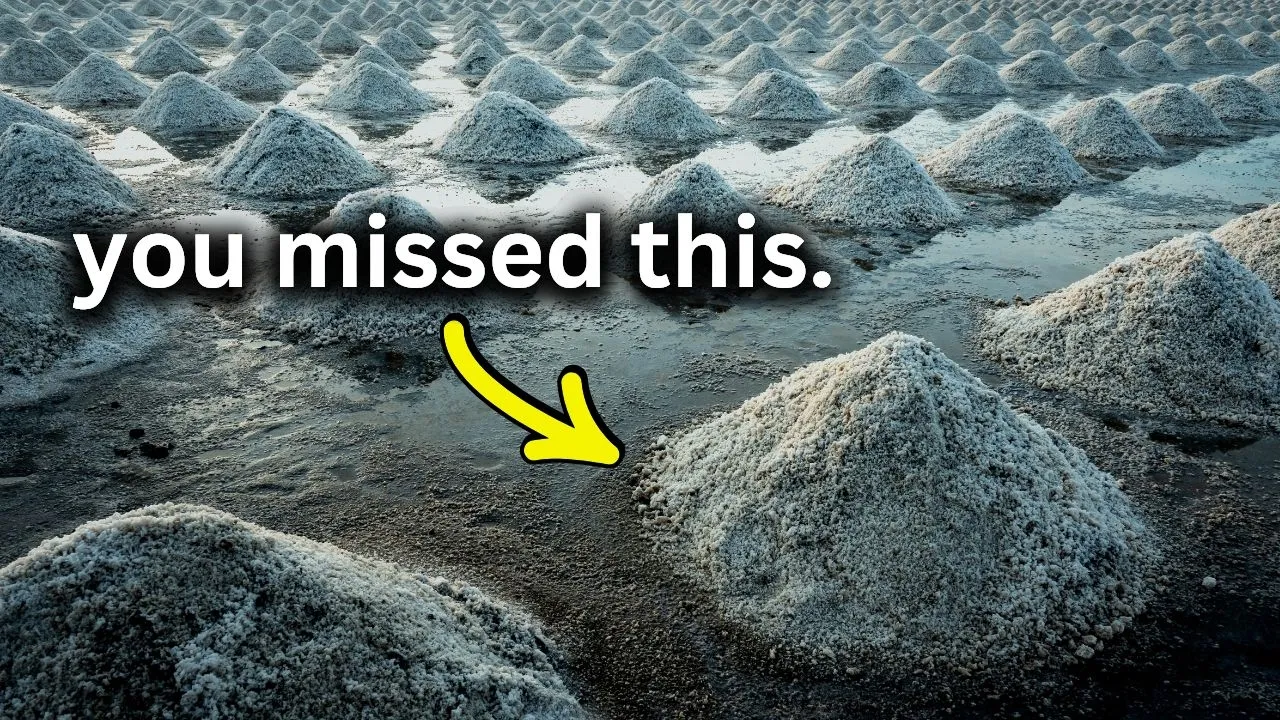
Jesus said, "You are the salt of the earth and the light of the world. " This video explores why we haven't even scratched the surface of the meaning when Jesus said this statement. Salt affects its environment simply by being what it is.
Light also affects its environment not by saying or doing anything, but simply by being what it is. So, if we're going to be salt and light, we have to learn from these two substances. Salt and light are both very different from their environments.
Too often we put our own meanings on Jesus's words instead of what Jesus actually intended his audience to grasp in that cultural context 2,000 years ago. We think that salt is just for flavor or it's a preservative cuz that's what we know. But that's not what Jesus meant.
Luke tells us what Jesus meant. In Luke, Jesus says, "If the salt loses its saltiness, it is no good for either the field or the dungill. " And this tells you exactly what salt was used for in the ancient world.
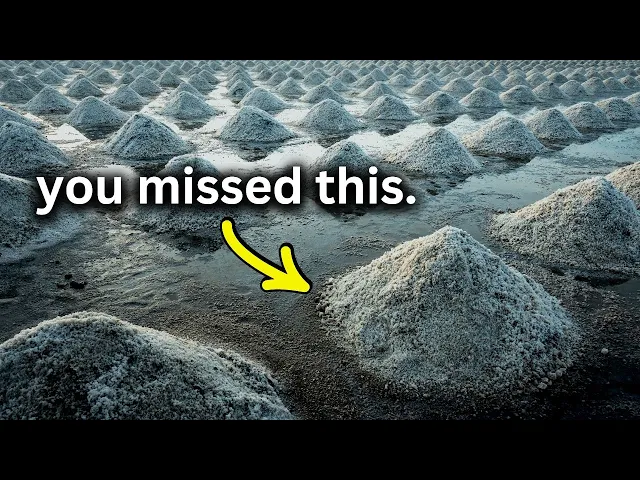
The field and the dungill, it was scraped up from the shores of the Dead Sea, which is 34% salt in solution. Now, it's not pure sodium chloride. It's a mixture of various salts.
There are all kinds of different salts in the Dead Sea. One of the main ones is potassium chloride. If you're a gardener, then you know that every plant needs three kinds of fertilizer.
It needs phosphate to develop the roots. It needs nitrates to develop the leaves. And it needs pottish to develop the flowers and the fruit.
And a balanced fertilizer will include all those three. And so the salt scraped up from the Dead Sea was widely used as a fertilizer because it had these different salts. And the word soil is exactly the same word earth in Matthew.
The salt of the earth. One could read earth as in soil or dirt. So, it could be read that you are the salt of the soil.
The fertilizer is what you put on the soil to make good things grow. Salt equals growth. Salt causes plants and fruit to grow.
And on the flip side, Jesus also mentioned using salt in the dunghill or the manure pile. This second use of salt is something that our modern-day Western society won't understand. Jesus wasn't talking about animal manure.
He was talking about human manure. He's talking about the backyard. They had a heap of dirt at the bottom of the yard.
You went and you emptied your bowels at the bottom of the yard in the dirt and then by the side of the dirt was a box full of salt from the Dead Sea. And you put a handful of that salt on your dirt. And that in fact was a disinfectant.
A very simple disinfectant to stop the spread of things you didn't want to grow. Now those two put together give you a negative and a positive influence of salt. It shows you that it promotes the growth of good things that you wanted to grow and it inhibited the spread of bad things that you didn't want to grow.
It's a vivid picture and Christians are to be the salt of the soil, the salt of the earth. Jesus was always using very familiar pictures from the ordinary life and using them to illustrate profound truth. You are the salt of the earth.
You are the people who will stop bad things growing and spreading and who will promote the growth of good things that are wanted there. And it's as simple as that. In the kitchen, a little sprinkling will do.
A little salt in the soup and that's enough. But as a fertilizer or a disinfectant, you need a considerable amount before the effect shows. You need handfuls in both cases.
A little sprinkling on the soil will not do anything. And therefore the very concept of being salt in society demands a certain proportion of that society being Christian being different being salt. And the simple fact is that we don't have enough salt.
And that is why social trends are going in the wrong way. And there's no way it can be reversed until there's a sufficient amount of salt to do the trick to do what it's designed to do. We need shovels and we haven't got them at the moment.
The second aspect is the aspect not only of amount but of distribution. Salt has no use in the box or in the salt seller. It has got to be in direct contact with the dirt before it operates.
In other words, it operates by presence, not absence. And as long as salt is locked up in a meeting like this or sitting around watching YouTube videos, we can't be the salt of the earth. We physically can't do it because we're out of contact with the dirt.
And third, Jesus talked about salt losing its flavor. Now, how can sodium chloride lose its salty quality? The answer is it can't.
It is a physical impossibility. And yet, it must have happened in Jesus's day for him to be able to talk about it. He said that if salt has lost its flavor, it's good for nothing.
And men throw it in the street and it was trotten underfoot, trotten in the dirt. And that's what happens to dirt in the Middle East. Now, how could salt lose its flavor?
Well, very simply, not by ceasing to be sodium chloride, but by being adulterated with other substances. A clever salt dealer would scrape up plenty of sand with the salt from the Dead Sea shores. And so, a lot of it was not salt at all.
That's why the only way in which salt can lose its saltiness is by having too much other stuff mixed in with it. And so, it loses its quality. And any housewife who has bought adulterated salt that was half sand and half salt would throw it out of the door and into the street and men would walk it back into the dirt from which it came.
Now, the lesson of that is pretty obvious. Christians will only influence the world if they're different from it. Somebody said of the church, "The lifeboat should be in the sea, but when the sea gets in the lifeboat, you're in trouble.
" It also needed to be in direct physical contact with the situation it's going to influence. And in fact, our real situation today is not that we don't have enough salt per se, but that the salt we do have is losing its saltiness very, very rapidly by being adulterated by having too much of the world in it. And now we see that salt can lose its flavor.
Jesus said that if the salt loses its saltiness, there's no way it can be restored. How shall it become salty again? Now, that's important cuz once you lose your saltiness, you can't get it back again.
When an individual Christian loses their reputation, it's almost impossible for them to get it back again. When salt loses its saltiness, how will it be salty again? It's gone for good.
So then what is saltiness? Well, to answer that, we've got to get back to the biatitudes. And when you read those biatitudes properly, they are the exact opposite of the attitudes of the world in which we have to live and move.
Jesus's kingdom is backwards and upside down from the world. If you want to be exalted, you must first humble yourself. If you want your light to shine to the entire world, you've got to seek the father in the secret place.
If you want to throw a grand banquet, don't invite your friends. Don't invite anybody that can pay you back. Instead, invite the poor, the blind, the crippled, and the beggars.
Literally, everything is upside down. The biatitudes are upside down. Everything is backwards.
No wonder the crowd chose Barabus and crucified Jesus because Jesus is the antithesis of this world. Be salt, be light, follow Jesus. So, if you liked this video, I guarantee that you'll love these.
And again, thank you so much to my supporters. God bless.