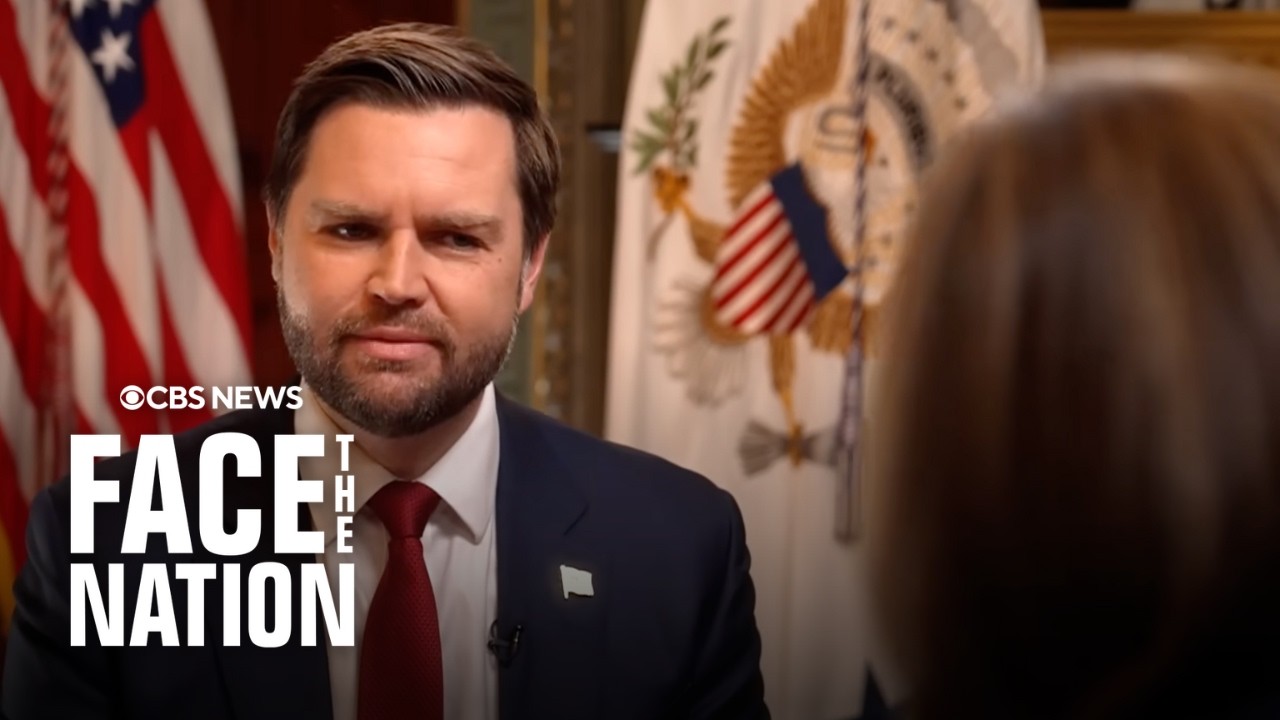
When a journalist tries to corner JD Vance with provoking questions about his past on live TV, he thinks he's in control, but then everything flips in a way no one saw coming. But before we dive in, let me know in the comments where you're watching from. Now picture this: the studio lights were blazing that evening at one of America's most-watched talk shows.
The atmosphere was charged with anticipation as JD Vance, our newly inaugurated Vice President, stepped onto the set, fresh from taking his oath of office. Vance carried himself with the quiet confidence of a man who had nothing to hide and everything to prove. But Marcus Bennett, the show's host, had other plans.
Known for his sharp tongue and liberal bias, Bennett had spent weeks preparing for this moment. His producer had promised a respectful discussion about the new administration, but the glint in Bennett's eyes told a different story. As Vance took his seat, the usual pre-interview pleasantries were rushed, almost mechanical.
Bennett's smile didn't quite reach his eyes, and the production team seemed unusually tense. Something was off, and Vance, with his Marine Corps background, could sense an ambush coming. Years of military training had taught him to read rooms like this, and right now, every instinct was telling him that Bennett had loaded his questions with carefully hidden landmines.
The first question came with a smile, but Vance noticed Bennett's white-knuckled grip on his interview cards. "Mr Vice President," Bennett began, his voice dripping with artificial sweetness, "let's talk about your remarkable journey from Trump critic to his second in command. " Vance smiled, his eyes reflecting the wisdom of someone who'd grown from life's challenges.
"You know, Marcus, that's actually a perfect place to start because it speaks to something bigger than just politics. It speaks to the American capacity for growth and understanding. " The audience leaned forward slightly.
This wasn't the defensive response Bennett had expected. The host shifted in his chair, his prepared follow-up suddenly feeling less potent. "Growth and understanding?
" Bennett's tone carried a hint of mockery. "Is that what we're calling it now? Because some might say it's more about political convenience.
" "You see, Marcus," Vance replied, his voice steady and clear, "in America, we have this incredible tradition of being able to change our minds when presented with new information. When I criticized the President years ago, I was looking at things through a narrow lens. But then I saw something remarkable; I saw how his policies were actually helping the forgotten Americans I wrote about in my book.
" Bennett's expression tightened, almost imperceptibly. "Let me ask you something, Marcus," Vance continued, his gaze direct but not confrontational. "Have you ever changed your mind about something important?
Have you ever looked at evidence and realized your initial judgment might have been wrong? " Bennett's pause was a fraction too long. "We're here to talk about your changes, Mr Vice President, not mine.
" He shuffled his cards, clearly eager to move to his next planned attack. "Speaking of changes, let's discuss your recent speech at the National Prayer Breakfast. You spoke about divine guidance in government decisions.
Don't you think that's a dangerous mixing of church and state? " The audience tensed. Bennett had just stepped onto sacred ground, and the glint in Vance's eyes suggested he'd been waiting for exactly this kind of challenge.
"Divine guidance? " Vance leaned forward slightly, his voice carrying the weight of conviction. "What I actually said was that our founding fathers understood the importance of moral guidance in leadership.
They weren't afraid of faith; they were afraid of tyranny. " A few "amens" echoed from the audience. Bennett's jaw tightened.
"But surely in our modern, diverse society—" Bennett started, but Vance raised his hand slightly. "Let me finish this thought because it's important. " Vance's tone was respectful but firm.
"When I took my oath of office, I placed my hand on the Bible the same way leaders have done throughout our nation's history, not because we're establishing a state religion, but because we understand that our rights come from God, not from government. " Bennett glanced at his producer, who was watching intently from the sidelines. "You know what's interesting, Marcus," Vance continued, his voice carrying a hint of personal reflection, "when I was a Marine, nobody questioned our chaplain's presence.
Nobody complained when we prayed before missions because in those moments of truth, even the skeptics understand there's something deeper than politics. " Bennett's face flushed slightly. "Let's move on to your relationship with President Trump.
Your recent statement about him being God's instrument for America's renewal—don't you think that's a bit extreme? " "What I think is extreme," Vance replied, his calm demeanor unchanged, "is how some in the media seem more concerned about a leader who prays than about policies that hurt American families. " He paused, letting the words sink in.
"But since you brought up President Trump, let's talk about results instead of rhetoric. Let's talk about what's actually happening in our community. " The studio grew remarkably quiet.
Even Bennett's usual rapid-fire interruption style seemed momentarily subdued by Vance's steady presence and measured responses. Bennett's composure started cracking. "Let's talk about your background, Mr Vice President.
You've written about your humble beginnings, but now you're sitting in the halls of power. Some might say you've forgotten where you came from. " "That's interesting, Marcus," Vance replied calmly, "because where I come from, we judge people by their character, not by how well they fit into the Washington elite's expectations.
" "Character? " Bennett scoffed. "Is that what you call this complete reversal on Trump?
You wrote quite passionately against him before. " "Yes, I did," Vance said. "And you know what takes more character?
Admitting when you're wrong. Standing up for what you believe in, even when people like yourself try to twist it into something else. " The audience murmured in agreement.
Bennett tugged at his collar. "Mr Vice President…" "Voice took on an edge of dissension. You've built your reputation on being a voice for working-class Americans, yet here you are in an expensive suit defending a billionaire.
Don't you see the irony? " The temperature in the room seemed to drop 10°. Several audience members shifted uncomfortably, but Vance's expression didn't change; if anything, a slight smile played at the corners of his mouth.
"You know what I see, Marcus? I see someone who thinks an expensive suit can change a man's values. Let me tell you something—these values," Vance touched his heart, "the ones I learned from my grandmother in Middletown, Ohio, they don't change with your ZIP code or your job title.
" Bennett's eyes narrowed. "So you're saying your transformation has nothing to do with political ambition? " "I'm saying, Marcus, that unlike some folks in the media, I don't measure success by how many people I can please.
I measure it by whether I'm staying true to the principles I was raised with. " Bennett shifted uncomfortably in his chair. "So you're saying we should just ignore your past criticisms?
That we should accept that you're now Trump's new—" he paused for effect—"puppet? " The word hung in the air like a thrown gauntlet. Several audience members audibly gasped, but Vance's response came with the steady precision of a master chess player.
"You know, Marcus, that word? It reveals more about you than it does about me. " Vance's voice remained measured but carried an undercurrent of steel.
"In your world, maybe having a strong loyalty to someone you respect is something to mock. But let me tell you what I learned as a Marine. " He leaned forward slightly.
"When you're in combat, you learn to judge a person's character by their actions, not by what the media says about them. I've seen President Trump's character firsthand—not the caricature that you and your colleagues have created. " The audience erupted in applause.
Bennett tried to interrupt, but Vance continued. "You call it being a puppet. I call it recognizing true leadership when I see it.
And yes, I'm proud to serve alongside President Trump. " "But surely—" Bennett pressed, his voice dripping with sarcasm—"a man of your intellectual background must see the contradiction in supporting someone you once criticized. " "There you go again, Marcus," Vance replied calmly.
"You're so focused on trying to find contradictions that you're missing the point entirely. The real contradiction would be ignoring what I've seen with my own eyes just to please critics like yourself. " The applause was now thunderous.
Bennett glanced at his producer, who was making frantic gestures from the sidelines, but Vance wasn't finished. "And since you brought up my intellectual background," he added with a slight smile, "why don't we talk about the intellectual dishonesty I've been seeing in your coverage of this administration? " "My coverage?
" Bennett's voice rose slightly. "We're not here to discuss—" "Oh, but we are," Vance interjected smoothly. "Because just last week, you spent an entire segment questioning my faith, suggesting it was, what did you call it?
Ah yes, 'convenient election season Christianity. '" Bennett's face reddened. "I was merely pointing out the timing.
" "The timing of what, exactly? " Vance leaned forward. "The fact that I've been attending the same church since before I entered politics?
Or maybe you'd like to question my grandmother's faith too? The woman who taught me to pray before every meal, even when we barely had food on the table. " A woman in the front row nodded vigorously.
"That's not what I—" Bennett protested, but his voice lacked conviction. "Let me be clear, Marcus," Vance continued, his voice carrying both strength and dignity. "You can question my politics.
You can disagree with my decisions. But when you start suggesting that my faith is some kind of political prop, you're not just attacking me; you're attacking every American who holds their faith dear to their heart. " Bennett glanced at his notes, clearly searching for safer ground.
"Let's talk about your recent statements. " "Yes, let's talk about statements," Vance agreed. "Like your statement last month suggesting that anyone who supports traditional values is—" and I quote—"living in the past.
" Tell me, Marcus, do you think the millions of Americans who go to church every Sunday, who believe in family values, who love their country, are they all just living in the past? " The silence in the studio was deafening. Bennett's carefully crafted persona was crumbling with each passing moment.
He fumbled with his papers. "Mr Vice President, you're trying to turn this interview around. " "No, Marcus," Vance replied.
"I'm trying to have an honest conversation about the contempt you and your colleagues seem to have for regular Americans. " Vance's tone remained steady. "You invited me here thinking you could shame me for my beliefs, my background, my support for the president.
But let's talk about what really bothers you. " The studio grew quiet, captivated. "It bothers you that someone can come from where I came from and not subscribe to your worldview.
It bothers you that I can be educated at Yale Law School and still believe in traditional values. Most of all, it bothers you that I can see through the game you're playing. " Bennett attempted to regain control.
"Your accusations are—" Vance's expression hardened for the first time. "They're not accusations, Marcus; they're observations. Like how you rolled your eyes when I mentioned prayer earlier or how you mockingly referred to my hometown as 'Trump country' in your show last week.
" The rebuke hit like a thunderclap. The audience sat in stunned silence. "You see, this isn't about politics," Vance continued, his voice firm but controlled.
"This is about respect. Respect for faith. Respect for traditional values.
Respect for the millions of Americans who don't need your approval to love their country or support their president. " Bennett's face had lost all color. He glanced at his producer again, who was now watching the exchange with a mix of concern.
And Fascination! The interview had clearly veered far from their planned ambush. "Perhaps we should move on to.
. . " Bennett began, checking his watch, checking the time.
"Already? " Vance noted with a slight smile. "I noticed you've been doing that ever since we started talking about faith and values—uncomfortable territory for you.
" The audience chuckled; Bennett's discomfort was now plainly visible. "For someone who prides himself on hard-hitting journalism," Vance continued, "you seem remarkably eager to change the subject when the conversation doesn't go your way. " Bennett tried one last attack.
"Is this the same kind of deflection you used when you switched from criticizing Trump to praising him? " "There you go again," Vance replied calmly. "You keep coming back to that, don't you?
Let me ask you something, Marcus: Have you ever changed your mind about someone after getting to know them personally, after seeing their true character instead of relying on media narratives? " An elderly woman in the audience called out, "Tell him, Mr Vice President! You know what the real story is here.
" Marcus, Vance asked, his voice carrying the weight of conviction, "It's not about my past criticisms or my current position; it's about something that terrifies you and your colleagues: the fact that someone can think for themselves, can change their mind based on direct experience, and can stand firm in their beliefs despite relentless media attacks. " Bennett was now visibly sweating. "Mr Vice President, you're twisting my words!
" "No, Marcus," Vance interjected calmly, "I'm just holding up a mirror, and I don't think you like what you see: a journalist who came here hoping to embarrass me but instead exposed his own prejudices. " He turned slightly to address the audience directly. "You see, what Marcus doesn't understand is that real integrity isn't about never changing your mind; it's about having the courage to admit when you were wrong, even when people like him are waiting to pounce on you for it.
" The audience erupted in their loudest applause yet; even some of the production crew were nodding. "When I first met President Trump, I had a choice," Vance continued, his voice carrying quiet authority. "I could either stick to my preconceptions or I could judge him by his actions and his genuine love for this country.
I chose truth over pride, and that's something your network might want to try sometime. " Bennett glanced desperately at his producer, who was now making a slashing motion across his throat—the universal signal to wrap it up. "And you know what else, Marcus?
The American people are tired. They're tired of being looked down upon for their faith; they're tired of being mocked for their values. Most of all, they're tired of journalists who think their job is to tell people what to think instead of reporting the truth.
" The entire studio audience was now on their feet; Bennett's attempts to speak were drowned out by thunderous applause. His carefully orchestrated ambush had backfired spectacularly. Bennett cleared his throat, his demeanor completely deflated.
"Well, I think we're about out of time. " "Yes, I believe we are," Vance agreed, rising from his chair. "But before I go, I'd like to say one last thing to the American people watching at home.
" He turned to face the camera directly, his expression sincere and resolute. "What you've witnessed today isn't just about one interview or one journalist's attempt to discredit me; it's about something much more important. It's about standing firm in your convictions.
" The studio was absolutely silent now, hanging on his every word. "You see, they thought they could shame me for my faith; they thought they could mock my support for President Trump; they thought they could make me apologize for believing in traditional values. But here's what they don't understand: these aren't just political positions; these are the principles that built America, the values that sustained us through hard times, and the truths that will guide us forward.
" Vance straightened his tie, standing tall. "To every American who's been ridiculed for their faith, who's been mocked for their values, who's been told they're on the wrong side of history: stand strong! Because at the end of the day, character isn't about winning the approval of critics; it's about staying true to what you believe in.
" As Vance walked off the set, the audience rose in a standing ovation that seemed to shake the studio. Bennett sat in stunned silence, his carefully planned ambush thoroughly dismantled by a display of unwavering principle and quiet strength. And that proves one thing: sometimes the best response to arrogance is dignity, and the strongest answer to bias is truth.
If you enjoyed this story about standing firm in your beliefs, make sure to like and subscribe. And remember, faith, family, and freedom aren't just words; they're the foundation of everything we hold dear. God bless you, and God bless America!