hello in this lecture we shall look at the sources of international law the lack of structure in international law when contrasted with domestic law is evident and has been noted in an earlier lecture there is no single body able to create laws internation Ally binding upon everyone nor a proper system of Courts with Comprehensive and compulsory jurisdiction to interpret and extend the law so where is the law to be found and how can one tell whether a particular proposition amounts to a legal rule the problem is underlined because of the anarchic nature of world defers
and the Clash of competing sovereignties nevertheless international law does exist and is ascertainable there are are sources available from which the rules may be extracted and analyzed article 38 one of the statute of the international court of justice is widely recognized as the most authoritative and complete statement as to the sources of international law it refers to International conventions whether general or particular establishing rules expressly recognized by the contesting States International custom as evidence of a general practice accepted as law the general principles of law recognized by civilized Nations and subject to the provisions of
article 59 judicial decisions and the teachings of the most highly qualified publicists of the various Nations as subsidiary means for the determination of rules of law this provision expresses the universal perception as to the enumeration of sources of international law we should look at each of them in turn in any society certain rules of behavior emerge and prescribe what is permitted and what is not as the community develops it will modernize its code of behavior by the creation of legal machiner such as courts and legislature custom for this is how the original process can be
described remains and may also continue to evolve custom within contemporary legal systems particularly in the developed world is relatively cumbersome and often of only nostalgic value in international law on the other hand it is a dynamic source of law in the light of the nature of the International System and its lack of centralized government organs the existence of customary rules can be deduced used from the practice and behavior of states and this is where the problems begin how can one tell when a particular line of action adopted by a state reflects a legal rule or
is merely prompted by for example courtesy indeed how can one discover what precisely a state is doing or why since there is no living state but rather thousands of officials in schores of departments exercising a variety of governmental functions other issues concern the speed of creation of new rules and the effect of protests there are disagreements as to the value of a customary system in international law some writers deny that custom can be significant today as a source of law noting that it is too clumsy and slow moving to accommodate the evolution of international the
law anymore While others declare that it is a dynamic process of law creation and more important than treaties say it is of universal application the essence of custom according to article 38 is it that is that it should constitute evidence of a general practice accepted as law thus it is possible to see two basic elements in the makeup of a custom first the material fact that is the actual behavior of states and secondly the psychological or subjective belief that such behavior is law this is called the opino Urus as the international court of justice noted
in the Libya Malta case the substance of customary law must be looked for primarily in the actual practice and opino Urus of States much help now can be obtained from the draft conclusions on identification of customary law adopted by the UN international law Commission in 2018 we shall look at each of these in turn there are a number of points to be considered concerning the nature of a particular practice by States these include its duration consistency repetition and generality as far as duration is concerned most countries specify a recognized time scale for the acceptance of
a practice as a customary rule within their municipal or domestic systems this can vary from time immemorial in the English common law dating back to 1189 to figures from 30 or 40 years on the continent of Europe in international law there is no rigid time element and it will depend upon the circumstances of the case and the nature of the usage in question in certain Fields such as air and space law the rules have developed quickly in others the process is much slower duration is thus not the most important of the components of State practice
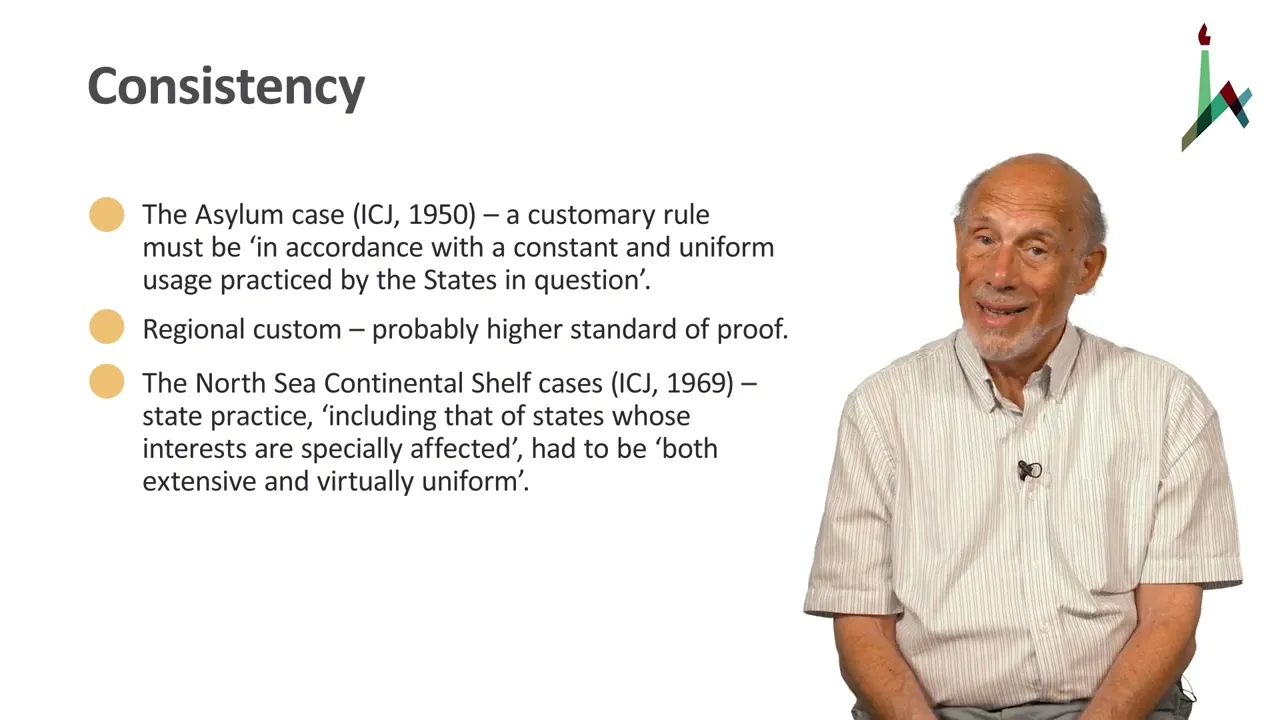
the essence of custom is to be sought elsewhere the basic rule as regards continuity and repetition was laid down in the Asylum case decided by the international court of justice in 1950 the court declared that a customary rule must be in accordance with a constant and uniform usage practiced by the states in question the case concerned haa deore a Peruvian who was sought by his Government after an unsuccessful Revolt it was granted Asylum by Colombia in its Embassy in Lima but Peru refused to issue a safe conduct to permit delator to leave the country Colombia
brought the matter before the international court and requested a decision recognizing that it Colombia was competent to Define dore's offense as to whether it was criminal as Peru maintained or political in which case Asylum and a safe conduct could be allowed the court in characterizing the nature of a customary rule held that it had to constitute the expression of a right pertaining to one country Colombia and a duty incumbent upon another Peru however the court felt that in this case State practices had been so uncertain and contradictory as not to amount to a constant and
uniform usage regarding the unilateral qualification of the offensive question the issue involved here dealt with a regional custom pertaining only to Latin America and it may be argued that the same approach need not necessarily be followed where a general custom is alleged alleged and that in the latter case a lower standard of proof would be upheld in the North Sea continental shelf cases in 1969 which involved a dispute between Germany in the one hand and the Netherlands and Denmark on the other over the delimitation of the continental shelf the international C Court remarked that state
practice including that of States whose interests are specially affected had to be both extensive and virtually uniform in the sense of the provision invoked this was held to be indispensable to the formation of a new rule of customer international law however the court emphasized in the Nicaragua and United States case in 1986 that it was not necessary that the practice in question had to be in absolutely rigorous Conformity with the purported rule the court continued in order to deduce the existence of customary rules the court deemed is it sufficient that the conduct of States should
in general be consistent with such rules and that instances of State conduct inconsistent with a given rule should generally have been treated as breaches of that rule not as indications of the recognition of a new rule the threshold that needs to be attained before a legally binding custom can be created will depend both upon the nature of the the alleged Rule and the opposition it arouses this partly relates to the problem of ambiguity where it is not possible to the point to the alleged custom with any degree of clarity as in the Asylum case where
a variety of conflicting and contradictory evidence have been brought forward another relevant factor is the strength of the prior rule which is purportedly overthrown for example the customary law relating to a state sovereignty over its Aerospace developed very quickly in the Years immediately before and during the first world war similarly the principle of non sovereignty over the space route followed by artificial satellites came into being very soon after the launching of the first Sputnik it was argued that in such circumstances repetition is not at all necessary provid Ed that the opino Urus could be clearly
established thus instant customy law is possible it is inevitable that customs should to some extent mirror the perceptions of the majority of States since it is based upon usages which are practiced by Nations as they express their power and their hopes and their fears but it is inescapable that some states are more influential and powerful than others and that their activity should be regarded as of Greater significance this is reflected in international law so that custom may be created by a few States provided those states are intimately connected with the issue at hand whether because
of their wealth and power or because of their special relationship with a subject matter of the practice for example Maritime States and the law of the sea law cannot be divorced from politics or power and this is one instance of that proposition thus for a custom to be accepted and recognized it must have the concurrence of the major powers in that particular field a regulation regarding the breadth of the territorial sea is unlikely to be treated as law if the great Maritime Nations do not agree to or acques in it no matter how many landlocked
States demand it other countries May propose ideas and Institute pressure but without the concurrence of those most interested it cannot amount to a new rule of customary law accordingly the duration and generality of a practice may take second place to the relative importance of the states forming the new customary rule in any given field universality is not required but some correlation with power is some degree of continuity must be maintained but this again depends upon the context of operation and the nature of the usage it is how States behave in practice that forms the basis
of customary law but the evidence of what a state does can be obtained from numerous sources obvious examples include government decisions administrative acts legislation decisions of Courts and activities on the international stage for example treaty making a state is not a living entity as such but rather consists of governmental departments and thousands of officials and state activity is spread through a whole range of national organs International organizations may also be instrumental in the creation of customary law for example The Advisory opinion of the international court of justice declaring that the United Nations possessed International legal
personality was partly based on the actual behavior of the UN and the international court has also noted that evidence of the existence of rules and principles may be found in resolutions adopted by the general assembly and the security Council of the United Nations once one has established the existence of the material fact the specified usage it becomes necessary to consider how the state views its own behavior is it to be regarded as a moral or political or a legal act or statement the opinion Urus or belief that a state activity is legally obligatory is the
factor which turns the usage into a custom system and renders it part of the rules of international law to put it slightly differently States will behave in a certain way because they are convinced it is binding upon them to do so the permanent Court of international Justice expressed this point of view when it dealt with the Lotus case in 1927 this concerned a collision on the high seas where international law applies between the Lotus a French ship and the BOS Court a Turkish ship several people aboard the latter ship were drowned and turkey alleged negligence
by the French officer of the watch when the Lotus reached Istanbul the French officer was arrested on a charge of manslaughter and the case turned on whether turkey had the jurisdiction to try him among the various arguments that were put forward the French maintained that there existed a role of customary law to the effect that the flag state of the accused France had exclusive jurisdiction in such cases and accordingly the national state of the victim turkey was barred from trying him to justify this France referred to the absence of previous Criminal prosecutions by such States
in similar situations and from this deduced tacit consent in the practice which therefore became a legal custody the court rejected this and declared that even if such a practice of exstension from instituting criminal proceedings could be proved in fact it would not amount to a custom it held that only if such abstention were based on their the states being conscious of the duty to abstain would have be possible to speak of an international custom thus the essential a ingredient of obligation was lacking and the practice remained a practice nothing more a similar approach occurred in
the North Sea continental shelf cases in the general process of delimiting the continental shelf of the North Sea in pursuance of O and gas exploration lines were drawn dividing the whole area into National spheres however West Germany could not agree with either Holland or Denmark over the respective boundary lines and the matter came before the international Court the Court held that the principle of equidistance enshrined in article six of the Geneva Convention on the continental shelf of 1958 to which Germany was not a party did not reflect an already existing custom the issue then turned
on whether practice subsequent to the convention had created a customary rule the court answered in the negative and declared that although time was not of itself a decisive Factor only three years had elapsed before the proceedings were brought an indispensable requirement would be that within the period in question short though it may be State practice including that of States whose interests are especially affected should have been both extensive and virtually uniform in the sense of the provision invoked and should morever have occurred in such a way as to show a general recognition that a rule
of law or legal obligation is involved this approach was reaffirmed by the court in the Nicaragua case uh 1986 and in Germany against Italy in 2012 it is thus clear that the court has adopted and maintained a high threshold with regard to the explicit demonstration of the subjective constituent of customary law formation Confluence of practice in itself is not enough the great problem connected with the psychological element the opino Urus is that it calls for behavior in accordance with the law but in that case how can new customary rules be created since that obviously requires
action different from or country to what until then had been regarded as law if a country claims a three M territorial sea in the belief that this is legal how can the rule be changed in customary law to allow claims of for example 12 miles since that cannot also be in accordance with prevailing law one has to treat the matter in terms of a process whereby States behavi behave in a certain way in the belief that such behavior is law or is becoming law it will then depend upon how other states react as to whether
this process of legislation is accepted or rejected it follows that rigid definitions as to legality have to be modified to see whether the legitimating stamp of State activity can be provided or not if a state proclaims a 12 mile limit to its territorial sea in the belief that although the 3M limit has been accepted law the circumstances are so changing that a 12m limit may now be treated as becoming law it is Vindicated if other states follow suit and the new rule of customary law is established if other states reject the proposition then the the
projected rule Withers away and the original rule stands reinforced by state practice and common acceptance customy law is thus established by virtue of a pattern of claim absence of protest by States particularly interested in the matter at hand and acquiescence by other states together with related Notions such as recognition Admissions and EST exle such conduct or abstinence from conduct forms part of a complex framework within which legal principles are created and deemed applicable to states it is however possible for rules to develop which will bind only a set group of states such as those in
Latin America or indeed just two states in the Asylum case for example the international court of justice discussed the Colombian claim of a regional or a local custom peculiar to the Latin American states which would validate his position over the granting of Asylum the court declared that the party which relies on a custom of this kind must prove that this custom is established in such a manner that it has become binding on the other party it found that such a custom could not be proved because of Uncertain and contradictory evidence in such cases the standard
of proof required especially as regards the obligation accepted by the party against whom the local custom is maintained is higher than in cases where an ordinary or a general custom is alleged in the right of passage over Indian Territory case Portugal claimed that there existed a right of of Passage over Indian Territory as between Portuguese enclaves within geographical India and this was appell by the international Court over India's objections that no local custom could be established between only two states Court was declared that it was satisfied that there had in the past existed a constant
and uniform practice allowing free passage and that the practice was accepted as law by the parties and had given rise to a right and a co-relative obligation more generally the court stated that where therefore the court finds a practice clearly established between St between two states which was accepted by the parties as governing the relations between them the court must attribute decisive effect to that practice for the purpose of determining their specific specific rights and obligations such a particular practice must Prevail over any general rules such local Customs therefore depend upon a particular activity by
one state being accepted by the other state or States as an expression of a legal obligation or right while in the case of a general customary rule the process of consensus is at work so that a majority or a substantial minority of interested States may be sufficient to create a new custom a local custom needs the positive acceptance of both or all parties to the rule we shall take a break at this point