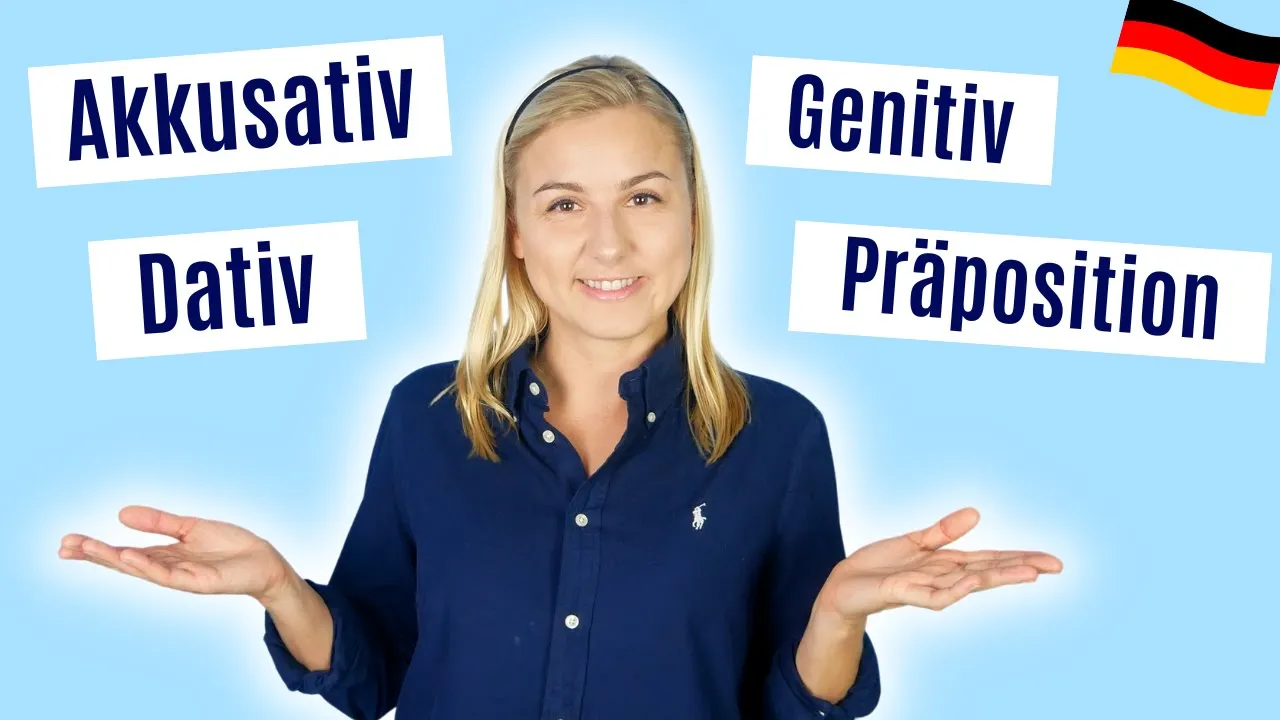
Who or what? Who or what? Whom?
Whose? Hello and welcome to the Lingster Academy! I'm your German teacher Julia and today we're looking at a particularly important grammar topic: Objects.
Along with the predicate and the subject, they are the 3rd of 5 functions in the sentence. I explained the other two topics in the last videos. So, you definitely know the accusative object, because that's the most common.
E. g. Kai has a day off.
Who/what does Kai have? a free day. His girlfriend is planning a trip.
Who/what is his girlfriend planning? a trip You've also often heard of the dative object: The boss helps his employee. Who does the boss help ?
his employee. He congratulates him on his success. Who does he congratulate on their success?
Him genitive objects are extremely rare, you don't need them at first, but here's an example: The victim accuses the person of robbery. What does the victim accuse the person of? of robbery The genitive that you otherwise know is an attribute, i.
e. the teacher's book, my father's car, etc. You will learn that in the 5th function or up here.
And what about prepositional objects? They are everywhere, here are a few examples: Kai is looking forward to the vacation. What is he looking forward to?
on vacation. His girlfriend talks about the planning. What is she talking about?
from planning Attention: This is grammatically different than adverbials, because the questions are different: Kai is on vacation. Where is Kai? On holiday.
Adverbials are the 4th function, you'll learn them in the next video. So that you have a good overview of everything, get the free learning package that I made for you. In it you will find all kinds of rules, phrases, German vocabulary and lots of exercises.
The link is below this video. So, back to the topic: whether a sentence needs an object or not is determined by the verb. Look: Thomas is sleeping.
Is that a sentence? Yes. Felix is working.
Is that a sentence? Yes. The computer works.
Is that a sentence? Yes. And this one: Thomas has.
Felix needs. The computer does. Hmm, something's weird here, isn't it?
Naturally! There is no information here! You want to know, what's wrong with Thomas?
What does Felix need and what does the computer do? And this is where objects come into play: Thomas has a comfortable sofa. Felix needs a new screen.
and The computer is making strange noises. Now the sentences are complete. What does that mean?
A verb needs an object or not, you usually know that when you look at the verb, because it probably works similarly in your native language. The last three examples were verbs with an accusative object, which is the most common object. The question is always and ONLY who/what?
- Who kind of people, what kind of things. Again: Always look for the predicate in the sentence first, i. e.
the verb, then the subject with the question Who/What? and only then do you look for objects. Why?
The question “What? ” can be for subjects and objects and because the German language has a flexible sentence structure, this can easily be confused. In principle, there is a subject in every sentence, but not an accusative object in every sentence.
Therefore again: predicate, subject, object. OK? Next, let's look at the dative object.
Question: Is that a sentence? Steffi congratulates. or: Alexander thanks.
Hmm, not without context, because you ask yourself: Who is Steffi congratulating? Who does Alexander thank? Steffi congratulates her friend and Alexander thanks his mom.
The question again, are these sentences? Steffi congratulates her coffee. Alexander thanks his window.
Huh? Ok, grammatically they are correct, but do they make sense? Of course not, but why?
the coffee and the window are not people. And the question for the dative object is always and ONLY Whom? Not who or what?
Dative objects are mainly for people or animals. There are of course a few exceptions, e. g.
B. Smoking is harmful to health, but these are very few. We use around 40 dative verbs, which is very few compared to the verbs with accusative objects.
You can find the list in my free learning package in the description under this video. By the way: There are verbs that need both objects: I'm giving you a learning package. Let's analyze this: Predicate: give - Who/What gives?
I, that is the subject. Who/what do I give as a gift? a learning package, that is the accusative object And who do I give a learning package to?
you! This is the dative object. Again, if the object can be a person or a thing, it is probably an accusative object, but if it can only be a person or an animal, it is probably a dative object.
Huh, good right? Very briefly about the genitive object: The question is whose + verb? Who does Paul remember?
Paul remembers his late grandfather. The verbs “commemorate, accuse, need” need genitive objects, but these are C-level verbs and they are rarely used, so they are not as important to you as the other three objects. The question “Whose?
” you can also ask for the genitive attribute: whose jacket is that? This is my sister's jacket. Whose car is in front of my garage?
My friend's car. After the noun there is the genitive, these are combinations of nouns and have absolutely nothing to do with genitive objects, okay? And finally we come to an object that you will find in a lot of sentences but have probably never identified as an object.
Even in the German course, this is not so clearly defined as an object. But you are here at the Lingster Academy and I am a linguist, so you will now learn this topic in detail: Take a look at this example: Michael is waiting for the bus. What are we asking here?
What is Michael waiting for ? In colloquial language people also ask: What is Michael waiting for? Many people therefore think that this is an accusative object, but it is not.
For the accusative object you always and ONLY ask “who or what? ” But here we ask “on what? ” And because "on" is a preposition, "on the bus" is a prepositional object.
Next example: Michael is waiting for his girlfriend. Because his girlfriend is human, we don't ask "what for? " but rather "Who is Michael waiting for?
" to his girlfriend. If you don't know what or who Michael is waiting for, first ask "What are you waiting for? " But if you know that Michael is waiting for someone, you ask “Who are you waiting for?
” OK? Next example: The employees discuss it. What do you think when you see this sentence?
What question do you want to ask to get more information? What are the employees discussing? about the project plan Petra is looking forward to it.
What is she looking forward to? on your wedding. I thank you for that!
What are you thanking for? for the flowers Michael is annoyed about the bad weather. What is he angry about?
Michael is annoyed with his little brother about the bad weather . Danger! The little brother is a human being, so: Who is Michael angry with?
about his little brother What do you conclude from these examples? Prepositional objects only exist when a verb needs a preposition, e. g.
E. g. thinking about something/someone, fighting for something/someone, depending on something/someone, complaining to someone, asking about something, etc.
Attention, important: What are you waiting for and Where are you waiting? are grammatically two completely different topics, look at the possible answers: I'm waiting for the bus, for food, for my son, for better weather and for a higher salary. Where are you waiting?
on the bus, on the sofa, next to the building, under the table and between the two cars. Do you see the difference? Take a closer look!
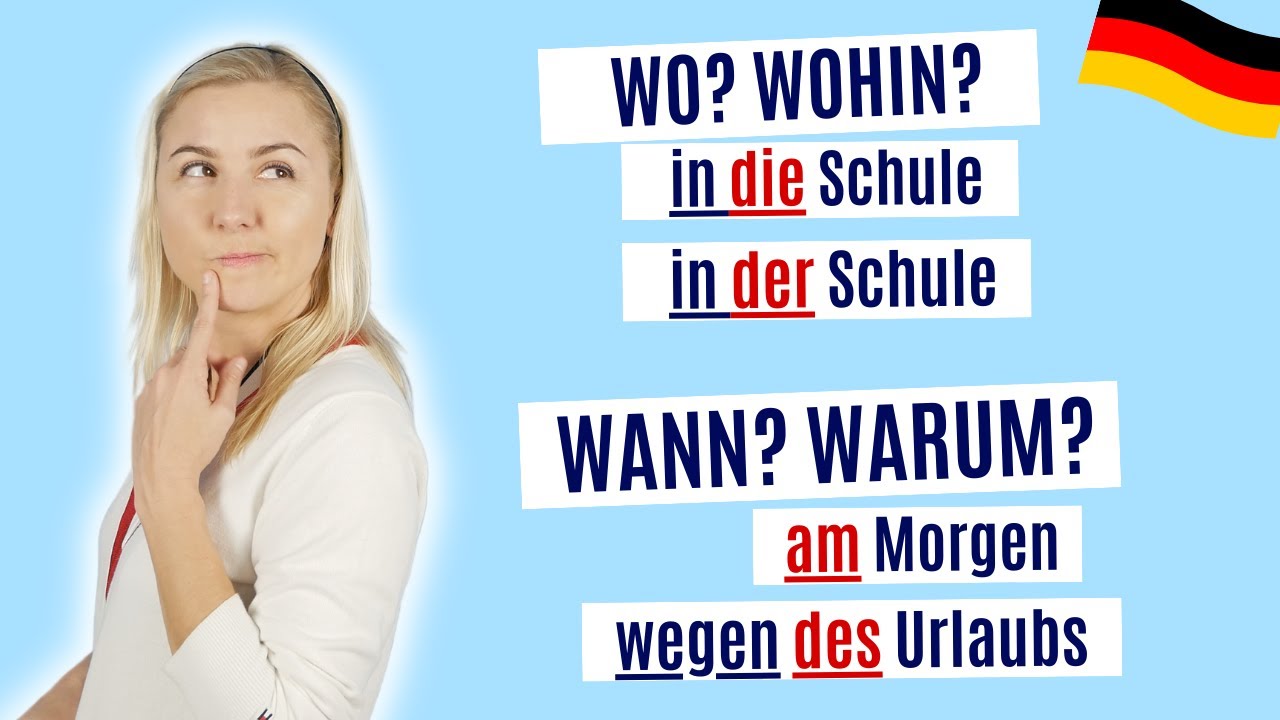
A prepositional object is a verb with a specific preposition. But an adverbial can have many prepositions because it is about a place. Prepositional objects answer questions like “What about?
” By which? For what? Where?
Etc. " But adverbials answer questions like “Where? When?
Why? How? Where?
" But both topics have in common that prepositions as individual words need a certain case, e. g. B.
the accusative, the dative or the genitive. Don't worry, you'll learn this topic in detail in the next video! And that's it for today!
If you enjoyed the video and learned something , subscribe to my channel now. I say goodbye, see you next time!