- You guys, I am so excited. This video is the first video I'm publishing after hitting 100K. And I just wanna take a minute to say thank you so much.
Honestly, I have been dreaming of this moment since I started my YouTube channel. It took me over two years to get here. I started my channel on February 13, 2019.
And on June 15, 2021, I finally hit 100K. I couldn't have done it without you. So thank you, thank you, thank you for your support, for watching my videos time and time again, for all your incredible comments and suggestions that you leave below.
I am really excited for the next year. Two years spending with you here on my YouTube channel, I can only, only tell you that it'll get better. I am constantly learning, improving, taking your feedback.
And I have a lot of exciting stuff planned for you ahead. (upbeat music) Wanna write killer e-commerce copy that gets you more attention, more customers, and more money? Of course you do.
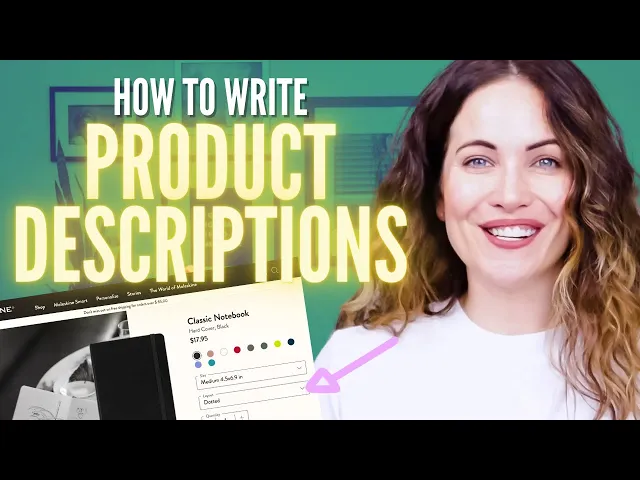
Here are five tips for product descriptions that sell like crazy. Alright, let's do a pop quiz, shall we? When was the last time you purchased something online?
(clock ticking loudly) Yeah, if you're like most people, it was probably sometime within the last week or so and more likely sometime in the last couple of days. In fact, it's estimated that 2. 14 billion people are online shoppers.
That's one out of every four of us. And that number is only expected to keep rising. Collectively, we spend trillions of dollars, with a T, trillion online every single year and buy things online every single second of every single day.
Okay, now, think about the process you go through to purchase a product online. It probably goes a little something like this. Step one, you found out about a product somehow, whether through an ad, or an email, or you heard about it, or you have a need that you need solved so you browsed around, read product descriptions and customer reviews, and made a short list of your top options.
And then step two, you decided on the one you actually wanted to buy based on those product descriptions and reviews. Am I right? With the e-commerce industry growing at such a rapid speed, more and more online stores are popping up to cash in on the action, reach a larger customer base, and scale their growth and revenue, which can only mean one thing.
The competition is fierce. So fierce, in fact, that 81% of people spend time researching and browsing products online before they actually make the decision to buy. So it goes without saying that if you want your products to stand out in the severely oversaturated market, then you need to make sure that your product descriptions are doing more than, well, describing your product.
I know, crazy right? Gone are the days of simply writing descriptions that ramble off a bunch of features and describe the product specifications. If you wanna stand out, then your copy needs to go deeper than the mundane, need to know, left-brain kind of stuff.
So in this video, I'm gonna cover the five things that all product descriptions must include to take your copy from crappy to snappy. Hey guys, what's up, It's Alex. This video has been requested by the posse quite a few times over the last several months, and I want you to know that I hear you.
I really do write down every single one of your suggestions, so keep them coming and make sure you give me a thumbs up below if you've been waiting for this one. And if you're new around here, welcome. I put out a new marketing, copywriting, or freelancing tutorial every single week.
So if you wanna learn the hottest strategies, tips, and techniques that are working in the industry today, then go ahead and subscribe below. And don't forget to hit that bell to be notified when my next video goes live. Alright, now, when it comes to e-commerce entrepreneurs, there's a pretty big misconception that copywriting actually comes secondary to product imagery and demonstration.
Now, don't get me wrong, those are both hugely important, but by half-assing your copy, you're missing out on a huge opportunity to boost conversions. So here are the five things you need to do for product descriptions that don't suck. Number one, address your avatar's needs and desires.
It's marketing 101, knowing your customer avatar will always, always, always be one of the most important things you can do as a copywriter or a business owner. Whether you're writing ads, emails, or product descriptions, you need to know who your ideal customer is, what they want, how they like to be spoken to, and what types of messages really resonate with them. Do they wanna know all the information or just the necessities?
Do they want a little sass and humor or are they more direct and to the point? Painting a crystal clear picture of who your customer avatar is, and writing your product descriptions as if you're speaking directly to them is one of the biggest tricks in writing copy that converts like crazy. So let's look at these two examples for Birkenstock sandals.
This one directly from the Birkenstock website is honestly pretty dry, lacking personality, and very to the point. If Birkenstock knows their customer avatar, they aren't doing a great job of speaking directly to them versus this product description for the exact same sandal being sold through Goop's e-commerce site. Goop is communicating pretty much the same things but in a way that is way more relatable to their customer avatar, especially this line.
And unlike their suede leather cousins, you can take them to the pool, or the beach, or the lake without worrying about ruining them. Here, they are speaking directly to one of their customer's key concerns. Alright, number two is bennies over features.
So after you know how to talk to your audience, you need to decide which features and bennies, AKA benefits you want to include in the product description. And the answer, of course, is to not talk about anything and everything. When writing product descriptions, you don't have a lot of space to work with, so that means you really need to put your copywriter cap on and narrow in on those features that are the most compelling to your audience.
These are the things that make your product unique, help you stand apart from the competition, and make your customer think, "Ooh, I have to have this. " Now, the best way to do this, of course, is to talk about bennies, not features. As a general rule, most shoppers don't really care about what the product is.
They care about how it can help them, what problem it solves, and what they'll get from it. And that goes for e-commerce products too. Remember, most e-commerce product pages have an entire section that includes the specifications, and that is where you can include all of the need to know features and details of the product.
But make sure that the main product description is as juicy as possible. So here's a really great example from Lunya. Not only do they correctly call out that mental conflict that some women feel when it comes to feeling comfortable or feeling sexy, they also give relatable meaning behind each of their core features.
So for example, thermoregulating, so you can maintain a comfortable body temperature. Machine-washable, so you can throw it in the machine and forget about it. Pockets for all the essentials and an adjustable T-back for a perfect fit every time.
I love those features turned into bennies. So if you need help turning features into benefits, you can grab a copy of my Feature-To-Benefit Converter down at the link in the description box below. Alright, number three, captivate with a killer hook.
In the words of advertising tycoon, David Ogilvy, "Nobody was ever bored into buying a product. " And he's right. And I see boring product descriptions everywhere I look, like here, and here, and here, you get the point.
Now, I'm not picking on these products specifically, to me it's the way Amazon descriptions are set up. It just doesn't make any sense. They feature all the boring stuff up at the top.
And then to see the copy that's actually any good, you have to scroll all the way to the bottom, past all of these other products vying for your customer's attention, and of course, drastically hurting your chances of conversion. I just don't get it. In this example, you can clearly see the difference between the copy that's at the top versus the copy that's lower on the page.
It's a cocktail table. It's a cooler, it's a coffee table. You'll be the envy of all your guests.
Discover the freedom of easy entertaining. The Cool Bar is a cooler, cocktail table and coffee table all in one, your ultimate 3-in-1 backyard, garden and patio accessory. Now, that is a great hook.
So really going the extra mile to make sure your product descriptions lead with a captivating and engaging hook can make all the difference in a customer choosing you instead of your competition. Remember, you want your customers to feel like you understand what they need and that your product is the solution they've been looking for. Alright, number four, declutter.
So when it comes to product descriptions, less is more, like in most copywriting. No matter how captivating your copy is, most people just won't take the time to read a lengthy description. Instead, they will scan through the information and make a quick decision if the product is a good fit for them or not.
So because of this, it's really important to not just keep the length of your copy short but to also consider formatting and readability. So break up your descriptions into easy-to-read sections, bullet points or paragraphs. And of course, when it comes to copywriting in general, run-on sentences and long paragraphs are always a big no-no, and product descriptions are no different.
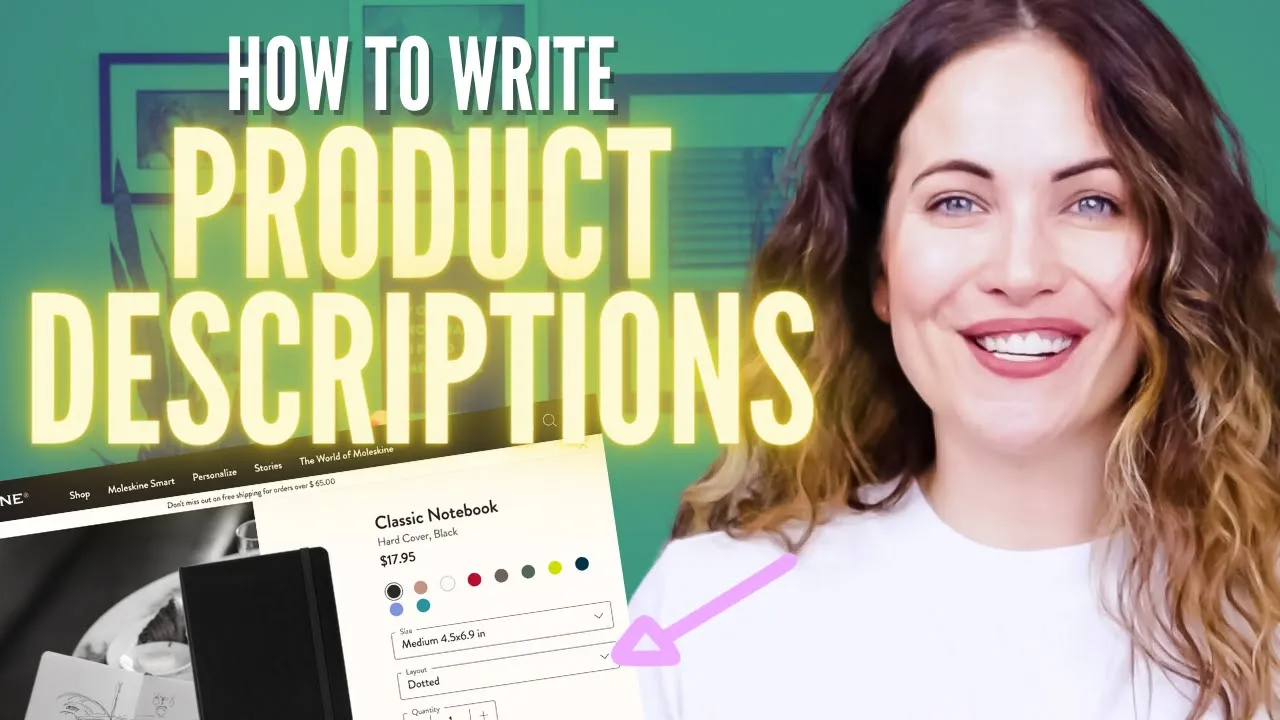
So take this example for Moleskine. They have the main product description here in larger font, and this is where they're really doing the selling, by speaking to your emotional wants, desires, and needs. Who would have thought that I had an emotional need for a notebook?
I mean, don't we all? (laughs loudly) And over there on the left, they've included all the product specifications that a consumer might need to know but in a way that doesn't distract and it's easy to read and skim. And I cannot stress this enough, but makes sure your copy is optimized for mobile.
The formatting might look great on desktop but how does it look on your mobile device? Remember that the vast majority of all e-commerce purchases are made on mobile devices. Alright, and lastly, number five, end with keywords.
Now, I've said this before, I am not an SEO expert, but no e-commerce product is complete without including at least some keywords to increase the chances of it showing up in the search engines. So after I've written my product description and features, I then go through and add in a few relevant keywords, where it makes the most sense. Now, a word of caution on this, you don't wanna overdo it with keywords.
Again, just like in anything you write, it's important to include them strategically, but what's even more important is that your title and description makes sense. Never sacrifice quality, or readability, or compelling copy just for extra keywords. So use them, but use them wisely.
Alright, now, here is a recap of my five copywriting tips for writing killer product descriptions. And if you need help remembering, just remember your A, B, C, D, Es. Always address your customer avatar, bennies over features, captivate with a compelling hook, declutter and end with keywords.
Alright, guys, I hope you enjoy this video. If you have any more video suggestions for me, go ahead and leave them in the comment box below. Until next time, I'm Alex, ciao for now.
(upbeat music) Alright, guys, if you enjoyed that video, make sure to check out the next one from me right here. And you can click right here to get a free gift. So get this, 80% of online readers will not read past your headline, which is why your headlines are the single most important part of any copy you write.
So what makes a great headline? I thought you would never ask. Keep watching as I critique nine headlines live.