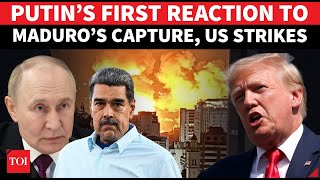
In the last 72 hours, Putin, Trump, and the seizure of Maduro have collided in a way that's reshaping global power calculations. What followed was not outrage or theatrics, but a new threat designed to change how Washington thinks about unilateral action. This isn't about Venezuela alone.
It's about precedent, deterrence, and the hidden costs of forcing outcomes. And once those costs start accumulating, they don't stop where the operation began. Tonight, we are not talking about spectacle, personalities, or headlines designed to provoke emotion.
We are talking about structure, power, and the quiet mechanics of coercion that operate beneath public diplomacy. Because what followed the seizure of Nicholas Maduro was not a reaction driven by anger, nor was it an impulsive display of bravado from the Kremlin. It was something far more calculated.
When Vladimir Putin issued a new threat to Donald Trump after Maduro was taken, the message was not primarily meant for Washington's press corps, nor even for Trump himself. It was aimed at every state that still believes alliances, guarantees, and red lines retain meaning in a system increasingly defined by unilateral action. To understand why this moment matters, you have to step back from the dramatic framing and look at how Russia interprets credibility, humiliation, and deterrence.
From Moscow's perspective, the seizure of Maduro was not simply an intervention in Latin America. It was an implicit test of Russia's ability to protect partners beyond its immediate periphery. For years, Russia has sold itself to the global south as a counterweight to American dominance, a power willing to offer security cooperation without political conditions.
That narrative only works if Russia's guarantees are perceived as real. The moment Maduro was removed without resistance, that narrative came under direct threat. Putin's response, therefore, was not about Venezuela alone.
It was about restoring the credibility of Russian power in the eyes of observers who matter far more than Washington's critics do. The threat issued to Trump was a signal that Russia would not allow this episode to become precedent. Precedent is what great powers fear most because once an action is normalized, it becomes expectation and expectation shapes behavior across the international system.
What made this situation especially volatile was not the seizure itself, but the speed with which it unfolded and the silence that preceded it. In strategic studies, silence is rarely neutral. When a state that usually relies on rhetoric and signaling suddenly goes quiet, it often means that decisions have already been made and the window for prevention has closed.
Russian intelligence services noticed this silence weeks before Maduro was taken. They observed reduced diplomatic messaging, the absence of public threats, and the narrowing of American communications into smaller, more insulated channels. To Moscow, this pattern suggested that Washington was no longer trying to coersse behavior through pressure, but was preparing to impose outcomes through action.
That distinction matters because it triggers a different set of assumptions inside the Kremlin. Pressure can be negotiated. Action demands response.
When the seizure occurred, Putin did not rush to speak immediately. That delay was deliberate. In Russian strategic culture, timing is part of the message.
Speaking too quickly suggests loss of control. Speaking after internal alignment has been achieved signals authority. The threat that followed was framed not as retaliation but as consequence.
It was designed to tell Washington that the cost of unilateral action would not be paid in the same theater in which the action occurred. This is a crucial point that many commentators miss. Russia does not respond symmetrically.
It responds systemically. If Venezuela is not a viable battlefield, Russia looks elsewhere. It looks for pressure points that impose strategic discomfort rather than tactical pain.
That is what made the threat so unsettling to policymakers watching from Europe, Asia, and the Middle East. Putin was not threatening to reverse the seizure of Maduro. He was threatening to alter the broader environment in which American power operates.
From Moscow's perspective, the United States had crossed from influence into enforcement. That shift collapses ambiguity and forces other powers to choose whether to accept American primacy or contest it. Russia's threat to Trump was therefore less about punishment and more about boundary setting.
It was a warning that future actions of this kind would trigger coordinated responses across multiple domains. Not because Russia seeks escalation for its own sake, but because allowing such actions to pass unchallenged would erode its position irreversibly. Inside the Kremlin, there is a deep awareness that Russia cannot match the United States economically or globally in conventional power projection.
What it can do is complicate American decisionmaking. The threat issued after Maduro's seizure reflected that logic. It emphasized unpredictability, linkage, and coalition signaling.
Putin wanted Washington to understand that this was not a bilateral dispute. It was a systemic challenge that could activate relationships and leverage points far removed from Caracus. That is why the language of the threat avoided specifics.
Specifics invite counters. Ambiguity forces restraint. At the same time, the threat had to be credible.
Credibility in deterrence does not come from volume, but from consistency with past behavior. Russia has a record of responding to perceived humiliation with asymmetric measures. It has done so in Europe, in cyberspace, in energy markets, and through diplomatic obstruction.
The message to Trump was that Venezuela would be added to that ledger. What makes this episode different from previous confrontations is the domestic context on both sides. Putin is managing a prolonged conflict in Ukraine, economic pressure from sanctions, and internal elite balancing.
Trump, for his part, operates within a fractured political environment where decisive action is often used to project strength outward and unity inward. When leaders under pressure interact, their incentives become misaligned with stability. Each action is filtered through domestic credibility rather than international restraint.
Putin's threat recognized this dynamic. It was framed in a way that allowed Trump to claim victory in Venezuela while warning that the victory would not remain costfree. In deterrence theory, this is known as allowing face- saving exits while imposing delayed consequences.
It is a sophisticated approach designed to avoid immediate escalation while preserving leverage. Observers in allied capitals understood this immediately. They did not hear a threat of war.
They heard a declaration that the rules governing intervention were being renegotiated. That renegotiation is what truly unsettles the international system. For decades, American unilateral action was buffered by the assumption that rivals would protest but adapt.
The seizure of Maduro challenged that assumption, and Putin's response made clear that adaptation was no longer guaranteed. The threat to Trump was therefore also a threat to predictability. If predictability erodess, so does deterrent stability.
States begin to hedge. alliances become transactional and crisis management becomes harder. This is why the reaction to Putin's statement extended beyond Washington.
Governments that rely on American security guarantees began quietly reassessing the limits of those guarantees. If the United States is willing to act unilaterally against one sovereign leader and if that action triggers systemic push back rather than acquiescence then the costbenefit calculus of alignment shifts. Russia understands this.
It has always played the long game of erosion rather than replacement. It does not need to defeat the United States outright. It needs to make American dominance more expensive to sustain.
The threat issued after Maduro's seizure was a step in that direction. It signaled that interventions once considered low risk would now carry broader consequences. It reminded Washington that power projection is not just about capability, but about the reactions it provokes.
And it warned that Russia, even under strain, retains the ability to shape those reactions in ways that complicate American objectives. As the night unfolded, analysts focused on what Putin said. But the more important question was what he did not say.
He did not specify timelines. He did not outline demands. He did not propose negotiations.
This omission was intentional. It placed the burden of uncertainty on Washington. When arrival refuses to define its response parameters, it forces restraint not through fear, but through calculation.
Trump could not know where the response would emerge, only that it would. That uncertainty is the essence of deterrence by denial rather than deterrence by punishment. It does not stop action through threat alone.
It constrains action by making outcomes unknowable. This is the strategic environment that followed the seizure of Maduro. It is an environment in which rules are no longer assumed, where silence signals intent, and where threats are less about immediate violence than about long-term structural consequences.
Putin's new threat to Trump was not the beginning of this shift, but it was a clear marker of how far it has progressed. The world is entering a phase where unilateral actions no longer dissipate quietly into diplomatic noise. They accumulate, interact and provoke responses that reshape the system itself.
That is the context in which this crisis must be understood. And it is why what comes next will matter far beyond Venezuela, far beyond Washington, and far beyond Moscow. If you want to understand what happens next, you have to stop thinking in terms of retaliation and start thinking in terms of constraint.
Great powers rarely seek revenge for its own sake. They seek to shape the future behavior of other states by altering the environment in which decisions are made. That is exactly what Russia began doing once it became clear that Maduro was no longer on Venezuelan soil.
The immediate military signaling, the diplomatic outreach, and the carefully calibrated threat to Trump were not isolated acts. They were components of a broader effort to redefine the cost structure of American intervention. From Moscow's point of view, the seizure of Maduro exposed a dangerous asymmetry.
The United States demonstrated that it could still execute precision operations far from home with minimal warning. Russia demonstrated in response that it could still disrupt, complicate, and escalate across domains that Washington does not fully control. Neither side was trying to win Venezuela.
Both sides were trying to shape the next crisis. This distinction is critical. Analysts who focus on the tactical brilliance or legality of the operation miss the strategic implication.
Once a leader is seized, the question is no longer whether the action was justified, but whether it can be repeated without triggering unacceptable consequences. Russia's objective is to ensure that the answer to that question becomes increasingly uncertain. That uncertainty forces hesitation and hesitation is the enemy of unilateralism.
The Kremlin understands that it cannot reverse the seizure without risking direct confrontation. What it can do is demonstrate that future operations will not remain compartmentalized. They will bleed outward into other arenas where American interests are exposed.
Energy markets, arms transfers, cyber infrastructure, diplomatic processes, and regional flash points all become potential venues for response. This is what is meant by horizontal escalation. It does not increase intensity in one place.
It increases breadth everywhere. Putin's threat to Trump was crafted to communicate precisely that logic. It avoided language about Venezuela itself and focused instead on norms, sovereignty, and consequences.
That framing was not accidental. It was designed to resonate with states that are not ideologically aligned with Russia but are deeply concerned about precedent. Many governments tolerate American dominance because it is predictable.
When dominance becomes arbitrary, tolerance erodess. Russia is attempting to accelerate that erosion by presenting itself as the defender of a rule-based order, even as it violates that order elsewhere. This apparent contradiction does not weaken Russia's message.
It strengthens it because the audience is not western capitals. It is the global south, the non-aligned states, and the middle powers that sit uncomfortably between Washington and Beijing. These states are not looking for moral purity.
They are looking for leverage and protection against coercion. By framing the seizure of Maduro as a violation that could happen to any leader, Russia is tapping into a deep reservoir of elite anxiety. Leaders everywhere understand that sovereignty is fragile.
They also understand that once a method is demonstrated, it can be reused. Putin's threat to Trump was therefore also a warning to those leaders. Russia sees you and Russia will not allow this method to go uncontested.
Whether that promise is fully credible is less important than the fact that it exists. Deterrence does not require certainty. It requires doubt.
As the crisis unfolded, the United States found itself in a familiar but increasingly uncomfortable position. Operational success had outpaced strategic preparation, not through singular crises, but through accumulated mistrust. The final and perhaps most important implication of this episode is what it reveals about the trajectory of the international system.
We are moving away from a period in which unilateral action could be absorbed without systemic reaction. We are moving toward a period in which actions reverberate through a network of actors with overlapping grievances and shared incentives to resist dominance. In such a system, stability depends less on raw power and more on signaling, credibility, and the careful management of expectations.
Putin's new threat to Trump was a reminder of that reality. It was not a declaration of war. It was a declaration that the old assumptions no longer hold.
That is why the threat matters. Even if no immediate escalation follows, it marks a line in the sand. not geographically but conceptually.
It tells us that the era of cost-free intervention is closing, replaced by an era of contested consequence. What comes next will depend on whether leaders internalize that shift or attempt to ignore it. Ignoring it may yield short-term gains, but it risks long-term instability.
Acknowledging it requires accepting limits, which is never easy for a dominant power. As this story concludes, one thing is clear. The seizure of Maduro and Putin's response to it have altered the strategic conversation.
They have forced a reckoning with the realities of power, vulnerability, and interdependence. The threat issued to Trump was not about yesterday's action. It was about tomorrow's world.
And in that world, the rules are being rewritten not by speeches alone, but by the cumulative weight of choices and the reactions they provoke. Whether that rewriting leads to a more restrained order or a more volatile one remains to be seen, but the direction of travel is unmistakable. Power is being contested more openly.
Precedent is being challenged more aggressively. And the space for unilateral action without response is narrowing. That is the enduring significance of this moment.
It is not a crisis that will be resolved quickly. It is a signal that the international system is entering a new phase. one defined less by dominance and more by friction, less by certainty and more by consequence.
That is the reality policymakers must now confront. And it is the reality that will shape global politics long after the headlines have moved on. This is John Mirheimer and thanks for watching.