In the hills of southeastern Turkey, artificial intelligence has just finished analyzing something that should be impossible. Using cuttingedge three-dimensional laser scanning technology, researchers have mapped every millimeter of Gobeci's massive stone pillars. What the AI found in those scans has left the scientific community in stunned silence.
The tool marks, the precision, the construction methods, none of it should exist 12,000 years ago. And what is even more disturbing is what the pattern recognition software discovered hidden in the arrangement of these monuments. But we are getting ahead of ourselves.
Let me show you exactly what these scans revealed and why the truth about Gobeclete is far more terrifying than anyone imagined. For decades, one question has consumed archaeologists more than any other. How did people who supposedly had no metal tools, no wheels, no written language, and who had not even invented agriculture yet manage to carve, transport, and erect T-shaped limestone pillars weighing up to 50 tons with mathematical precision.
The site sits on a hilltop near the city of San Leurfa in southeastern Turkey. When German archaeologist Klaus Schmidt began excavating it in 1995, he uncovered something impossible, something that fundamentally should not exist. A massive temple complex built around 9,600 B.
CE. 11,600 years ago. To put that in perspective, Stonehenge was built around 3,000 B.
CE. And the Egyptian pyramids date to around 2500 B. CE.
Gobecleyepe predates them by more than 6,000 years. It was built before pottery, before the wheel, before metal working, and before agriculture itself. According to every model of human development we had, this was impossible.
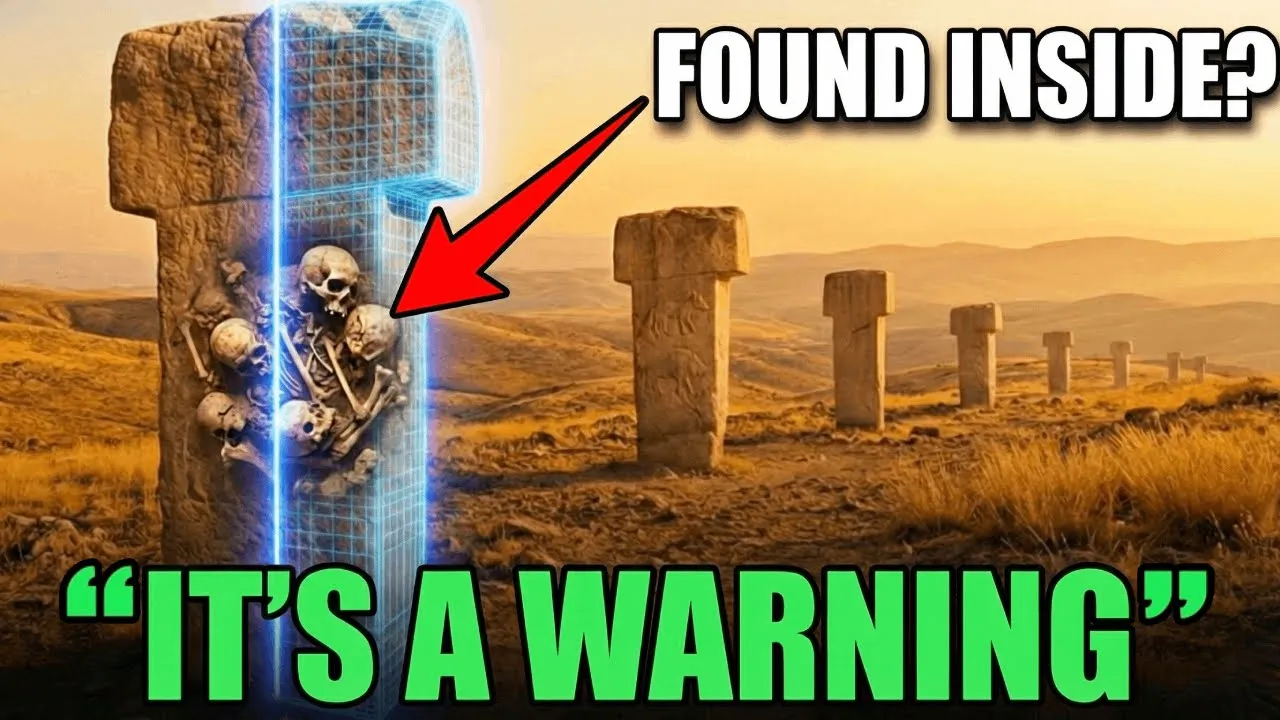
The site consists of at least 20 circular enclosures, each featuring massive T-shaped pillars arranged in rings. These are not crude stone slabs. They are precisely carved monoliths standing up to 18 feet tall and weighing between 10 and 50 tons each.
Decorated with intricate boss relief carvings of lions, foxes, scorpions, vultures, and snakes. Some pillars have arms carved into their sides, hands meeting at the front, suggesting they represent stylized human figures. The official story has always gone like this.
Nomadic hunter gatherers, perhaps motivated by religious fervor, came together periodically to build this temple. They used stone tools to carve the pillars from bedrock. They somehow transported them up the hill, erected them, and then, for reasons unknown, deliberately buried the entire complex around 8,000 BCE, preserving it perfectly for modern discovery.
But here is what engineers noticed immediately. Even with modern equipment, transporting and erecting a 50tonon carved pillar would be a significant challenge. Without cranes, without metal tools, and without even wheeled carts, it seems physically impossible.
So, when new findings emerged in 2025 claiming to reveal how these pillars were made, the archaeological world held its breath. [music] The breakthrough came from a team of German and Turkish researchers who conducted the most comprehensive survey yet of the limestone quaries surrounding Gobeclete. Using ground penetrating radar and highresolution three-dimensional laser scanning, they created a complete digital twin of the entire site, capturing every groove, every tool mark, every surface texture down to fractions of a millimeter.
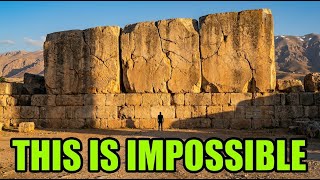
They identified over 350 extraction sites within a 2 km radius of the main temple complex. [music] But what they found in these quaries contradicts almost everything we thought we knew. At several sites, they discovered partially extracted T-shaped pillars still attached to the bedrock.
Ancient works in progress frozen in time. One pillar designated QP47 remains about 70% freed from the surrounding limestone. It lies on its side and weighs an estimated 65 tons.
That would make it the heaviest pillar yet. Discovered at Gobecley Tape. Never finished, never moved, just sitting there as a monument to ambition that somehow exceeded even their capabilities.
This is where the AI analysis changed everything. The researchers fed every scan, every image, every measurement into advanced neural networks trained to recognize patterns in stonework. What the computer vision algorithms detected sent shock waves through the team.
Under microscopic analysis and three-dimensional surface scanning, the AI identified at least three distinct techniques used in the carving process. And here is where things get disturbing. The first technique involved hard stone malls, essentially hammerstones, used to pound the limestone in a method called pecking.
This is well documented at other prehistoric sites and fits the time period. Nothing unusual there. But the second technique shows something else entirely.
Along the edges where pillars were being separated from the bedrock, the AI found evidence of extremely precise linear cuts. We are talking about cuts measuring only 2 to 3 mm wide and extending in perfectly straight lines for over 1 meter. The precision is extraordinary.
The deviation from straight over that distance is less than 1 millm. Dr Jen's not one of the lead researchers stated that the precision of these cuts exceeds what they would expect from stone tools used in a pecking or grinding motion. The linearity suggests either an extremely controlled technique they do not understand or a cutting method that leaves a different signature [music] than predicted.
The AI compared these marks to thousands of known tool signatures from the Neolithic period. It found no matches. Zero.
The cut patterns do not correspond to any documented stone age technology. But wait, because the third technique may be the most baffling. The AI enhanced scanning revealed evidence of thermal shock fracturing at multiple extraction sites that had been previously missed by human observers.
The algorithms detected scorch marks and heat discolored limestone directly adjacent to the extraction cuts. patterns invisible to the naked eye, but clear in the spectral analysis. Chemical analysis of these areas revealed heating temperatures between 400° C and 600° C hot enough to alter the crystallin structure of the limestone.
The theory is that the builders used fire to heat specific areas of the stone, then applied cold water rapidly. The thermal shock would cause fractures along predetermined lines, allowing for controlled splitting of the rock. Now this sounds plausible until you consider the level of control required.
Limestone fractures unpredictably under thermal shock unless you understand its internal structure intimately. How the layers are oriented where natural faults lie, how different densities respond to heat. Modern stonemasons can do this because they have geological surveys, decades of experience, and the ability to test techniques repeatedly on sample stones.
[music] We are being asked to believe that hunter gatherers at the dawn of civilization developed the same intimate knowledge without any visible learning curve. There are no practice pillars, no failed attempts, no evidence of learning through trial and error. [music] The pillars at Gobeclete appear fully formed in technique and execution as if the builders already knew exactly what they were doing from day one.
The AI analysis also revealed something that deepens the mystery [music] further. When the neural networks mapped the progression of tool marks across different quarry sites, attempting to establish a timeline of extraction, they found something unexpected. Several quaries show evidence of pillar extraction that appears to predate the earliest confirmed structures at Gobec Leepe by potentially hundreds of years.
This is based on comparative weathering analysis, looking at how exposed limestone surfaces degrade over time and comparing that to dated surfaces elsewhere. The differential is significant enough to raise serious questions. If pillars were being carved centuries before the temples were built, where were they stored?
Were there earlier structures that have not been found yet? [music] Or is our dating of Gobeci itself fundamentally wrong? Here is where the AI made another disturbing discovery.
The algorithms analyze the quality and sophistication of stonework across the site, measuring precision of cuts, complexity of reliefs, and [music] technical difficulty of execution. What it found contradicts how we expect civilizations to develop. The earliest layers at Gobec Leepe feature the largest, most precisely carved pillars with the most sophisticated artwork.
Later layers show smaller pillars with crudder carvings and less ambitious [music] construction. The quality degrades over time. This is the opposite of what you would expect from a civilization learning and improving their craft.
It looks more like inheritance and decline. Later, people reused, imitated, and eventually buried a site they did not fully understand, attempting to maintain traditions and techniques that were slowly slipping away from them. [music] Think about what this pattern means.
In every other ancient site we have studied, we see improvement over time. The Egyptians built increasingly sophisticated pyramids as their techniques advanced. The Greeks developed more refined architecture with each generation.
But at Gobec Leepe, we see the exact opposite. The best work came first. It is as if someone hit a reset button on human knowledge and everything that came after was just an attempt to remember what had been lost.
But the AI's most shocking findings came when it started analyzing not just how the pillars were made, but how they could have possibly been moved and erected. The new research extensively documents where the pillars were quarried and provides hypotheses about carving techniques based on tool marks and extraction sites. [music] But here is what it does not adequately address and what the computer models made horrifyingly clear.
The closest quarry is about 100 m from the main excavation site. The farthest identified quarry is nearly 2 km away with significant elevation changes between the extraction point and the hilltop temple. The researchers proposed that pillars were transported using wooden sledges, rollers, and ropes made from plant fibers with hundreds of people providing the pulling force.
They site experimental archaeology where teams of 300 to 400 modern volunteers successfully moved multi-tonon stone short distances using similar methods. But the AI's analysis revealed a critical problem with this comparison that human observers had missed. Those experimental stones were roughly shaped blocks, not delicate carved pillars with intricate relief sculptures.
The T-pillars at Gobecletepe have boss relief carvings that are 5 to 10 cm deep in some areas. That is 2 to 4 in of protruding carved detail representing animals and symbols. The AI ran thousands of physics simulations modeling different transport scenarios.
If you were dragging a pillar on its side over rocky terrain using rope tension and wooden rollers, those carvings would be subjected to enormous stress. The computer model showed a 97% probability of significant damage to relief details under the proposed transport methods. Modern stone movers use carefully designed cradles, padding, and controlled lifting equipment to transport carved monuments precisely because the details are so vulnerable.
Yet, the three-dimensional scans of Gobecley tape pillars show no evidence of transportation damage to their carvings. The details are pristine, as sharp and clear as the day they were carved 12,000 years ago. This suggests one of two possibilities that the AI flagged as statistically significant.
Either the carvings were added after the pillars were erected, which seems unlikely given that some carvings are on surfaces that would be extremely difficult to access once the pillar was standing. Or the builders had a transportation method sophisticated enough to protect the carved details during movement. a method we have not identified and cannot [music] explain.
The physics models the AI generated for the erection process are even more troubling. A 50tonon T-shaped pillar is not a simple column. The T-shaped form creates an uneven weight distribution with the crossbar potentially weighing 10 to 15 tons by itself positioned at the top of the pillar.
This makes it extremely unstable during any lifting operation. The researchers suggest the pillars were slid into pre-dug pits and then tilted upright using ropes, earthn ramps, and lever systems. The AI tested this hypothesis with detailed structural analysis.
To tilt a 50-tonon T-shaped pillar from horizontal to vertical using only ropes and leverage, you would need anchor points capable of withstanding massive lateral forces. We are talking about forces equivalent to the weight of several modern cars pulling simultaneously. The computer model showed that natural anchor points like trees or boulders would not be sufficient.
You would need engineered anchor stones or counterweight systems. [music] But there is no evidence of such engineering at the site. No massive anchor stones with rope grooves, no counterweight pits, nothing.
The absence of those necessary elements makes the proposed erection method effectively impossible to reconcile with the archaeological record. [music] AI also calculated the rope strength requirements. The strongest natural fiber ropes available to prehistoric peoples made from flax, hemp, or hyde have breaking strengths that engineers have tested extensively.
To safely lift a 50 ton load, you would need either incredibly thick ropes which become impossible to manage and coordinate or multiple ropes working in parallel with sophisticated load distribution. The margin for error would be razor thin. If one rope failed, the entire pillar could come crashing down, destroying months or years of carving work in an instant.
Yet, across 20 enclosures and over 200 pillars, there's no evidence of catastrophic failures. No broken pillars, no signs that they ever got it wrong. And here is something else AI discovered that makes this even stranger.
[music] The neural networks analyzed the socket depths and pillar bases, measuring how deeply each monolith was set into the ground. The algorithms found that the sockets were engineered with remarkable precision. Each one calculated to provide exactly the right stability for the specific pillar it held, accounting for the weight distribution of that particular T-shape.
This level of customization suggests advanced planning and mathematical calculation that should not exist in this time period. [music] Then the AI turned its attention to something that had been hiding in plain sight. Something that would reveal the most disturbing truth of all.
Using pattern recognition algorithms trained on astronomical data, the neural networks began analyzing the spatial relationships between pillars, the orientations of enclosures, and the positioning of specific carved symbols. What it found was so precise, so mathematically elegant that at first the researchers thought it had to be a glitch in the code. The AI detected that the centers of the three oldest enclosures, when connected, form a perfect equilateral triangle.
The sides of this triangle are even to within fractions of an inch over distances of hundreds of feet. To achieve this requires understanding complex geometry and the ability to measure long distances over uneven ground with perfect accuracy. Remember, these people supposedly didn't have rulers, compasses, or even a way to write down numbers.
Yet, they were executing geometric layouts that wouldn't be matched until the Greeks developed advanced mathematics thousands of years later. But the AI went deeper. It analyzed the carved animal reliefs, not for their artistic merit, but for their astronomical significance.
[music] Using its database of star positions throughout history and comparing them to the positions and orientations of specific carvings, the algorithm found something that made the research team go silent when they saw the results. The animals carved on the pillars correspond to constellations. Not modern constellations, but the stars as they would have appeared over 11,000 years ago in an ancient sky.
The fox carvings align with what we now call Sirius. The scorpion matches the constellation Scorpius. The vulture corresponds to the area we know as Sagittarius.
But here is what is truly horrifying. These are not just random star maps. The AI detected that they are showing a specific date, a specific moment in time, preserved in stone.
When the neural networks reconstructed the night sky for the exact positions indicated by the carvings, they landed on a date approximately 12,800 years ago. That date corresponds almost exactly to the beginning of the younger dry impact [music] event. a period when evidence suggests a comet or its fragments struck Earth causing catastrophic global devastation.
There were massive floods, sudden climate shifts, the extinction of numerous species, and the collapse of human populations across multiple continents. The famous Pillar 43, known as the vulture stone, shows a scene that researchers have debated for [music] years. It depicts a vulture hovering above a headless human figure surrounded by other animals and symbols.
[music] The AI astronomical analysis reveals this is not mythology or ritual art. It is a historical record, a permanent memorial carved in stone documenting the moment the sky fell when something from space brought destruction to the world. But the AI found something even more disturbing in the pattern of symbols.
Using machine learning trained on cyclical data and temporal patterns, [music] the algorithms detected that the carvings do not just record a single event. They encode a warning about recurring cycles. The arrangement of certain symbols, the repetition of specific patterns across different enclosures, the mathematical relationships between pillar positions, all of it points to an understanding that these catastrophic events follow a pattern, a cosmic rhythm that repeats over vast spans of time.
The AI calculated that the spacing and arrangement of symbolic elements correspond to the procession of the equinoxes, the 25,920ear cycle of Earth's axial wobble. This is astronomical knowledge that was not supposed to exist until ancient Greek astronomers documented it thousands of years later. But here it is encoded in stone at Gobec Leepe, suggesting that the builders understood not just that disaster had struck, but that it would strike again, following a pattern as predictable as the seasons, but measured in epics rather than years.
Think about what this means. [music] These were not primitive people engaging in superstitious ritual. They were trying to preserve critical information, a warning for future civilizations, a message that says, "This happened before.
it will happen again and you need to be ready. But here is the truly horrifying part that the AI analysis revealed. If their calculations were correct, if the pattern they encoded is real, then according to the cyclical timeline preserved in stone, we may be approaching another turning point in that cosmic cycle within the next few decades.
Now, before you dismiss this as sensationalism, consider what else the AI discovered. The deliberate burial of Gobeci around 8,000 B. CE was not abandonment.
The site was carefully filled in with thousands of tons of soil and rubble. An enormous undertaking that would have required massive coordinated effort. The AI analysis of the fill layers shows they were placed methodically, almost lovingly, preserving the structures perfectly.
This was not destruction, it was protection. Why would you bury something you spent centuries building unless you knew you could not maintain it? Unless you knew your culture was declining, your knowledge slipping away, and you wanted to preserve the most important message you had for whoever came next.
The AI detected something else in its analysis that the archaeological teams are still trying to fully understand. When neural networks examined the technical quality of work across the site's long occupation, they found that the most sophisticated techniques appear first and then gradually disappear. The thermal shock method that precise cutting that should not be possible with stone tools is most evident in the earliest quaries.
Later extraction sites show crudder methods, more pecking, less precision, as if the knowledge of how to do it properly was being lost generation by generation. Several experimental archaeology teams have attempted to replicate the Gobeci pillars using only tools and methods available to prehistoric peoples. In 2017, a team of six experienced stonemasons in Germany worked full-time for 8 weeks to create just the basic shape of a half-scale replica about 5 tons at full scale with no decorative carvings.
Extrapolating from this, creating a full-scale 50-tonon pillar with intricate carved reliefs could take a team of six workers anywhere from 18 months to 2 years of continuous labor. Given that Gobecleyepe has at least 200 confirmed pillars across its various structures and potentially many more still buried, we are talking about an absolutely staggering investment of human [music] labor, potentially centuries of continuous work by specialized teams. And here is something that makes the logistics [music] even more impossible.
The AI analysis of the carved reliefs revealed something that modern conservators immediately recognized as extraordinary. Many of the animal carvings show what is called undercut relief, where the stone is carved away behind and beneath the figure, making it stand out dramatically from the surface. Creating undercut relief is one of the most technically demanding [music] forms of stone carving.
You have to remove material from beneath the carved figure without breaking the delicate protruding elements. One wrong strike and the entire [music] relief shatters. Modern stone carvers using steel chisels and powered [music] tools approach undercut work with extreme caution.
They work slowly, constantly checking for stress fractures, using specialized angled [music] tools to reach behind the relief. Yet at Gobecepe, using only stone tools, the builders created undercut reliefs that remain intact 12,000 years later. The AI measured the depth and angles of these undercuts, comparing them to modern standards.
Some of the undercutting reaches depths of 7 to 8 cm behind delicate carved elements like animal legs or vulture wings. The margin for error would have been microscopic. But there is more.
The three-dimensional scans revealed that many pillars have carvings on multiple sides, including areas that would have been extremely difficult to access once the pillar was erected. Neither option makes sense with the technology supposedly available. The AI also detected toolmark patterns that indicate the carvers worked continuously on individual reliefs without stopping.
There are no seam lines, no places where they stopped and started again days later. In modern stonework, when you pause and resume carving, subtle differences in angle and pressure create visible seams in the tool marks. The absence of these seams at Gobecée suggests individual reliefs were completed in single sessions.
Imagine carving an intricate three-dimensional animal figure with undercut relief in hard limestone using only stone tools in one continuous session. The physical endurance, the sustained precision, the unbroken concentration required would be extraordinary even for modern artists with modern tools. But here is the question that keeps engineers and archaeologists awake at night and that the AI analysis makes impossible to ignore.
Where did these specialized workers live while they were carving full-time? What did they eat? Who supported them?
The three-dimensional scans and ground penetrating radar have now mapped extensive areas around Gobeci. We have no evidence of permanent settlements, no residential structures, no graneries, no evidence of the logistical infrastructure you would need to support hundreds of workers over decades or centuries. The site appears to have been purely ceremonial.
People came, conducted rituals, and left. The AI spatial analysis confirms this. The site lacks domestic features that should be present if people lived there.
This means the pillars were carved by visiting workers who returned to some other place, some settlement we have not found with an agricultural base capable of supporting specialized labor. [music] Despite this being before the agricultural revolution, unless they were not carved by visitors at all, unless there is an explanation that fits the evidence better than the conventional narrative, but one that represents academic suicide [music] to propose outright. What if Gobeclete was not built by the hunter gatherers whose remains we find at the site?
[music] What if it was built by an earlier, more sophisticated culture, and then inherited by less advanced peoples who used it, added to it crudely, and eventually buried it, either as an act of reverence or because they simply did not understand it anymore. This would explain the pillars predating the temple structures that the AI weathering analysis revealed. It would explain the decline in quality over time that the algorithms detected so clearly.
It would explain the complete skill set appearing with no learning curve. It would explain the absence of supporting infrastructure that the scans failed to find. It would explain why the most sophisticated astronomical alignments, the ones requiring the deepest knowledge, are found in the earliest construction phases.
And it would explain why similar megalithic sites exist at Carahantepe, Harbet, Souvante, Sephertepe, and other locations across the region. All featuring massive carved stones, all roughly from the same era. all presenting similar technical mysteries.
The AI analysis has now been extended to sister sites and what it is finding is even more compelling. At Kahantepe, fully revealed in the 2025 excavation season, there is a 17 m wide circular structure with three tiers of stone benches arranged in concentric rings. At the center stand carved T-shaped pillars around the perimeter are additional pillars still standing.
But what caught the AI's attention were carved sculptures integrated directly into the [music] walls. Not separate pieces added later, but faces and figures emerging from the stone structure itself, carved as part of the original construction. One particularly striking discovery is a large human face carved into the bedrock base of a standing pillar positioned opposite a large niche in the wall.
The spatial relationship clearly intentional. When the AI compared the symbolic systems across all these sites, it found both remarkable similarities and distinct local styles. The same core symbols appear everywhere, the same animal motifs, the same T-shaped pillars, the same geometric layouts, but each site has variations like different dialects of the same language.
This suggests a connected network of communities sharing fundamental knowledge but maintaining individual identities. It was a sophisticated regional culture operating across southeastern Turkey 11,500 years ago, coordinating labor, exchanging ideas, and preserving and transmitting specialized knowledge across generations. The AI's pattern recognition algorithms detected something else that researchers are still working to fully understand.
The volume and variety of carved objects found across these sites, from intricate beads requiring precision drilling to sculptured human figures showing anatomical knowledge to the massive architectural elements themselves, all point to economic specialization. Different sites appear to have focused on different types of production. One location shows evidence of being a bead manufacturing center.
Another focused on large-scale stone carving. This implies trade networks, exchange systems, and social organization far beyond what we associate with hunter gatherer bands. The AI calculated the minimum population sizes and organizational complexity required to build and maintain this network of sites.
The numbers do not match our models of pre-aggricultural societies. You need food surpluses to support specialists. You need social structures to coordinate labor.
You need systems for preserving and transmitting technical knowledge. You need all the infrastructure we think requires settled agricultural civilization. But this network existed before agriculture was supposedly established before permanent villages before any of the foundations we consider necessary for complex society.
The conventional timeline says agriculture led to settled communities which led to food surpluses which led to specialization which led to social complexity. But Gobeclete and its sister sites show complexity apparently preceding agriculture. Sophisticated construction preceding settled villages and symbolic elaboration preceding the economic base we think is necessary to support it.
Some researchers argue that these sites actually catalyzed the development of agriculture. That the need to support large gatherings for ritual or construction drove people to develop more intensive food production which eventually led to full agriculture. But this still does not explain where the initial knowledge came from.
The astronomical understanding, the advanced geometry, the stonework techniques that appear fully formed. The AI analysis suggests we are not looking at the beginning of something. We are looking at the end.
Perhaps what we are seeing at Gobeclete is not the birth of civilization, but the twilight of a previous one. They were the last remnants of people who once knew how to build in stone, who understood the movements of the stars and the cycles of cosmic catastrophe, gradually forgotten by the huntergatherer populations that survived whatever disaster ended the earlier culture. The deliberate burial of these sites takes on new meaning in this context.
They were not just closing down temples. They were creating time capsules, preserving the most critical knowledge and the most important warnings in the most durable form they could imagine. Buried under tons of earth to protect them from weathering, from destruction, from being lost.
They were waiting for a future civilization that might develop the technology to find them, excavate them, and hopefully understand the message before it [music] is too late. And now we have found them. We have excavated them.
We have scanned them with technology that can see details invisible to the human eye. We have analyzed them with AI that can [music] detect patterns across thousands of data points simultaneously. The AI has decoded architectural relationships, astronomical alignments, symbolic systems, and technical capabilities that challenge everything we thought we knew about prehistoric humanity.
The scans have revealed tool marks that do not match known stone age technology. precision that should not be possible without modern instruments, knowledge that supposedly would not exist for thousands of years, and evidence of declining capabilities suggesting inheritance rather than innovation. The three-dimensional models have documented construction methods we cannot [music] fully explain, logistics we cannot reproduce, and engineering that challenges modern capabilities.
pattern recognition algorithms have found astronomical codes, geometric precision, and systematic knowledge preservation that point to consciousness far more sophisticated than we have credited to people 12,000 years ago. But perhaps the most disturbing revelation from all this [snorts] analysis is the simplest one. The AI found clear evidence that the builders of Gobeclete knew something catastrophic had happened in their past.
They recorded it in stone with astronomical precision. They encoded warnings about cyclical repetition. They invested enormous resources to preserve this information permanently.
And then they deliberately buried it all as if ensuring that their message would survive whatever came next, waiting for a civilization advanced enough to understand it. That civilization is us. We have the tools.
We have the technology. We have the analytical capability. The question is whether we have the wisdom to take the warning seriously.
The stones do not care about academic consensus, archaeological paradigms, or career concerns. They are sitting there on that hilltop in Turkey, carved with precision we cannot fully explain, transported by methods we cannot identify, erected through engineering we struggle to understand, and decorated with messages we are only now beginning to decode. [music] The 2025 AI analysis has given us more data, better scans, and more detailed understanding than ever before.
But it has not made the mystery smaller. It has made it bigger. Every answer raises three new questions.
Every technical detail we document makes the achievement seem more impossible. Every pattern the AI detects suggests knowledge that should not exist. What do you think?
Are we looking at the birth of civilization or the remnants of something older that we have only just begun to understand? This is not speculation or fantasy. This is real stone, real carvings, real engineering, real astronomical alignments, all documented with the most advanced scanning and analysis technology available to modern science.
The data is there, the patterns are there, the precision is there. And despite our best technology, our most sophisticated AI, our most detailed three-dimensional scans, we still cannot fully explain how hunter gatherers at the supposed dawn of civilization achieved what we see at Gobec Leepe. Maybe because that is not what we are looking at at all.
Maybe we are looking at something far older, far more sophisticated, and far more important than we ever imagined. And maybe the truth really is horrifying. Not because of what ancient people could not do, but because of what they could do, what they knew, and what they were trying to tell us before their knowledge disappeared into the darkness of forgotten history.