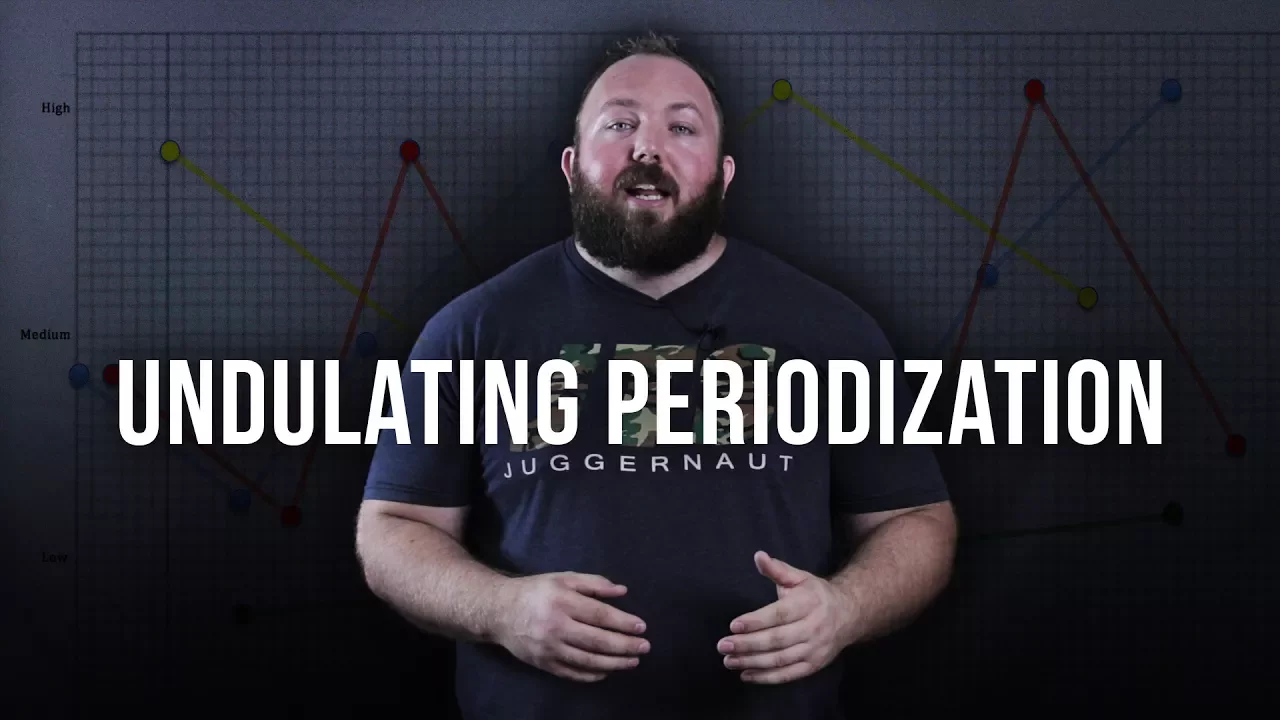
hey everybody Chad Wesley Smith here for Juggernaut Training Systems today we're going to be talking to you about undulating periodization you know there's a lot of different periodization strategies out there and a lot of times you'll hear about daily undulating periodization or what is referred to as dup and the way that I program is involves undulating periodization but I would not consider it to be daily undulating periodization as it's not variable uh based on any type of uh daily feed back or Auto regulation in that sense uh in the broader sense of of that term
rather it's a more long-term planning of undulations that's really going to help us in three main areas of the scientific principles of strength training uh if you're not familiar with these principles we have a full playlist of videos that discuss them we'll link it right up up here up there one of one of those spots there'll be a link to it as well as Down Below in the info and those three principles that this under periodization strategy is really going to help uh bolster and improve are fatigue management overload and the principle of SRA stimulus
recovery adaptation so first off let's establish that what I'm talking about is geared towards more intermediate and advanced athletes the only time I would see it being appropriate for a beginner athlete or necessary for a beginner athlete to employ a strategy like this is if they're working maybe uh you know shift work where they are you know three days on two days off or four on three off that type of thing where they have a lot of a lot of fatigue and stress to be managed outside the gym beyond that beginner athletes should probably be
fine to get away with more of a linear periodization strategy it wouldn't require these changes uh and and more intricate management of intensity and volume so the way that it's going to affect fatigue management and be able to improve our fatigue management when designing programs is that you're going to avoid accumulating too much fatigue because training does not happen in a vacuum and fatigue that is generated isn't just from you know a squat workout generates squat fatigue and that has its own category and a bench workout generates bench fatigue and that has its own category
and deadlift has its own category no they all generate fatigue on the system the body does not differentiate between squatting benching and deadlifting so there is cative fatigue so if I have a very hard squat workout on Monday very very taxing nervous system muscular system so on and so forth that is going to affect my Tuesday bench workout maybe my Wednesday deadlift workout Tuesday's bench is going to affect Wednesday's deadlift Wednesday's deadlift is going to affect Friday's squat is going to affect Saturday's bench numerous different ways that you could structure the week but understand that
the the fatigue being generated from one lift or one you know focused Training Day carries over to subsequent days undulating the periodization and varying the levels of of intensity and volume through the different lifts is going to help avoid too much fatigue being accumulated and maybe one lift suffering at the benefit of another unel periodization is a strategic application of Sr the stimulus recovery adaptation which means when I introduce a stimulus which generates fatigue and we have to generate fatigue to to build Fitness these different length SRA curves or the length of the SR curve
is going to vary based on how much fatigue it is being generated so we could have a very very hard workout which has a longer Sr curve we could have a a easier workout that has a shorter Sr curve and that's going to allow us to maybe fit the most hard training the most overloading training in to a a specified time period so let's say we're training on a three up one down schedule 3 weeks of hard training followed by one we de lo we want to do as much hard training as you possibly can
in that time or let's even say you have uh 3 months before I meet 12 weeks the more hard training you can do in those 12 weeks the stronger you can potentially get by the meat but if you're if you aren't applying some level of strategy to the way you set to the way you set up your frequency and the way that fatigue is managed within that that uh frequency you're not going to get to do quite as much training so the unan strategies that we're going to talk about today are going to allow you
to fit more hard training into a bit more of a compressed time period and you know still manage fatigue still have proper recovery but be able to do more hard work which in turn is going to allow you to potentially become stronger finally it's going to affect overload because the stronger an athlete becomes the heavier weights they are lifting the more experienced they are the bigger stronger more muscular they are the more stimulus they will arrive from a single training session so when you get an athlete who's very very strong and the weights of they
lifting become very very heavy that a very hard workout up here a lot of fatigue is going to be generated from that a longer SRA curve is is going to be developed but you could run into a problem there because as they generate a lot of fatigue and would require a longer srra curve before being able to do another comparable workout they are now potentially going to run into an issue of decaying technique as different physical qualities so strength hypertrophy uh ten and ligament Integrity technique neural fatigue all have different length SRA curves technique is
very short if you have this big training session and then you wait a full week or two weeks in in some programs cases between those you could actually experience some technical Decay so as the athlete becomes capable of greater and greater overload they need to be more strategic in the way that they organize their training so they can make sure that technique is still developing while you know they're not beating up their joints tendons ligaments too much the nervous system is able to recover between these very hard overload sessions again make sure you refer to
the scientific principles of strength training playlist here on YouTube the book by Dr Mike isrel Dr James Hoffman and myself to learn more about these topics the final Factor that's going to make this undulating periodization strategy so valuable so potentially valuable to you as an athlete or for the athletes that you coach is it's going to create an improved predictability of training training that has a direction to it and this is all part of phase potentiation uh you know train that has a a more predictable direction to it is going to allow for you as
an athlete or coach to better say this is the day that I'm going to feel strong as a competitive power lifter or even apply trying to apply this idea to weightlifting or strong man could be appropriate that better that you can say this is the day the competition day where my athlete will be the strongest the better Coach you will be the more successful athlete you will be this is something that I take a great amount of pride in that I have peaked extremely well over the duration of my powerlifting career I you know very
proud of Marissa every time that she puts her best lifts of the Train Cycle on the platform the day that it matters and it goes beyond just peing because of course being ready for that one competition day is the most important thing but within the course of a training cycle you're going to have days you know where you feel great you're going to have days where you feel run down days where you're supposed to go heavy days that aren't designed to be as heavy and creating this undulating strategy is going to give you a better
understanding and control of which days you're going to feel good on so you can plan for those to be heavy days which days you're going to feel run down on so you can plan for those to be lighter days because usually with every big high heavy hard day that you have what comes to follow that a day where you feel fatigued so then you're able to use that later fatigue day to still accomplish good work to still develop technique to still get volume in but not you know to not be guessing at it a perfect
example of this and a violation of pH potentiation and probably the biggest violator of phas potentiation is Bulgarian style training you know squat everyday training and Max and I have talked a lot about his 13 years of experience squatting for mult multiple daily maximums and he would talk about you know that there was there was no way for him to tell which day he would feel good on some days where he felt terrible he would lift really well some days where he felt good as good as you could feel doing that he would lift very
poorly but there was no way for him to know this is the day that I will feel great and he said even taking a taper or a day or two off U did not allow him to feel that way either because there's no direction to that type of training so it lacks a predictability which is critical to be able to Peak optimally for competition there are two models that I'm going to going to show you of different undulating periodization strategies that I use one will'll just refer to as the intermediate and one the advanced the
intermediate could also be called alternating and the uh Advanced model could will be a low medium high strategy so first up the alternating model for more intermediate athletes even Advanced female athlet this is how Marissa Inda training is structured this is how Kristen dunmore's training is structured uh Advanced men's lifters maybe in a lower weight class particularly shorter lifters as they're not able to generate as much fatigue because the bar is not moving as far this is how Kevin torres's training is structured this is a usually a four up one down strategy that is going
to kind of alternate weeks between very hard deadlifting in weeks 1 and three or weeks two and four or very hard squatting and benching in the alternating the opposite week of the deadlift so we're going to have this type of strategy going on so as you can see in the graph uh showing just the squat workouts so you see the blue dots for the squat workout you know starting out in week one with a medium you know slightly on the lower side of medium difficulty workout so on the x-axis we're going to have time you're
seeing the days down there Monday Tuesday Wednesday Thursday Friday Saturday Sunday and on the Y AIS that's basically showing the relative difficulty of the training session and I I'll get into that a little bit more so starting out with the our first squat workout in week one we're having you know a lower side of medium but still a fairly challenging workout this is going to be a lot of like 7 eight RP work for a good amount of volume then later in the week our second workout of the week is going to be a little
bit less challenging uh usually about 75% as difficult I would say as the first workout of the week and then as we move on to week two the first workout of the week gets a little bit harder than the first workout of the week was uh the previous week because the principle of overload dictates that training must become more difficult over time and then finally that second workout of the second week is up on the high uh relative difficulty side of things and we repeat that process again over the next two weeks so you know
we we'll Implement different uh exercise selection here usually doing High bar uh what I usually do with Kristen and Marissa High bar early in the week low bar for the second workout of the week um the weights end up being about the same between those but the higher weights are relatively harder at high bar earlier in the week than they are at low bar and then on the high workout that is a low bar either up to a maximum single uh with a rep max after that or just the rep max you know individual differences
are going to dictate some of the some of the changes there now as we bring in the bench workouts you can see following a very very similar pattern to the squat workouts I find that the squat and bench work harmoniously together a little bit better than the deadlift they tend to respond more similarly to different training strategies so you can see almost an identical pattern through there the only real change is that in the higher week the hard week for the squat and uh the squat and bench we have the hard bench workout early in
the week the hard squat workout later in the week and that is done again strategically nothing we're doing here is is just by accident we're doing that because a hard bench workout is much less or much uh more unlikely to have a negative effect on the squat workout where if we put a really hard squat workout on Monday and then tried to have a hard bench workout on Tuesday the bench workout would suffer a lot more from that squat workout whether it's stress on the wrists and elbows from the low bar position or just general
nerval uh neural fatigue now looking at the the third lift the deadlift we're going have two different colors here for the deadlift uh the yellow dot being our primary deadlift workout and then the Green Dot being a secondary deadlift workout I distinguish between these two because they are periodized two different ways the yellow dot our primary deadlift workout is going to follow the same strategy as the squat and bench just flipped so instead of going you know medium high medium high followed by a D Lo which I know the D Lo is cut off in
the graph now the deadlift will go high medium high medium and so they're inverted from each other so week one can be very hard stressful work for the deadlift while week two very hard stressful work for the squat and bench alternating throughout the secondary deadlift workout we treat a bit differently just because the deadlift is so much more neurally taxing that trying to put two workouts of it uh that are comparable difficulty the way we do in the squat and bench has tended to just not work out as well and then we just have a
more linear periodization strategy for that second deadlift workout which is often just focused on technical development uh trying to keep it much more low neural stress and is done after the second squat workout of each week so for example the high deadlift workout uh in week one depending on the phase let's say we're in a strength phase for Marissa might be up to five rep max in the deadlift so that was recently 355 for five followed by back down sets 320 for three sets of five and then some accessory work like vert pole back raises
or ghrs maybe some rows while the second deadlift workout of the week the secondary deadlift workout could either be you know three sets of five deadlifts at 275 to 295 if it's in an earlier more General phase it might be rdls or vert poles at that point just a deadlift movement to help stay in touch with tech technique to give those muscles some extra stimulus to respect the idea of the technical SRA curve being shorter so you don't want to even though the the neural Sr curve for the deadlift is very long that might make
you inclined to say well I should only doli once a week but in doing that strategy technique tends to at least not at at best stagnate definitely not improve and at worst uh at worst start to Decay so we want to keep technique improving throughout now we're going to discuss the more advanced low medium high undulation model and this is what I would be using for myself athletes like Steve gentiy t papula umand Allen Evan mening guys who have put up these really big you know 2,000 plus pound totals but this strategy could also be
appropriate for intermediate lifters who for whatever reason whether that's you know genetics lifestyle factors like jobs sleep nutrition have a hard time recovering so this is going to have a little bit more recovery built into it and it's going to work on uh the principle of these three different types of workouts low workout medium workout High workout easy medium hard rotate through those to create fatigue management for each given lift and then also to work harmoniously together to create these more predictable Trends and better fatigue management of all the accumulated fatigue through the three different
lifts so looking at the squat first we start with a low squat on the first day that would be Monday week one followed by a med ium squat on Friday week one then a high or heavy squat on Monday week two a lot of fatigue is going to be accumulated from that so what do we need to do to Decay that fatigue bring it back down to a a low workout obviously that low workout because the principle of overload is going to have to be harder than the previous low workout and the same thing with
the medium and the same thing with the high but going through this low medium high low medium high structure is I found it to be extremely helpful to know that on the days that are supposed to be high I feel good I can lift and push the heavy weights on that one and you know what follows that a day where you feel really run down your joints hurt weights that feel should feel light feel heavy but that's fine because it's by Design we're programming lighter weights on those days maybe still for a lot of volume
and it's not going to be fun to do them it's not going to be a great feeling workout but you're going to get through it anyway anyways so it's going to add that level of predictability to it so we follow that same Strate or that strategy low medium high low medium high and then a D Lo for the squat now looking at the bench workouts the bench will start on the medium workout the first Tuesday we're going to be benching on Tuesdays and Saturdays again I'm showing you the training schedule that I use that I
use with the majority of my athletes it is not necessarily the right one or the best one but it is a way to strategically and soundly apply these principles that we've talked so much about so again this is just the way that I do it there's a lot of good ways to do it a lot of possible ways to satisfy these principles so benching on Tuesday and Saturday we're going to start out with the medium workout on week one day one or week one Tuesday and then a hard workout on week two on Saturday or
sorry week one on Saturday and we want to get that hard bench workout in before we have the really hard squat workout because again if you're squatting low bar and I'm sure you know those of you watching who do squat low bar can relate to this after that hard squat workout elbows hurt maybe your shoulders hurt the last thing you want to do is have a heavy bench workout so we have that that heavy bench workout on Saturday then the heavy uh squat workout on Monday and right now you're probably feeling very beat up and
you don't want to have a have a hard bench workout luckily it comes back down to a low bench workout on Tuesday uh week two then uh back up to medium on Saturday week two and then again before we get to the heavy squat workout we're going to have the heavy bench workout on week three Tuesday and then finally after the heaviest squat workout of the whole program or of the whole cycle on that week three Friday you'll still have a low bench workout and again it might feel terrible and that's fine it feels terrible
by Design we're expecting it to feel bad that's why we programmed the lighter weights or manipulate exercise selection to allow you to still have a good workout to still satisfy the principle of overload and do hard work but without it you know just compounding fatigue and pain on top of itself as it would if you had hard squat workout on Friday hard bench workout on Saturday over and over finally as we put the deadlift workout in there again the squat bench and deadlift these rotations are all working independently just as we had in the intermed
mediate Alterna model uh in this in the deadlift workout we have two different deadlift workouts here our primary one which follows a high low medium strategy and then our secondary deadlift workout which we do after our second squat workout in the week and that's kind of its own periodization model just a linear periodization of relatively easy workouts 60 to 75% as difficult as the the first workout of the week and you can see with the deadlift week one heavy hard hard workout we start the cycle off with that you know it's it's maybe not the
most optimal thing when looking at just one training cycle one four-week block three weeks up one week down but over the course of the entire training cycle when keeping in mind that the deadlift is the most fatiguing and you need to take your heavy your cut out heavy deadlifts the farthest away from a meat relative of the three lifts it ends up working out just fine so we go heavy in week one followed up by again light workout we always want to follow the heavy workout with the light workout because the heavy workout is going
to generate the most fatigue it's going to make you feel the worst for the the next subsequent workout so we go low in week two back up to medium in week three and then finally in week four a d Lo though all of these lifts work independently of each other through this high medium low structure or low medium high structure um and it's all it's important how they all work independently of each other is even more important is how they all work when you put them together training does not happen in a vacuum the squat
workout you do on Monday affects the bench workout on Tuesday the bench workout on Tuesday affects the deadlift workout on Wednesday that affects Friday that affects Saturday that affects the next Monday it all has to work together fatigue is being accumulated through all the different lifts where a bench workout can be negatively affected by a squat workout vice versa and so on so that's why we use this alternating High Media low strategy and I think it works so well uh when you put them all together to create a trend of week one and into early
week two is up in a lot of harder workouts relatively harder workouts in that time frame you're going to have a hard deadlift week one Wednesday medium squat week one Friday hard bench week one Saturday and then a hard squat on week two Monday those four workouts are going to generate a lot a lot of fatigue those are all going to be you know pretty challenging to very challenging workouts so what do you need to do after that you need to follow them up with lighter workouts which is why on Tuesday Wednesday uh Thursday as
an off day and then Friday of week two we have low bench low deadlift low squat to Decay that fatigue and now you're going to start to feel better and better coming into week three where we come with high bench on on Tuesday medium deadlift which is still going to be a very challenging workout and then our biggest squat workout of the whole uh cycle on that last Friday so it and because the principle of overload once again dictates training must become more difficult over time the second low workout is always harder than the first
low workout it's always heavier or has more volume in it the second medium workout always heavier has more volume than the first medium workout and same thing with the the hard workouts so our our Trend ends up being if we're going to assign uh just like a difficulty on a 1 to 10 not necessarily an rpe scale here just a a general you know for the the point of of demonstration just a a difficulty 1 to 10 our first week maybe is a six or seven our second week you know a four or five and
then the third week you know 8 nine maybe even a 10 depending on how many hypertrophy phases and strength phases you're going to pair uh after one after another that is going to change you know if you want the the last week to be a nine or the last week to be a 10 but it's that trend of pretty hard easier very hard D Lo very easy that's going to allow us to create better fatigue management by strategically using stimulus recovery adaptation and manipulating overload so we can create long-term training predictability so that you can
better know these are the days where I'm going to feel strong where I can go heavy uh all trending towards this is the one day that matters most where I'm going to lift the most weight that I've ever lifted the day of the competition so we have two different models we have the the intermediate alternating model and then the advanced uh high medium low model hopefully this gave you some better insight into uh potential ways to better structure your or your Athletes Training if they're struggling with fatigue management you don't feel like they're they're able
to get enough hard work in in whatever time frames you're you're dealing with this can be a great great tool to use it has been extremely successful for me this is the the type of model that I use for you know 2248 total 234 total 2325 total the alternating model is what we use with Marissa for her world record in the 52 kilo class the high medium low you know got Brandon Allen 2300 Tula the world record 242 and sleeves at the time you know Kevin Torres all those big total Steve gentiy big PRS this
is a very very effective model and I know looking at it you know the whole graph altogether especially on the high medium low looks a little bit overwhelming and and maybe confusing but as you look at each lift independently I think it should create you know a better understanding of how we're manipulating relative uh volume and intensity for those lifts to set you up for the most long-term success possible so hopefully you learned something in this if you enjoyed the video please subscribe to the channel