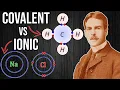
Since the 18th century, scientists have been wrestling with the idea of molecules and chemical bonds. The concept of an ion was brought forth in the 1830s by Michael Faraday. And by the 1890s, ionic bonds were well understood as molecules composed of, at the most basic level, a positively charged and negatively charged ion stuck together due to their attraction to one another.
Although the understanding of ionic bonds is extremely important in chemistry, it wasn't even close to the entire picture of chemical bonds. Many chemists in studying chemical bonds in the 19th century and early 20th century described their nature by using two terms, veency and polarity. The meanings of these two terms were rather ambiguous in the primitive days of molecular theory.
But American chemist Gilbert N. Lewis would make these terms more clear in 1913 and help scientists classify chemical bonds with these two terms. In his paper entitled veance and tomism, Lewis first defines the veence number to be the number of atoms attached to an atom in a bond and this today is known as the coordination number.
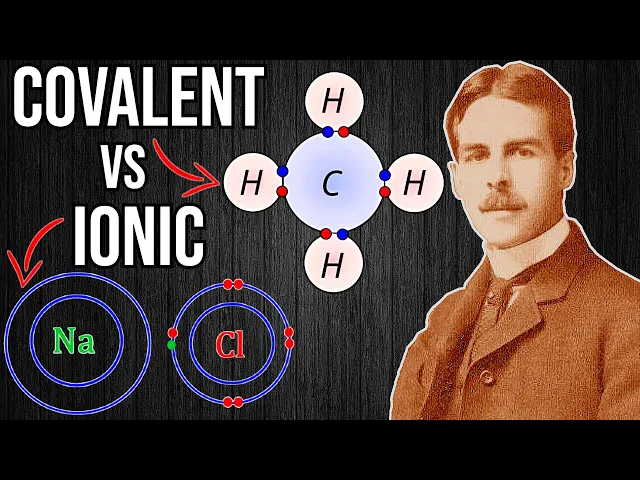
He then defines the polar number to be the number of electrons that an atom has lost and this today is known as the oxidation number. After clarifying definitions, Lewis moves on to a key piece of his paper which separates chemical bonds into different types classified more or less on a spectrum based on polarity. To make his point, he takes two common compounds, potassium chloride and methane, and classifies the salt as polar and methane as non-polar.
Polarity in this sense refers to the electrical charge on two opposite ends of the molecule. If a molecule is polar, then it will have an electric dipole. Meaning one side of the molecule will have a net positive electrical charge and the other side will have a net negative electrical charge.
The key aspect of Lewis's spectrum is that it's just that, a spectrum. There aren't two distinct types of chemical bonds. The nature of the bond changes as the polarity increases or decreases on the spectrum.
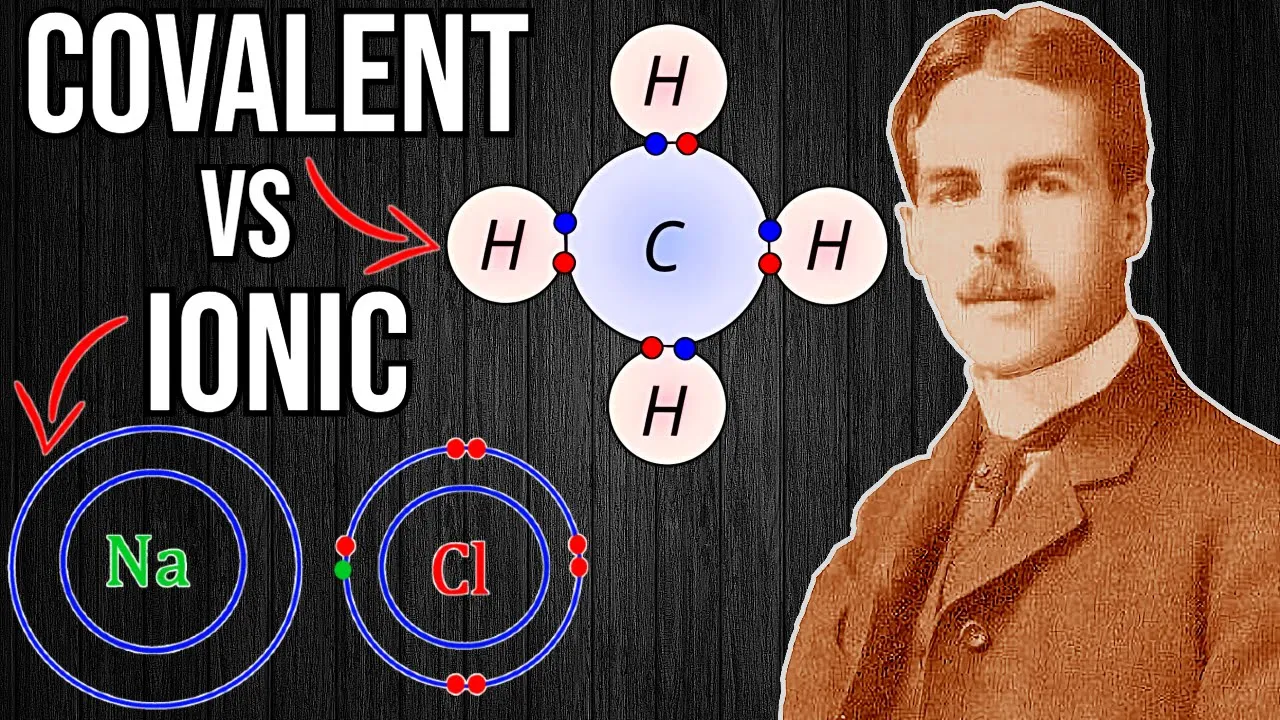
And Lewis understood this. What he called the polar bond and the non-polar bond were simply two opposite ends of the spectrum and are what are today called ionic and covealent bonds respectively. JJ Thompson the father of the electron would independently come to make the same distinctions based on polarity one year later unknowing of Lewis's work.
Lewis would go even further in his much more famous paper in 1916 entitled the atom and the molecule. In this paper, Lewis describes his distinctions in terms of atomic structure rather than knowledge of the behaviors of molecules and also introduces a few more concepts. He starts by building off the foundations of German chemist Richard Ag who 12 years prior first defined the term veency.
Ag found in his studies an interesting behavior regarding veency that would be instrumental in the progression of molecular theory. Lewis would credit Abeg directly in this 1916 paper and coined the behavior as Abeg's law which later would become known as the octed rule. It goes as follows.
The sum of the absolute value of maximum positive veence and maximum negative veilance of an element is frequently 8 and is never more than 8. This rule of 8 is the basis for Lewis's atomic structure in this paper which he dubbs the cubicle atom. This model represents all atoms as having a veence shell with a capacity of up to eight electrons with each element having a specific number of veence electrons in its natural state.
He then uses the cubicle atom to describe three types of bonds. Keep in mind here that Lewis is still keeping these bonds on a spectrum but uses these three types of bonds as specific points on the spectrum. The first is in a situation of complete ionization.
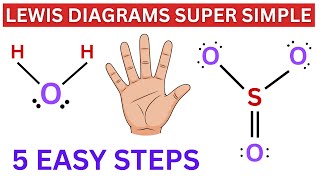
The second is in a situation without ionization in which one of the electrons of one outer shell fits into the outer shell of another sharing an electron and satisfying one atom's veency. Finally, the third is also in a situation without ionization but this time two veence electrons of one atom fit into the veence shell of another atom and the two atoms share two electrons and satisfy the veence shells of both of them. This third type that Lewis denotes actually leads Lewis down a path that ends in the formulation of both the concept of double bonding and the famous Lewis dot structures still used today.
These two papers by Lewis led to the distinction between ionic and coalent bonds and laid a foundation for modern physical organic chemistry filled with seemingly endless ways that elements can connect with one another and build a diverse and enriching universe. If you enjoyed this video, please consider liking and subscribing. Click here if you want to see more scientific progress made during this time period.
Thank you for watching and I will see you in the next video.