The Ministry of Home Affairs has been reviewing and amending the Penal Code over the years to ensure that the law remains fit for purpose. We made major amendments in 2019 and 2021. We have since completed another round of review which has culminated in this bill.
The amendments in the bill cover six themes. First, increase deterrence against scams by introducing caning as a punishment while recalibrating its use in other offenses. Second, enhance measures to address the increasing misuse of technology to produce and circulate abusive materials.
Third, enhance protection for minors and vulnerable victims. Fourth, better protect public servants and public service workers. Fifth, ensure adequate penalties for older youth offenders.
Sixth, recalibrate the requirements on workers and dealers of precious metals. The first category of amendments will enhance deterrence against scams by introducing caning for scammers and scam mules while recalibrating its use in other offenses. With your permission, m Mr Speaker, may I ask the clerks to distribute an annex?
>> Go ahead. >> Members may also access these materials through the MP at SG PAL app. Sir, scams are by far the most prevalent crime type in Singapore today.
Between 2020 and the first half of 2025, there were about 190,000 cases reported with losses amounting to about 3. 7 billion Singapore dollars. These are staggering numbers.
They constitute 60% of all reported crimes and the losses are more than three and a half times the cost of building Woodland's Health Campus. MHA has been working with agencies with other agencies and the private sector on measures to counter the scourge of scams. Earlier this year, Dr Tan Wuing suggested in this house that MHA also consider introducing caning for scams [snorts] to better deter and punish those who commit scams or facilitate the commission of scams.
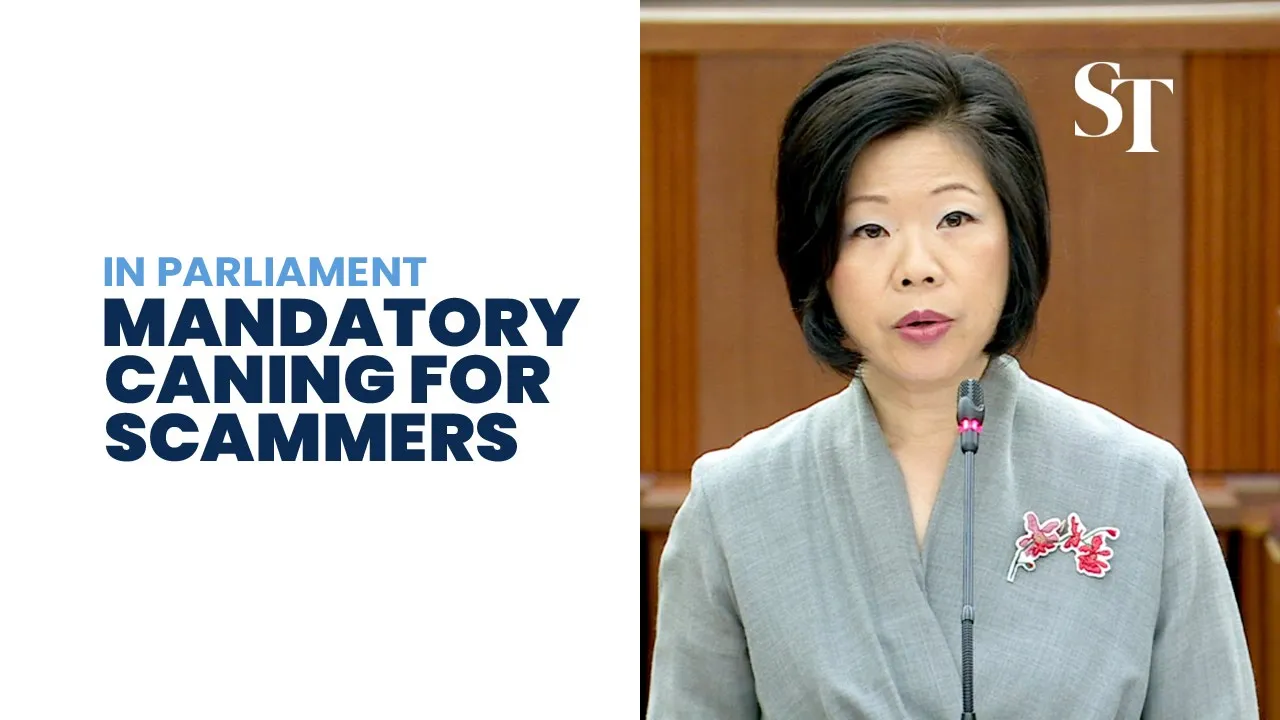
We have reviewed the suggestion and agree with it. Members may refer to part A of the annex for the proposed amendments. We will introduce mandatory caning for scammers.
Clause 64 of the bill amends section 420 of the penal code so that offenders who commit scams defined as cheating mainly by means of remote communication will be punished with at least six strokes of the cane. We will also introduce discretionary cananing in section 420 of the penal code for serious cases of cheating. We will take an equally firm stance against scam syndicates.
These syndicates mobilize significant resources to conduct and profit from scams and have the highest level of culpability. Clauses 37 and 38 of the bill introduce new offenses in the Organized Crime Act so that members of and recruiters for scam syndicates will be subject to mandatory caning of at least six strokes if they knew that the organized criminal group was a scam syndicate. Beyond dealing with scammers and scam syndicates, another key strategy is to deny them the tools that enable them to conduct scams.
These scam enablers include SIM cards, Syncpass credentials, and payment accounts. Crippling the supply of scam enablers would significantly increase the difficulty for scammers to successfully conduct or profit from scams in Singapore. We will therefore introduce discretionary caning for those who facilitate scams.
These are offenders who either knew or had reasonable grounds to believe that the scam enabler they provide would be used in the commission of or would be used in the facilitation of a crime. Clauses 10, 11, 19, 20, and 30 to 34 of the bill introduce discretionary caning for certain offenses under the miscellaneous offenses public order and nuisance act. the corruption, drug trafficking and other serious crimes confiscation of benefits act and the computer misuse act.
In this regard for upstream enablers such as sing pass credentials and sim cards discretionary caning will broadly apply to two categories of cases. First category is where the offender intended or knew depending on the offense that the enabler would be used to commit or facilitate the commission of a scam. The second category covers cases where the enabler is actually used to commit or facilitate the commission of a scam even if the offender did not intend or know this.
For the second category of offenders, discretionary caning will apply if the offender fails to prove that he or she had taken reasonable steps to ensure that the enabler would not be used to commit or to facilitate the commission of a scam. For downstream enablers such as payment accounts, discretionary cleaning for downstream enablers such as payment accounts, discretionary caning will apply if the criminal proceeds laundered involve benefits from a scam and the offender had failed to take reasonable steps to ensure that the account is not used to launder scam proceeds. Let me assure members that genuine victims who are found to have been deceived into providing a scam enabler would not be affected by the introduction of caning as a punishment.
The existing offenses do not penalize genuine victims in the first place. The ministry will continue monitoring the scam situation closely and will further increase our penalties if needed. Mr Speaker, in Mandrin, The government continues to place strong emphasis on combating scams.
In the first half of 2025, there were almost 20,000 cases and almost half a billion dollars lost. While these numbers have decreased compared with the first half of 2024, they are still significant. In this bill, we are proposing to introduce mandatory caning for scammers as well as members of and recruiters for scam syndicates.
We will also introduce discretionary caning for those who facilitate scams through providing enablers such as their SIM pass credentials, SIM cards or bank accounts. If we can deny scammers access to such enablers, it will be much more difficult for them to carry out successful scams and we can better protect Singaporeans. As we introduce caning for scams, we also intend to recalibrate the use of caning in other offenses.
Today, there are 96 offenses that attract discretionary caning and 65 which attract mandatory caning. My ministry has conducted a review to ensure that caning is only applied where there is a need. As members can see from part B of the annex, we are proposing to amend eight provisions to remove caning entirely and in the case of vandalism to remove caning for a subset of the offense.
As our societal context and crime situation have evolved, cananing may no longer be necessary in some offenses. These are generally offenses that do not involve intentional harm to a person nor cause significant harm to the public and for which we assess that the other penalties are adequate. Clauses 41, 61, 67, and 69 to 76 of the bill make the necessary amendments for 15 provisions reflected in part C of the annex.
We propose to give the courts the discretion to decide whether to impose caning rather than to require caning in all cases. These are given effect by clauses 15 to 17, 40, 54 to 60, 6265, 66 and 72 to 74 of the bill. For avoidance of doubt, more serious cases should still result in caning, even as we make these amendments to change mandatory caning to discretionary caning.
Let me illustrate with vandalism. Clauses 72 to 74 of the bill amend the vandalism act so that mandatory caning is replaced with discretionary caning for vandalism of public property and designated private property. The latter category includes private property that is of national, cultural or religious significance and any other private property that the minister may prescribe.
In short, primarily property that has public significance or serves a public function. For these vandalism offenses, we will leave it to the court to decide whether caning should be imposed on a case-byase basis. This approach maintains a firm stance against vandalism generally while allowing the punishment to be calibrated based on the facts of each case.
The court may consider factors like the extent of property damage, the vandal's motivations, the degree of premeditation, and the impact on public services and functions. Similarly, in other offenses which only involve preparatory acts or do not require an element of harm to be present before the offense is made out, we have assessed that discretionary caning is adequate. The courts can still impose caning in serious cases where real harm results or there are other aggravating factors.
This includes certain offenses under the Corrosive, explosive substances, and offensive weapons act as well as attempted robbery and making preparation for gang robbery under sections 393 and 399 of the Penal Code. Let me be clear, the amendments do not signal any softening in our stance against crime. The large majority of offenses which attract caning today, including serious sexual and violence offenses will continue to attract caning as a punishment.
Sir, the second category of amendments ensures that our criminal laws keep pace with technology. First, we are introducing amendments to deal with largecale circulation of of obscene objects which include sexual images or videos. Members will recall the case of the chat group SG Nasi Lamak in which over 44,000 members circulated and shared obscene materials involving women and girls.
The government's view is that the current penalties are not adequate. Technology allows obscene materials to be shared with tens of thousands of recipients through a single keystroke. The harm is amplified many times over.
We cannot begin to imagine the distress suffered by a young girl whose images are sent to thousands of prying eyes. And because these materials can be sent to so many people, it is impossible to take them out of circulation entirely. They will always be lurking somewhere threatening to resurface.
These victims may never have peace of mind again. Clause 42 of the bill therefore introduces enhanced penalties for offenses under section 2921 of the penal code where obscene materials are circulated by electronic means to 10 or more persons. This threshold takes reference from other provisions where the involvement of 10 or more persons introduces a public dimension.
For example, under the Society's act, the threshold size of a group that must be registered as a society is 10 persons. The maximum imprisonment term for such offenses will be increased from 3 months to two years. If the obscene material depicts a minor below the age of 18, the penalty will be mandatory imprisonment of up to four years, a doubling of the current maximum of two years imprisonment.
These enhanced penalties will also apply to cumulative transmissions to 10 or more persons in total to close the potential loophole of accused persons sending separate messages to single individuals but to a large number of individuals. In addition, clause 43 of the bill introduces a new offense to target those who set up and manage online locations where obscene materials are circulated, including administrators of chat groups or channels, blogs, or accounts on video sharing platforms. The offense is scoped to offenders who intend that the online location be used to circulate obscene materials.
It will not cover, for example, platforms whose online locations are used in this way contrary to their original intent or administrators whose chat groups are spammed by bad actors. Given the seress of such conduct, the offense is punishable with a fine and mandatory imprisonment of up to 5 years or seven years if the obscene material circulated depicts a minor below the age of 18. Second, we also intend to deal with the problem of images and videos generated by the use of artificial intelligence or AI.
Let me begin with intimate images or recordings. By virtue of section 377BE5 of the penal code, our criminal laws already cover sexually explicit deep fakes where an image or recording is altered to depict the victim. It is already an offense to possess or gain access to or to distribute or threaten to distribute such sexual deep fakes without consent.
However, generative AI now makes it possible to generate entirely synthetic images or videos of a person without making use of a pre-existing image or recording. Clauses 50A and B of the bill update the relevant provision to get ahead of this development. Clause 49D makes clear that it is an offense to produce any intimate image without consent.
Today, such offenders would already be liable for the offense of possessing or gaining access to an intimate image. But we want to make criminal liability clearer as far as production of the intimate image is concerned. Clause 50C makes explicit what has always been our intent.
That for the offense of threatening to distribute an intimate image, it is not necessary to prove that the intimate image exists. Such threats can cause serious harm even if the intimate image does not exist, especially now that it is easier to generate such images using AI. Sir, let me turn to child abuse materials.
When the relevant offenses were introduced in 2019, it was always the government's intention to criminalize realistic computergenerated child abuse material, even if the material depicts a fictional child. The offenses should not require proof that an actual child was involved, for example, that an image of an actual child was used as part of the training data for the AI used to generate the material. This is both to reduce the roadblocks to enforcement and to reduce the supply of such materials which contributes to vicious cycles of abuse.
Clause 53 of the bill amends the relevant definitions to put these points beyond doubt. Mr Speaker, the third category of amendments builds on past efforts to protect minors and vulnerable victims. First, clause 42 of the bill extends enhanced penalties for offenses relating to obscene materials under section 292 of the penal code to obscene materials depicting minors below the age of 18 up from the current threshold of 16.
This will also bring us in line with the United Nations optional protocol to the convention on the rights of the child on the sale of children prostitution and child pornography. Second, we propose to strengthen the sexual offenses under the offenses generally meet or charges not be preferred because the sexual acts were done. officers of the bill will amend the sexual grooming offenses also apply intended to be done overseas as long as the acts would constitute prevent only when either the groomer or victim travels from a location in to meet.
The amendments also increase penalties for sexual grooming offenses. Fore introducing the Because they cannot and they depend on others even for their abuse. So tragedy woman convicted of murder.
means not for life that life Jesus may be prosecuted under such You know, these provisions were specifically introduced to overcome certain hurdles cases of fatal amendments will be available as a subject such cases. The fourth category servants and public service and public are at risk of in the course of performing their duties and having their identity information published harassment, alarm. Nothing can deter them from discharging their duties objectively and impartially undermines public institutions.
Section six Today removes this in the line of duty. You can experience experienced by the victim should bill introduces a new offense in the miscellaneous offenses accompanied by a defender knows or has reason to believe it's especially harmful because not only are the individual public servants in our public undermined section of the protection from online publishing confidence department of meeting to show diminish To be clear, neither of these quickly through can help us improve our service delivery and staff training. There will also not be any offense disclosed if the feedback is based on genuinely mistaken facts since the offense requires that the person knows or have reason to believe that a statement of fact is false.
Mr Speaker, the next category of amendments in this bill ensures that adequate penalties, including reffirmative training, imprisonment, and caning can continue to be imposed on older youth offenders who are repeat offenders or who commit serious crimes and whose cases are heard outside the youth court. In 2019, the government moved the amendments to the Children and Young Persons Act or CYPA to expand the jurisdiction of the Youth Court to all offenders below the age of 18 up from the previous age of 16. The policy intent, however, was to ensure that if youth offenders between the ages of 16 and 18 commit serious offenses or repeat offenses, their cases could be transferred out of the youth court to the high court and state courts.
In those cases, it was always intended that the high court and state courts will continue to have the full suite of powers to deal with the offenders. However, when preparing to operationalize the CYPA amendments, we identified certain provisions. In the earlier round of amendments which are not fully aligned with the policy intent clauses 3 to 7 and 23 of the bills straighten out these provisions and ensure that the policy intent is given full effect.
In particular, it ensures that reffirmative training, imprisonment, and caning are available in such cases. To be clear, the amendments will not require the court to impose these penalties, nor otherwise limit the court's discretion in sentencing. The court can still upon a close examination of the facts impose a rehabilitative sentence.
The final set of amendments, sir, in clauses 26 to 28 of the bill pertains to workers and dealers of precious metals. The amendments to the miscellaneous offenses act will increase the waiting period before such workers or dealers can work on or deal with goods sold to them from 3 days to five. This will give the police more time to trace and recover stolen goods.
At the same time, we are reducing the scope of the requirement. This waiting period will only apply to the worker or dealer who first receives goods from a customer and not the worker or dealer who receives the goods from another dealer. Stolen goods usually come from a customer rather than from another dealer.
The overall intent of the amendments is to improve law enforcement's ability to trace stolen goods and the criminals while minimizing the burden on businesses in a risk calibrated manner. Sir, the amendments in the bill are part of MHA's regular efforts to make our criminal laws clearer, fairer, and more responsive to the prevailing operating environment. They will help MHA carry out our mission of keeping Singapore safe and secure more effectively.
We seek the support of members for the amendments.