So a lot of people ask me how I study languages. Obviously there's a lot more to it than just the source of learning that you choose, like a movie or a book or going to school. However, people seem to be trapped within just a few simple modes or sources of learning.
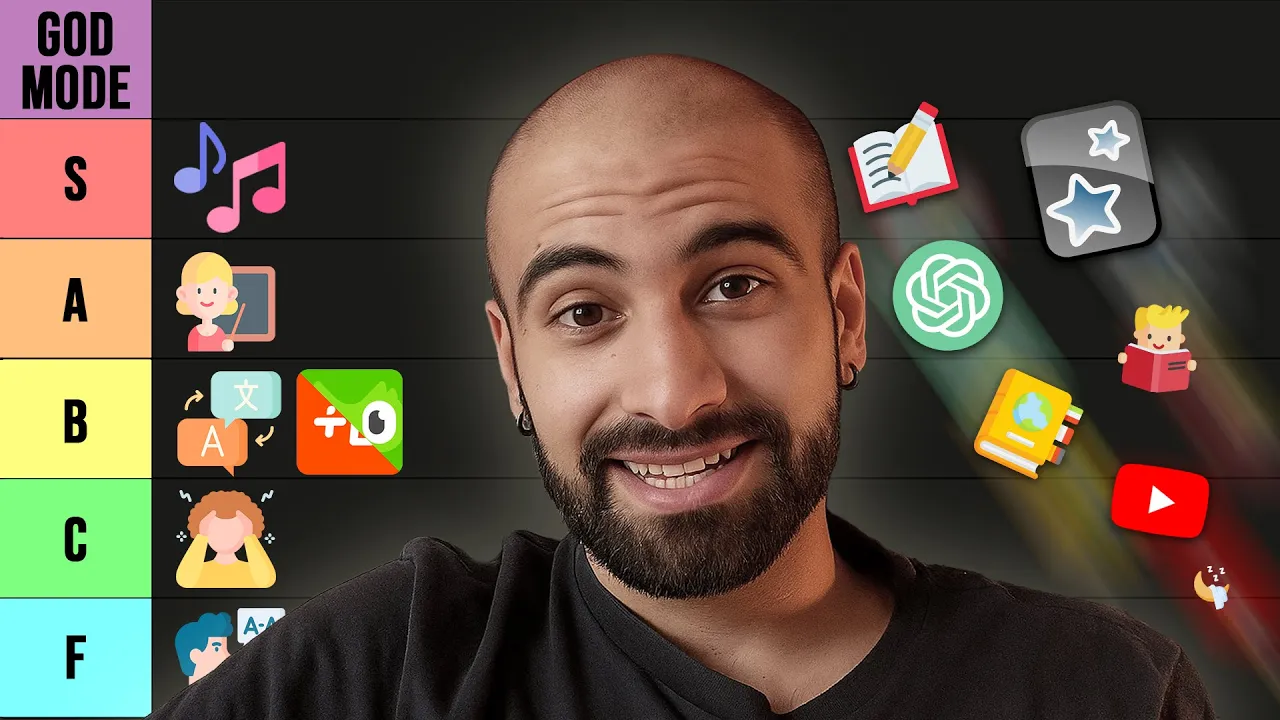
And in this video I want to, first of all, discuss many different possibilities that could help you learn your language and then rate how effective they are. We get a tier list, we get a colorful display of different ranking options and we got six levels and we're gonna rank it together. What I want you to get home is that anything on the garbage part.
. . .
Don't do. It's a waste of time and money. It's probably a scam.
But actually everything above is sort of okay to do. It might not just be as effective. But if it's something that really resonates with you, you should do it anyway.
And I've actually pretty much done all of these things, like all of them and some of them have helped more than others. So this is what we're going to rate, how effective they are, how likely they're going to make it for you to really get good in the language and to be consistent. This is really important.
And also how accessible they are, how expensive they are. So, without further ado. Let's start with teaching.
Now, getting a teacher is pretty much the most common way of learning a language and some people think that that's just the only way. The reason why teachers are so popular, nothing is more historical than anything. Most of the techniques that I'm going to show after that only appeared recently because of technology.
So back in the day, a teacher was the only way for you to get there. So they have a profound impact and a lot of people associate language learning with actually going to class with a teacher in the traditional sense and you will be surprised to learn that that is absolutely fine with me. And in fact in every language where I've done remotely decent, I've had a teacher at some point at least some of the time.
So because of that, I'm going to take having a teacher all the way to the almost awesome. And the reason for that is, well You can find pretty crappy teachers out there. Or people just don't know how to explain their language to a foreign person.
Native teachers, unless they're trained, tend to be pretty crappy. Another reason is they're very expensive. In fact, getting a private tutor, probably is the most expensive way to learn a language.
However, they're really good because they take you by the hand and they adapt to you. You get instant feedback, expertise and they can help you get there in a very targeted way. But the financial side of it and always having to wait for a lesson with them to actually learn is what makes them not really that great and not absolutely necessary for learning in today's world.
The next thing is exercises like language exercises that you find in language learning books. Some of these are sort of alright but I'm going to quickly put them in the desperate measures tab just because what I've really found out and I have family who worked in this industry actually is that these books are often made for the teacher rather than for the student. They try to make them for the student but a lot of the times they're just filled with crap that's supposed to make the teacher relax while you do stuff.
These are not proper representations of what using the language is like. And some of them can be somewhat decent but they're also usually not so great when you're supposed to use them on your own. And for that reason, you know, if you've got one and you just really like it, go for it.
But, for me, desperate measure. Another desperate measure is trying to cram the information, just getting like a vocabulary list or something and just saying okay, that's going in. Learning by heart.
There is a reason why that's not great is because language is not pure memory and memory fades when not used and very quickly goes away. If your brain finds out that you're not actually using it. Having said that, it's not something to completely avoid.
Some words, you just learn by heart however taking it as an approach to learning the whole language will get you absolutely nowhere. What else we got? Oh this is a really good one.
Now a lot of people tend to do this one as well repeating the same words to try to nail down the pronunciation. Now when you're actually doing it just for the pronunciation this could be sort of a right-tish. Here we go to desperate measures straight away but because some some people actually think that they're learning this way.
I'm gonna go ahead and put it in the garbage. Pretty much no use, Waste of your time and you even have to buy some sort of cassette or CD or program that lets you do this, then it is an actual proper scam. The next one is music and here I'm assuming that you're paying some attention to the lyrics.
I actually try to investigate a little bit about the meaning of the lyrics but music on its own is actually a fantastic way to learn languages and I think for all of us, music has played such a huge role. First of all preparing my brain for this sound of the language but also giving me something that I could be passionate about that I would learn by heart without effort just like out of passion and through which I could understand the language in certain expressions really well. Now probably the reason why it's not in God mode even though it has such a profound impact on everyone's learning is that a lot of times lyrics are kind of weird and pretty detached from normal communication.
The language itself is not absolutely great and it doesn't prepare you to be able to speak normally and also tends to be a bit inaccessible for beginners. So for that reason it's not up there with the based but it's pretty pretty good and you could learn a lot of a language just by getting songs and studying them. Now I wouldn't recommend you do any of these things on their own I would recommend you do at least four or five of these but it's really nice to know that you got quite a few options Okay, the next one is learning grammar rules.
The thing is I really like grammar so this is something that I naturally do. I want to figure out the patterns of the language so that I can create new expressions and I can get a bit further without having to have previously internalized all the rules just by exposition. So for me learning the grammar rules is really valuable.
However, it is something that's probably not going to impact your overall performance and your ability to learn so much. First of all, because studying something that you actually internalize it and doesn't mean that you can use it. So things that make you use the grammar well are going to be a little more helpful than just studying the grammar.
And for that reason I'm going to put it with Decent Doodles. So something to do, just not something that's going to get you incredibly far. And there are actually books on grammar.
And the whole book is on the grammar of a certain language. I've actually found useful stuff in these books. But if someone just grabs one of these like they used to do in the good old days and they just intend to actually learn the language just by reading those, that's an actual scam.
So that would go on garbage. But if you are sort of a bit more advanced and you actually want to get a better perspective and understand the language, grabbing one of those books and really going through them can improve sort of the model that you have in your head for how the language works. So for that reason and for that reason only I'm going to save it from the garbage can and put it up with desperate measures.
And now we get on with language apps. So there are some decent language apps like Babbel and Duolingo though, there's many many more popping up every day and I'm gonna actually put these ones again with Decent Doodles. I think Babel is a bit better than Duolingo.
I have seen a lot of examples of Duolingo just teaching a bunch of nonsense or making you feel like you're actually doing something without being tested properly. I think this is especially true with the free versions so we can't blame them for that. But I think Duolingo is responsible for at least introducing a lot of people to language learning that wouldn't have even tried it otherwise.
Definitely not a good thing to rely on for you know, continuous learning but, you know, if that's your thing, they might be a good place to start. There are other apps however, and in this case I'm just taking an example which is an app called Drps, maybe got better probably not. This is the category of apps that we called flashy apps.
Apps that just look really good, really interactive, powerful visuals and sound effects, they do create the impression that you are delving in the language but they're just teaching you a bunch of nonsense or not teaching you at all. So for that reason I'm just gonna put them in garbage. Don't waste your time with that.
Especially don't waste your money with that. Passive listening. Now there's a lot of movements like AJAT all Japanese all the time where you just constantly listen and to being exposed to the language and if you're insane enough to actually take it to the level that you would need can be really helpful and it really prepares your brain for the language To the point where your brain will have deduced and made room for certain words without you actually having any idea what they mean.
But I do think that it's actually pretty difficult to pull off. And because it's so passive, I think it's not making you develop the skills so much as I wanted to believe when I first got into it. But it can be pretty cool.
I'm gonna put it up there with the almost awesome guys. Now're starting to get to the classics. The next one is reading.
Reading is a great way to get exposed to a lot of grammar and words in ways that are actually useful in the language, especially if you choose a topic that sort of speaks the way that you want to learn to speak. But it is often a bit hard and it's often difficult to start from there. You will find yourself not knowing many many many of the words constantly checking on the dictionary while you're reading and the book doesn't read itself unless you do it.
You are the one who's pushing the ball there and for that reason it's a bit more active. It can be very disruptive and make you lose the pace and passion for what you're doing. Reading is one of the four main skills that you want to absolutely get when learning a language.
We have the passive ones reading and listening as well as the active ones which are producing the language by speaking and writing. So reading is fantastic but it does come with all these different shortcomings. So for that reason I'm gonna put it on the based but not on the god mode category.
The next one is social media. Social media has a lot of advantages for language learning. The first one is you are not going to run out of it.
It's practically infinite and the content tends to be very digestible and you use the language that is a bit more close to speaking language which is really what you often want when you're learning a language to be able to interact with people. But a lot of times the topics can be a bit limited and it's also very addictive. An issue I have with social media is that it'll often be mixed with your own language so it's hard to actually create a set of accounts that only show you stuff in the language that you want to learn.
And also, a lot of times the content itself is a bit crap and kind of toxic even in a mental health level. So for that reason, I would say it has a lot of potential but a few downsides. But I think social media is the reason why newer generations, especially in Spain you can see this, are many many times better at speaking English than people that had actually genuinely studied it from previous generations that relied solely on books and teachers who by the way were often not even native.
So I think we've got to give a lot of recognition to social media for this spread of different languages. However, that language is normally just English. So that is to me an issue.
It might work pretty decent with English, but it might not work so easily and so well for others. Pretty solid, still some dangers to it in annoying bits. Another one, and this one was actually suggested by someone.
I've really never done this. Just like people tend to sometimes study in order to cram for exams just literally copying one thing from one piece of paper to the other and maybe the brain will grab a little bit of it but without actually using it I think your skills in the language will not get developed whatsoever so we put this on the scam garbage category right away like something not to waste a second doing. Another one that's going straight into garbage is the theory that if you just put let's say the radio in your target language next to your bed and just fall asleep just let it play it will go straight to your subconscious and you will develop the language without doing any effort I think that is an absolute scam.
You can go ahead and not waste your time with those tricks The next one is traveling to the country or especially moving to the country. This is probably one of the best conditions that will allow you to master the language to a degree that is really, really great. And for that reason, I'll put it straight in to God mode.
But there's an issue with that. And the issue is that that by itself won't do the trick. It will make it a lot easier, but it will not do the studying, the practicing.
It definitely will not do the learning for you. And I'm sure you know a lot of people who move to a different country and still can't speak a word, some of which actually had the intention of learning it. So for that reason, I'm just leaving leave it on the almost awesome but I do want to make a note if you were a serious student student and you're doing a lot of the best work you can.
Moving to the country is gonna unlock some of the biggest chances for you to become an actual master in the language. It might be not replaceable by anything else but it's not a silver bullet. It doesn't do it all for you.
You still gotta do a lot of things. A similar one that gives you a lot of exposition is finding a partner that is native in the language. You want them to be experts but you also want them to be comfortable.
No one's going to actually teach you their second language with so much patience as a native speaker. But a lot of the success stories of people that have really mastered another language come from finding a partner. And this usually goes hand in hand with moving to the country.
And of course the passion, the love you got for this person will really help you conquer the many challenges that you will find in learning a language. But we also know a lot of people that got the partner, they're native, they're happy to teach but they just don't get anywhere with that. So for that reason again, I have to put it in the almost awesome category.
The next one is memes and I'm going to actually tell you memes are downright based. It goes hand in hand with social media but I would say memes that even better. They are super easy to read.
Your brain has to do the least amount of effort and expect the most amount of reward. Second, they're usually written with very familiar colloquial simple language which is the language that you want to go for at least at the beginning. But third, they really take advantage of using the language in a masterful way, while also being accessible.
There's so easy to consume, they just make you laugh. There's no shortage of them. And it's a way of actually starting the language without feeling like you're doing it.
For the time that it takes to consume them and the enjoyment you get and how they can advance your skill and integrate, go deep inside your memory, I think they're pretty great. Now we get into the pretty decent ones. Now we get Chat GPT.
This is a tricky one because chat GPT is really really good at one thing and that is "speaking". Creating text that looks native sound like a human if anyone knows about languages very deeply that's probably chat GPT. It is free and it can give you really good advice it can produce as many examples as you want it can talk to you in whatever language you want even whatever level you want whenever you want in your phone, in your computer really accessible but the tricky thing here is that You sort of need to know what to ask it.
It's kind of easy to get tired of pretty quickly. It struggles sometimes with talking to someone as if they were a learner. So in a way you have to sort of be the teacher manager and the student.
For that reason, while it holds a lot of promise and a lot of startups are making cool apps and stuff that takes advantage of their capability, which is incredible. I'm gonna say it just stays at almost awesome. Unfortunately I couldn't put it up with the greats just yet but I'm sure people will develop some really really great pieces of software that make it fun, easy, very interactive, well tailored to people's level and a bit more accurate too because many of the times when you push it against the wall, ask something about grammar, why is it like this?
I don't understand this, it would just make a bunch of nonsense but one day some app will be on God mode 100% no doubts about that. The next one is something called shadowing. We just hear a native speaker and you try to act exactly like the acted.
Speak like the acted. like they acted. I think this could in theory sort of help you.
Some people swear by it. I don't think it actually accomplishes that much. Especially when it comes to developing a skill in the language and to gaining knowledge.
I just think it's a desperate measure honestly. So for that reason, that's right. Put it next one is translating.
Translating can be a really powerful, active exercise that engages your brain in a way that really helps you learn and develop the skill. So almost like going to the gym and for that reason it's gonna go sort of high. But one problem that I have with translating is that it's often going to fall short because it's going to be restricted by the other language from which you are translating.
So you're not creating in the language from meaning you are creating in the language from the way something was put in a different language already. So in that way it constrains the point of communication. It also can be a bit too taxing on your brain and boring and you have to also find the material that you want to translate and it not being too easy or too difficult So, for that reason, I'm going to leave it at Decent Doodles you know, something to do from time to time and a really great skill that could help you professionally, too but I don't think it's a language learning technique so powerful or so easy to actually implement and continue with Language learning books, the ones you get when you go to a different country they get every single sentence in existence there they barely explain the grammar.
They give you an outrageous amount and variety of examples downgrading to the nitty-gritty without any help without any sort of building up to it. They prepare you to say pretty much everything of every situation. Don't explain you why something is said the way it's said.
They're just an ungodly amount of undigestible information. But for some reason, people used to buy and believe in. And I honestly hate them.
They're only ever said are useful if you actually had to have it in your hand and look up something. Woah, this is the sentence and you just say it. Obviously, this is total crap.
And since the creation of translation itself, this is completely obsolete and useless even more than it was already. The next one is Flashcards. And I have two types of Flashcards and this is just the logo of the Anki app which is the most common, probably most complete Flashcard app.
Open source is pretty cool. The first one stands for just bland Anki. So just a word, no context, no voice, no color, no nothing.
Just downright Flashcards like you can find in school. I would say this gets at best to desperate measure. Won't get you far.
Doesn't train the skills so much and it might help you learn some words by heart but I would say that format is a really poor implementation of flashcards which are actually pretty powerful. The next one I would say is flashcards gone pro you don't have words but instead you get sentences you make sure that the context is there and that it makes sense. Not only that the context is global so you're not just making different sentences that different people could have said in different situations but instead you actually take them from video course, from a movie, from a show, from a book, something that is actually sort of a topic with continuity in which the sentence make even more sense.
You make sure you got high quality audio and you make sure there's variety in this type of flashcards. You got to understand the native language, you got to understand just the audio, you got to understand just certain words from a sentence, you got completions, you got reversals, you got to produce the language, you know, you got variety in there. If you do that, we are talking about some really based technique.
The only shortcoming of these to not put them on God mode I think is that they may not be so fun but it's a bit like going to the gym. It don't need to be fun you just do it and they are pretty quick to do pretty accessible and they really really train the skill at a sort of subconscious level. By the way this is the stuff we sell in the webpage so if you are interested in that you know where to go.
The next one is something that I have pretty much never seen discussed in language learning channels or debates or books or anything and that is playing video games. Now video games are not for everyone but there's certainly here for some people. video games are actually absolutely great for language learning.
And the reason for that is that they are absolutely surround multimedia experience. Video games have a lot of text. First of all, often you got diaries, you got the menus, you got to interact in conversations but you got also audio and you get a lot of audio you get a continuous, cohesive context that makes a lot of sense you actually interact with all this content and perhaps most importantly, they are really fun So you can get lost in the actual game which really puts you brain in the perfect state for language learning.
Now the only one shortcoming I see is that they're blocking your ability to go into the dictionary check what something is but I do think that this one is going straight into God-mode. Of course you've got to find a good video game that makes sense. I can recommend Bioshock, The Witcher, probably many other games too.
Also even games without sound can be really helpful because they let you read the text and get used to it at your own pace. Overall really really overlooked and really really amazing technique. The next one is YouTube.
YouTube is fantastic for language learning. There's even an extension for that. You got subtitles, you get unlimited content that is really high quality.
You often have a language which is supposed to be understandable by a wide variety of people, conversational, but also interesting. And every last topic that you could ever dream of. The only shortcoming is that sometimes it's so cool on its own that you will forget about the studying part and for that reason I'm gonna put it on Based to put the next one on God mode.
And the next one is just YouTube as I've described it with all this greatness but instead of watching different video every time watching the same video many times and then moving to a different video. Just making sure that you watch some of the videos more than a few times. And this is kind of difficult to explain.
I got a whole video on why this is amazing but when you give your brain the chance to learn from the same material it builds up the knowledge and lets it penetrate deeply into your subconscious in a way that develops the skill in an active way somehow while the activity itself is pretty passive very similar to how children learn languages through repetition also this is really great because Youtube videos are usually pretty short so you can watch them many times over in a relatively short amount of time and this technique watching the same YouTube videos many times over, I do remember clearly when I was 11 years old, was the thing that elevated my ability to learn and communicate in English like no other thing had. Very similarly with movies you get audio video and interesting plot, great characters, you know all the things that make it engaging for you but if you rewatch the same movie you get very close to getting all the juice out of the examples on the media and then we got just three more we got speaking, having conversation with people and I'm not talking about just regurgitating sentences and sounds I'm talking about having conversation with people And this is actually fantastic, this is Based But it can sometimes be intimidating, it can be challenging You need another person to be there for you. Chat GPT and language learning models are not so good at this yet, especially in languages that are not English.
So speaking and conversations and interactive conversations. Absolutely foundational. Absolutely trains the skill in an active way.
But because it can be a bit intimidating, I understand that it's hard to implement regularly. The next one is writing and it goes in the same way. This is one of the four foundational skills that you need to be able to do and writing actually really helps you clean up your brain and sort up your thoughts and your understanding of how to use the language.
And you would quickly realize, oh, I don't actually know how to say this. I forgot this word, but there's something you want to be able to do. And by grabbing the word and learning the word while you're doing this process, you're really, really good.
Writing is just fantastic for learning how to articulate your thoughts and the language itself. But of course, it can be challenging, it can be a bit boring, it can be a bit too hard a bit too intense to do repeatedly the register is a bit different from the one when we are speaking so it will feel sometimes a bit detached from the set of language that we want. I recommend you do it anyway until the point where it doesn't get that hard so you can really take advantage of it.
But perhaps something that is the perfect mix of having conversation and writing and I realized this early when I was learning Chinese is chat and there's plenty of chat apps that are specifically made for you to interact with random people that are native to the language that you want to learn and that are learning the language that you speak. And I'll put this in the absolute top tier. And the reason for that is that it's not so intimidating.
It's not so demanding as speaking where you need to actually articulate things fast, but it also trains your ability to articulate in a bit more thoughtful way while being very interactive. The level of entry is not so high. You usually will be also speaking with a person that sort of understands your language because they will be wanting to learn that otherwise, Why are they talking to you?
People are also a lot more available on their phones for a quick chat and you can also you know do calls voice messages too, sometimes, you can send images you know so i think that actually is as good as it gets and it trains both of the skills beautifully so probably this is the best so i would use as much as possible exposition to the language through memes, music, flashcards, youtube movies, reading, doing a fair bit of writing, doing a fair bit of conversations if you can. I would actually experiment with video games if that's something you like. I would definitely do YouTube movies on repeat.
And I would try chat apps Now, if you can afford it and you think it's good for you, get a language teacher, just saying that it's not absolutely necessary. If you can move to the country, definitely do so. If you're serious, it's going to get your level incredibly high.
Do use chat GPT and language learning models as much as you can and do give a fair consideration to the grammar. But please don't do anything on the garbage side and don't try to get too far using the desperate measure. This is just my opinion of course different people have different experiences but for me this is it.
This is a pretty solid stuff and this is how I learn my language these days usually. I rarely have a teacher because I feel like I don't need to you know there's better things but of course having the experience of learning helps you do it yourself without a teacher. Maybe if you're a complete beginner in language learning even if you do these great techniques you, you might still feel lost in which case, you know, getting a teacher can be ideal.
This is just how things look for me at the moment. I hope it helps. I hope you got some good ideas about what to do.
I also get a bit of understanding on why these things are great or crappy, at my opinion. Thanks so much for watching. I'll see you on the next video.