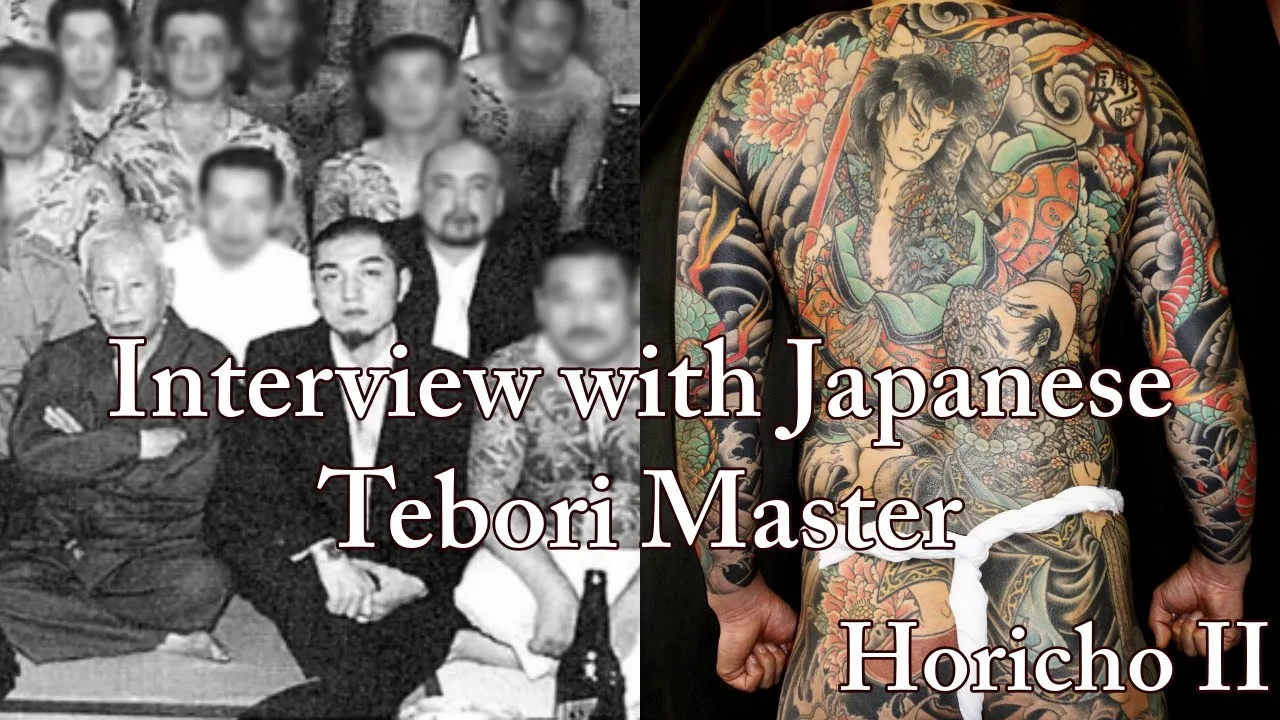
Today we sit down with traditional Japanese tattooer Horicho II of the legendary Asakusa Tokyo-based Horicho family We get to learn about his upbringings in the tattooing world, his composition style, we get to ask him a bunch of questions and we also get to walk through some of his exemplary tattoos. This interview is pretty special because Horicho used to operate in the traditional secrecy of the Japanese tattooing world, and it wasn't until 2023, when he opened an Instagram account and I reached out I was like "Hey, I love your work, I would love to get a back piece done by you, and by the way, I would also love to interview you. " Fast forward to 2024 my back piece is almost done and here's the interview so, without any further ado, let's just get to it Enjoy the interview At first, I was going to get a one-point tattoo by one of the teacher's apprentices, about half way up my back, and I was looking at the materials while waiting.
There were a lot of the teacher's works on display. After going there a few times, I realized that the Japanese tattoos here were different from the yakuza tattoos I had seen, and had a kind of stylish feel to them. I don't know what's so good about them, but they have a stylish feel to them, and, while I was going there, I started coming to see the reference room a lot.
I wanted to tattoo what I saw myself, and I thought that a person who tattoos is the only one who can tattoo (no one else can do what they do), and is an irreplaceable craftsman, so I decided to become a (traditional Japanese) tattooer. So, how could I become an apprentice? Well, I had heard a rumor that he didn't take apprentices, so I had to meet the teacher somehow, so I said, "Then I'll have him tattoo my back,'' and made an appointment.
At first I pretended to be a customer, and after that. . .
"Actually, I want to be your apprentice," I said. At that time, I thought, "I probably will have to go back,'' like "I'll be refused and I'll have to go back,'' but he just said, "Bring some drawings. '' It seems like he thought, "Well, he'll probably quit eventually.
" I asked about it later. That's how it started. Around that time, one point tattoos and American tattoos were coming into Japan, and there were (Western style) tattoo artists, but I wasn't interested in that at all.
When it comes to Japanese tattooing or "Wabori'', as the word that everyone knows it for, since that is the only type of (Japanese) tattooing that exists, doing tattoos by hand (instead of machine) was commonplace. That's why I didn't have any interest in becoming a (Western style) tattoo artist. I already equaled "hand carving/Tebori'' to "tattooing'', so it was natural for me to do it by hand from the start.
So, after I became a disciple, when I went to have the tattoo done by the teacher, I would bring a drawing with me at first. After the session, we finished about 10 minutes early and cleaned up together afterwards, and he would check on my drawings. So, it was mostly only when I was getting work done, but after that I was commuting once a month from Yokohama.
Eventually, I decided, "I can't live like this anymore'' and started living in Asakusa. I rented a house nearby so I could go as soon as I was called, and then he would said, "Okay, you can come. '' At first it was just cleaning.
While I was cleaning, I laid out the futon and fetched water. The tools were never allowed to be touched. But other craftsmen don't let young guys touch the tools either.
Watch from a distance and think about how the teacher is doing what he is doing, and what the teacher will do next, so you can be proactive. Remember your teacher's support. Then, eventually I understood, "Just do this.
Just do that. " Then, when customers arrive, welcome them. Next time, keep drawing until you are called.
At that time, I still couldn't get to practice actual tattooing. Because many people came to get tattooed and could become "victims". The teacher wouldn't even let me touch the machine until I was able to draw to a certain extent.
There were days that were like that all the time. Then I was taught how to make needles, but until I got the OK, I kept making them myself. Once I got the OK, the teacher would finally use them.
It's not like there were jigs like there are now. In the past, people used to use glue , Japanese paper, hanging candles, and other methods that are popular now, but these were the norm back in the day. Then, once I was able to properly setup the tools, I was happy when the teacher finally used what I had set up.
After that, I gradually started to be able to work behind the scenes while the teacher was working, wearing just my underwear and working on my legs. I had to go when I'm called, so I would go with just my underwear. .
. That's what it felt like. The teacher would only check my drawings while taking breaks such as a bathroom break, and when I became his apprentice, he didn't teach me anything.
Other craftsmen also say, "Just watch and learn for yourself,'' which is the Japanese style. That's why I pretended to have something to do nearby so I could peek at his work without entering his space. I did this every day and it was always burned into my eyes.
The difference between Tebori (tattooing by hand) and machine tattooing is that with a machine, you are painting on the surface. Tebori goes deep into the skin. To exaggerate, it goes all the way inside, so even after 10 or 20 years, it will still seep into your body and feel like it has become a part of your body.
Machines now have very good ink, so they last quite a long time, but if you try to match the colors, or if you leave them exposed to sunlight for a long time, like stickers pasted outside , the prints will fade. On the other hand, if it is hand-carved, at worst it will smudge and get dirty , but I think it will fade with age and become better . In my case, the reason why I use a machine to carve the lines instead of "completely by hand'' (So-Tebori) is that machines are faster when it comes to round or thin shapes , and I can carve them neatly, but for the very thin lines at the beginning, it seems like it's a lot better.
So, I use a machine. The Tebori for the middle and thick lines starts from there. If you use a machine to do thick lines, it will have a different touch, so I only use machine for the thinnest lines.
The colors and the shading is by hand. Broadly speaking, as everyone knows, Kanto is where the "Hikae'' is short, reaching above the nipple, and Kansai is where it goes to below the nipple. Also, Kanto is where the skin break lines are thin, and Kansai skin break lines are thick, but in Japan today, there aren't much regional differences.
More than that, in the past, people who were influenced by Mr Horiyoshi II in Azabu and did that kind of background still call it ``Kanto-bori'', but now there are people who do thin and thick lines, so I don't think it's just because of the thickness of the lines. In my opinion, people from Kansai do thicker lines, and since they are thicker, the gradation range goes from pitch black up to being almost clear like water. In my opinion it makes for a really beautiful image.
There's only really a few people who can do that nowadays. Being honest with you. That's why people who tattoo by hand, although they aren't competing with each other to see how far they can create the gradation, from pitch black to water, in their minds, they've all been trying to see how far they can take it or how beautifully they can make it.
I feel like it's some kind of special training. However, the recent trend is to use just pure black and gray, with two colors blurred together, and maybe it's good thing in the long run, who knows. I'm all about the gradation becoming almost water-like.
Because it's my teacher's style, I always pursued that range, but after about 10 years, the lightest shade disappears, so lately I've been trying to finish with two or three shades of darker color. So. .
. Kanto-bori, when you look at the kimono or hanten in the old videos, you might feel like it's not stylish, although maybe people don't think that way now. In terms of Kansai.
. . I would say that the compositions tend to be bold and simple rather than delicate, and there are some really powerful compositions.
Kansai tattoos have a slightly scary image. . .
though that's what I used to think when I was younger. Lately though, I've been seeing a lot of cute, American traditional-style, pop pictures with thick skin breaks, so my image has changed a bit. In my case, I don't particularly consider myself to be Kanto-bori.
I've been doing the Horicho style for a long time, and it doesn't feel like it's thin or thick in terms of the "mikiri". That's why in Japan today, there are many cases where people are getting thinner or thicker lines because it's a trend or something, so I think that kind of thing may be becoming less common these days (the distinction between Kanto and Kansai style). When it comes to colors, I'm very particular about the sumi, vermilion, and our (family style) green.
There may be many styles that use a little bit of brown and yellow. As expected, I don't use bright red that much, and instead use something a little more orange-ish. I don't really like harsh colors, so I think I've toned down the color a little.
I don't think too bright colors would go well with Japanese carving. When the sumi blends in and fades, it would be a little strange if the other colors remained bright (like current colors), so I choose slightly lighter (less bright) colors. When it comes to style, I try to keep it neither simple nor detailed.
It may be that I deliberately restrain myself from thinking, "I want to do this in more detail,'' and I may also be very conscious of not including too many patterns so as to make it too cluttered. In my case, I don't think about Kanto-bori or Kansai-bori. I've been practicing the teacher's style all this time, so I change it up from time to time, making it a little more exaggerated, or making it a little more detailed.
I do it according to the situation. Generally speaking, I don't have a particular preference about whether the background lines are thin or thick, I just choose the thickness that suits the person's body. For example, if a person is overweight, you can make them a little thicker, or if a person is thin, you can them a little thinner.
Also, for example, in the hikae area, if the person is very thin, in terms of length and balance, if it's a half sleeve (5/10), I'll make the hikae smaller. If I extend it all the way to the wrist, I'll do it all the way down to the bottom of the nipples. If the person is overweight, so much so that the breast is sagging, doing it above the nipples will result in a lot of space being covered, and it will be weird if it's a half sleeve, because if the lines here (arms) and here (breast) are parallel, it's not cool.
I would recommend 7/10's. That's basically how it's structured. Also, when it comes to the background, everyone's backgrounds are becoming more and more realistic.
Realistic waves, wind, storms, etc. It becomes a bit of a landscape, so the motif, I think of it as a frame that balances the subject and the body, so I try to fit all the pictures properly within that frame. That's why I don't draw in a way that leaves the frame.
Also, the good thing about Japanese backgrounds is that if you study properly, you can cut and later connect backgrounds easily. So, if you have been trained properly, you can connect things easily. Just drawing circles and drawing lines is something anyone can do, so I think it's a bit of a cheap job.
I do most of my work keeping those things in mind. That's why, even if in the future you go elsewhere to continue your work, I make sure that the work is done in such a way that it can be continued or finished by others who are properly trained Because my customers usually focus on their backs and Japanese tattoos are developed starting from the back, with the back usually being the widest area, they're usually human figures. If it's a small person, choosing human figures make the work look bigger, and if they want to include living things, I tell them, "It's going to be a little smaller scale then,'' and proceed like that.
Personally, I prefer warrior paintings from Japanese stories to Suikoden. I like things like Ryuomaru. I also like Unryukuro.
By now there's nothing I want to do. When a customer says, "I like this,'' I say, `"Okay, let's draw a picture. '' I make a drawing , answer any questions or requests, and modify the drawing accordingly, so as not to be similar to other tattooers.
It's a feeling, so I express what I want to do within it. Also, the space provided by the body is roughly fixed, so if you tattoo a lot, you develop patterns. I don't know if that's a good thing or a bad thing, but I think it's better than saying, "That style is ours'' and changing it every time to match the trends.
There are many Suikoden works, but the one that everyone likes is definitely the "nijubori" tattoo, where the character in the tattoo also has tattoos. My teacher used to call it "zeitakubori. " In any case, when people say, "I want to get that,'' I say, "Well, there's something like this in Suikoden.
'' After all, characters like "Kumonryu'', "Chojun," and "Kaosho'' are popular. People find it impressive, and it's nice when people order it and are like, "I like this. '' In my case, I make sure that the style of the "nijubori" matches the actual body, and I pay attention to the direction of the background, and make sure the background of the tattoos in the tattoo are not made with "jaribokashi", but with proper lines, including the directions in different areas.
I think of adding the lines properly, as if done on a real person. In the beginning, I didn't know anything about the teacher's tattoos. At first, I kept looking at his style and looked at all the tattoos in his book, but when I became his apprentice, I was able to imitate the teacher's drawings, by drawing them myself.
For the most part, Kuniyoshi is the base. At first, everyone looks at Kuniyoshi. At that time, I didn't want the ukiyo-e itself, but I thought, "Maybe I can use this as a sketch,'' or "I could use it for tattoo.
'' So I started looking at ukiyo-e books, and then I started thinking about the shapes, the motifs, and studying them. So instead of just using the Ukiyo-e picture itself, I took hints (ideas) from it. After that, instead of Ukiyo-e, I took inspiration from people like Kyosai, who created hand-drawn paintings called "hanging scrolls".
So I guess I was influenced by that person. Now that I've seen most of those kinds of works, I'm trying to absorb them into my own work. When a customer first comes to me, in my case, I say the usual greetings, tell them a little about my plans for the day, and then start right away.
I start by talking about various things. There are people who can take the pain and are not nervous, so we get right to business, but there are also some customers who come in nervous every time, so I talk with them a bit and get them relaxed. Some people also can't last two hours, so in those cases I don't say anything other than the initial greeting, and we may talk a bit at the end.
In the case of Wabori (traditional Japanese tattoos), it's a one-on-one space, and people come here for years to get work done, so strong relationships are built over time, and people who can't maintain that kind of relationship won't come. There are some people you become good friends with, and there are others who once the work is done, it's over. My teacher often told me, "While you're tattooing, it's best not to make friends with the customers until the tattoo is completed.
'' We keep it professionally courteous. After the work is done, we say, "Okay, let's be friends,'' and we go out drinking together, go to various get-togethers, and such. There is also a pattern where the relationship is severed once the professional name is tattooed in.
I haven't taken apprenticeships for a long time, but the conditions are, if somebody would come and say "I want to imitate the teacher's work,'' "I want to study in his way,'' "I want to be able to tattoo in the same way,'' and so on. Somebody who's really into the Horicho style. Without that, the relationship probably won't last, and nothing will come out of it.
I don't know about young people these days, or rather people around the world, but it's a bit like the "master-pupil relationship in Japan. '' Being an apprentice is a little different from working at a company or school. When you become an apprentice, people don't even look at your paintings at first.
Kids these days might not be able to last much because they will be doing things like cleaning a lot. There will be some things that they won't like doing, They might be like, "Oh, I can't tattoo yet? Kids these days get annoyed, because they don't have much patience.
I think it probably won't last. So if you don't have a strong desire to create similar works or carry on this tattooing tradition, you probably won't be able to persevere during such difficult times. In the past, I used to make my contact information public, so about three people would come a month, and even though I didn't make them apprentices, I looked at their paintings, but since they wouldn't get the "OK" from me, they didn't feel like coming back.
There are too many people who just want to be apprentices in name only It would probably be better for the would-be apprentices if they brought several drawings for me to check, but since they can't even do that (they leave at the first rejection), I feel like most people probably won't last. Honestly, I'm not that strict. But in any case, that's why, after all, you have to judge, "Will this person last?
'' Most of the time, they'll disappear, and if that's the case, you'll end up thinking, "I'm glad I didn't take them in the first place. " Right now I don't have any particular plans to take apprentices, although I think I would like to eventually teach someone who has the guts to come along and stick to it. Although I'm still learning as well, maybe I'm not mature enough to teach others.
I don't know. I don't have any plans, but I think I'll probably continue tattooing in this style until I can no longer move my body, and I don't have any desire to become famous by doing some kind of (dramatic) action. I think it's better for me to hone my skills and study than to take some dramatic action, so I'll probably just continue this way of being.
If somebody comes to me, I will give them my best I would like to work together with those who share the same artistic sensibilities I guess that's how I feel, like continuing like that Jean, thank you very much for coming from a far away place. Lastly, I'm a little bad at talking, but since I'm on Instagram, you can go see my work, and I hope that you will feel it's representative of Japanese tattoos and feel something. That would be nice.
Thank you very much.
![Japanese Bodysuits Walkthrough - Asakusa Horicho II Interview Part 2 [ENG/ESP/JPN SUBS]](https://img.youtube.com/vi/OPs6GzKc3dc/maxresdefault.jpg)
![Rico Daruma [Traditional Japanese Tattooer Interview]](https://img.youtube.com/vi/x3TIjiHkiRU/maxresdefault.jpg)
![The Buddhist Deity Fudo Myoo [History and Traditional Japanese Tattoos]](https://img.youtube.com/vi/1J0BiFaArEw/maxresdefault.jpg)
![Tutti Serra [Traditional Japanese Tattooer Interview]](https://img.youtube.com/vi/j-aK3--8Y4g/maxresdefault.jpg)

![David Ramirez [Traditional Japanese Tattooer Interview]](https://img.youtube.com/vi/-gW4sE2YzRU/maxresdefault.jpg)
![Yutaro Warriorism [Traditional Japanese Tattooer Interview]](https://img.youtube.com/vi/bazkfY7A9BE/maxresdefault.jpg)
![Horibudo I [Traditional Japanese Tattooer Interview]](https://img.youtube.com/vi/4uH6CSRhDLs/maxresdefault.jpg)
![Rodrigo Melo [Traditional Japanese Tattooer Interview]](https://img.youtube.com/vi/JkojuEKGcMA/maxresdefault.jpg)
![Kian Horisumi [Traditional Japanese Tattooer Interview]](https://img.youtube.com/vi/TV5_eHhn9w0/maxresdefault.jpg)
![Hugo Hab [Traditional Japanese Tattooer Interview] [ENG/ESP SUBS]](https://img.youtube.com/vi/VMcXq-UVbzk/maxresdefault.jpg)
![The Suikoden Outlaw Chojun [History and Traditional Japanese Tattoos]](https://img.youtube.com/vi/FqqBiRKRfhU/maxresdefault.jpg)
![Kisaragi II [Traditional Japanese Tattooer Interview]](https://img.youtube.com/vi/-n5Iwj1Twoo/maxresdefault.jpg)
![Damien Rodriguez [Traditional Japanese Tattooer Interview]](https://img.youtube.com/vi/R-8UBuWUS8g/maxresdefault.jpg)

![The Japanese Folk Hero Kintaro [History and Traditional Japanese Tattoos]](https://img.youtube.com/vi/MrUDRu2sF6E/maxresdefault.jpg)
![Interview with Japanese Tebori Master [Teaser]](https://img.youtube.com/vi/kROq1AG8uLQ/maxresdefault.jpg)