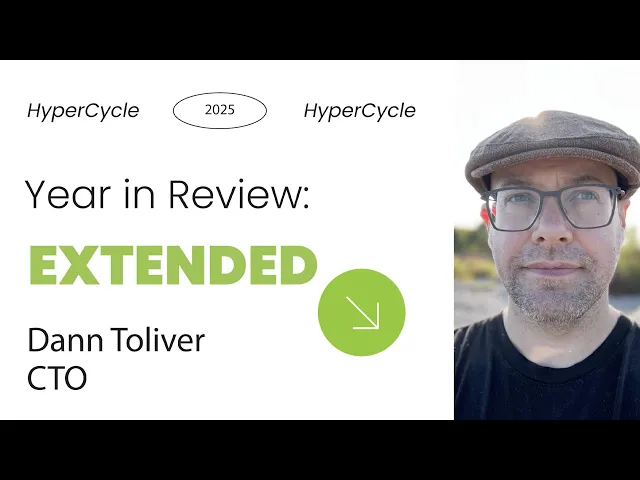
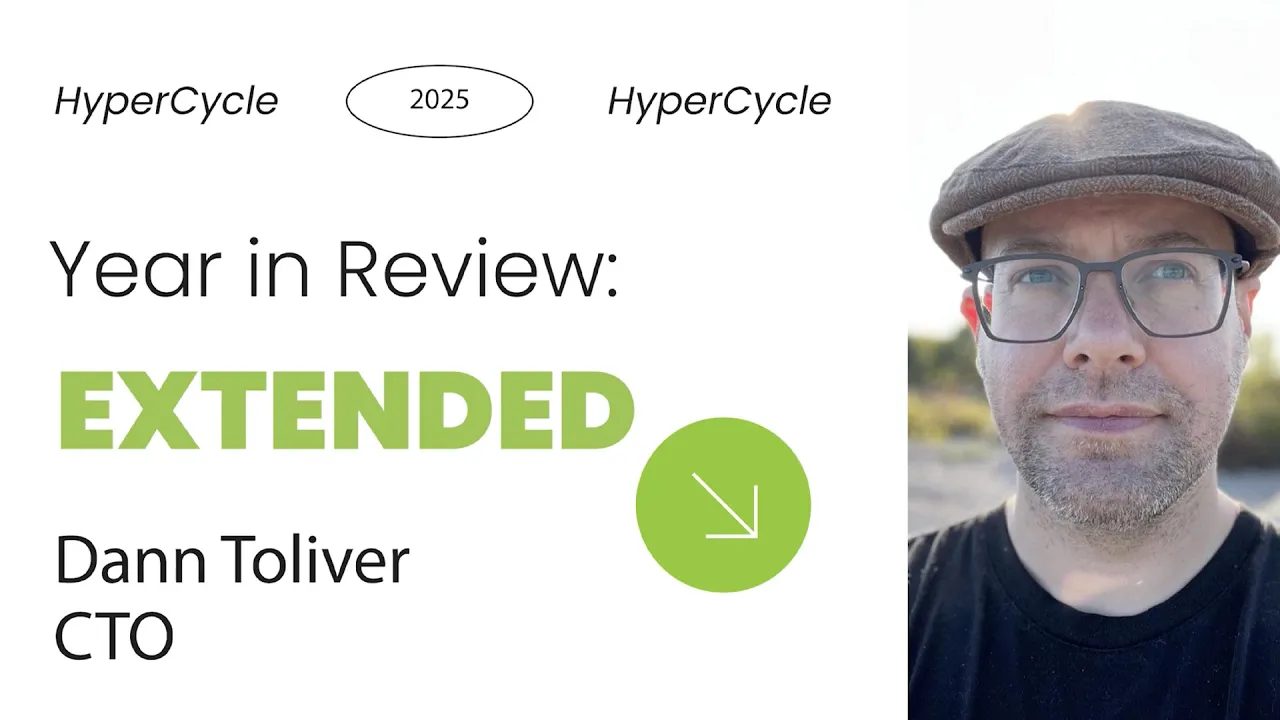
[Music] Hello, Hyp Cycle community! Today we are going to dive into the heart of innovation, and by that, I mean our engineering team. As we all know, 2024 has been a groundbreaking year for Hypercycle's technology, and we're excited to have none other than our Chief Technical Officer, Dan Toiv, with us today.
Dan, welcome! How are you? Hi, everyone!
Great to be here. Thanks, Sh! Oh, we are happy to have you, Dan.
So, let's start looking back at 2024. It's been a very intense year, filled with product development, deliveries, but also challenges. I guess I would like you to walk us through all the key milestones that you have achieved this year.
If you want to talk about that. Uh, yeah. Well, all of them would be a long list, but I can throw out a few.
So, yeah, node factories—I think that was a really big one this year. Being able to put together this kind of business that encapsulates all of the different pieces that have to go into a node and then allows people to manage that business, and ultimately to sort of franchise off of it as they are unlocking new nodes from their Node Factory, I think that was a pretty major arc of product design and engineering as well. The AIER, which ended up producing a ton of AS for us, I think that was another milestone as well.
Obviously, HTS was a big milestone. We did a bunch of hyper appliance work in terms of distributing those out, but also in terms of the engineering behind the scenes for getting the hyper node set up on the hyper appliance, getting aims that were compatible with it, and then working through a lot of interface issues of various kinds with it. The Explorer, which I believe we're launching very soon—so by the time people see this, it will presumably be out—that was another milestone on our side.
I'm reading from a list; I'm not just making this up as I go. I actually prepared for this, if you can believe it! Yeah.
I would be wandering around a lot more in the crevices of my mind if I had to do this in real time. There has been a lot of deep work that we've done in the kind of engineering, I guess more in the R&D side of things, on the implementation of SAT servers and the specification of those over the course of this year. That's mostly LED WR by Robert, with myself and TWY involved, and then a couple of people on the implementation side.
That's been very productive this year, and I think that we will see the fruit from that tree, no pun intended, ripening next year and coming out, which is amazing. Yeah, because that gives us some abilities that unlock our ability to do things in a different way than we've been able to do it so far, and that's part of the foundational story of Hypercycle. But that kind of deep work is something that just takes a long time.
Those seeds take a long time to grow, and it can't really be rushed. Probably my favorite thing that we launched this year on the Hypercycle side is the Hyper Y project, actually, which again, I think will have been announced by the time people watch this, so it's okay for me to talk about it a little bit. This is a great project; I'm really excited about it.
Al, so many things! Thank you. Oh, I guess I agree with what you are saying.
The Hypercycle tree has so many branches that even for us on the marketing side, it was a bit stressful to imagine how you would pull that out, you know? How you would be able to connect all those moving parts together and actually design what was intended. So, really, really impressed by the work that you all did, and really, really congratulations to all of you.
I'm sure that there were some moments that stood out for you, and perhaps you had a major challenge that you had to overcome, or maybe an unexpected breakthrough. Maybe you want to talk about that a bit. Yeah, um, you know, I didn't mention it on that list above because we haven't launched it yet, but something I'm really excited about is the Hackathon Kit.
So this is a kind of bootstrapping kit or SDK for app developers to be able to build on top of Hypercycle. A lot of the big picture stuff comes down to perspective, and that's changed a lot. That perspective that we have on what we're building, and how we're building it, and what Hypercycle is—that perspective has changed a lot over 2024.
So we're seeing Hypercycle very differently now than we did a year ago, and this Hackathon Kit is both the outcome of changes in perspective that we fought for. These are not gentle changes in perspective where you just kind of gently walk or flow, you know, and drift into a new perspective; these are things that we're actively fighting for to climb these kind of hills so that we can see things differently from the top of that hill. We fought for some changes in perspective over the first half of 2024, so the Hackathon Kit is both the outcome of that.
But it also is stimulating still more changes in our perspective as we focus on what it really means to run applications in this fully distributed setting and to run them on top of this fully distributed engine that we're building. So I think this is the most exciting thing, really, that hypercycle is doing; it changes the way that AI works as the internet of AI. But it also, that change ripples out to ultimately change everything that we're doing with computers, including the way our apps are built and the way that they're used, really, because distributed apps work differently.
For the most part, they work differently in a good way. So I'm really excited about that. Thanks for the great insights!
Then, if you don't mind, the next segment of our interview will focus on an outlook for 2024, and my first question is: looking ahead to the year, what are some of the most exciting developments your team is working on, and what should our community be excited about going into 2025? Well, you know that I hate talking about things before they happen, but since it's the holidays, I'm in a generous mood. Technically, this hasn't been released yet, but I mentioned the Hyper Y project, and in my mind, that really is the most exciting thing that we've worked on to date in 2024 in terms of its impact.
It's such a great project, and there's a great team of people on both sides of that who are really putting the benefit of this global movement first, and I think that makes such a difference when we're engaged with a group like that. We can really work together to build something that meets the needs of a broad community in a way that's very focused and is not impacted by incentive misalignments; that makes a huge difference. From a technical perspective, this project paves the way for building in this new distributed style that I was talking about.
Because we're building an interface that allows us to chat with multiple agents and interact with them in sophisticated ways simultaneously, those agents are drawn from a cast of, in this case, in the case of the Hyper Y project, a cast of thousands—tens of thousands, potentially—and they're pulled in as needed to help the user with whatever they need. So really, that's going to end up serving as a template for everything that we build as we continue to develop applications on top of this and scale this out. The ideas that we're developing there on the interface side are really a way of engaging with this fully distributed setting; it's a microcosm of it, but it also stretches what we're looking at in terms of the numbers involved.
So yeah, I'm very excited about this. It's like a huge sandbox for Hypercycle. That's right, and it really maps well to the federated nature of that movement, right?
Because there are over 12,000 independent associations, and each of those really is its own independent autonomous agent. You need to be able to interact with those, ask questions, and perform operations—book times, book rooms, do different things with those agents independently in a single unified interface. So that really perfectly maps to our desire to build these fully distributed apps and to build interfaces that work on top of this distributed system that's underlying it.
I need a better word than "distributed. " Maybe I should say "decentralized" system, but that word comes with so much baggage these days, right? What I really mean is a system of independently interacting, sometimes cooperating, sometimes transacting agents.
The magic that Hypercycle brings is that we're able to allow these agents a wide variety of different ways of interacting. This isn't just actors engaged in some kind of economic game where they're using game-theoretic economic incentives to try to coerce their behavior so they work together. It's not the alternative, which is the corporate setting, where you've got a big data center and a bunch of servers forced to cooperate with no kind of choice in the matter.
These are actually independent interacting agents who can transact if they need to, in terms of micro-payments on an agent-to-agent basis made autonomously. It's the agent's decision to do that unilaterally, but they can also choose to cooperate if they want to. It's up to the agent.
This is a different kind of dynamic for building a system like this—a decentralized system. Neither of those terms—decentralized and distributed—quite cover what we're trying to do here, but the Hyper Y project really pushes the state-of-the-art in that. As you said, it's a great sandbox for this.
Okay, I see that's very exciting. So, so much liberty for the AI agent that I'm almost jealous, as a human. Because we are creating a system where every agent can do whatever they want, and they can benefit from each other and create new ways to operate together.
It's a very creative environment, I find. Yeah, yeah, that's right. I wouldn't be too jealous of the.
. . AI agents, though!
I mean, partly because I think part of our explicit goal is to empower human beings, but also because humans have such a wide way of interacting with each other, right? So the ways that humans are able to work together and to convince each other to cooperate are so sophisticated compared to what we can do with computers. Like, convincing computers to work together follows this kind of “you will do what I tell you because that is the only thing you can do, and you have no agency in the matter” way of doing this, which is what, you know, 99% of our interactions with computers are like.
Especially when computers are interacting in a data center behind the corporate firewall, they have no choice in the matter; there's no agency that they have there. If we look at nodes in a decentralized system, we see a very prescribed set of behaviors that they're following. They have a little bit of agency, perhaps, but that protocol is very specific in what they must do at different times.
Otherwise, nobody even listens to them. They have really very little choice in how they message or when they message other nodes, and if they do anything out of line, they're just completely ignored. It's sort of a very Drconian regime; more than that, they have to fulfill a very specific role, or they're ignored by the rest of the group—basically kicked out.
So humans have all kinds of behaviors that are not modeled in computer agents at all at this point. We have very sophisticated and subtle ways of working together that are almost impossible to quantify, and to have anything remotely like that with computers, we have to think very differently than we've been able to think so far. So I wouldn't be too jealous of the agents yet, but the goal of them is ultimately to empower humans to have richer digital lives.
Because again, our descendants are going to look back at this time period and what we're struggling with in terms of computers, our software, our systems, and the way these things interact, and they're going to just shake their heads that we've been able to get anything done at all. Because this stuff is very primitive. The technology that we're using today is very primitive, and we don't really know what we're doing yet when it comes to computers.
So there is a huge amount of opportunity—a huge green field—for being able to try to craft the types of systems and the types of actors within those systems that can actually interact with each other in ways that are getting closer to or stepping a little bit into that domain of sophistication and subtlety that humans have when we interact with each other. We're opening the door to that in a few different dimensions in Hypercycle. Thank you for that great outlook!
I'm sure the community is really excited to hear what they heard. We now have a mini AMA with some questions from our community, and my first question is: Is Hypercycle able to compute tasks on the network already, and have AI models been implemented into Hypercycle nodes yet? Yeah, yeah!
There's a lot of examples of this. We've got a RAG working, actually, as part of that Hyper-Y project. This is running on a third-party operator, one of our partners, so that's a really exciting component.
The Hyper-Y system makes use of these kind of independently acting agents, which are Hypercycle nodes, running at the moment two different kinds of RAGs behind the scenes, but we can open the door for more of those. Go ahead, CH. What's a RAG?
Oh, yeah, yeah! So Retrieval-Augmented Generation, but basically it's just a database. So, you know, we've got one that's using a vector database and one that's using Elasticsearch.
Effectively, what you're doing is taking your query that you have for the LLM or, you know, whatever it is, running it into this database so that you can get some more results, and then taking the query and all of those results—this is the augmented part—and passing that to the LLM so it then has more context to be able to give you a good answer. It doesn’t have all those database entries, and all of that information, but you have that because you've been able to grab that for this specific thing. For the Hyper-Y project, you know, we're grabbing content that's specific to Hyper-WI.
We've got tens of thousands of documents at this point, and rather than trying to fine-tune an LLM or something with that information, what we're doing is just grabbing the information out of the database that is relevant for that query, packing it into the context that the LLM can then work with. The LLM's job is really then to just kind of smooth out that answer, to take the words that are in those documents and kind of work those into an answer. And then we've also got—this is another really important aspect of it—we've got references, because we know the context for that; then we know where that answer came from, and we can actually reference those specific documents.
Wow, okay! Yeah, yeah, that's good. Thanks!
Yeah, I mean, there are a lot of other examples. We've got the science united, uh, aim running on the hyper appliances. We've got a web scraper that we're planning to bring out soon that will actually be useful in building up and maintaining, uh, these RAG systems.
So those two dovetail very nicely together. We've got a bunch of demos that are ready to go out the door. We've got the Voice Board demo, we've got Pandoc, we've got others, and I think we've got, at this point, over dozens—over 40, as in our industry—and we haven't even opened that for submissions yet.
So, you know, we like— we haven't opened up our AI Marketplace for people to bring in their aims at this point. That's just like our early, early Alpha partners, and we've already got more than 40. So, yeah, the answer is yes to both of those questions, definitely.
Great insight! Sounds like a lot of scaling to come with the new year. My next question is: Given the surge in Ethereum gas costs, is Hypercycle considering the use of layer twos or other solutions to bring down costs for users?
Yeah, yeah, and this is really important to us, especially as we start to roll out more features and more things that people can do with their node factories in 2025. We will see a lot of use. I mean, it depends on what you're doing with it, but there will be lots of opportunities for people to make use of their node factories in different ways.
If each of those is going to hit them with a huge gas fee every time they do something, that really is going to add a lot of friction to it. So, this is a really important problem for us. There are multiple proposals on the table; it's too early to talk about details.
We're still sorting this out, but we're looking at layer twos, we're looking at alternative chains, but we're also looking at potentially doing some modifications to the existing Ethereum-based system, which would reduce, or in some cases completely eliminate, the cost for making use of your node factory in these different opportunities that are coming out in the new year. That's all from me. Back to you, Jack.
Yeah, um, I mean, it’s been fantastic discussing with you. I could go on for all day, right? Um, yeah, I mean, you've been sharing all that intel, and even for me and for OK, it’s exciting to imagine the scale that is going to expand for Hypercycle because we have barely, you know, started in 2024, and now we are ready to deliver.
I mean, I can't wait to be part of that and to, you know, to test all those products and all those demos to see people make use of them. So, I guess I want to say thank you to you, and the community is very excited and is always eager to have more info on what we are building. They will come up with more questions in the course of 2024, so Okan and most of the Hypersquad will be gathering all the intel for that, and we will forward it to you.
Now, I’m addressing the community: If you have some questions, please come to us, join us on social media, and don't hesitate to interact with us. You know that there is a place for you; we will always take care of what you have to say. We will always integrate your feedback.
What you say to us means a lot. We have always been there for the community. Okan is a testament to that because he was part of the community and now he's working with us, and so is Ray, and so is Anon, and so will be more people.
So, thank you for all the support that you have been providing to us. Don't hesitate to meet us on social media—on Telegram, X, YouTube—and enjoy your holidays, guys. Thank you!
Yeah, happy holidays, everyone! See you in the new year!