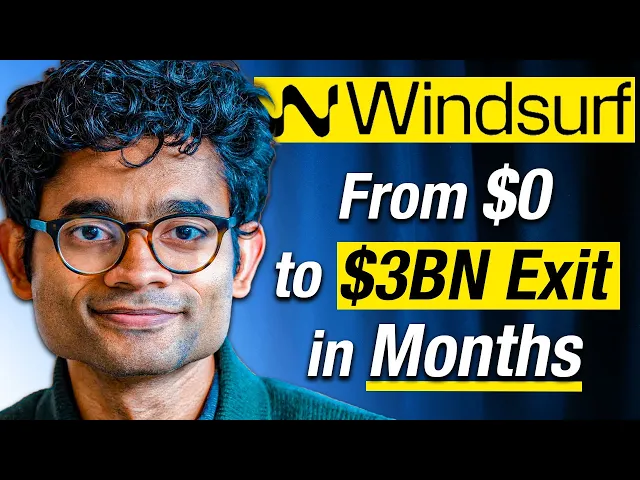
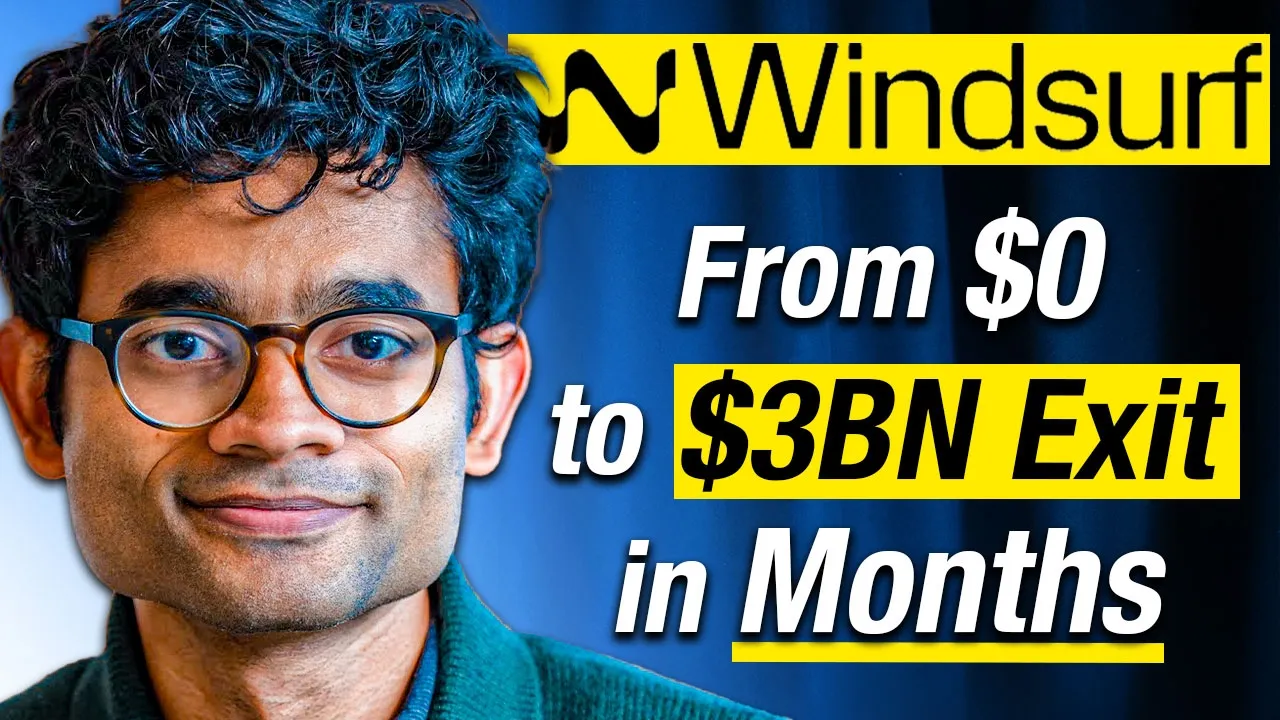
One of the weird things about startups is that you don't win an award for doing the same wrong thing for longer. Down the line when you fail, none of them will care. So excited to welcome one of the hottest, most talked about startups from the valley, Windsurf and their CEO, Verun. Companies that are usually first to a new paradigm are companies that are willing to disrupt themselves. When you have a new great idea, even the crappy Version of that idea is already amazing. Startups don't fail because they look like messes inside. Startups fail because they
don't do the right thing well enough. It is much easier to run a company that has only one thing that matters than it is to run a company with the same amount of revenue with five things that matters. What idea do you think that you are too in love with today? I think if I was to go empirically ready to [Music] go Vun, I'm so excited for this dude. I've heard so many good things by the way from Lee Marie, from Neil Mater, from many others. So, thank you so much for joining me, man. Yeah,
thanks a lot Harry for having me. Not at all dude, but I wanted to kind of pick apart. I've literally just been running and I've been listening to some of your shows before and there are a couple of segments where I was like, damn, I wish We double clicked on that. And there was one that I thought I wanted to start with. You said it's very rare that the first thing you believe will be the right thing. How have you changed your mind on what a truly great idea is versus what's not? I think there's
a lot that's right about the Peter Gillism of you want to pick something that seems a little bit not obvious to start with, right? Um for for whatever company you're starting. And the problem is most Ideas that are not obvious are just bad ideas. Like most ideas that are non-conventional, just because you are non-conventional doesn't mean you're going to pick a good idea. Um, and I think people sometimes forget that. But I think at a high level though, like if you pick an idea that is like obvious to everyone, there's probably no alpha, right? A
big company is going to go out and already beat you to the market, right? Because they have more Distribution resources and capital than you. So startups usually win by picking non-conventional ideas to the public. But you kind of need to go in and be humble enough to understand that probably there's a good chance that your weird idea is not actually a good idea. What do you believe was your non-conventional insight when you made the pivot to wind surf? Yeah, so I mean I could even start before this like the first idea that we had even
like our Company name has changed twice now at this point. It was called Exa Function when we first built GPU virtualization technology was that GPU workloads were going to power the world, right? That was like sort of the the mission there. A lot of us at the company had previously worked in autonomous vehicles and ARVR um at the at the company. We had a fairly small team that was actually accurate that GPUs were going to become very popular. Like we were we Basically said Nvidia is going to sell a lot of GPUs. The thing we
were wrong about was how diverse the GPU workloads were going to be, right? We thought a bunch of different model architectures would be run. There were going to be hundreds of different model architectures and we were wrong. All of them ended up being transformers. And in a world in which all the architectures look the same, um there's very little reason for us to be a differentiated Infrastructure provider in that category. So we needed to pivot at that point. But that's some one of those things where you don't know going into the market that that's how
the world is going to turn out. Uh right. And we were just wrong about our hypothesis. And uh so that's why like sometimes you have a take that is not very obvious at the time and then you could be wrong. Totally. The trouble is many people are in love with their thesis. That's why I Hate thesis driven investors bluntly. But many people are in love with their ideas and they're told that actually the true grit and persistence of an entrepreneur is what separates those that win versus those that don't. How do you think about that
versus a brilliant statement which I agree with. You said never be too in love with your ideas. I think I think this is the hardest part about starting a company or or building a company in in the first place, right? It requires these two almost counter beliefs in your head, right? Irrational optimism because if you don't have any optimism at all, you won't do anything and you won't get out of bed, right? And uncompromising realism. Every single day, you need to be asking your question, do we have a reason to exist, right? And if the
answer is not really, you need to change your mind really fast and reorient the entire company really fast. One of the weird things about Startups is that you don't win an award for doing the same wrong thing for longer. Like it might feel better to tell your co-workers, tell your investors, tell your friends that hey I'm still doing the thing I did. But down the line when you fail, none of them will care. What idea do you think that you are too in love with today? So I'll give you an example. For me as an
investor, discipline around portfolio construction. I love the belief of a Disciplined investor, the craft of portfolio building. The challenge is in today's world, you have to break most rules. And it doesn't mean that you're a cowboy and you're gambling, but it means you're much more elastic than the more concrete investor mind. That's what I'm too in love with. What do you think you're too in love with? I think I think if I was to go empirically, we were too in love with our ideas every time. Like other people outside looking in might Have been like
this company has pivoted multiple times and that's a positive outcome, but I wished we had done it faster. I still beat myself over the head on why did we not pivot from the GPU virtualization to the code AI company three months earlier. I think we had the signals but we waited until the companies we were working with were starting to go belly up before we actually pivoted the company. Right? A lot of our customers at the time were Autonomous vehicle companies and it was peak zerp era, right? And then in the middle of 2022 when
a lot of them were unable to raise their next funding round, that's when we started to question, hey, like the market is changing, the technology is also changing, but also our our future customers are not looking like they're going to be able to kind of satisfy our sort of our market, right? And uh I wish we had done that faster. And the same is Also true for for ideas like Windsurf, right? Um, I think we knew agents were going to be very powerful and we could have built Winerf a couple months earlier and I think
we we should have done that if we could have. Can I ask you a question? I just had the CEO of Fiverr on the show and he said that time to clone is one of the most important things that have changed over the last few years. Time to clone being the amount of time it takes for someone to Copy exactly what you have. Um, my question to you, how important is it to be first if time to clone is shorter than ever before? I think time being first being first does two things, right? Um I
think it's a signal of how you're running the company. That's one. Um and the second thing is it allows you to learn faster. And I'll maybe double click on the first one. Companies that are usually first to a new paradigm are companies that are willing to disrupt Themselves. They're organizations that are open to the idea of changing at a dime, right? uh very very quickly and they're al always investing in technologies that are not incremental and and willing to sort of sort of break themselves right um and I think that's a good organization in a
category like software or code AI where the space is changing so so quickly right that's one and then two I think it kind of boils down to what does it mean if you're First that means you get to learn from the market faster and that means you're first to the next idea too right uh because you you see where all the dead bodies are in your category Right. Um, one of the nice things that I like to think is um, if we have a product in market earlier, what are all the things we can learn
in the first month that enable us to build the next product in the market as well. And I think that that could give us a compounding Advantage with time. Is it not more helpful seeing someone else go first, see what they do as a mistake and then learn from their mistakes and leverage the cost that they have and then do it without that cost for you? I think the problem in software in general is they could have made a lot of mistakes internally during research and development that we we could never kind of take a
look at and organizationally now I believe our company has so much Wisdom in our category uh that there are ideas that we would not even touch because we are just like hey we've tried this before right and it didn't actually work and that's something that's like built into the DNA of the company uh as we continue to innovate um and that's just not easy to just look at outside looking in. What have you tried before that didn't work that the world doesn't know about? Yeah, so we we shipped a beta version of this product, but
we Were dog fooding it for such a long time. I'll give you maybe a couple examples here. The first thing is we actually shipped a beta product for code review last year and we actually tried out different ways of shipping a code review product. We had a Chrome extension. We did something internally where we built a parallel website and we were able to try a bunch of things internally and none of them felt quite right. And now a couple weeks ago, we Actually shipped a code review product and it feels much better and is providing
a lot more value. And we shipped it in the way we shipped it because of all the failed attempts that we made last year. I'll give you a second example here. For the code agent product that we launched with WinSurf, we actually had our first cut of that product in the beginning of last year and it was not good. It was not good for a variety of reasons and that enabled us To go back to the drawing board and fix up the different elements that would allow us to ship Windsorf, right? which was that we
needed to get really better at codebased understanding as well as the models needed to get better. But then once the once the models had already gotten better, our internal R&D on codebased understanding had gone good enough that we were ready to go and ship the product. So this is one of those things where if we had just waited for The rest of the world to have it, we would need to have played catch-up on multiple axes, right, just to ship the product. Can I ask you do you advise founders to raise as much as possible
early because it is about the number of atbats that you have the experiments that you can take and if you raise more you have more experiments fundamentally do you advise that given the experience that you have so we're we're obviously like just to shed some light here we Actually raised our series A on the GPU virtualization idea green oaks actually led that led that round um whether or not they led they led your seed as well no they didn't yeah they led our seed too, which uh whether or not they should have invested in the
series A on that one, I'll I'll I'll leave that to to the audience. Uh but I think what that did give us is the confidence that hey, like if we pivot, we will still have the cash to go out And and pursue an idea. And we actually launched Kodium, the extension product before this entirely free. And we were able to do that because of the infrastructure expertise inside the company, but also we were confidently able to do that because we knew we had cash in the bank, right? uh to go out and like actually ship
this product and not have to worry about any details there, right? So, I actually agree with you. It does give you more shots at That, but I think you need to be a company that is able to pivot very quickly, right? Um like most companies, I would say when they have 10, 15, 20 people, they're unwilling to change the idea, their idea entirely. Um, we on the other hand decided we wanted to work on Kodium over a weekend, me and my co-founder, and we told the company on Monday and everyone started working on it that
Monday despite the fact that we had we were making a couple million in Revenue off the previous business. Is there anything that you can structurally do to increase the response time of an organization to move faster post pivot? Yeah, I think I think the answer is for a startup, one of my true beliefs is that companies don't succeed because they do many things well. they succeed because they do maybe one thing really well. Like it's kind of like what I said. I think having one good idea already is like a miracle for most Startups, right?
And when you think about it from that perspective, when you think about a company, um, think about two companies, you know, any product has some sort of exponential curve at which it's able to grow, right? There's some R value attached to a product. Uh, the right thing for a startup to do is always focus on the product with a higher RV value. It never makes sense to be diverting your resources to work on two different products that have Different exponential growth curves, right? If they're completely disjoint. So when you do a pivot, I think the
right answer is you should just give up what you were doing in the past because the thing you were doing in the past probably will have no sort of relevance to your business going forward. Right? The revenue multiple on that business is not going to look at all like the revenue multiple of the other business. And I think if you can go cold turkey And actually go and make your organization completely work on the new thing, uh you're more likely to succeed. But that's scary, right? You need to tell people, tell your investors, tell your
customers, you're no longer going to support that. Uh but I think once you make the tough decision, it's really easy. Dude, revenue cannibalization when you're doing millions in revenue is hard. So yes, I completely agree with you. You said that success is about Doing one thing really well and it's hard enough to have one thing. you have that, but what thing would you most like to do that you're not doing because you retain that element of focused mindset? Yeah, I think in our category, maybe if I was to just say this, in our category, a
lot of our users of Windsurf are actually people that are non-developers. They're people that are vioding apps and they're actually using it for productive use cases. Like internally at our Company, we have someone who's a non-developer who leads partnerships that has used our product and built apps to replace a lot of sales tool spend like over $500,000 of sales tool spend internally. And I think there's a lot of things we can do to make so they they they've coded 500,000. Yeah. They built apps inside the company for like a partner portal and quoting tool and
so on and so forth that these are sales tools that in the past cost hundreds of Thousands of dollars a year. Now the reason they deserve a payriseise phone, right? Yeah. I mean, we should we should get we should consider that. Um, but the reason why that was the case before um not to go on a tangent was because no one really these are very bespoke tools, right? These are very bespoke tools that do a singular function and no single company wants to build this out themselves, right? in the past, but now with software being
so cheap to build, Like ephemeral software or simpler simpler software being so cheap to build, um you can now have nontechnical people kind of building these apps. And I think Harry, like one interesting avenue for us is how do we make that user much more productive than they are right now, but there's always this tension, right? If we make that user much more productive, we might be giving up the ability to make developers that operate on large code bases much more Productive, too. It's just a focus game. Is winds surf about making engineers 10x better
or is it about making the normal person able to be an engineer? Yeah. So I think we are focused on the former. Uh we're focused on the former and a consequence of that is the latter right because the technology underneath is capable of doing that but the focus is definitely the former. Will you converge over time? Will Cursa and you converge to eat the lovables and bolts and will The lovables and bolts converge to try and eat you? You know, I think once once and this is uh this is I think a really common question
we get which is that I think those tools that are very focused on like the lovables, the bolts that are very focused on the non-developer. I think with time they're going to need to build out more and more tunables, more and more ways to configure the product wi with time. Um but I think I think for us if we can deeply understand code like Large code bases it'll naturally fall out that with very little effort non-technical people can build apps. But maybe my point is if we build for that use case right now it's it's
we're we're going to be kind of forgoing the ability to help developers. But I think it will converge it will converge with time uh between both of these categories. Like a company that deeply understands your codebase will be able to with very little natural language build an entire App that is consistent with existing code bases inside the company. If you had infinite resources I'm so enjoying this by the way. I'm sorry I had this beautiful schedule but it. Uh if you had infinite resources is there anything that you would do differently to how you're doing
it today? I think we would be making many more bets. We'd be making many more bets inside the company like trying many more things. Like as I said probably 50% of the things that we Try inside the company or more actually fail right we are actually investing a lot of our product technology on things that are in the future uh and most of it fails actually I would like to fail even more but the weird thing about startups is the one thing that works pays for the hundreds of things that fail uh internally at a
at a startup I I spoke to Neil Ma about stuff that I had to ask you before and he said you do have to ask him about how he builds product and His product building cycle you mentioned mentioned there 50% fail the internal cycle. Can you talk to me about some unconventional ways that you think about internal product building that you think are important? Yeah, I think there's conventional uh wisdom and you know from other people that a company with more engineers is just going to succeed. But that sort of kind of makes software engineering
and just R&D feel like a factory building Process. I think the right way to actually look at it is when a product or an idea has no legs and you're proving it out, you should actually have very few people working on on an idea, right? Because actually like this is a very common everyone will understand this. Imagine having 10 people working on something that has not been proven up. Everyone has opinions. Everyone has ideas and nobody's ideas are wrong, right? Because no one has proven Anything out. So it's very hard to get alignment. it's very
hard for people to work in one direction without causing communication issues. Um instead what is actually really good is can you have a handful of people with an opinionated stance that can go out and prove out an idea and then the question is uh with that if you can if you can go and get a nugget of value and this is like a hard question for any product how do you know when to stop working on it right um and I think there's this interesting like kind of piece of wisdom that that we've built and
a lot of us at the company have worked in hard tech before this like companies like autonomous vehicle companies before this is that when you have a new great idea, even the crappy version of that idea is already amazing. Like it already proves something amazing, right? Uh like for instance, when we built the first working version of like the agent in Windsurf, um the Even the crappy version of that was able to do things that we were never able to do in the past like eight or nine months ago, right? And we were like, okay,
this thing has legs. And then at that point, once you've proven the crappie version has legs, you can then go and resource more uh more people on the project to actually go out and and uh and and pursue it more deeply. That no wonder Neil loves you cuz he always talks to me about like the real customer delight Moment and that shock and awe that they feel when they have that first agent experience that you mentioned. Um I totally get that. Can I just dig in on a couple of elements before we carry on? You
mentioned like a handful of people. How many is that? How do you structure these teams on new bets? It's it's maybe three or four people. Okay. And couple of engineers and a designer. Yeah. Or or actually in the in the case of if it's just purely like a systems technology or It's like it could be just you know kind of pure engineers that are building this out. One of the cool parts about our product is we are a developer product. So our developers themselves have some intuitions on on a crappy version and how useful it
could be at least the v 0ero right because we're building a product for developers do budget-wise and timewise do you set that do they set that how does that work I don't think we actually think about that and I think That's that's partially because we're in an unconstrained market right now right the value of great technology that could accelerate software development is so valuable to our customers that um for us like I guess we largely speaking don't think about it from like a perspective of what is the budget of a particular project. Now what we
do look at inside the company is what are the what is the progress we're unlocking in a project over time and whether or not we should Decide to move on and work on something else like table something and work on it later like that is something that we decide and that's not a democratic process inside the company it is it is like a little bit of a top- down process inside the company is there is there anything that you've tabled that with the benefit of hindsight you're like oh verun I should have kept going with
that one yeah I think I think so I think uh an example of something we probably did Table was the autocomplete experience which is the first product that we actually built out. I think we actually delayed on building a much better product experience sooner rather than later. Part of the reason why we the product experience wasn't as good actually was because we were stuck in VS Code and VS Code didn't give us the UI capability to make the product much better and once we had Windsurf we were able to invest much more in the Capability.
You mentioned VS Code there. It brings me to the topic of kind of Moes and defensibility. I'm obviously an ambassador for my sins today as well as being a terrible British podcaster. Um, Moe's dead in a world of AI. You you you're not blind to this. Everyone says cursor Windfur I can switch between the two. Help me understand dead. And how do you think about that? You know, I think startups by and large just this idea of a startup having a moat is usually kind Of silly uh for the for the most part. like the
conventional seven powers, you know, like if if anyone in the audience has actually listened, you know, read the book. Um I love it. Yeah, it's a great I think it's a great book. I think it's just a premature for a startup uh for the most part because okay, fine, you have a company with 50 engineers. Um you could have the best engineers in the world. I think we have amazing engineers like like a majority of our engineers Are from MIT. I think we do get the top percentage top few percentage of MIT to come to
the company. And um but still like it's still like if we have 50 to 100 engineers, it's still only hundreds of engineering years that have gone into our product. This is not something where ultimately someone else can't build something in this in this as well. And I think the only moat in our category is speed. It's kind of like what I just said. It's learning where the dead Bodies are, learning how to compound an advantage. And I think maybe an example of this that I I like to bring up is even a company like Nvidia.
I think everyone outside looking in is like CUDA is the real mode or something like that. Um I think that's just inaccurate, right? When you look at large companies like OpenAI, Anthropic, Google, let's say Google if they were buying Nvidia, I know that they build their own TPUs. They spend tens of billions of dollars On chips. Are you telling me if CUDA didn't exist, they would not use Nvidia GPUs? No. They'd find a way to write assembly, the lowest level code, and make that run on the GPUs. It's that expensive for them, right? The reason
why people use it is it's just awesome. They've made it really capable at doing low floatingpoint math. They've made the interconnect really good. The computer's really fast and every year they have a ticking time bomb on their head. If they Don't make the hardware, the interconnect um kind of the memory bandwidth much much faster every year. They're going to lose like their profit margin is going to shrink, right? And AMD will be on their case, right? And that, you know, that's a that's a little bit of a surprising sort of uh sort of feeling like
it doesn't have the like Nvidia doesn't have the same properties of a company that a company like Google has, right? Uh but it's still one of the Most valuable companies out there. I agree totally in terms of the moes for startups like if you have two companies starting start line today. But if one of them becomes part of a very large company, say an open AI or an anthropic and they suddenly have distribution and they have brand and they have resources which buys you know chips at scales that are unparalleled compared to what any other
startup can do. Suddenly seven powers becomes increasingly prominent And moes exist. No, I think the reason why some of this wisdom is potentially not not correct is I think speed is still important in that case, right? And and the reason why is like why does a startup ever win, right? Why does a startup ever win in an important category? Why did Google win in in the early 2000s when Microsoft was already a behemoth at that point? I think it's just if if a company has good insights and is able to outexecute strategically Another company, they
will win. They will win in a in a space. Um, I would I would argue that distribution is more important than speed. Listen, you're the multi-billion dollar founder, so like please correct me, but I'm like, partnership agreements is really what propelled Google in the early days to be so successful. But it was also that there were lots of companies in the category and they had the best product and for that reason a lot of people Wanted to partner with them. Maybe let me put it this way, our space is like very very valuable, I would
say. But if you actually look at a lot of the hyperscalers, their products in the category are not amazing products, right? Um, even though they have a lot of distribution already. Why is that? And I think it's actually because it is hard to marshall together talent to actually go out and execute in this category very quickly, right? We're the Kind of company where right now we're shipping a major release every 1 to two weeks. Name a large company that is able to learn that quickly. Why do large companies suck at velocity of development when the
market is as hot as it is today? I think it's existential dread, right? A a startup has existential dread on on whether or not they can survive if they don't ship fast enough. if they don't learn fast enough, right? If I'm inside a behemoth, like I'm inside Amazon, right? And Amazon has a product in our category right now. Um, do you think the employees working on this are worried if they will have a job in 6 months if they don't ship a great product? If we had shipped the same quality product that some of these
hyperscalers have shipped, we'd be out of the market a year ago. But they probably still have their jobs right now. It's the seven days a week that's becoming the norm again in Silicon Valley, huh? I mean, we're we're an in-person company actually right now. Yeah, we're like a 100% inerson company. Can you build a company today remote as efficiently as the in-person 7 days a week Silicon Valley specialness that you're seeing return to the valley again? I think it's just it might just be a little bit harder, right? I think you need to be a
much more I guess principled company to start with. But I also think it's it's it's Just an unfair advantage if a company is able to get get their engineers kind of in the same room and on the same page like every five minutes if necessary, right? It's an unfair advantage on speed uh compared to a company where people are on different time zones. Like you don't know when you can reach out to someone. right now if if if if it's 2 or 3 PM everyone at the company can be called can be kind of like
brought into a room at that very moment right so it Just it just makes your flexibility a lot faster and in the early days Harry when I was talking about how how obvious it is that your first idea or your ideas are not going to be accurate um you should be able to pivot extremely fast and kind of like marshall everyone at the company as quickly as possible do you think in your category brand power is important people are associate with being a winds surf user or a cursor user. Do you think brand has that
same Power that it does in other categories? You know, I I would I would like to obviously I think having a good a large brand is just helpful. It enables you as you ship more and more new products for more and more people to be able to use it and not have to build that build the user base up from from scratch. But if I just was to remind everyone, you know, kind of like a year or two ago, probably in Silicon Valley, GitHub Copilot was the product that everyone everyone was Talking about, right? Uh
at that time and if I was to talk about it a year ago, right, actually a bit over a year ago was the Devon launch. And I think for 3 to 6 months, I was not hearing anything but Devon uh from from everyone, right? And I think it's like in our category, we need to prove ourselves almost every day. If in three months we don't ship something amazing to our users, we will become irrelevant, right? Uh to to a lot of them, right? If We don't actually like keep up with with the pace of innovation,
we will become irrelevant. So I think it's it's a little bit of if you can maintain if you can continue to innovate at breakneck pace, the brand is definitely helpful, but I don't think the brand gives you the right to move slower as a company. But should these businesses not be valued inherently less or at a much lower multiple if they're sustenance of value is able to Deteriorate it more quickly than ever before. As you mentioned Evan, as you mentioned, GitHub Copilot, brilliant examples. Yeah. And then suddenly have a reduction of value so fast. Should
they be valued in the same way? So, I think there are still qualities of our company that we haven't really talked about of like having a large enterprise business, being wall-to-wall at very large Fortune 500 companies, right? and being able to work properly for large teams which has Inherent switching costs for the business right not the same class of switching costs as a as some of the products like I don't know Salesforce yet I don't think we built that out there's a trade-off where if you focus so hard on making your product to switch off
of if you also don't improve your product fast enough people people will just switch on to the onto the better product despite the fact that it is hard to switch off of your product right I Always remember seeing a tweet from Tom Blfield who's a friend of mine he was like I don't really get this space. I was a cursor user and I switched to Windsurf and it was like better or just as good or like he switched to Windsurf for this one project. Um I have no idea if he stayed. I'm not making a
comment. Tom, don't kill me. Um but um my question to you was like how do you think about switching cost and retention and is it that easy to switch between The two? We need to innovate on features and product fast enough that we're able to build differentiated experiences for for folks. That actually takes a lot of work, right? Like as I was saying, like most of our products that we end up building don't end up working. And even though we're shipping releases every couple weeks, some of the more complex pieces of technology that we've shipped,
they take months to actually ship. So I'll give you an example. A couple weeks Ago, we shipped a model that was comparable to some of the frontier models at the agentic workload. And our model suite 1 is much faster, much cheaper for us to run and capable of operating over a large codebase as well. And we were able to do that by learning from our users on how they use the product internally, right? And that was not a single month kind of experience for us. It took us many months to actually build out that that
model Internally. But these are the kinds of and now it processes hundreds of billions of tokens of code a day. That single model, right? And it's running on our own GPUs. Um, but this is like one of those things that it takes time to kind of build out these capabilities. uh just like how maybe you know for everyone in the audience and folks like Tom he probably never heard of our company 10 months ago and used our product 10 months ago right so I think These ch these things change extremely quickly but you're totally right
the fact that it can change this quickly means that you need to be ultra vigilant right the same reason why no one had heard of us in Silicon Valley like maybe 10 12 months ago and now like a lot of folks have heard of us um the same thing can happen in the other way too you mentioned the strength of enterprise in your business how much of your revenue/ usage today is enterprise versus um Bottoms up. Yeah. So I would say like probably of our total amount it's like over 50% is is is actually is
actually enterprise. What are the biggest questions lessons things that enterprises care about when they buy you? I think it's there's a maybe a handful of things. I I think the first thing is a lot of enterprises and large companies this is something that's not very obvious to folks outside looking in. They have a lot of Java developers, Right? And for the Java developers, actually most most large companies have a lot of code in Java. They use an IDE called Intelligj as part of the Jetrains family. So this is like an interesting fact. Even though we
have the Windsorf editor, we still support plugins into all the Jetrains ids and it has the same functionality as the Windsorf editor. The reason why we forked the VS Code uh editor was because we didn't have enough flexibility to build out the UI that we Wanted uh to give out the new agentic experience. But we were able to give that out entirely in Jet Brains in the plugins. And I'll give you an example. JP Morgan Chase, who is a customer of ours, over 50% of their developers are Jetrains users inside the company. And for those
people, we're able to support all of their developers. We're not a product that's only for their VS Code users, right? Uh so they can move over to Windsor. So that's again an Interesting fact that I think outside looking at people don't really understand that for the enterprise there are lots of these intelligent users that we need to satisfy and when we go into an enterprise we don't want to tell them hey only 40% of your users can use our product we want to make sure all of their developers can use use our product do you
think your customers will have more or less engineers in 5 years time it depends on the type of customer right And and the word engineer is going to become a very flexible word as I was saying right as the technology gets better and better people that are technical adjacent are going to using windsurf as well and we're already seeing this by the way at some of the companies. So what does engineer in 5 years time mean? If I was to explain it to an engineer, if you were to go over time just for an engineer,
right? If you go back 50 years, everyone is writing Assembly. Then after that, they're writing C. And by the way, people still write assembly though, they after that they write C. Then it's like C++, then Java and Python. And then now a lot of people writing JavaScript, right? And I'm just giving you an example on like ease of programming has gone up, but a lot of the people that are that write JavaScript have no idea how to write assembly at this point. So I think it's going to be something along those lines, Right? There will
be people that are able to operate purely on a natural language based abstraction, right? And the AI tools are able to explain to them how different components of the software stack work. So that just even though they're operating on top of natural language, they're able to still be valuable to the company. But then ultimately down the line, there will always be production critical applications. Let me give you an Example. Let's say I'm JP Morgan Chase and I'm building my transaction processing system. You probably don't want to vibe code then, right? like Harry, if you give
me a $100, probably you don't want to like lose a hundred and for me to not get the $100, right? I'm going to complain. And that's some transaction processing system that's running in JP Morgan Chase that is probably doing millions of transactions or billions of transactions a day, Right? And for that, you probably want someone that can go all the way down to the weeds and validate that this actually makes sense because that's core to the way the business operates. So, I think you're going to have a spectrum of people, right? people that can operate
purely on top of natural language and they're building capabilities and technology and and apps inside companies, but then people also that can go to the weeds go down to the weeds. Um, now how many people need to go down to the weeds? Probably fewer than there are today. Do we have PMs? I'm I'm always told that PMs are CEOs of the product and many have said that actually we're not going to have PMs anymore. 11 Labs I had that the head of growth on the show the other day was like we don't have PMs. Do
PMs have a role in 5 years? I think the expectation for PMs is not going to be down the line. It's not going to be I tell someone to go and Build something. It's going to be you should go out and build it too, right? Uh there will be need to be a lot more agency on their side. But the benefit is these AI tools are going to give them that capability. Right? Let's say you do have a technical PM that is that understands code and that can write code. They are even more deadly now
than they were in the past. You don't need to give them a team of 10 people to prove out their idea, right? And one of the Things that I kind of don't like about PMs probably in in uh nowadays in a lot of cases is they spend so much time writing docs to try to convince the organization to do what they what needs to be done. But instead they should just go and build a version of what they want to get done and then prove to the organization that that's what needs to get done. Why
do you need to spend so much time babying your organization playing a playing a game of thrones, Right? It doesn't really make a ton of sense in the future. Did we skip the design stage and go straight to prototyping in the future? Probably the ability to very quickly mock up a design that is consistent with the design inside your company and prototype it is going to be much faster, right? Like internally right now when we build apps, we're not very very quickly going to Figma at the very beginning if the app can be built very
fast uh inside. And Then obviously if it's core to our product experience, we're going to go out and design the layout and make sure it's it's it's it's to our standards. Uh but rapid prototyping can it can we can definitely skip like a laborious design stage right now. I'm just fascinated like where where all of it converges together. As we said, you meet the lovables and the bolts in the middle and then the figs are coming in now and actually saying hey turn design into Code and kind of coming in from outside. I'm trying to
figure out what it this kind of mess looks like in five years time respectfully, you know. Yeah, I think I think it's a fair question. Maybe one thing is for people outside looking in the things that the lovables and figs do is like maybe a very small fraction of what software is. Uh like ultimately like most software is not just like a website that that has like some backend attached to it, right? It's There's complex database systems uh software out there. There's all of this infrastructure. Most of Google is not the front end, right, of
Google. Like think about how much work goes into Google. Google's probably one of the most complex pieces of technology. There's a very complex re-ranker. There's this database called Spanner. That's a geographically consistent database um that that exists that's probably tens of millions of lines of Code, right? And all of those things, there's no one that's designing something in Figma for modifying the Spanner codebase, right, inside the company. But we would like it so that they're using Windsorf to actually go out and do that. So the way we sort of like to look at it is
like I don't we don't sit and think about what these other companies are doing all the time. We're sort of thinking about what are all the ways in which software engineers Spend their time and how do we make them much more efficient. So you're totally right that I think the design stage a lot of things are going to get disrupted inside. But maybe one point I just wanted to add is that's maybe just the tip of the iceberg on what a software developer ultimately does. I was going through some of your tweets as well and
you said async remote agents will happen and I just wanted to double click on that first. Can you expand on how you Think about this and which tasks will be automated first? So the idea of async remote agents if you were to look at a product like windsurf windsurf is actually a local agent that runs runs locally and it can do very longunning tasks like you can migrate an entire codebase from one version to the next and it should be able to do that without you having to touch your keyboard right once you once you
instruct it to which is very very powerful but this idea of Being able to do it asynchronously is also very powerful. You can imagine like just firing something off from your phone and it just generating a like a pull request for you. But I think one of the complexities of this is there's a building products in our category is I think there are three things that really are important right uh there's latency so how long it takes to get the response back there's quality right which is what is the what is the correctness right and
Then correctability how quickly can you make a change right and I think people kind of feel like if the technology is really good they can kind of ignore these facts but it's really really important if you build an asynchronous exper experience and it takes 10 20 30 maybe a couple hours to go out and build something, people's expectations on the output are going to be really high. Your quality has to be really, really high. And if the quality is not high, it Better be easy to correct. But it's not very easy to correct. Like when
when the workflow of how people build software, if all I do at the very end is I create a pull request on GitHub, which is the final way that people review the code, and even 20% of it is wrong, let alone 10%. I I wrote it has to be at least 90% correct. people were like it needs to be 99% correct because and I think they I think they might be right because if even 10% is wrong people lose faith in The product because they waited hours to get the result right and they need to
bring it back in locally and modifying something that is 90% correct is not that easy because you need to understand the 10% that is wrong also which takes time too right you're still human time limited at that point so my rough feeling on things is what are going to be done asynchronously remotely are things that where the task is so easy that it can actually get it done Properly. Like the complex tasks are still going to get done in windsurf in the in the short term, right? Um just because things that are complex and require
a lot of rapid iteration, it's unlikely that you're going to do something asynchronously, wait 30 minutes, go and look at it in GitHub and then decide, hey, it's not correct and bring it back. This the feedback loop is too slow at that point. To what extent do users care about latency have you Found? Very very much. I'll give you an example. Like even for a tab product 10 milliseconds which is like the product that gives you not only the autocomplete but but the automatic refactors as the user is typing every 10 milliseconds affects a percentage
points in acceptance rate right now for the product. When we think about these async remote agents that have to be incredibly responsive that have to be correctable what form factor do they take? We Mentioned that earlier like just pinging off a message. How do you envision the right form factor and what that will take? Yeah, I think it's it's it's not super clear, right? It's possible that the right form factor is you need to fire this off from your ID because people are people are in their work state in their ID. Now, the question is
how how common is the use case that people want to fire things off from their mobile phone, right? And then if They do, is it fine for it to just be on Slack? Do people want to continuously talk to something on their mobile phone? I think the answer is maybe not because if I get thousands of lines of ch code changes, I don't know how to review code very effectively on my phone and then in which case like I don't want to interact with something on my phone back and forth. So maybe I'm I'm game
to do one and done interactions on my phone and then it better be 100% correct and I'll Go back to my laptop and be like no it's correct and then stamp stamp it and then approve it and merge the code. So it's there's a lot of trade-offs here. When we talk about the right form factor for these remote async agents, it kind of makes me think about something that Satia said, and I I did write it down because I wanted to make sure that I got it right because I didn't want to misquote Satia, but
he essentially said that obviously apps will collapse into Agents and become just databases with business logics. Do you agree with him in that respect? Salesforce becomes a database that agents just crawl all over, a HubSpot the same, and you basically have their utility value reduced to just databases. Yeah, I mean I'm I'm trying to think about why I think that's that is not exactly true, but you're totally right that I mean, you know, for any company, Their entire state could could be distilled down to a database, right? Uh for for any company. I don't know
if I completely buy that in the short term, these complex applications like Salesforce and Workday completely get replaced by another company that just builds a database and an agent operating on top of it. I think a lot of complex workflow has been built around the idea of using Salesforce. So, I'll give you an example. When we built our sales Team, everyone already knows how to use Salesforce down the line and now we built custom workflows inside Salesforce. And you're right, those are all database transitions, but they affect the way humans operate with software. It's very
unlikely to me that what's going to happen is Salesforce will get dethroned by a company that is just a database with an agent operating on top of it. It just there's too much inertia for the company uh building out These complex workflows. And maybe here's the the final piece and maybe why I believe that I don't think agents are good enough today that you can kind of just let them operate on top of on top of a database and write to the database automatically write to the database uh without human supervision for some arbitrary workflow.
Right? Right now we're still in the stage right now where these agents are mostly reading from data sources. They're not like modifying Things at scale. Um, and that's just because maybe we don't have the tr the the we don't we don't trust these systems uh deeply enough right now. Do you think we are overly optimistic about the progression of the agent landscape? Obviously, as a venture investor, the only thing we give a about today is agents. Um, do you think we are overly optimistic about where we are? This is going to be the the most
obvious statement, but I think people think These systems are way more capable than they like a lot of investors might believe they're more capable than they are um today. I'll give you an example. My goal here is not to not to, you know, kind of downplay anything here, but I remember last last March when kind of the Devon launch came out. Everyone was giddy with excitement of the idea of like software engineering is getting replaced. Uh like a bunch of investors are like, "Oh, there's no reason to ever Hire junior developer. You will have this."
And now we're very far from that right now, right? I don't think like or at the time we were very far from actually replacing a junior developer with with an asynchronous AI agent, right? But I think what people don't understand is even if the technology is not there yet, I don't think they grasp how quickly the exponentials are improving, right? Which is that in six months what is capable of these models Is going to be very different than what is capable today. And I think people are it's it's very hard for people to understand that.
Like what I just said about agents and the fact that they're really good at reading systems at scale, but people don't trust them to make rights to systems to internal databases at scale. That will probably change in six months, right? uh because eight or nine months ago people were not using agents a ton. So yeah, I think people Underestimate the speed at which these things improve. What do you think in 12 months will be crazy that we don't have today? Like you said there about kind of the transition and models bluntly improving so fast in
such short time frames. If you think about what we do today that we would consider crazy that will be a reality in 12 months, what do you think it would be? I think a lot of things that maybe I understand the software development uh landscape a lot Better um is the way how end these tools are going to be is going to be I think shocking to people. I think right now if I was to say one of the biggest problems of these tools is mostly they help in the code writing experience. they're not helping
in a lot of different aspects of the of the software development life cycle which is software developers design software right they deploy software review software right uh build navigate they do a lot of debug test They do a lot of different things and I think the reason why it's mostly been kind of siloed to one or two areas is actually when when you look at a software engineer and their job at a company they look at a lot of distinct data sources they look at like a logging system they might look at a database they
might do all these other things and I think these agents are going to access to all of this data and all of this data, your browser data, all this stuff. And I think what's going to be possible is debugging very complex tasks. Designing systems is going to be something that these agents are going to give much more leverage for than they are today. And I think this idea that software engineering, there's like a part of software engineering that AI is not going to touch because it's too hard, I think is is just going to be
wrong. I think every aspect is going to become 10 times more effective. Can I ask you a really hard one? You mentioned Devon there. If you look at say a cursor, what have they done well that you've learned from? And what do you think they've maybe made a mistake on that you've learned from? I don't know. I don't know about a mistake, but I think for them just actually I think they took a really good approach on building high quality UIUX. Um, and that actually proved to be uh what people really loved, right? And I
think that's That's like very impressive that they were that they that they were able to do this right off the bat. I think that's that's that's not actually what our initial intuition was. Um and I think they they executed wrong. What do you mean by that? It wasn't where you placed importance in terms of that initial UIUX being seamless. Yeah, I think for us to go out and build Windsor, we actually felt that we needed a massive like technical breakthrough of like actually A new product experience. And I think that was the only reason why
we actually decided to go out and build like actually have our own ID. I like if we didn't do that, I think we're the type of company that would not just go out and build UIUX just for the like, you know, for a much better experience by default unless we had great technology. I like to think of ourselves as like we're a technology company and I think we ship product to maximize the amount Of technology that our users can consume productively, right? Um, and we want UIUX that is not harming people's experience of our of
our product. To what extent is the quality of your customer experience defined by the software that you create, the UI, the UX versus the model progression that lies beneath it being open AI anthropic? Yeah, I think I think you can't downplay the fact that that the latter is very helpful, right? The frontier model is Getting cap getting more and more capable. Every new capability unlocks maybe a new type of product experience that wasn't capable in the past. But I think it's a little bit of both, right? Um may maybe maybe to put it put it
kind of uh kind of bluntly like we were the first agentic a IDE experience right uh for when we launched windsurf uh we were we were the very first ones obviously now that idea is not very it's not non-conensus like it was the obvious Thing to do but these models like sonnet had existed for quite a while but it actually took us some work to actually put together uh like using these models but also using our own models internally to make this a usable experience with the UIUS to be ble to review all the software
very quickly before people actually this the product experience kind of took off. So I think it's a it's maybe a little bit of both but I don't want to underplay how much the models Actually affect you know the value people get from these experiences. People often compare the model landscape to the cloud landscape. The thing that I I find challenging about that is cloud you generally stick to. You're on AWS you're not switching between AWS and Google and anyone else. To what extent do you think model landscape will be one where you have a preferential
relationship with an AWS of the world in cloud or anthropic or open AAI and Models versus actually you just work between many different model providers and you switch between them for different functions. I think you're right. The the space is very early is the reason why it's kind of like the switching cost of these c of the category is not very high, right? Moving from one model provider to the next. It's very low switching costs ultimately. And by the way, that's because there's no state in these models For the most part. So for the most
part, it is almost like a Twilio like experience where it's like send text message and you kind of send a text message, but maybe I could send text messages with a lot of different applications. But I don't take that as a big negative. I think what that means is we're still evolving in this category right down the line you could imagine models can actually internally keep a lot of state right about a user about About all the data they have inside their company about all the data they they use locally if you were to look
at a lot of large code bases they are actually getting to billions of tokens of code right what if that's actually something stateful that you can inject and inject and eject context about this from a particular model provider like I'm sure there are ways in which they can increase their switching costs down the line as the technology gets better And better. But I think this is what it comes down to, right, Eric? In a category that is evolving so quickly and when the models are improving so quickly, it is actually bad for them to overinvest
in ways in which they can increase switching costs. That's just doesn't make sense because let's suppose they did do that but they missed the next improvement in the model like they for they they didn't they didn't do test time compute or something they would be Behind and then it wouldn't matter that they increase the solution cost. So I think ultimately your the analogy to cloud providers is not accurate right now. They don't have the same properties. It's not the same kind of business right now. Um but could it be down the line? I think it
could. Today models do have non-commoditized properties. Anthropic is often hailed as being better for developers for example just as like a most base one. To what Extent do we actually see the complete commoditization? I mean there are literally 12 13 different providers in China who are racing faster than ever and we'll reach some asmtoic utility point where all of them hit the same level and I'm sure the US will be the same. To what extent do we hit that versus no no anthropic is the one for developers X is the one for whatever else. I
think it is unlikely that in the short term you will have a like a an Ability for one model provider to just run away with a particular category um if the category is like very valuable right I think it's it's unlikely that that's the case now I do believe in things like the scaling hypothesis which is to say with more scale you you are able to build better and better models and you do have like your your hands tied up if you're operating with less capital in the category right it's just it's just the the
nature of the game um Right now. But I don't I don't think we're anywhere near the point in which you're going to have someone who's the defining leader of having a great model and no one else can touch it for for years, right? Um and and maybe the the reason for that is actually because 6 months from now if a new technique exists and someone else finds the new technique um ultimately they're able to do it in a much more efficient way. And if they're able to do it in a much more Efficient way, it
means that if you just miss it and you're still applying your previous technique, you're going to be behind them, right? So, it's almost like unless you believe that companies one company is going to get all the capital in the world uh and no one else is ever going to get the capital in the world and one company has a monopoly on all great ideas, it is unlikely that you're going to have someone that is able to like run away with with something in in The short term, if that makes sense. Given the commoditization of that
model layer as we said and no one being able to run away to what extent the model providers have to move into the app layer to have any form of differentiation maybe in the in the API side I think there are lots of ways you can build better APIs for a lot of different applications and it's kind of like maybe you can you can you can kind of focus on the applications you do Support and an example of this is like let's say you you were kind of working with a company like us um and
we were using a model provider you when we output code, maybe a lot of the code looks the same as existing code and you can actually optimize from a latency perspective to help our workload versus another workload that exists for images out there and you can be a much better kind of vendor to us than another company. So there is maybe Specialization you can have on different axes to provide a better experience but as you can see you you are seeing like these model companies actually going up to the app layer too in whatever apps
they see are like valuable to them. Um so I think you're seeing a little bit of both. People have too many opinions about what the right way to do things are and I think you you have to be rational on on what the best way to win is and I think that's the only thing That matters. Uh final thing I I do just have to touch on because I talked to you for a long long time. Um Dario the other day was talking at at some event or conference or whatever and he was like 2026
we'll have like solo billion dollar companies without doubt. I just wanted to touch on this with you. Do you agree? No, I don't believe in that. Please explain. This feels like a university essay. Discuss. I mean I mean I think the like the solo billion dollar Company would imply that no one else cares. Like we live in a capitalist market so there's competition and if you're able to do something with one person unless you're just a thousand times smarter and more capable than everyone else. Like someone with two people that are as smart as you
are probably going to be able to do your idea. And if they do that's going to compress your margins. That's going to compress your ability to be the Pervasive brand out there. that's going to compress your customer acquisition cost or increase your customer acquisition cost. Like I don't know, seems like very hard for it to be the case that a single person is going to be able to run away with a billion dollar product uh without continued investment. Like it just the implication of that is like no one else cares about this but magically you're
able to do well. So I don't know what what do people who Believe this to be true get wrong? What are they fundamentally mistaking? I I I actually I' never understood this idea of like a single person is going to be able to build a billion-dollar company. I've never kind of understood it. I mean, because what is a company? A company is the sum of the discounted cash flows over time. And uh and like down down the line like you're going to need people probably or if the AI is so good that you don't need
people like at Some point I would just wonder like if like what are you really contributing and is the AI building the whole thing in which case like I don't know like actually that would reduce the that would increase competitive pressure because everyone else will have access to the AI too. Can I ask you, you know, you've been across multiple different cycles of the business, ups and downs. When did you question your love for it most? I think we often say like, "Oh, I'm always inspired. I'm not inspired every day to do what I do.
Some days I am, some days." Was there a period where you were not? And how did you get through that period? I think every time basically every time we've needed to make a strategic pivot like actually it's before the pivot that that it's it's probably the the most anxietyinducing because you feel like something could be much better than it is but you are not acting on it and I Think that is potentially the the part that is that is the most uh kind of gut-wrenching. Um, you know, it's actually an interesting point when we pivoted
from Exopunction to Codium. I actually think post pivot was was the freest I've ever felt because I had written off in my head uh both me and my co-founder that we're likely going to fail, but at least we're likely going to fail in something that we believe in. In the past, yeah, we were making a couple Million in revenue, but I know what it means to be like a very large successful company. You need to be able to make billions in revenue, right? Uh so we were so far away from that outcome that it was
almost like yeah this this feels very hard to do. But after pivoting we had a new lease on life and I actually feel like for us and for me the part that is the most anxietyinducing is when we believe we could be doing much better but there's random inertia friction that Is preventing us from doing the right thing. And even if doing the doing the right thing has a low probability of success, actually starting to work on it is is the most free experience that I feel like I've had at the company. I heard you
say once an interesting statement. You said you wait until you're drowning in a role before you hire for it. And I just thought it was really interesting because I was always brought up on the value of board members Being they highlight hires that you need to make six months ahead so you don't have a bottleneck in six months time. How do you think about those two seemingly opposing ideas? We've had cases where I would say it's a little bit of a of an antiattern on that one. Like for instance, when we before we hired our
VP of sales um who who was who was really awesome um we we actually closed some very large enterprises inside the company without any Salespeople. Some very large enterprise sales would look like inside the company and also it proved to the person we were going to hire, Graham, that we were an awesome company to potentially work at. Right? So I think it's it's an interesting trade-off where maybe there's a belief that I have that domain experts are awesome, but if inside the company you're not able to get get an outcome that is 1% 10% as
good inside the company, it's probably Not the right time to go out and make the hire. Like maybe let me put it this way. This is maybe the the the concise way to actually answer this. Startups don't fail because they look like messes inside. Startups fail because they don't do the right thing uh well enough. That is the reason why they fail. And I think people love to say, hey, like I don't have this role and that's why I'm not working. And it's like actually when you look at the most successful companies, They look like
train wrecks inside, right? Ultimately, and what I think is important there is is as long as you are doing the basic things that make your product very successful, I think you can actually make these hires like as necessary. I don't think it's like critical that you make them six months in advance. The worst thing for me would be making a hire and for them to not be important on day one and just to be, hey, chill out over here and wait for The next 3, 6, 12 months because then they're going to manufacture something to
work on and I won't really care about what they're doing. Final one before a quickfire. What did you believe on management that you've changed your mind on? So like for me as an example, like I brought in this incredible person, Julian, he led workplace in Europe for 10 years and I always believed dude arrogantly as a young person. I could read Elac Gill's high growth handbook And I know how to manage people and it's The wisdom and experience this guy brought from 15 20 years leading teams is so nuanced and granular. I learned so much
from him about management every day now. You can't learn it in a book. I've changed my mind on that. What would your change of mind be on management? Maybe the biggest change of mind I I did have was was what you originally said which is how large your team is is not a function of like Output output and actually ruthless focus is the only thing that matters right so you can have a lot of people but the answer is if those people are not ruthlessly focused on one thing um you are going to be very
very not successful like it is it is much easier to run a company that is focused that has only one thing that matters than it is to run a company with the same amount of revenue with five things that matters that with five different priorities and I think in retrospect that always feels that that feels obvious but at a startup like ours where there's so many things we can do there's always a couple shiny things you can always open Twitter and it's like X is solved Y is solved Z is solved but actually I think
being able to say no to things and to focus on on the hand like the one thing that matters with many people and ruthlessly optimize optimize that Um, it's very hard. Uh, but when you can actually get that Right, you can you can make magic happen. I could talk to you all day. I do want to do a quickfire and I have some great quickfire questions for you. So, I'm going to start with one of that I'm adding. these ones. Um, Neil Mater, I love him as an ambassador and I'm an ambassador. So, I don't
see the same Neil M that you see. What makes him so special for you as a founder? I think his ability to analyze companies and be very intellectually flexible is is uh is Actually pretty remarkable, right? Like the breath of knowledge that he has about all these different businesses, but also to understand what makes them work, what are some of the ways they could improve and how that could be applicable to us um is is actually like very awesome. And he's like a very kind of person with his time, right? You would assume given the
fact that you know he is he's he works with so many companies that he would not have a lot Of time but he is extremely generous with his time. Who do you not have on your board that you would most like to have on your board? I actually I would love to have someone like Scott Cook on our board. Someone someone like uh someone who's the CEO of like a a CEO and founder of like an extremely successful software company. Um, yeah, someone someone I' I've had a handful of conversations with him and every time
I walk away just with a deep understanding Of just uh competitive dynamics and just what it takes to run a very enduring long long-term successful business. Dude, that is a great shout. Um, I haven't had that before. If you had to make Windf open source tomorrow, how would you feel and what would you do instead to win? You know, I I I feel like that's a that's a question I've been I've been getting uh recently. I don't think it would affect affect much if we had to make it open source because Most of the work
that it's kind of like the thing I said before right you know Google is yeah they have a front end but the front end is just a single box and if they open source the front end of Google I don't think anything would really change about the world right that that box the UX for that was not really the big deal I am aware of the fact that copilot has done that but most of our logic is actually in the back end ultimately so I don't think that it Would change a ton I also don't
think it would change our adoption um of the of the product uh like most of the differentiation has nothing to do with the fact that the front end is actually open source or not. You have a sibling, they're 18 years old and they ask you, should I go to university? What should I study? And how should I position myself best for this new world of work? What do you advise them? Just focus on problem solving, right? How do you how do you Like break down problems? Uh be a high agency individual. And I think computer
science largely speaking is just the study of problem solving uh for the most part. So maybe what doesn't matter as much is did you learn X language or Y language but can you break apart a problem into their P distinct pieces and actually go out and execute on them is is probably the most important thing. What's one thing that you think Open AI did wrong that you've learned from Oh Maybe naming let's go with naming on that one. Penultimate one. You can change one aspect of your CEOship. What do you need to change most? I
think there are probably some details I I should be I shouldn't be actually like looking at very deeply that fundamentally don't matter about the long-term success of the company, but I just I'm a person that's very neurotic and I like to understand everything that's happening Internally like what we're spending money on at a level that probably doesn't matter. Uh and uh and I just like waste cycles in my head um that that could be put to better use. Final one for you. You can be known for having one impact on humanity. What impact do you
want your future generations to say? Verun, my grandfather, he did X. I think the mission of our company is is very exciting and and I wouldn't say it's just me, but but the team um is uh we Want to reduce the time it takes to build technology by 99%. And and if we are able to play a meaningful role of how that could shake out in the future, like I would be extremely excited about that. Brilliant. Listen, as I said, I heard so many things from Lee Murray, from Neil. I I was so looking forward
to this. You've been fantastic. Thank you so much for putting up with my base level of knowledge and I so appreciate it, man. No, this was this was Fantastic, man. Thanks a lot.