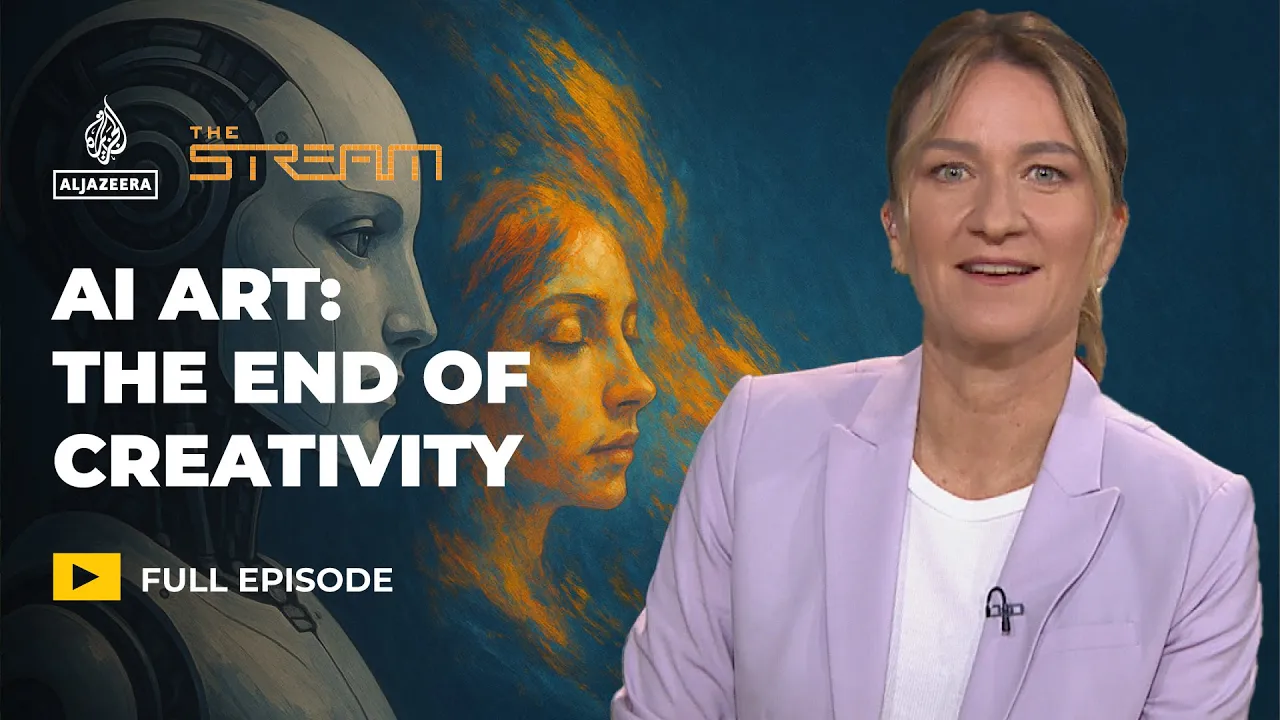
Art has been described as the reflection of the soul of its time. From cave walls to digital canvases. Now add artificial intelligence and it challenges our idea of creativity, ownership and originality in a whole new way.
What does this mean for art and artists? Is this a threat to our human touch or simply a new artistic revolution? I'm Stephanie Ducker and this is the street.
Some creative jobs maybe will go away. Um, but maybe they shouldn't have been there in the first place. Snoop doggy dog.
It's like this and like this. It's like that. It's like drink.
You can now create your own animated cartoons with this tool. I am the sword of justice forged to protect the innocent and strike down evil. Call me naive, but I really did think that us creative people would have some form of solidarity against AI.
Now, in this episode, we're painting a picture of how AI is reshaping the creative landscape. We're talking about art made or influenced by AI. Now, is it still art if a human didn't make it?
Who decides what art is? Can art be anything? We'll hear from creators and critics who are trying to keep up with how quickly things are changing.
Now, to discuss this further, we have Molly Crab Apple. She's an artist joining us from New York. Hassan Rajab is a multid-disciplinary designer and conceptual artist.
He's in Irvine, California. And Sophia Krespo is a visual artist joining us from Lisbon. A warm welcome to you all.
Um Sophia, I would like to start with you. if you could describe to us what AI in art is, how is it being used, if you can like a synopsis. Yeah, of course.
Hi everyone. Thank you for having me here. Um, for me, the way I see AI is first of all not just a single thing.
It's a set of very diverse tools. The way that I use AI in my practice is as raw code that I run on my GPUs at home uh my studio and basically I have the capacity to train my own AI. Um there's very often this um kind of discussion between what AI means in the mainstream and what it means for artists that have been working with AI for many years.
I've been working with AI for around seven years. And so, as you can imagine, none of the mainstream tools that we talk about today existed. So, artists back then, we had to learn to train our own models, gather on our own data, and think about uh the things we're creating with it.
So, AI to me means a very different thing to um the the set of tools that we have available today that are mainly talked about. Um, so and I think that's something very important to point out. Yeah.
Okay. So, you use it as simply another tool in your creative art box, so to speak. Um, exactly, Molly.
Uh, AI, is this a good or a bad thing when it comes to the creative process of making art? I mean, AI, generative AI is terrible. And not just for the livelihoods of illustrators and not just because it's filling our visual landscape with slop and brain rot.
AI art generators are also destroying the planet. They're using up massive massive amounts of water of power of um conflict minerals that are mined by enslaved kids in the Congo. And they're using them for the purpose of allowing venture capitalists to speculate on companies like Stability AI and also to allow people to churn out dumb memes of Tony Soprano eating a hamburger.
We are literally destroying our natural world and also destroying the livelihoods of anyone with a creative job so that we can turn out frivolous and really really stupid memes. Well, um, let me just play a short clip that, uh, goes to what the feeling is online, not everyone is against using AI in their artwork. Some say since a machine cannot replace a human's touch, why are we worrying so much?
AI art is never going to replace artists because AI can't create new things. That is a fundamental misconception that people have about many of these algorithms. Bard, midjourney, chatt, these are all just very sophisticated averaging functions.
They just generate things similar to their training data. Sure, you can say that humans take inspiration from other human art styles. However, when they do this, they're applying their own artistic taste and their own unique experiences.
Even if artists sample other artists, they're bringing something new to the equation. But AI does not. It's often observed that things are very tedious or detailed for humans to make or super easy for AI to generate.
Whereas to draw a simple thing requires being able to simplify it, which means understanding what that thing is and understanding which parts need to be drawn and which parts don't. All this to say, that's why I think artists should not fear a art and rather they should try to learn how to use it and incorporate it into their workflow because it's not going to replace you in the thing that you're good at, but it will save you a lot of time. It's interesting as we talk about AI replacing jobs, not just in art, but across um across sectors.
Hassan, you say you wouldn't have a career uh if it weren't for AI. That was from our pre-in show. What do you mean by that?
I wouldn't be here with you if like I wasn't using like large language models, the ones that are available at the market and uh you know posting on like social media. That's what I meant by a career. But actually like I have a career as an architect uh as a computational designer for 13 years.
I will be doing that uh what you're seeing here on Instagram for about 3 years and um I don't know for me it's just like the AI tool is just like the tools out there they're just a discovery and I'm really interested in the models like the big models so I don't train my models like Sophia and I'm really because my work is focused on exploring the potentials of the tools that we have right now. So basically that's what I meant by career like basically that's me being here. Do you think do you think we should be scared of AI in art?
Does it change what art is? Because I mean art is very subjective, right? And it also the artist takes from their emotional experience, their ups, their downs, their pain, their trauma, their happiness.
Um, when you start pulling that kind of inspiration from technology, which has taken it already from things that exist, and we'll get into that about copyright. Um, does it change what art is or does art simply always change? Um, I've never had like I never I never thought that I have the like I don't know the proper way to say what art is.
I really don't know. Um, that's my way to try to explore what art is. I think it is subjective.
I think for some people they like stuff. Some people don't like stuff. Some people like Mona, some people don't.
Some people like your Jackson Bulock, some people don't. Um, I think I mean for me art should come from authenticity. So that you trying to be honest with yourself and be true as yourself with yourself regardless like what tool are you using.
Art should come from authenticity but that's an issue isn't it with AI when it sources from what is already out there. Sophia, you were talking about it is our natural instinct to build. Um, you know, you were mentioning in our pre-in as well, birds build nests, we build computers and things evolve.
But you have built an AI model. You were saying only sourcing from your own work. So copyright and licensing is something you're aware of and is important to correct.
Yeah, exactly. So I really like the craft of making my own data sets. Sometimes I also work with public domain data.
So illustrations that are hundreds of years old and are in the public domain. So we all have access to using them. Uh but I also really like the the craft element of you know I love diving, digging underwater photography.
Uh I like analog photography. Uh working with different techniques that allow me to make my own data sets. There's very often this conception that we all need like a huge uh data center where the AIs are being trained.
That's the industrial model. That's what the big corporations are doing, but not what small artists like myself are doing. We have literally 4GPUs.
Um, and it's no different to like a game engine workflow. You know, we we train our own small models. we don't have massive models with millions of hyperparameters.
So, um I just want to point that out because I think under the word AI, a lot of things get grouped that don't really belong together. And yeah, I just want to show that there's different ways to work with AI outside of the big standard models as well. All right.
Well, um, have you ever wondered why these AI tools are so accurate with their image generation? Some artists say that's because the AI companies use the photos of real artworks from the internet to train their programs. And not everyone is a fan of that.
When an AI creates a piece of art, it doesn't generate that content out of thin air. Instead, there needs to be an input in order for there to be an output. In the big picture, machine learning companies such as Stability AI generate profits from highquality media.
And the creation of this media depends entirely on training their AI on a specific data set. These images are made by assembling visual data that have statistical correlations to each other to produce a final result that looks acceptable. That's a very simplified explanation, but that's the gist of how AI systems work.
All you got to know is in order for that image to be generated, there has to be a data set. And that is where the problem comes in. In these data sets, there exists billions of copyrighted images of artworks of photographs of people.
All of which was collected from the internet without the consent of the intellectual property owner. My personal artwork that I share on my Instagram page has been used to train AI models. And chances are if you've shared your work online or even images of yourself, your house, your environment, you might have been included in these data sets.
Molly, are there safeguards against this? How out of control is this situation? There are absolutely no safeguards.
I appreciated what Sophia was saying about the difference between what she's doing and these huge image generators that are what most people think of with AI. I'm talking about like Dolly, Midjourney, Stable Diffusion. These image generators suctioned up billions and billions of images of copyrighted work, including my own work, every other working artist's work.
And they use them to train these bots whose goal is to replace us, to get rid of our ability to make a livelihood. They produced image generators that quite literally knock off our work without our permission so that someone doesn't have to hire us. they can just get our disembodied style.
And there are absolutely no safeguards in the US. Trump just fired um the head of um the part of the government that deals with copyright because she recently said that all these image generators were trained on stolen work. Um, I don't know, maybe in the EU perhaps where there are stronger authors protections.
But the problem is is that these generators, even if people are having fun using them, even if they think they're making something cool, these generators are making the world worse in every single way. from contributing vastly to the climate crisis to stealing the work of working-class illustrators and destroying their ability to make a living. And yes, sure, people will always be creative.
That's what humans are. But taking away the ability of people that aren't rich to make a living doing creative work, that cuts off the legs of an entire generation and it destroys our ability to have young people make art and make a living making art. Uh just for our viewers, uh Trump, of course, that is the US president, Donald.
Um Trump Hassan, you said something interesting earlier. You said that you didn't think that the work you do is your own that ideas should be shared. Can you elaborate on that because that hopefully comes down to copyright and comes down to all these things we're discussing.
Yeah, I would. Yeah, I'd love to talk about my philosophy but first of all like I want to like take a minute and like reflect on the mall is like u um respond basic. I think you can look at like any technology uh that it could could like destroy humanity or can build on like great things and I think there is a big problem when we think about like utilizing big uh or like large language models that they're only there to destroy humanity.
There are great things that can come from like these tools. Um so like yeah there are like dangers there are problems there are so many things that can happen to these tools uh that can go south really but again it's I I look at them as a collaborative tools like a like many people are like aro yeah I know there's a lot of people who are against it for me it just like it gives me access to to the world really and in my work I'll try to be very very careful not to replicate um I'm not my intention is not like when I using these models. I don't want to, you know, get anybody's work.
I don't want to, um, I don't know, destroy anybody's life really. I'm just want to explore things. Um, and you can say that about any technology really.
Any any technology can go bad and any any technology can do great achievements. Um, I can see really her point, but again, that's not what only large language models are capable. For so many people it has um gave them access to express themselves in ways that they couldn't and again some art is subjective.
So Molly might say that yeah she doesn't agree with it but other people they might agree with Marley do you want to jump in? It looked like you wanted to say something there. No, I I absolutely understand what you're saying, but the thing about AI is that it or I'm sorry, the large language models and um the image generators is that they are destroying our physical world.
Like we only have so much water in this world. We only, you know, have so many degrees that the climate can warm before all of our our coastal cities are in deep trouble. And at this point, AI is like the the data the data centers and the server farms and the training and all of that with AI is poised to use more energy than the entire country of Argentina.
This isn't sustainable. I mean, you know, I'm a painter. I love cool tools.
If I painted stuff with radium, it would make a cool glowing green that was unlike any green that I could make. It would also give everyone who saw that painting cancer because radium, you know, has radiation in it. And I just don't see how we can possibly justify the destruction of the planet and the destruction of other people's livelihoods.
Not just artists, but so many people's livelihoods just because we can do a cool trick with this. We're artists. We can do all sorts of cool tricks.
We are creative people. That that's why we're artists. I was reading actually a fact saying that if you ask chat GBT around 20 questions, even if you're just playing around, that's the equivalent of pouring half a liter of water down the drain.
Um, which actually I I did sort of wake me up because we all play around the chat GBT. Um, Sophia, I want to ask you, you use this in your art. You've been using this for years before sort of I guess all of us sort of woke up to it.
How essential is it? or is it something I mean it's sort of a relevant question because it's here to stay as everyone has been telling us that we talk to about artificial intelligence but how relevant is it to your art and could you survive without it? I could survive without it.
I was making art before it I didn't start making art because of AI. I uh for me I I always enjoyed expressing myself in a creative way. uh but I became interested in especially in this idea of collaging.
So uh again it's a it's a bit of a different approach in the sense that I don't need a large data set to do that. I can literally use 20 images and train my own little model and collage and have fun with it. Um definitely I think it's not going to go away.
Um there seems to be a race to the bottom in the sense that corporations are pouring more and more resources to make larger and larger models and I don't think that's going to stop anytime soon again uh unless there's some huge regulation that comes and somehow shuts it down. I I agree that it's very important to uh protect copyright and to honor that in general because of privacy as well. So I think if an artist says I don't want my work to become part of a data set I think that should be honored that wish.
Um and I think I what I hope is that we change our way of seeing AI as the culprit of something. Uh agency needs to remain human. Humans have to be in charge.
So ultimately I don't think it makes any sense to blame the AI because the AI didn't create itself. Uh it doesn't have agency. It's only humans that really choose where to direct it.
And so whatever gets done wrong, it's always a human sitting behind the computer that does it. Um, so yeah, that's something that uh that I care a lot about specifically because I work with the natural world and I think it's very important to to think about how the how the natural world is being represented as well. But um yeah, Hassan Hassan, you have called this a very disruptive moment in our time.
What do you mean by that? I I wasn't the only person who said that. Everybody's saying that.
I have you on the show, so you're going to have to you're going to have to No, no, no. I agree. It's disruptive.
It means that like the conversation that we're having right now like we have something that is uh or like a tool that is very powerful but also it's very democratic and people are using that in so many different ways and different applications and uh usually whenever there are new technology like comes to like the becomes available to the masses you come like a big disruption think about electricity think about the internet think about nuclear power nuclear power wasn't like in the hands of the availability but I mean like it was available to people like the government and when that happens usually there is a big disruption that happens for me personally um using these large language models enable me to explore a new visual vocabulary for me maybe for other people and the idea that Sophia was talking about the collaging idea I'm also very interested in it and I've also been an artist for maybe 12 or 13 years like building stuff like even buildings I've built many uh objects of many scales in real life or like painting. But with large language models, I I could really make a collage. I like to think by the hand of the entire human existence because basically now you have a big data set and I know the copyrights are issued and I understand that.
And again, I'm not I don't want to force people to put their work on large language models and not get credit or pay for it. I'm truly with like empowering people whatever tools that they're using. But again with this tool we had never something like that where you can really explore so many ideas.
I for for myself if I'm always getting inspired by other people and that's what I mean by my work is not really my my own because I get inspired by this artist by this architect by this furniture designer and that's how my ideas are formed. But with AI it really helps me to explore things that I couldn't have gotten on my own. many people maybe and I'm seeing a lot of people using these large mangas models in in great ways.
Um yes, we have problems with um maybe like yeah like something about like power consumption that's something that needs to be looked into and like you know like we can get we need to get solution on that talking about the copyrights yes we need to get solutions that again um I don't know maybe I'm trying to play the devil's advocate here uh because sometimes I'm against the eye but for me it's a great tool to express and I while I don't think it's going away I think many people will continue to use it and that's what I mean by disruptive because it's uh it's something that is too very very powerful and we don't truly fully understand the impacts on the society yet we are we are running out of time I'm going to have to jump in there impact on society it is here to stay Molly how would you describe the era that we are in um when it comes to artificial intelligence not just in art but it's affecting every aspect of our lives I guess I would call it the slop We're at a time where the United States government saw hundreds of thousands of jobs slashed by an agency Doge that claims that AI can do the job of experienced government workers. Basically, what these lang large language models are doing is they're allowing big Silicon Valley corporations to either eliminate the jobs of everyone from illustrators to coders to writers to translators, or else to make the jobs vastly worse. Because the thing with these models is that they're actually quite bad and glitchy, and they actually do need humans to check them because they hallucinate bizarre fantasies.
But what they can be used for is they can be used to allow companies to pay workers less, to give them less autonomy and power and um to fire half of them and make the remaining people do their do those jobs. I see it as nothing more than a further degradation of our society, of our natural world, of the bonds we have with each other, of work, of truth, of creativity. Uh on that note, we've unfortunately run out of time.
Just like art, I think AI is how you view it is subjective, open to opinion, but I think we can all agree that it is here to stay and we do have responsibility of uh of how we use it. Molly, Hassan, and Sophia, thank you so very much for joining us today. And thank you all for watching.
Stay in touch online, and I'll see you next time.