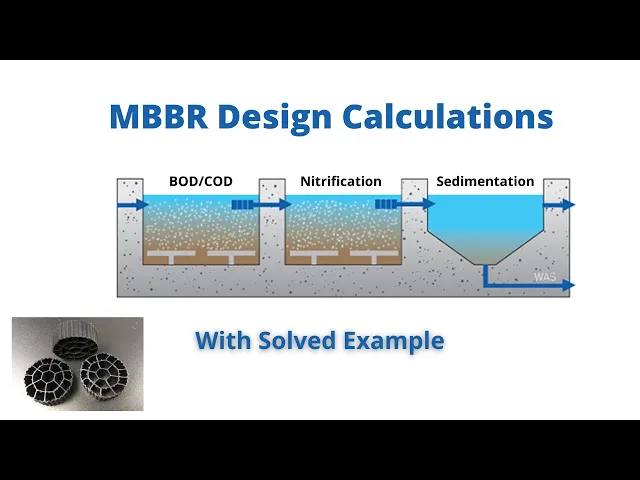
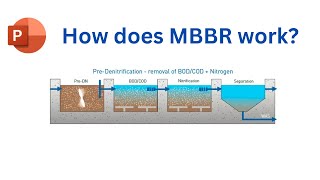
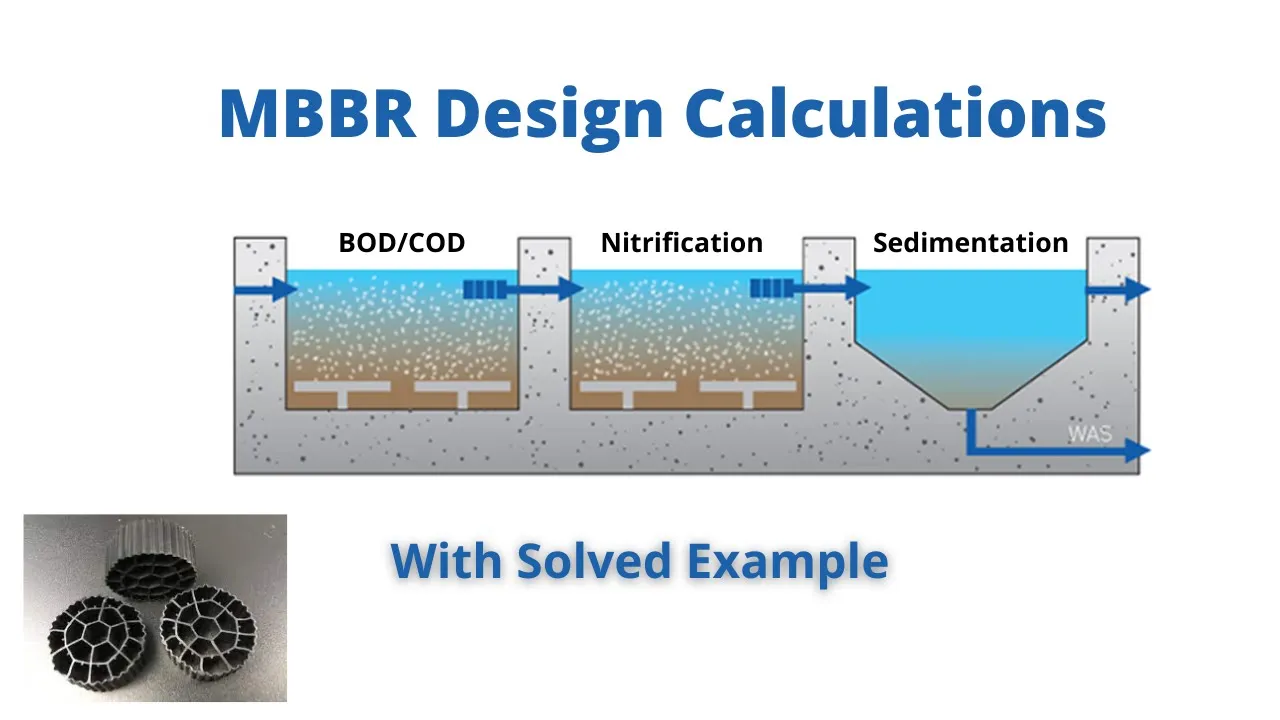
this lecture is part of a udemy course entitled design of wastewater treatment plants for on-site projects you will learn how to fully design a treatment plant for small to medium scale projects you can find an 80 discount promo link in the description box hello everyone and welcome to this lecture that will be about the mbbr wastewater treatment design in this lecture we will be covering one mbbr process out of many processes that is a two-stage bod cod removal and nitrification so this mbbr process is made of first of all the primary clarifier which is a primary treatment component to be able to highly reduce the total suspended solids then we have the mbbr process and in our case it is made of two aeration tanks the first tank is for body removal and as you can see we have here the mbbr media that is inside this tank this is the mbbr media these are small plastic media that we have to include in the mbbr tanks so the first tank is the for body removal and the second tank is for nitrification and as you can notice we are injecting air through an air blower and this air is being diffused in these two tanks then we have a secondary clarifier to be able to settle down the sludge that is formed in this mbbr process now we will start by sizing the bod removal tank that is the first process in this mbbr configuration so let's see the formulas first of all we have to compute the bod loading rate in grams per day which is equal to the flow rate that is commonly known as q so the flow rate and in this case it is the daily flow rate in meter cubes per day times the initial pod concentration or let's say the bod concentration entering the body tank so as i have already said we have the primary clarifier then we have the bod tank usually in this settling tank we have a reduction of the initial or the main bod we have a reduction of around 30 so we have to remove around 30 percent of the initial bod concentration and this will be our bod value entering the body tank then we have to calculate the carrier surface area and meter square so which is equal to the to the bod loading rate that we have previously calculated in grams per day over the s a l r so the sal r stands for surface aeration loading rate this value you will get it from this typical design values for bbr reactors in our case which is this two stages mbbr process the salr for the bod will be six grams per meter square per day and this value will allow us to remove 90 to 95 percent of the vod which is a very high uh percentage for body removal third we can calculate the media volume which will be in meter cube so the media volume is the amount of mbbr media that we need to include in the bod removal tank which will be equal to the carrier surface area so the value that we have previously found over the media specific surface and meter square per meter cube now this value you get it from the manufacturer depending on the type of mbbr media you are using so in this case for example if you are using the k3 mbbr the media specific surface will be 500 meter square per meter cube so it depends on the mean on the manufacturer's brochure for the media that you will be using for your system for you can calculate the volume of the tank so the volume of the bod removal tank which will be also in cubic meters so the volume which is the length times the water depth small d times the width and this will be equal to the media volume so this value over the fill fraction the fill fraction is the percentage of the media that will be filled within the bod removal tank so this value typically is between 30 to 70 percent now note here an important note always keep a free board of point 35 meters the free board is the distance between the water and the surface of the tank so let's say this is the water surface so this is what we call a free board and it must be around 0. 35 meter now let's go to the sizing of the nitrification tank we have some similar formulas but the salr here is different and it is of course based on the nitrates loading rate not on the bog loading rate so as a first formula the nitrate's loading rate in grams per day it is equal to the flow rate meter cubes per day times the nh3n concentration entering the nitrification tank in milligrams per liter then you can calculate the carrier surface area in meter square equal to the nh3n loading rate over the salr of the nitrification tank which is different than the vod removal tank you can use the values in this table so if the effluent nh3n is higher than three milligrams per liter so if the nh3n exiting the nitrification tank so let's say that this is the nitrification tank and before this tank we have the bod removal tank and the primary clarifier so the if the exiting nh3n must be higher than three milligrams per liter and here it depends on the rules and regulations and the waste water quality the effluent quality that is needed so it is if it is higher than 3 milligrams per liter so the design salr must be 1 grams per meter square per day and if the effluent nh3n is less than 3 milligrams per liter take it as 0. 45 now also the media volume in meter cube so it is also equal to the carrier surface area over the media specific surface and the volume of the nitrification tank is equal to the media volume this value over the fraction between 30 to 70 percent now the third uh tank which is the sedimentation tank that comes directly after the nitrification tank it is based on the hydraulic retention time the hrt which is typically between 3 to 10 hours and the volume of this tank is equal to the hrt times the q here it is in meter cubes per hour to be consistent with the units and in this sedimentation tank don't forget to include a submersible pump to pump the sludge back to the septic tank or to the primary treatment tank which is usually a sedimentation tank now let's take a detailed example so we have to design a two stages mbbr secondary treatment system to treat a flow of 10 cubic meters per day consider an initial bod of 250 milligrams per liter and the required effluent is 10 milligrams per liter so the initial bod is the body entering the primary treatment or the primary settling tank so it is initially 250 milligrams per liter then we have the body removal tank then the nitrification tank and finally the secondary settler so the 250 milligrams per liter is in this tank and the required effluent vod is 10 milligrams per liter so the effluent at the end of the secondary treatment must reach 10 milligrams per liter consider entering nh3 and 40 milligrams per liter so also here we have an nh3n of 40 milligrams per liter and the required effluent at the end of the secondary treatment is 4 milligrams per liter so let's start by sizing the bod removal tank first of all we have to find the body loading rate we have to assume 30 percent removal in septic tank or in the primary treatment tank so the body at the secondary treatment and inlet will be equal to 250 times 0.
7 or 175 milligrams per liter so the body entering this tank is 175 milligrams per liter the total body to be removed will be 175 minus 10 so minus 10 then is the effluent required effluent at the end of this stage so our aim and this secondary treatment is to remove 165 milligrams per liter of body so the body loading rate will be equal to the flow rate times the body concentration equals to 10 times 165 it is equal to 1650 grams per day so this is our goal to remove this amount of vod loading rate now we can calculate the carrier surface rate take the salr equal equals to 6 grams per meter square per day so the carrier surface area is equal to the bog loading rate over the salr equals to 1650 over six so the carrier surface area is equal to 275 meter square now we can find the media volume which is equal to the carrier surface area over the media specific surface we are using here the k3 media so equals to 275 over 500 provided by the manufacturer so we need a media volume equals to 0. 55 cubic meters so this is the amount of volume that we have to put inside our body loading or removing tank removal tank now we can calculate the volume of the bod removal tank which is equal to the media volume we have already found over the fill fraction we chose here a 50 percent fill fraction so 0. 55 over 0.
5 1. 1 cubic meters so this is the volume of my body removal tank now i can choose the dimensions of this tank the depth of the water so let's say this is my tank so the water depth is small d equals to 1. 1 meters the total height of this tank so as i have already mentioned we have to include point 35 meters as free boards so this total depth will be 1.
1 plus 0. 35 equals to 1. 4 45 meters the width of this tank will be 1 meter and the length 1 meter so the volume of my mbbr tank will be 1.
1 times 1 times 1 with which is equal to 1. 1 meter cube now we can size the nitrification tank let's start by the nh3 unloading grade so the total nh3n to be removed will be equal to 40 minus 4 so 40 the entering nh3n concentration minus the uh required effluent nh3n which is equal to four so we have to remove 36 milligrams per liter of nh3n the nh3 and loading rate will be equal to the flow rate times the nh3n concentration 10 times 36 360 grams per day now let's calculate the carrier surface area equals to the nh3n loading rate over the salr now we will take an salr equals to 1 because as you can see the required nh3n effluent is 4 milligrams per liter so higher than 3 so take salr as 1 so the carrier surface area will be equal to 360 over 1 360 meter square now for the media volume it is equal to the carrier surface area over the media specific surface so 360 over 500 the media volume is 0. 72 cubic meter now we can find the volume of the nitrification tank equals to the media volume over the fill fraction 0.
72 over 0. 5 the volume of the tank will be 1. 44 cubic meter and we will take a volume of 1.
5 for for easiness we round it up the value we will take the depth of the water 1. 1 similar to the body removal tank depth of water the height is also 1. 5 45 meters the width is one meter and the length of the tank is 1.
4 meter now notice we took the same width for construction easiness it is easier to have the similar same width so let's say that this is my top view top view of the tanks if they are if the tanks are sticked together it is easier to have the same width w and we can change the length of each compartment now the last compartment which is the sedimentation tank that comes directly after the nitrification tank we will take an hrg of 8 hours v the volume of the sedimentation tank will be equal to the flow rate times the hrt the flow rate here is in meter cube per hour so we will divide 10 by 24 times eight and we will get a volume of a sedimentation tank that is 3.