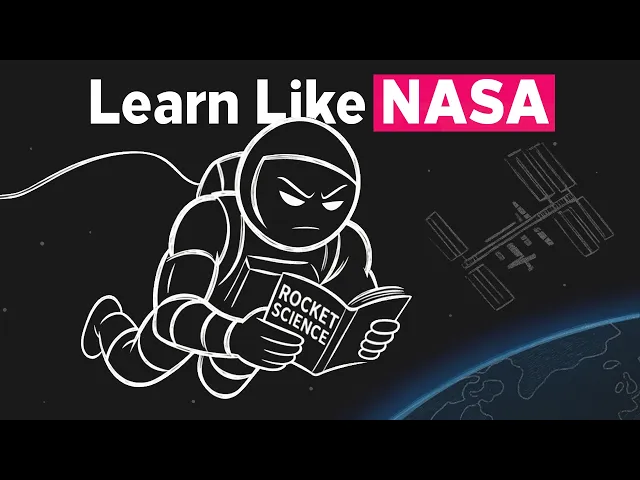
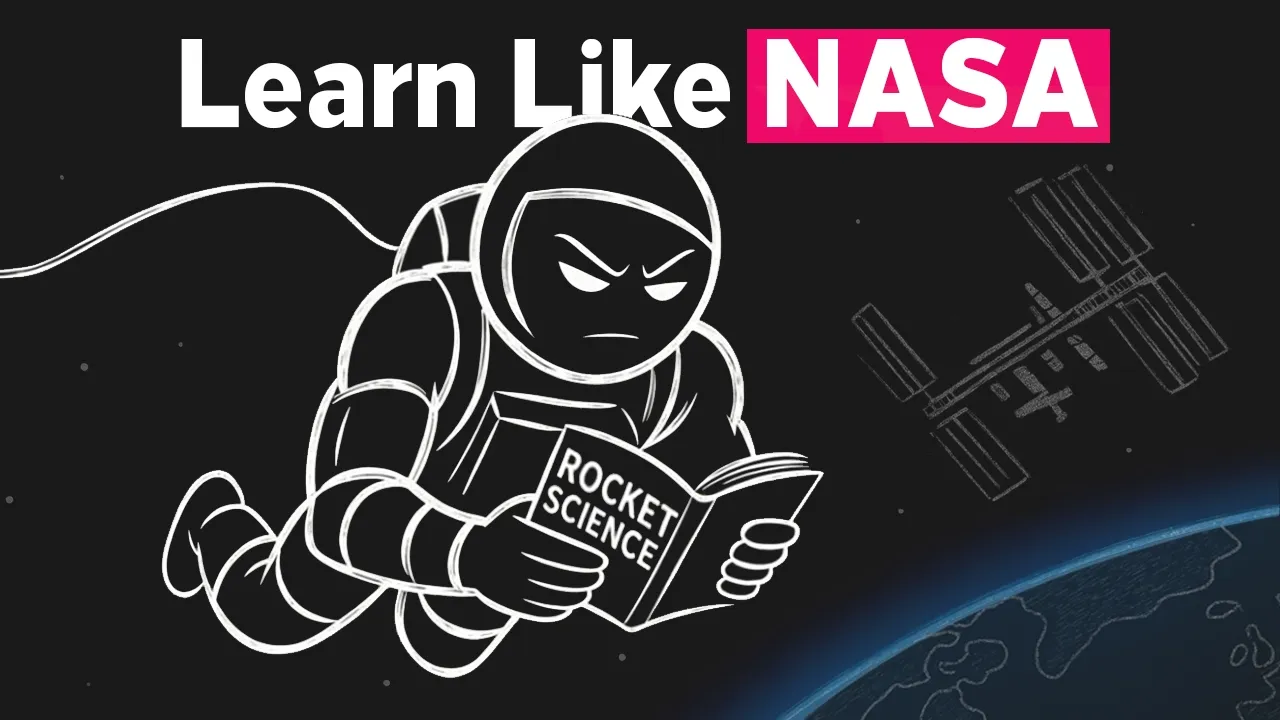
Most people study for hours, then forget everything the next day. NASA astronauts [music] master entire spacecraft systems in months. They memorize thousands of procedures, execute them flawlessly while floating 250 mi above Earth.
They're not smarter than you. They just train differently. The acceptance rate, 0.
1%. It's harder to become an astronaut than to get into Harvard. But the people who make it aren't geniuses.
They're trained [music] using methods that schools never taught you. The third method, schools actively teach you the opposite, and it's the reason most people forget everything they learn. That's fine.
Until you're in a job interview [music] and your mind goes blank, until you're giving the presentation of your career and you can't remember your own slides, NASA can't afford that. One [music] mistake in space means a dead astronaut and a $150 billion disaster. So, they engineered [music] training protocols that make forgetting physically impossible.
Here's the first one. Chapter 1, the death simulation. Here's what motivational speakers say.
Visualize success. See yourself winning. Feel the victory before it happens.
Idiots. Chris Hadfield, commander of [music] the International Space Station, says the opposite. Don't visualize success.
Hadfield calls this the [music] power of negative thinking. While you're visualizing success, he's asking one brutal question. What is the next thing that will kill me?
Astronauts visualize failure constantly, obsessively, [music] in brutal detail. It's an ancient stoic technique called premeditate your mealorum, the premeditation [music] of evils. Here's why this works.
Fear of the unknown causes panic. Your brain doesn't know what to do. It freezes, shuts down.
But fear of the expected, [music] that's manageable because you've rehearsed the response. Fire in the spacecraft simulated 100 times. Cabin depressurization simulated 100 times.
Complete power failure simulated [music] 100 times. Imagine a rocket launch. The engines ignite.
Violent vibration. Alarms screaming. A vacuum seal breaks.
A thruster explodes. oxygen levels drop. The margin for error is zero.
Most people would [music] pass out. Hatfield proved this in the most terrifying way possible. In his TED talk, he [music] tells this story.
He's on a spacew walk outside the International Space Station. Then the antifog solution from inside his helmet visor leaks into [music] his eyes. They start burning.
Vision goes blurry. He should be panicking. [music] Then it gets worse.
He goes completely blind. Floating outside the spacecraft, 250 mi above Earth, unable to see anything. But he's calm, methodical, moving through the procedure automatically.
He's already died in this scenario a 100 times. This is just another Tuesday. Meanwhile, you panic when your phone dies at 2%.
Idiots. This isn't just NASA. Gary Klene, a cognitive psychologist who studied decision-making for the US military, developed something called the premortem analysis.
His research found that teams who imagined failure before starting a project identified 30% more risks than teams who didn't. Successful business owners use the same principle. They don't ask, "How can I be more successful?
" They ask, "What would kill my company in the least amount of moves possible? " Then they build plans to make sure those things never happen. And if they do, they're already prepared with alternatives.
Your version before a big presentation. Visualize everything going wrong. The projector fails.
The audience looks bored. You forget a section completely. Plan your response to each [music] scenario.
Projector fails. Continue without slides. audience board, you have a backup story.
Forget a section, you have a transition that [music] covers it. List every reason you could fail. Don't just list them, solve them.
The key is this. Prepare for every failure and success takes care of itself. But mindset is only [music] step one.
Now you need to actually learn the material. Chapter 2, the crawl protocol. Here's what most people get wrong.
They try to learn everything at once. Schools throw lectures, readings, assignments, and exams at you simultaneously. [music] Your brain gets flooded.
Nothing sticks. You try to learn Spanish. You download five apps, watch Spanish TV, listen to podcasts, buy a grammar book, all in the first week.
You drink from the fire hose. You feel overwhelmed. [music] You quit.
Wrong. NASA does the opposite. They call it the crawl, walk, run protocol.
You don't learn anything until you've mastered the layer below it. There's a reason this works. Herman Ebinghouse discovered the forgetting curve back in 1885.
Without reinforcement, you forget 70% of new information within 24 hours. NASA system fights this by forcing you to master each layer before moving on, so nothing slips through. Cruel phase, [music] those are classroom instruction.
Single system, no distractions. An astronaut doesn't learn the whole spacecraft. They learn one switch, one valve, one procedure in a [music] quiet room, no pressure.
They keep repeating it for a week. They learn it until it's boring. Until they can draw it with their eyes closed.
Walk phase. Add [music] complexity. Two systems together.
Small simulations. Controlled stress. Run phase.
Full scale simulation. Everything at once. Instructors screaming.
Alarms blaring. Multiple failures happening simultaneously. You don't walk until you've proven you can crawl.
[music] You don't run until walking is automatic. Your version. Learning a new language.
Don't try to learn Spanish. Learn the 20 most common verbs. just verbs.
Drll them for a week until you can conjugate them half asleep. Then add basic sentence structure, then add past tense. [music] Layer by layer, learning an instrument, master one chord, then two.
Don't try to play a song until the basics are automatic. Use a flashcard app like Anki, RemNote, or Quizlet. They use spaced repetition.
They show you cards right before you're about to forget them, which burns information into long-term memory. Rodiga and Carpick approved this in 2006. Students who used retrieval practice retained 50% more than students who just reread the material.
Create a deck for just one concept. Drll it until it's instinct. This is how you build a professional-grade knowledge base.
Brick by brick. Whether you're preparing for a certification exam, a technical interview, or learning to code, these methods work. I learned this the hard way.
First year of college, first presentation of my life. Topic: Ireland. I'd never stood in front of an audience before.
I didn't even know you were supposed to prepare a PowerPoint. [music] So, I did the only thing I could think of. I memorized the entire thing, word for word.
I stood in front of the class. [music] I was so nervous my vision went blurry. I could feel my hands shaking.
I had a water bottle with me. My genius plan was to squeeze it like a stress ball to calm myself down. [music] Bad idea.
I was already shaking and holding the bottle just made it more obvious. Everyone could see it trembling in my hand. Then I opened my mouth and just started reciting.
[music] Frozen, robotic, spitting out memorized sentences like a machine reading from a script. My professor's feedback. It sounds like you just memorized it.
That was the crawl. And I didn't even crawl well. I fell flat on my face.
Second presentation. Stoicism. This time I had slides prepared, watched tutorials on how to structure a talk.
I opened with a hook I still remember to this day. [music] Imagine smiling after getting slapped in the face. I was smarter this time.
I kept the water bottle next to me, not in my hand. So, if I ever forgot a part, I'd grab it, take a slow sip, and buy myself a few seconds to remember. No one noticed.
I wasn't shaking anymore. I wasn't terrified. It was something I had done before.
My professor said I had improved so much. That was the walk. Third presentation.
This one we couldn't prepare for at home. We had to do it live in class. [music] No script, no slides, no rehearsal.
It was my best one. My professor's feedback. You're much better when you improvise than when you memorize.
By the end of the year, my classmates were coming to me asking for presentation tips, asking me to help with their slides, asking for ideas on how to make their work better. The same kid who stood in front of the class reciting a memorized essay about Ireland like a broken robot. That's crawl, walk, run.
I just didn't know it had a name. The key is this. Slow is fast.
Master each layer before stacking the next. By the way, I made a free printable called the NASA learning protocol. It's a one-page cheat sheet with all three methods from this video.
the death simulation planner, the crawl, walk, run tracker, and a pressure training log. Print it out, fill it in by hand every week. Link is in the description.
It's free. But here is the problem. You can have the skills, but if you can't access them when the pressure is on, you're dead.
And that's where the third method [music] comes in. Chapter 3, the library fallacy. Here is the most dangerous trap in learning, the library fallacy.
You study in a quiet room. Lowi beats playing. Perfect coffee.
You take the practice [music] test and get 100%. You feel like a genius. Then you walk into the real exam.
The [music] clock is ticking. The room is loud. The proctor is staring at you.
And suddenly [music] your mind goes blank. Why? Because you prioritize comfort.
Robert Bork, a cognitive psychologist at UCLA, calls this desirable difficulties. His research shows that harder practice conditions, the ones that feel uncomfortable, produce significantly stronger long-term retention than easy ones. Your brain encodes information deeper when it has to fight for it.
[music] NASA knows comfort is the enemy of retention. They don't just teach skills, they teach astronauts to use them in hell. Hadfield didn't train in a quiet library.
He trained in chaos. NASA has a final training phase [music] called integrated simulations. The astronauts sit in a full replica of the cockpit [music] and there's a person watching from a control room, the simulation supervisor.
Their job, destroy [music] you. The moment things feel comfortable, they break something. Master alarm, radio dead, fire warning.
They stack emergencies on top of emergencies. Now, hit subscribe before they stack another one. By the time Hadfield flew real missions, the real emergencies were second nature to him.
Your version. Stop babying yourself. [music] If you want to perform under pressure, practice under pressure.
Take your practice tests like they're real. Timed. [music] No phone, no breaks, no second chances.
If you wouldn't have it during the real exam, you don't get [music] it during practice. Whether it's the MCAT, a coding boot camp final, or a board presentation, simulate the real conditions. If you have [music] 60 minutes for an exam, practice finishing in 45.
Train your brain to work faster than it needs to. If you're learning a language, don't practice with apps in your quiet apartment. Go to a restaurant and order in Spanish.
[music] Stumble, feel embarrassed, do it again. It will feel terrible. You will [music] sweat.
Good. That discomfort is your brain building armor. The key is this.
If it feels comfortable, it's not working. One more thing, [music] this video gives you three methods, but I didn't show you how to combine them into one system. [music] NASA did.
Two NASA scientists wrote an internal paper redesigning astronaut training from scratch. It contains five additional training principles this video didn't cover, like why getting feedback at the wrong time destroys your memory, the optimal way to practice a skill, and the exact spacing protocol [music] NASA uses to make sure astronauts never forget what they learn. I broke down the full paper plus [music] the five missing principles on my Patreon link in the description.
In space, nobody [music] can hear you scream. But down here, the world is loud. It's messy.
It's competitive. You can let that crush you or you can train for it. You don't need to be an astronaut to learn like one.
You don't need a multi-million dollar simulator. You just need to change your learning methods. Whether you're upskilling for a career change, [music] preparing for a certification exam, or learning a new system at work, these three methods are the difference between professionals who get promoted [music] and professionals who stay stuck.
But learning is only half the equation. The other half, remembering it when you actually [music] need it. Most people blank during the important moments.
Everything they studied disappears, not because they have bad memory, because they stored it wrong. Your brain has biological exploits. Ancient memory systems that schools completely ignore.
[music] Navy Seals discovered how to weaponize them. They developed brutal methods that burn information into permanent storage. Methods so effective they never forget anything, even under gunfire.
[music] That's why I made this video breaking down exactly how Navy Seals memorize anything, so you can pair elite learning speed with elite memory retention. Watch it next.