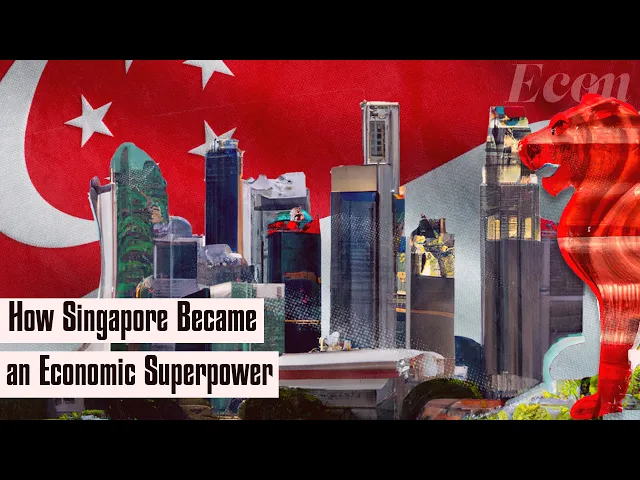
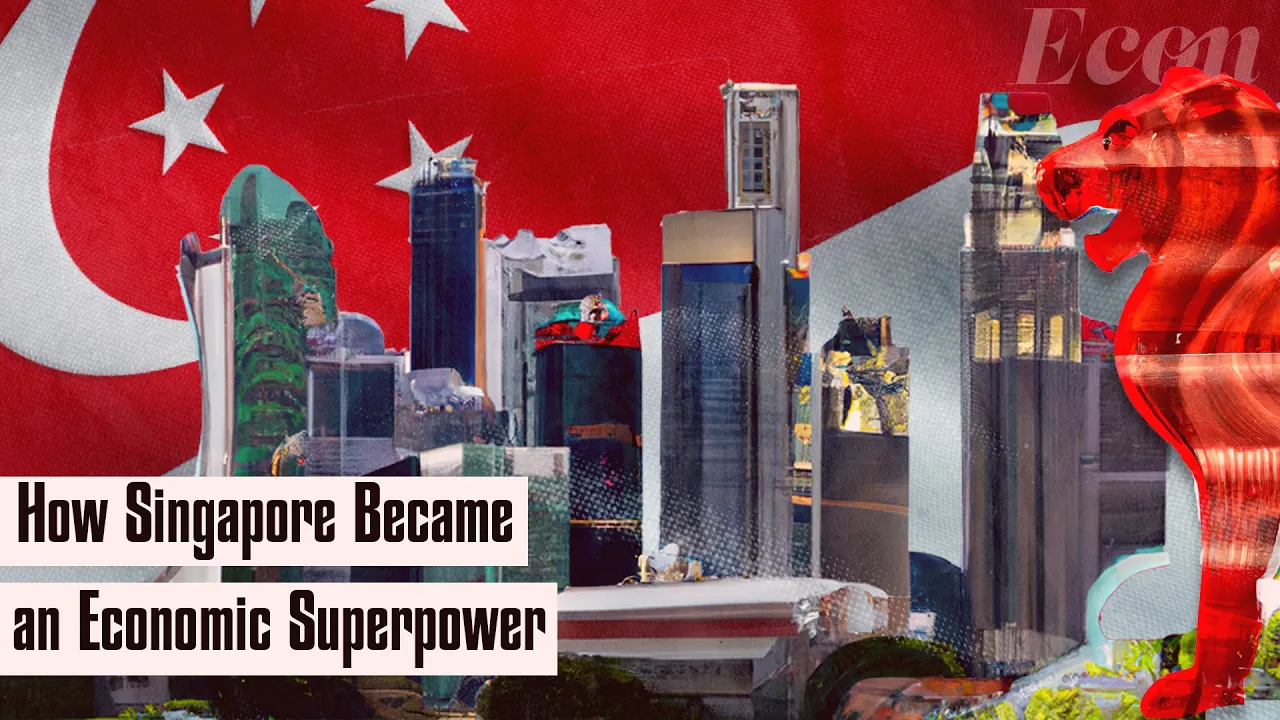
This is Singapore, the gateway to Asia. It ranked first in economic freedom, labor force quality, and lack of future political risks. It has the second-highest per-capita GDP in the world, and Singapore is the 4th-least corrupted country.
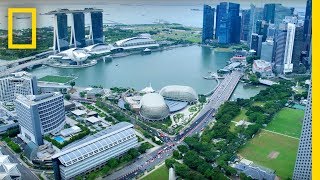
Facts like this have had a considerable impact on thinking about the economic development of Singapore. These two photos tell a lot about Singapore's economy; in the left photo, we can see the mouth of the Singapore River and the city's General Post Office on the right. Now, the post office is the Fullerton Hotel, and many skyscrapers accommodate one of the world's top financial hubs.
We can also see Theatres on the Bay - Esplanade. The tiny city-state and island nation, less than half the size of London, is currently home to a proud global business hub. It has achieved so much in its short solo history as it marks 57 years since gaining full independence from Malaysia on August 9, 1965.
In the 18th century, the Dutch Empire and British Empire were close economic rivals. Colonization enabled both parties to gain vast control of resources from civilizations whose economies were not as advanced. A British colonial official - Stamford Raffles, had been searching for a new settlement that could be used as an outpost of the British Empire.
He left Calcutta and set out to explore much of South-East Asia. When Raffles arrived in Singapore, he met Temenggong Abdul Rahman to negotiate for a British trading post to be established on the island. In 1819, Raffles signed an official treaty with Sultan Hussein and the Temenggong and successfully arranged for the territory to be incorporated into the British Empire as a trading post.
To compete with other ports under the control of the Dutch, Raffles established the settlement as a free port, which gave Singapore its strategic geographical location. There were three major trade networks in Southeast Asia at the time: the Chinese network connected Southeast Asia to southern Chinese ports of Fujian and Guangdong; the Southeast Asian network connected Indonesian islands; and the European and Indian Ocean network connected Singapore to European and Indian Ocean markets. By the 1830s, Singapore had become the center of English country trade and overtaken Batavia — a port of Indonesia (now Jakarta)- as the center for Chinese junk trade.
Because Southeast Asian traders prefer Singapore's free port to other major regional ports with complicated restrictions. Between 1824 and 1879, Singapore's port trade volume rose from 11 million dollars to 105 million dollars, with the most significant increase seen between 1869 and 1879 due to the opening of the Suez Canal, connecting the Mediterranean Sea to the Red Sea. This allowed for a decrease in travel time, which resulted in a rise in trade volume.
The city-state of Singapore became the administrative capital of British Malaya. Roads and railways were developed to transport primary materials such as crude oil, rubber, and tin from the Malay Peninsula to Singapore. Then these products were shipped to Britain and other international markets.
All the raw materials, profits, and resources in this colonial era went to Britain. In world war II, Singapore's infrastructure had been destroyed, including those needed to supply utilities. A food shortage led to malnutrition, disease, and rampant crime and violence.
So, there was nothing left for the local people. As a result, the region saw social unrest, which dissolved colonial powers in the 1950s. The colonial powers sought to empower and establish a formidable local government in the aftermath of race riots.
Singapore ceased to be part of the British Empire when it merged with Malaysia in 1963. After two years, in 1965, Singapore gained full independence, but it found itself alone with no substantial industries, no local markets, and high levels of unemployment and poverty. The only thing they had were their ports.
When Lee Kuan Yew was elected, he oversaw significant economic reforms in the country. At that time, Singapore doesn’t have the capital to start economic processes. So Mr Lee adopted economic liberalism and the free market for capital flow.
The needed capital came in the form of foreign direct investment, but the question remains: how did Mr Lee attract so much FDI? First, its strategic location and natural harbor helped. Second, Singapore had free ports, with only a few revenue and protective tariffs, and no foreign exchange controls or domestic price controls, which was common in many developing countries at that time.
There were also virtually no controls on private enterprise and investment, no anti-monopoly laws, no approval or licensing required of foreign or local private investments, no limitations on profit remittances and capital repatriation, and so on. so, it appears that free trade and free capital flows are seen as the foundations of Singapore's economic success. But the so-called Asian tigers — Hong Kong, South Korea, Taiwan, and Singapore, were doing the same thing then.
From a market perspective, these economies in the 1960s and 1970s developed through free trade by specializing in the export of labor-intensive manufactures based on comparative advantage. From a "developmental state" perspective, they relied heavily on the industrial policy of selective protection and subsidies to direct capital investment to particular sectors, which gave rise to almost complete multinational enterprise (MNE) dominance in the manufactured export sector. Despite the same industrial policy and free market, Singapore outperformed its tiger friends.
At the end of the 20th century, Singapore's per capita income was already higher than almost anywhere in Asia and overtook the United Kingdom. So, what did Singapore do differently to dramatically boost its GDP per capita? Since its political independence in 1959, the People's Action Party (PAP) has been the only party to have power in Singapore.
A distinctive feature of the Singapore economic model was government owns, controls, or regulates land, labor, and capital resource and their allocation. By doing this, the Singaporean government focused on the three most important aspects of social welfare; housing, medical care, and education. Most notably, Singapore's Housing Development Board (HDB) has housed some 85% of the population since the 1980s, building and maintaining "public" housing units which most residents own.
Affordable housing helped keep wages low while integrating industrial premises into residential housing estates provided an easily accessible supply of factory labor. Investments in public health and education increased labor productivity and skills. At the same time, a vigorous family planning campaign encouraged low fertility and significantly increased female labor force participation.
The government also influences the wages and salaries of its labor in several ways. The first thing it does is control the supply of labor through visas and immigration. Second, it employs a significant number of people through the public sector and the Government of Singapore Investment Corporation, which influences both labour demand and supply, as well as labour prices.
Third, it is the dominant participant in the government, unions, employers, and the National Wages Council, which comes up with annual wage increase guidelines for the private sector. Fifth, it controls the labor movement and significantly influences the business sector. Social security was provided through a Central Provident Fund (CPF) or “forced savings” scheme in which employers and employees contributed mandated percentages ranging from 20% to 50% of employees’ salaries to individual CPF accounts.
Though intended to be retirement savings, employees could and did use these funds to purchase housing, limited medical and educational expenses, as well as equity investments in specific “blue chip. ” Implementing such institutional innovations enabled the Singapore government to provide high-quality public and social goods and services without running a deficit in the public sector. The Majority of public sector agencies earned surpluses from user charges, and the government budget was almost always in surplus, with revenues exceeding expenditures almost every year.
“Singapore Inc. ” became a frequently-invoked moniker in the international business press, even before the privatizations of the 1990s and 2000s turned monopolistic state agencies into publicly-listed corporations, e. g.
, Singapore Airlines, Neptune Orient Lines, Singapore Telecoms, Singapore Mass Rapid Transit, etc. dominating the market capitalization of the Singapore Stock Exchange. Due to the state’s early ability to organize efficiently, it was able to embark on an extreme makeover of the cities with lightning speed with little political backlash.
As a result of the quick delivery of good infrastructure, low inflation, fiscal balance, political stability, policy predictability, and low corruption, it became the preferred regional headquarters for multinationals over cheaper neighbors. The fact that Singapore has been politically a “one-party state” for three generations has much to do with the social and institutional support of its economic success in the 20th century. Without a doubt, Singapore's transformation from a colonial port city to an industrialized economy in the twentieth century and now a high-tech economy parallels that of the other "Asian Tigers" of South Korea, Taiwan, and Hong Kong.
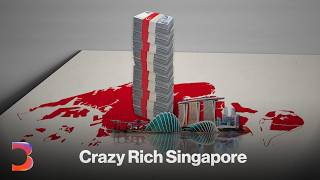
Singapore is now one of the wealthiest nations in the world; according to this report, the Singapore asset management industry had assets under management(AUM) of approximately $4 trillion in 2021. They are still attracting foreign companies in these new sectors by showering them with investment incentives like tax breaks, R&D and training subsidies, employment subsidies, cheap land, and unique buildings. Singapore is constantly improving its competitive advantages of location, infrastructure, logistics, legal and tax regimes, and the general business environment—all of which contribute to its popularity as a global financial center and regional headquarters for multinationals.
The attraction is so high that Singapore has become a tax haven, with the ultra-wealthy owners or investors contributing to widening income and wealth in the already densely-packed island city-state. Singapore is so small that it heavily depends on agrotechnology parks for agricultural production. This means Singapore imports 90% of its food supply and has a wide variety of supplier countries to achieve its food security.
It is highly dependent on world markets with exports, including re-exports, accounting for over 320% of GDP. Singapore is pushing growth in many different directions, like in new high-tech, high-skill sectors, while requiring heavy dependence on specialized foreign talent. Many of Singapore’s problems today are shared by other high-income developed economies, especially in their dense urban areas.
These include low birth rates, higher income and wealth inequality, more expensive housing, and more extreme reliance on foreign labor. The country also ranks far below its per capita income rank in comparative rankings, which include variables such as political freedom and the human development index. This is what Singapore’s government has always done: look around corners on behalf of its people and plan ahead, confident enough in the infallibility of its policymaking and in the certainty of its re-election to ignore pressure groups and to scorn pandering to populism.
Even its critics contend it has been successful. But times have changed. Social media have turned silent, isolated dissent into more concerted, vocal protest.
The young activists are against outdated rules, such as the bans on selling chewing gum or having gay sex. And knowledge workers, among others, feel suffocated without free speech. For its next half-century to be as successful as its first, Singapore will have to loosen up.