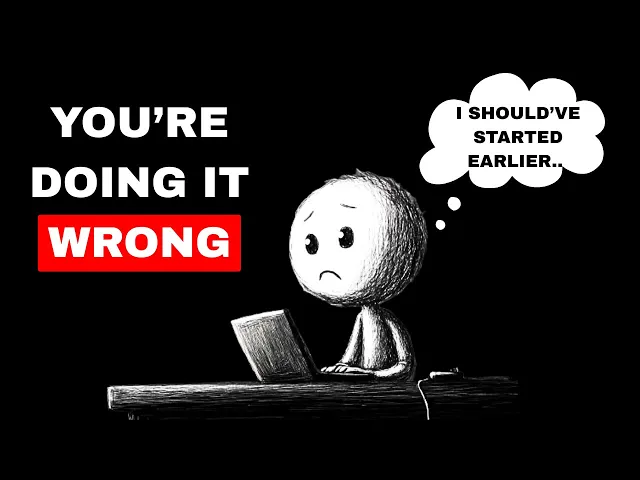
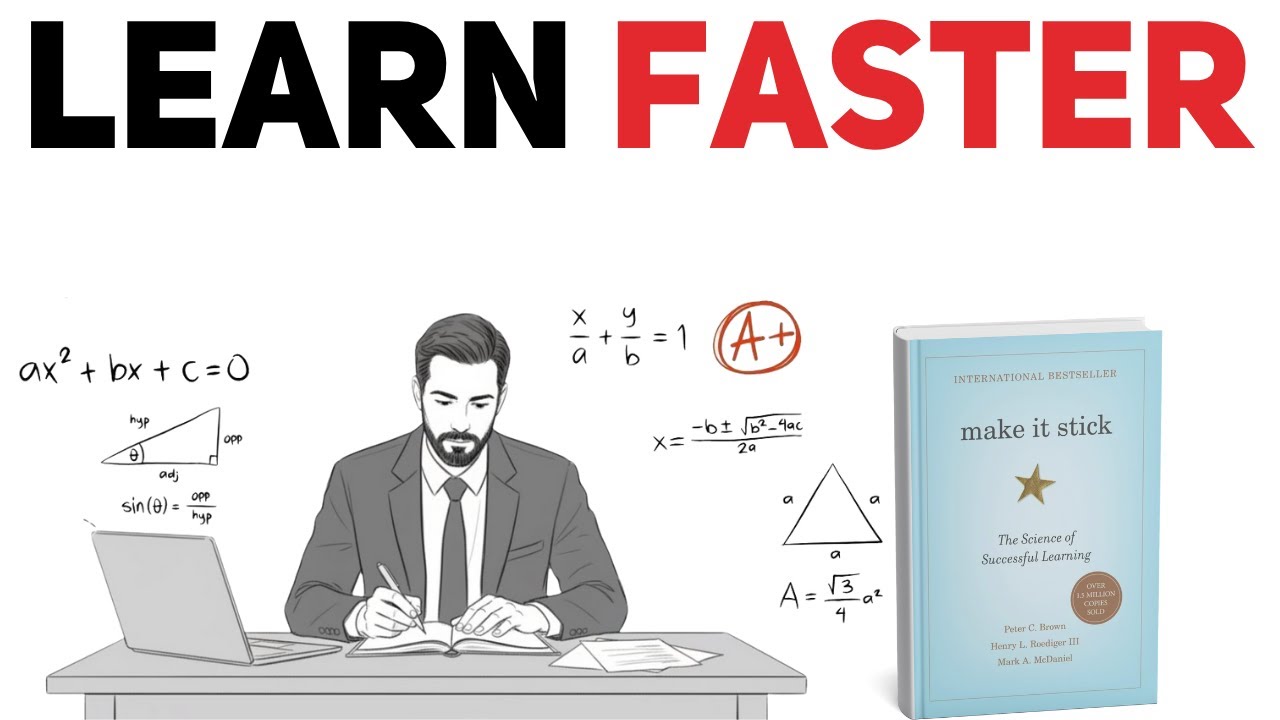
Here's the uncomfortable truth. Most people don't fail school or life because they're stupid. They fail because no one ever taught them how to actually study.
You're just thrown into the deep end and told to figure it out. So, you do what feels right. You highlight sentences.
You read notes. You stare at the screen until your brain goes numb. And you tell yourself, "I'm working hard.
This has to pay off. " But here's the brutal reality. Busy isn't the same as progress.
You can spend hours grinding and still make zero progress because effort without direction is wasted energy. It's like hiking in the forest without a map and wondering why you're lost. That ends today.
We're exposing five hidden mistakes that quietly destroy your ability to learn and the simple moves you can make to finally study smarter, sharper, and faster. Let's get into it. Mistake number one, passive learning.
Here's the classic scene. You sit down, open the book, read a few paragraphs, flip the page, maybe underline a sentence here and there. You're reading.
You're moving forward. But here's the question. Could you explain what you just read without looking?
Probably not, because what you're doing is passive learning. It's like trying to get stronger by watching someone else lift weights. It feels like you're absorbing something, but it doesn't stick.
And here's the worst part. Passive learning creates false confidence. You think you know it until you actually have to recall it under pressure.
Here's the fix. Active recall. After reading a section, stop.
Close the book. Ask yourself, "What did I just learn? Can I explain it without looking?
Could I teach it to someone else? " If you can't, that's not failure. It's feedback.
It means you need to wrestle with the information a little more. Learning isn't about passing your eyes over words. It's about pulling things you've learned out of your brain actively.
It's harder. It's slower, but it's how you actually learn. So, stop being a passive passenger and start driving.
Mistake number two, highlighting everything. Highlighters make you feel productive. You're busy.
You're engaged. You're making the pages look important. But highlighting is one of the biggest traps in studying.
Why? Because it's not processing information. It's decorating it.
And if you highlight too much, nothing stands out anymore. It's like shouting every word in a sentence. Your brain just tunes out.
The fix: be surgical with your highlights. Don't highlight while you're reading for the first time. Read the full section first.
Understand it. Then go back and highlight the single critical ideas you absolutely need to remember. Better yet, take it even further.
Instead of highlighting, write down the idea in your own words. For example, instead of just highlighting the mitochondria is the powerhouse of the cell, right? The mitochondria creates energy for the cell to function like a power generator.
By translating information into your language, you actually process it. Because memory isn't built by copying, it's built by creating. Mistake number three, cramming.
You already know this one, and yet we all fall for it. You wait until the night before. You pull an allnighter.
You shotgun six hours of reading, five cups of coffee, and two mental breakdowns, and you tell yourself, "I just need to survive tomorrow. " Cramming might get you through the test, but it guarantees that you forget everything almost immediately after. Because real learning doesn't happen in panic mode.
It happens through something called spaced repetition. Here's how it works. Instead of flooding your brain with information once, you revisit it over time.
You study for 30 minutes today. Review it for 10 minutes tomorrow, again three days later, again a week after that. Every time you review after some forgetting, you strengthen that memory.
It's like building a wall brick by brick, not trying to slap the whole thing together in one night. Cramming feels intense, but it's fragile. Spaced repetition feels slower, but it's bulletproof.
If you want knowledge to stick for life, not just for the next test, ditch the cramming. Start early. Space it out.
Build it strong. Mistake number four. Studying without goals.
Here's another crucial mistake. Sitting down to study without knowing what that actually means. You tell yourself, "I'm going to study for 3 hours today.
" And then you sit, flip through notes, check your phone, doodle on the margins. Suddenly, it's 3 hours later, and you barely move the needle. Why?
Because you had no target. You didn't define success. And when success isn't defined, it's almost impossible to achieve.
Here's the fix. Set clear, specific study goals. Before every session, ask yourself, what exact topic am I focusing on?
What outcome am I aiming for? Here's a few examples. By the end of this session, I will be able to write down the three causes of the French Revolution without looking.
I will solve 10 chemistry problems on balancing equations and get eight of them right. Clear targets keep you sharp, focused, honest. Because when you know the goal, you know exactly when you hit it.
And hitting goals, small wins every day. That's how you build momentum. Mistake number five, studying alone forever.
You might think studying alone is the ultimate form of focus, and sometimes it is. But studying only alone cuts you off from one of the most powerful learning accelerators, explaining. Because when you explain something out loud to someone else, you expose the gaps in your own understanding instantly.
Study actively with others. You don't need a full study group. Even one person is enough.
Teach them the concept you just learned. Quiz each other. Challenge each other with questions.
If you can explain a complex idea simply without reading notes, you truly understand it. And if you can't, good. Now you know exactly what to fix.
Don't let your ego get in the way. Use your friends, use your classmates, even talk to your pet if you have to. Don't have anyone?
No worries. You can still achieve the same results just by explaining the topic on the paper. The act of teaching turns passive knowledge into active mastery.
Final thoughts. These mistakes don't seem harmful, but they're limiting your potential. They make you feel busy.
They make you feel productive, but they rob you of the results you actually want. And the price isn't just failing a test. It's missing out on the opportunities that a real education could have unlocked for you.
The good news, you can change it today. Because once you know how to learn, really learn, you can master anything. New careers, new languages, new opportunities.
So stop passively reading. Highlight surgically. Space out your study sessions.
Set crystal clear goals. Teach what you learn. Because studying isn't about suffering more.
It's about strategizing better. And the difference between falling behind and rising to the top isn't about how many hours you grind. It's about how smartly you use them.
Because the life you want, the degree, the dream job, the freedom isn't waiting for you to try harder. It's waiting for you to study smarter. So don't wait until it's too late.
Don't wait until you're drowning in missed deadlines, forgotten facts, and wasted hours. Start now. Study differently.
Study intelligently. And take control of your future, one smart session at a time. Let's become better together.
If you liked this video, please don't forget to throw a like and subscribe my channel for upcoming videos. See you in the next one.